click hide image

Wednesday, January 27, 2021

Birds and Indian agriculture - turf wars

Alongside the activism against the plume trade in Victorian England, there was a widespread interest in understanding the "value" of birds to Indian agriculture possibly since many birds were trapped for the trade coinciding with famines in India. It was also a period when the British Empire intensified agricultural research efforts. Recall that professional agricultural entomology in India was influenced by Eleanor Ormerod who suggested that if she could do as much as she did voluntarily for English agriculture, a lot could be done with a paid position in India! Ormerod, oddly enough, was engaged in a campaign to eradicate the sparrow in England when other upper class ladies were clamouring for the protection of birds. While Reverend F.O. Morris and some other male conservationists wrote letters noting  her deviation from expected feminine conduct and requested her to show "compassion ... and fulfil her duty as a woman", there were farmers who agreed with her and argued on Christian foundations that although sparrows "...  were created for some wise purpose. Such was undoubtedly the case in the original order. But the Great Creator made man to rule over the fowls of the air and the beasts of the field, leaving it to his judgment to destroy such that were found more destructive than beneficial." [Bradshaw, 2014; Holmes, 2016] As early as 1892, the idea that some careful examination was needed was mooted and the phrase "economic ornithology" was introduced by Earl Cathcart. 

It is unclear how the bird-agriculture question spilled over into India but an early attempt to look at Indian birds from an agricultural perspective was by Charles William Mason, an entomologist. In 1907, Mason offered tubes and instructions for collectors of birds to provide him with the contents of the gut and gizzards of birds that had been shot. The idea at the time was that based on the diet, birds could be classified into three neat classes as being beneficial, injurious, or neutral to agriculture. Very little is known of the life of Mason, he joined the research institute at Pusa as a supernumerary entomologist working under Harold Maxwell Lefroy and left India in 1910 to study at Wye, and the US before moving to work in Nyasaland where he died of black-water fever (malaria) on 28 November 1917 at Namiwawa. Mason's intensive work on the examination of the contents of the guts of 1325 birds shot mainly around Pusa in Bihar may perhaps be among the few of its kind. Mason did not publish much before leaving India. Lefroy himself left India in 1911 but the interest in birds continued with his successor T.B. Fletcher who encouraged the a planter and naturalist Charles Inglis to conduct studies in relation to agriculture. The two wrote a series of illustrated articles on birds in the Agricultural Journal of India but it appears that the professional entomologists (note that Fletcher himself would easily qualify as an amateur by modern standards) were unimpressed. A reprint of the series was made as Birds of an Indian Garden (1924). 

Inglis later spent his energies editing the Journal of the Darjeeling Natural History Society and managing the society's museum in Darjeeling. His journal includes interesting discussions between Inglis and S C Law. Law was an avid aviculturist who obtained birds from the wild. Inglis met Law and his trappers in Darjeeling with a number of sunbirds and in a subsequent note Law documented their sad fate resulting from their aggressive behaviour. At the 1923 meeting organized by Fletcher he notes "the amateur entomologists, whom we are always glad to see and to help as far as possible, are also represented by Major Kingston and Mr. Inglis." 

Present at the same meeting was a professionally employed south Indian entomologist from Coimbatore, P. Susainathan. Susainathan had written an interesting note on the birds of the Coimbatore region from a standpoint of economic ornithology called "Bird Friends and Foes" (1921). Susainathan later worked in Iraq and at some point decided he was better off catching insects for taxonomic specialists and began perhaps a career unique in India, at least for an Indian (there were professional collectors like William Doherty who made much larger collections, pers. comm. Michael Geiser, NHM London). He advertised in various entomological magazines and offered to send specimens from India within the group that they were interested in. The Wikipedia biography covers the key bits on him and his family members who continued in the collection enterprise. There are nearly forty insect species with names like nathani or susainathani, nathanae, and nathanorum (of Mr Nathan, of Mrs Nathan, of the Nathans). Susainathan's book has a description of the sparrow which includes the term "aerial rat" which recalls Ormerod's usage of "avian rat".

The Nathan family in the 1970s - photo from Karl Werner (1956-2007)
P. Susainathan is second from right in the back row.
Scan courtesy of Juergen Wiesner

It is worth recording that professional entomologists appear to have guarded the field of economic entomology as far as its applications to agriculture went. When Salim Ali made an application to the ICAR to study birds (see linked document in the National Archives of India),  Baini Prashad of the ZSI was largely supportive, but the proposal was essentially nixed by the Imperial Entomologist at that point of time (viz. Hem Singh Pruthi, although the letter seems to have been forwarded to the government by F.J.F. Shaw). Pruthi's comments are worth noting for the tone of protection of the professional turf (apart from some casual sexism):

The most suitable man for undertaking the study of Insectivorous birds is one who is primarily a good entomologist and possesses some knowledge of birds in addition. He should be familiar with the habits of the Insect fauna of the area and be able to identify himself the stomach contents of the birds immediately after their death. The chief man should have a taxidermist to assist him in the preservation of the birds, which can be got named by specialists afterwards.
There has been a great deal of writing on the professionalization of science and most of what is written in traditional (or should it be professional?) history of science departments would appear to show professionalization as a positive and progressive step and few studies if ever look at the negatives  such as how profession-defenders define the boundaries of subjects, block so-called outsiders, and thereby prevent possible enrichment and growth.

Further reading

Postscript April 2023: Mr S. R. Nayak who worked in the BNHS showed me a very interesting collection of visiting cards that Salim Ali owned and in it was a rather interesting card. One can almost imagine Ali commenting on the title (occupation) used here. Yash Pal Beri was trained as an agricultural entomologist and appears to have been the founding member of the IARI agricultural ornithology group which was later joined by R. K. Bhatnagar and others. Bhatnagar retired around 1997 and he gave me his collection of issues of the Newsletter of Birdwatchers which are now digitized on the Internet Archive.

Beri's card from Salim Ali's card collection
(now in the NCBS archives)

PS: November 2024 - P. Susainathan's grandson sent me a biography of Susainathan and others in the family that collected insects. With his permission I put it up on the Internet Archive where you can find it.

Friday, October 23, 2020

Some little-known bird books from India - Torfrida

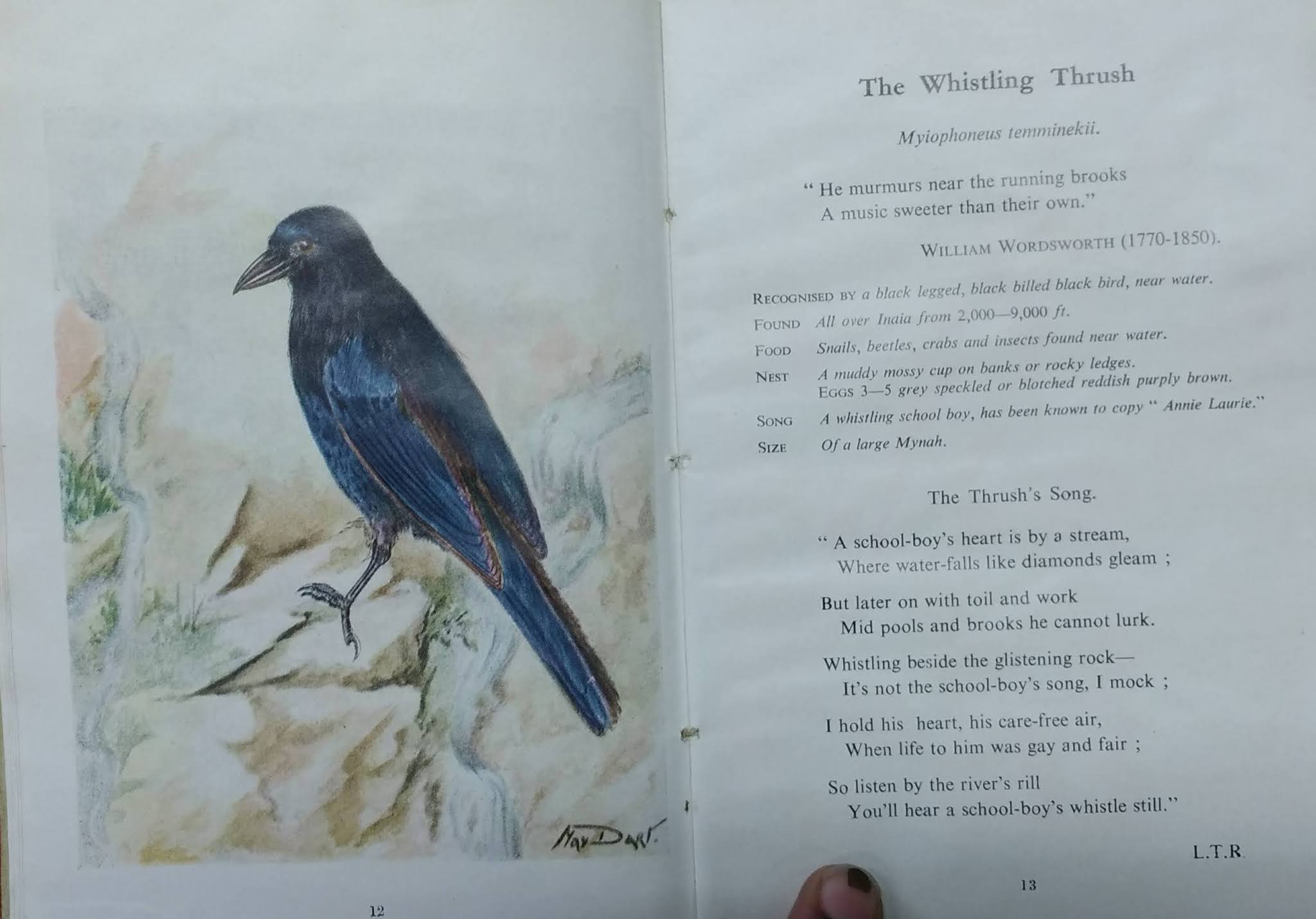
Among the little-known bird books of India, and of a rather unique genre, are Nurseries of Heaven  - More birds of India (1944) and Nurseries of Heaven - Birds (before 1944) written by someone with the pen-name "Torfrida" and illustrated by a Mrs May Dart who evidently lived in Wellington in the Nilgiris. This is not the only book written by this writer-illustrator pair, they also wrote Nurseries of Heaven - Wild Flowers of India. The flower and bird books deal principally with the Nilgiris. In 1944 the pair also wrote Flowering Trees of India (the geographic scope of that book seems wider). All the books appear to be a mixture of poetry, etymology, literary references, illustrations, fables, and a wee bit of original observation thrown in. These are all small pamphlets, presumably printed for children, possibly made for distribution in the local church.

The book is perhaps among the few Anglo Indian works with an aesthetic appreciation of birds [and not centered around humour like the writings of Phil Robinson, Eha or Dewar]. It also provides insights into Colonial life in the Nilgiris. I was fortunate to examine the contents of More Birds of India in a rather rare copy held by the Percy Fitzpatrick Institute of Ornithology at Cape Town in 2018. More information on May Dart and the mysterious Torfrida would be nice to have!

The first pamphlet on birds


The cover illustration is actually pasted into the frame


A few sample pages from the More Birds of India are included here to give a taste of the writing.


Some of her writing may need to be examined in detail. In her flower book she claims that the name "Portia tree" for Thespesia populnea is from the Tamil Puvassai! Some claims are outright incorrect like the idea that Osbeckia is called "Tipu China" from "Tibet China", that would in fact be from the old name Tibouchina.

Wednesday, September 16, 2020

A little-known naturalist from Chikkaballapur

Bangalore has historically, being an administrative centre with a mild climate, had a fair share of colonial natural history collectors and naturalists. We know a fair bit about the botanists who walked this region and a bit about hunters of larger game but rather little about those who studied insects. A few years ago I became aware of the Campbell brothers from Ireland (but of Scottish origin). It took some time to put together the Wikipedia entries on them which is where more straightforward biographical details may be found.

After a trip to the Nandi Hills [to examine a large number of heritage Eucalyptus trees (nearly 200 years old) that the Horticulture Department had decided to cut down to the stump, supposedly because falling branches were seen by the Archaeological Survey of India as a threat to heritage buildings nearby], some of us decided to visit Chikballapur to examine the place of work of  Dr Thomas Vincent Campbell (1863-16 December 1930) - "T.V." as he was known to his friends was a missionary doctor with the London Missionary Society and had worked briefly at Jammalamadugu where his older brother William Howard Campbell (20 September 1859 - 18 February 1910) had worked as a missionary. Another brother back in Derry, David Callender Campbell (1860-1926) was also a keen observer of moths and a botanist. In their younger days in Derry, they and their siblings had put together a "family" museum of natural history that was said to be among the best in the region! William was the oldest of nine siblings and appears to have been the sturdiest considering that he was a champion rugby player at Edinburgh University. He moved to Cuddapah in 1884 and he may well have been the first person to see Jerdon's courser in life - Jerdon, Hume, and others appear to have dealt only with specimens obtained from local hunters. William collected moths and many of them appear to have gone to Lord Rothschild and nearly 60 taxa were described on their basis by Hampson. In 1909, he was to become director United Theological College Bangalore but ill health (sprue) forced him to return to Europe and he died in 1910 in Italy. His Cuddapah-born son Sir David Callender Campbell (1891 – 1963) became a prominent Northern Ireland politician. William's life is covered in some detail by Alan Knox while examining the only known egg of Jerdon's courser. A biography (a bit hagiographic though) of William in Telugu also exists.

T.V.'s life on the other hand was hard to find information on, we knew of his insect specimens. He was in contact with E.A. Butler who specialized in the life histories of insects and T.V. seems to have taken off after him and not only colllected bugs (ie Hemiptera) but made notes on them which were used by Distant in the Fauna of British India. Several insects that T.V. collected have never been seen again. T.V. moved to Chikaballapur and worked at the Ralph Wardlaw Thompson Memorial Hospital which is now just known as the CSI Hospital and largely in disrepair. The hospital in its heyday was among the few in the region and treated a large number of patients. After suffering from tuberculosis, he also established a TB sanatorium at Madanapalli. Campbell treated nearly a thousand cases of cataract and was awarded a Kaisar-i-Hind medal for work in 1908. Campbell appears to have made a very large collection of insects from Cuddapah, Chikballapur, and from the Ooty area (where he would have spent summers). Many of these are now in the Natural History Museum in London and a good number are type specimens (ie, the specimens on the basis of which new species were described). Professor C.A. Viraktamath, entomologist and specialist on the leafhoppers, has for many years searched for a supposedly wingless Gunhilda noctua which was collected from the Nilgiris. Based on T.V.'s connections, I believe the place to look for them would be somewhere in the vicinity of the church in Ketti. Considering the massive alteration in habitats, there is a slight chance that the species has gone extinct but it is doubtful that it was so narrow in its distribution.
 
W.H. Campbell

 
Dr T.V. Campbell
T.V.'s former home in Chikaballapur

Dr TV attending to patients in Chikaballapur, c. 1912

A lane inside the hospital premises named after T.V.

Foundation stone of the hospital

The Wardlaw Thompson Hospital c. 1914

Gunhilda noctua - a monotypic genus never seen
since T.V. found them for W.L. Distant to describe in 1918
from The Fauna of British India. Rhynchota Vol.II

The Wikipedia entries can be found at T.V. Campbell and W.H. Campbell. Many people helped in the development of these articles. Roy Vickery kindly obtained a hard to find obituary of T.V., Alan Knox sent me some additional sources on W.H.C. and Susan Daniel, librarian at the United Theological College was extremely helpful. Arun Nandvar drove and S. Subramanya joined our little adventure in Chikaballapur. Dr Eric Lott made enquiries with the SOAS and LMS archives but found little. My entomologist friends and mentors, Prashanth Mohanraj and Yeshwanth H.M. shared their enthusiasm in discovering more about T.V. 

POSTSCRIPT - April 2022: S. Subramanya and I visited Jammalamadugu (and nearby places including Buchupalli where WHC had found a large pelicanry). It seems that the hospital that TVC began continues to prosper. It seems to have gained the favour of the political class thanks to the association of the former Chief Minister Dr Y S R Reddy who was not only born in the Campbell Hospital but worked there too. Apparently very little is known of the work of W.H. Campbell who seems to have largely been active as a missionary. The village of Buchupalli where he had described a large pelicanry seems to have no signs of any large water birds and absolutely no memory among its current day residents (who might be three or four generations down from those that lived in the 1890s).


The CSI Campbell Hospital

The entrance

Inscription below the statue with a gratuitous knighthood!

Dr TV holds a disarticulated stethoscope!


Tuesday, June 23, 2020

Some American links to Indian ornithology

One of the joys of being in India is the complete lack of access to a good library, and that makes one keep a list of books to find so that you know how to make the best of limited time when one get an opportunity to visit a well-stocked library. It took me nearly ten years before I finally managed to browse through Max Nicholson's Art of Birdwatching (1931) on a brief visit to the library of the Zoological Society of London. I had been looking for the context in which he had talked about how a so-called "open mind" was absolutely useless for scientific enquiry [a belief that starkly contradicts the argumentative Indian].
"One cannot observe without a theory, and what seems the simplest of ornithological tasks - to go out of doors and look out for something worth recording - is in reality one of the hardest… It is a mistake to imagine that complete impartiality and freedom from preconceived ideas is the qualification for the perfect observer. The cow has a remarkably open mind, yet it has never been found to reach a high degree of civilisation."

Nicholson also inspired another writer across the Atlantic. This was Joseph Hickey, a student of literature who moved to ornithology. I had heard of his work through a rather tenuous series of connections.

From The Auk
One of the leading lights of bird study and popularization in India, Dr Joseph George, a major influence on the Bangalore bird-enthusiasts circle, had undertaken several of his earliest and pioneering studies on bird populations in Dehra Dun. In 1948, a Mrs M.D. Wright conducted a census of birds in Dehra Dun and wrote out her observations in the Journal of the Bombay Natural History Society. One of her inspirations was the book by Joseph Hickey, A Guide to Birdwatching (1943). It is unclear if Dr George actually took part in her census but she influenced his own studies in Dehra Dun (since he cites her work) and they doubtless met and I strongly believe that Dr George actually read this book too given his own censuses of birds in Dehra Dun. It was not until a few weeks ago that I got my hands on Hickey's book thanks to the Internet Archive and their emergency pandemic-response library which allows in-copyright books to be borrowed and read online. Now Hickey was influenced by many giants including Ernst Mayr and Aldo Leopold. He recounted among his ornithological mantras, the one from Ernst Mayr about having a long term line of enquiry while watching birds - in Mayr's words "everybody's got to have a problem". On the first person Hickey met on the field watching birds, he writes:
The pleasures of meeting a kindred spirit are much more subjective but they are nonetheless real and they often ripen into lifelong friendships. In grade school it never occurred to my chums or to me that bird books were written for anyone other than boys, and that grown men and women liked to watch flickers and killdeers just the way we did. Our beloved scoutmaster, the Reverend Basil Hall, had given some of us a helping hand, but bird study still seemed like a boys' game. It was an almost stupefying shock when Richard A. Herbert and I, aged 14, quite by accident found an elegantly dressed gentleman watching a chickadee one February day in New York City's Bronx Park. Charles Johnston, who looked not unlike Charles Evans Hughes to us, had been a distinguished member of the British Civil Service in India. He was kindly and apparently ready to answer questions. He answered them for two full hours, probably with no little amusement. The decades between us seemed to vanish and from that point on, our bird study took on dignity and purpose. He helped us many times more in the years that followed.
I tell this story to illustrate how an interest in ornithology can span any barrier, and how people of widely diverse cultures can rapidly find a common bond of understanding. There are several ways to get in touch with other bird students. One is to attend meetings.

Now an Indian Civil Servant interested in birds had to be examined and I searched the internet for Charles Johnston and found one that was interested in theosophy (but the Wikipedia entry then had no mention of any interest in natural history). I found also that a Johnston had been active in New York birding circles but was not sure if the two were the same until I found an entry on the Theosophy Wiki. The other major Theosophist (at least briefly) and ornithologist was Hume and I had to check for encounters between the two. It seems that the two could not have been in great contact. Johnston  married the niece of Madame Blavatsky (with whom Hume had fallen out) and entered the Indian Civil Service only in 1888, well after Hume's exit from government service. Johnston worked only for two years before suffering from malaria led to his resignation and he moved to the United States in 1896 after treatment in Austria. His close friends in New York included fellow theosophists W. Q. Judge and Clement Acton Griscom, Jr. (1868-1918) who was the father of the ornithologist Ludlow Griscom. It would appear (esp. from the absence of any mention in the Bombay Natural History Society journal) that Johnston began his serious bird studies only in the United States and may well have been an important influence in Griscom's life. Allan Cruickshank's Birds around New York city (1942) includes many notes by Johnston, who is described as an "experienced and meticulous observer" (p. 289).

Recommended reading
  • Hickey, Joseph (1975). A guide to bird watching. New York:Dover. [This Internet Archive copy (which can be borrowed) is signed by Hickey. This book was his master's work, under the supervision of Aldo Leopold!]
Postscript
Dr Joseph George  (1st October 1921 – 9th July 2012) was educated at St Joseph's College, Trichy and at St. John's College, Agra, He researched polymer chemistry under Herman Francis Marks  at the Brooklyn Polytechnic Research Institute between 1946 and 1948, returning to the Forest Research Institute at Dehra Dun. He worked for a while at the CBRI, Roorkee and at IPIRI, Bangalore.

Wednesday, May 27, 2020

Science in disasters and disasters in science

Locusts are powerful agents in history, and just like malaria and other diseases (especially those that affected empire) they helped fund a lot of biological research, both in India and elsewhere. Unlike India, with a short institutional memory, aided by governments that simply cannot maintain archives (or even actively erases inconvenient material), the Chinese rulers maintained meticulous records of locust (Locusta migratoria) damage that go back about 1900 years. As India slowly dismantles long-term government organizations to be replaced by supposedly more profitable contract-only private entities it is worth looking at some pioneers in locust research and what was achieved.

Locust reporting in China (A geographical), B (annual trend), C (decadal trend) over 2000 years
Among the interesting findings was a strong 30-year cycle, as also 10-year cycles - recalling
the era of sunspottery and perhaps an overemphasis on what are now called BEL cycles.

The golden years of locust research were in the two decades following 1945 thanks to an exiled upper-class Russian, Sir Boris Uvarov. Nadia Waloff, herself a Russian emigre, writes in her biography of Uvarov (perhaps they were distantly related) that in the 20 years before his death there were nearly 7000 research papers (that is nearly 1 article a day!) published on locusts, largely from the London based Anti-Locust Research Centre (ALRC). The ALRC itself had been founded by Uvarov, who migrated shortly after the 1917 revolution to England.

Uvarov's Russian passport
From Fedotova, Anastasia; Kouprianov, Alexei (2016). Archival research reveals the true date of birth of the father of locust phase theory, Sir Boris Uvarov, FRS. Euroasian Entomological Journal. 15(4):321–327.
The Russian class struggle of 1917 led to scientists (who were mostly from the upper classes) being either made ineligible for continued work at universities or worse. "White Russians" who conspicuously supported the Tsars or, in the later period, opposed leaders like Stalin routinely ended up in the Gulags, often vanishing without a trace. A few escaped to other parts and found work, Uvarov being among the lucky ones. He became interested in natural history at a very young age thanks to a present from his father of a Russian translation of the German 6 tome  work Tierleben by Alfred Brehm. He then studied entomology, preferring interactive learning at the informal Russian Entomological Society, to the formal courses offered by Mikhail Rimsky-Korsakov (the entomologist son of the famous Russian composer, of flight of the bumble-bee fame). Uvarov's exit to England was possible because of chance encounters with wartime English entomologists, but he had also established a name already in Russia. Prior to his research, it was thought that the migratory locusts were a distinct species but he identified ecological conditions that altered a sedentary grasshopper that looks quite different, and found in smaller numbers to produce young with altered form that became gregarious and migratory. This has been called the Phase Theory (and of course theory does not mean hypothesis) and in a very far-sighted approach he and his team would later work out causes and mechanisms ranging from the spectrum of the ultimate to the proximate - looking at ecology, endocrine function, sensory functions etc. and how reduced "social distance" converted a sedentary high-fecundity breeder to a long-winged less-fecund migratory form. Waloff herself examined the polymorphism of winged- and wingless-ness in various groups of insects and compared them with ideas on ecological stability (and perhaps they were precursors to ideas on r-K selection). They also boldly experimented with new techniques such as using radioactive isotopes to study dispersion (albeit in bugs).

The ALRC had recognized the locust problem as being something that needed collaboration across artificial borders like nations (in other words, not atmanirbharata). Several Indian researchers also took part in this international network of locust research. These included H S Pruthi (who established the institutional framework for collaboration after Indian Independence), Afzal Hussain (now considered the father of entomology in Pakistan)  and Y Ramachandra Rao (who retired to live in Bangalore). With the end of the Second World War and colonialism, research shifted from colonial sponsors to the United Nations, an attempt at a democratic trans-national institution.

From Haskell, P.T. (1970). The future of locust and grasshopper control. Outlook on Agriculture 6(4):166-174.
The range of influence of Schistocerca gregaria

Now, it is hard to imagine what might have happened to Uvarov if he had stayed on in Russia. The future for people who understood Darwinian evolution and were capable of synthesizing it with ideas from genetics was positively bleak. Russian science went from this class struggle which evicted traditional intellectual actors from the leisure class (often assisted by royal patronage) [with access to books, intellectual circles (often with entry bars), space to hold material, and ability to buy tools] to a more accessible system with tax-payer funded universities, supported by libraries, museums, journals run by democratized organizations, and other infrastructure. The transition was truly ugly and sad. On its way it had to encounter demagogues like Trofim Lysenko who drew an easy to understand (simple but wrong) connection between the idea of genes determining organism outcomes, to eugenics, and to fascism - and that simple communication to the powers-that-be led to the killing of many scientists, and the removal of many into the margins. Lysenko's appeals were what ordinary people wanted to hear, he came from a working class upbringing unlike the supposed snobs he was up against and, in his breeding experiments with wheat, or in his tree-planting methodologies (to combat a famine that was thought to be climate-induced) he made use of ideas that organisms could change their characteristics when faced with challenges, the idea that outcomes were not limited by genes - ideas which had a social appeal that fitted with egalitarianism.
A S Serebrovsky (c. 1925) who worked on chicken
breeding, conservation, genetics, and evolution -
a little-known figure in science.

It would be wasteful to write more here about the political history of Soviet science as there are numerous works on the topic. It is worth noting however that Russian scientists, contrary to Mayr's version of biological history, had indeed synthesized ideas on evolution with ideas from genetics. Unfortunately there seems to be little written about it in English, but it includes scientists like Nikolai Koltsov (who was probably poisoned), and many of his students including A S Serebrovsky (who is credited with coining the word gene pool, producing an early evolutionary synthesis, and thinking up the sterile male technique of pest management - fortunately he was spared his life - Mayr credits Dobzhansky (escaped to the West) among others in the synthesis but many of his ideas may well have come from Serebrovsky), Efroimson, Simon Levit (killed), Izrail Agol (killed), Nikolai Vavilov (killed) ... the list goes on.

India is now in a very interesting phase where ordinary plants, cow dung, and urine, with miraculous properties are touted as cures for coronaviruses. We will soon see similar claims to rid us of locusts. These are claims that appeal to those without resources. These claims are made by many including politicians and while they receive sniggers from the English speakers across social media, it is hard not to sense that this is a reaction against the snobbery of the English speaking and scientific upper classes. There is an opportunity for progressive thought and action in this disaster but it is not going to be an easy one, most certainly not if gross inequalities cannot be seen and tackled.

Further reading