click hide image

Showing posts with label ornithology. Show all posts

Friday, August 18, 2023

The Hon. F. J. Shore

Frederick John Shore is not a name familiar to those interested in Indian birds. A pioneer bird observer and artist, his omission is rather unfortunate. He is apparently still remembered in Dehra Dun by the well that he had constructed there and for being among the "Three Fredericks" associated with Mussoorie (the other two being Frederick Wilson and Frederick Young). The Himalayan flameback (Dinopium shorii) is named after him, his type specimen was exhibited at a Zoological Society of London meeting by his brother. John Gould commented on him in the Birds of Asia:


F. J. Shore was the son of a governor-general of Bengal, John Shore, who took some interest in natural history, particularly botany. He supported the botanist William Roxburgh enough to earn himself a honorific genus Shorea. Frederick also joined the East India Company's Bengal civil service and began to work in India. He seems to have had very independent and outspoken opinions during his work. He was very critical of Company policies and of British attitudes towards Indians. He once adopted local dress while attending the court and received a government order against it. A later commentator, Douglas Dewar, declared that Shore's comments needed to be taken with a pinch of salt.

An 1820 portrait of F.J. Shore
 

Shore was involved in suppressing a revolt by gurjars in Saharanpur. According to the magistrate of Saharanpur, Rivers Grindall (who would later become the father in law of A.O. Hume!), the gurjars, nearly 800 of whom had assembled,  had sworn by goddess Kali that they would get rid of the rule by foreigners. Grindall wrote urgently seeking military support. It would appear that every white man in the region with a pistol was invited to join - including the naturalist J. F. Royle and an army engineer named Henry De Bude. The main force however consisted of gurkhas under the command of Frederick Young. In the ensuing bloodbath, 200 people were killed, Shore received two deep cuts on his torso. Young's biography written from oral records by his daughter claims that there was an arrow in Shore's neck that had just missed his jugular. Shore apparently recovered from the wounds but his health remained bad and he died at the age of 37 in Calcutta. A British history has a sketch of Shore fighting with a gurjar and Young saving him by shooting the assailant.

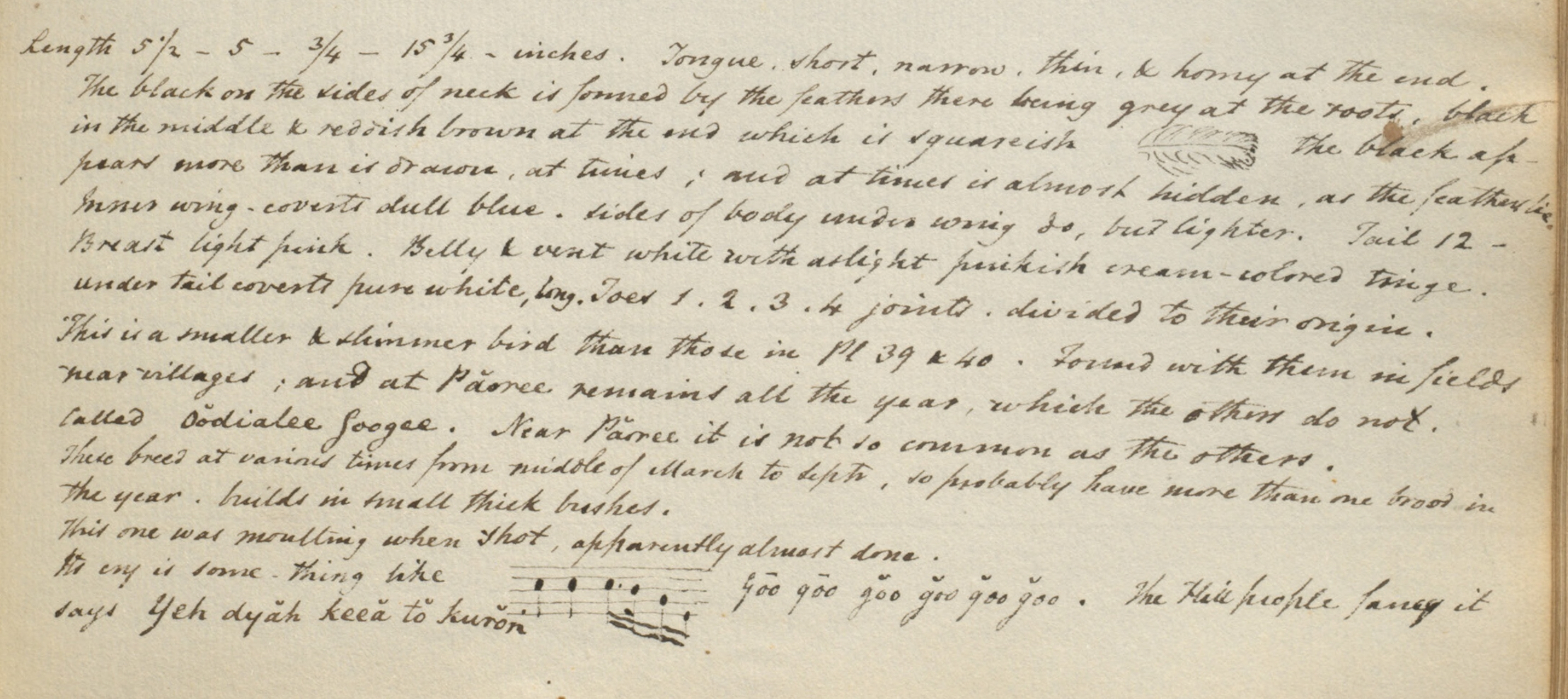
Now for what Gould wrote, about Shore's notes and illustrations. It appears that Casey Wood got hold of a bunch of the paintings and notes that Shore made in 1928. They are quite spectacular in that they capture the pose in nature very accurately in many cases. But evidently the set that has been so kindly shared by the McGill University library lacks the illustrations of the male and female painted spurfowl mentioned by Gould. In one plate Shore refers to "Volume 4", so clearly there are other books with illustrations that are unknown at least to online researchers. Shore clearly was a very careful observer, noting the colour of the mouth, anatomical features like the structure of the tongue and native names. He notes the calls of birds and in some cases documents them with musical notation - a first in India surely. He also tries to follow the color standards defined the watercolor company Ackermann that he presumably used. In transcribing native place and bird names he uses the scheme of John Gilchrist.

Notes on a little brown dove with call notation

Casey Wood noted: One of the most valuable manuscripts in the Blacker Library is an unpublished Appendix (in three volumes) to Latham’s Birds, 1821-8, with 195 original water-colors of Indian avifauna by F. J. Shore. Most of these are not to be found in the 1821-8 edition, or if they do appear, the coloring is probably incorrect. This fact is pointed out by the artist-editor who states that almost every picture in his collection is painted ad naturam so that unaltered plumage is depicted. Copious notes accompany each drawing. A more complete review of this historical series of drawings will be found in the appended Catalogue.


Here is a sampling of Shore's works (a few are added here).

Refers to volume 4


So where is Volume 4 of his book which presumably contains the illustrations that Gould refers to? ZSL? NHM? (Have checked the online catalogues and found nothing)

Thursday, July 15, 2021

Long before Salim Ali - an Indian bird collector 1906-9

Hidden away in the annals of systematic ornithology is the name of P. N. Krishnasamy Naidoo, Merchant on Victoria Street, Mahe, Seychelles around 1907 and living on Rue La Fague, St. Andre, Reunion in 1908. From the Indian diaspora, literate in French, Naidoo probably moved from Mauritius but little is known about his life. It appears that he began to collect bird specimens on the Indian Ocean islands for Lord Walter Rothschild and his assistant Ernst Hartert. Almost nothing is known about him beyond the few letters he wrote that are preserved in the Natural History Museum at London and the bird specimens he collected which are now in the American Museum of Natural History.

Naidoo collected nearly 450 skins of birds all of which are now at the American Museum of Natural History, part of their acquisition from Lord Rothschild, who was forced to make a distress sale of his collections to silence an unknown woman blackmailer. Suprisingly all the Naidoo birds landed in the American part while the letters of Naidoo are at the Natural History Museum in London. Some of the beautifully handwritten letters in French sent by Naidoo to Rothschild and Hartert tell of large payments being made for the bird specimens that he collected. For some of the island parakeets, Rothschild offered 30 pounds per specimen. [Kemp (2017) on Rothschild in the New Scientist calls him a useless banker who spent a mountain of cash to buy nature]

As always, every finding raises more questions, how did Naidoo get to be trained in skinning birds and preparing specimens? What was his own knowledge of the birds of the Indian Ocean Islands? 

A collection of the specimens that Naidoo collected along with the species, dates and locations can be found from the American Museum of Natural History website. Examination of some of his letters at the NHM London archives has not revealed much on his life. 

A chapter remains to be written on this interesting marginal character in ornithological history.

Notes:

Thanks are due to a number of people for helping unearth the precious little that we know about Naidoo - Robert Prys-Jones, Alison Harding, Kathryn Rooke, (NHM-London); Pat Matyot (who suggested that Naidoo may have come from a family of indentured labourers that left Mattur in Tamil Nadu to settle in Mauritius with some becoming successful entrepreneurs - like Govindasamy Krishnasamy Thambi Naidoo who financially supported Mahatma Gandhi); and Malavika Vyawahare (via Abhay Thakur, IFS).

Wednesday, January 27, 2021

Birds and Indian agriculture - turf wars

Alongside the activism against the plume trade in Victorian England, there was a widespread interest in understanding the "value" of birds to Indian agriculture possibly since many birds were trapped for the trade coinciding with famines in India. It was also a period when the British Empire intensified agricultural research efforts. Recall that professional agricultural entomology in India was influenced by Eleanor Ormerod who suggested that if she could do as much as she did voluntarily for English agriculture, a lot could be done with a paid position in India! Ormerod, oddly enough, was engaged in a campaign to eradicate the sparrow in England when other upper class ladies were clamouring for the protection of birds. While Reverend F.O. Morris and some other male conservationists wrote letters noting  her deviation from expected feminine conduct and requested her to show "compassion ... and fulfil her duty as a woman", there were farmers who agreed with her and argued on Christian foundations that although sparrows "...  were created for some wise purpose. Such was undoubtedly the case in the original order. But the Great Creator made man to rule over the fowls of the air and the beasts of the field, leaving it to his judgment to destroy such that were found more destructive than beneficial." [Bradshaw, 2014; Holmes, 2016] As early as 1892, the idea that some careful examination was needed was mooted and the phrase "economic ornithology" was introduced by Earl Cathcart. 

It is unclear how the bird-agriculture question spilled over into India but an early attempt to look at Indian birds from an agricultural perspective was by Charles William Mason, an entomologist. In 1907, Mason offered tubes and instructions for collectors of birds to provide him with the contents of the gut and gizzards of birds that had been shot. The idea at the time was that based on the diet, birds could be classified into three neat classes as being beneficial, injurious, or neutral to agriculture. Very little is known of the life of Mason, he joined the research institute at Pusa as a supernumerary entomologist working under Harold Maxwell Lefroy and left India in 1910 to study at Wye, and the US before moving to work in Nyasaland where he died of black-water fever (malaria) on 28 November 1917 at Namiwawa. Mason's intensive work on the examination of the contents of the guts of 1325 birds shot mainly around Pusa in Bihar may perhaps be among the few of its kind. Mason did not publish much before leaving India. Lefroy himself left India in 1911 but the interest in birds continued with his successor T.B. Fletcher who encouraged the a planter and naturalist Charles Inglis to conduct studies in relation to agriculture. The two wrote a series of illustrated articles on birds in the Agricultural Journal of India but it appears that the professional entomologists (note that Fletcher himself would easily qualify as an amateur by modern standards) were unimpressed. A reprint of the series was made as Birds of an Indian Garden (1924). 

Inglis later spent his energies editing the Journal of the Darjeeling Natural History Society and managing the society's museum in Darjeeling. His journal includes interesting discussions between Inglis and S C Law. Law was an avid aviculturist who obtained birds from the wild. Inglis met Law and his trappers in Darjeeling with a number of sunbirds and in a subsequent note Law documented their sad fate resulting from their aggressive behaviour. At the 1923 meeting organized by Fletcher he notes "the amateur entomologists, whom we are always glad to see and to help as far as possible, are also represented by Major Kingston and Mr. Inglis." 

Present at the same meeting was a professionally employed south Indian entomologist from Coimbatore, P. Susainathan. Susainathan had written an interesting note on the birds of the Coimbatore region from a standpoint of economic ornithology called "Bird Friends and Foes" (1921). Susainathan later worked in Iraq and at some point decided he was better off catching insects for taxonomic specialists and began perhaps a career unique in India, at least for an Indian (there were professional collectors like William Doherty who made much larger collections, pers. comm. Michael Geiser, NHM London). He advertised in various entomological magazines and offered to send specimens from India within the group that they were interested in. The Wikipedia biography covers the key bits on him and his family members who continued in the collection enterprise. There are nearly forty insect species with names like nathani or susainathani, nathanae, and nathanorum (of Mr Nathan, of Mrs Nathan, of the Nathans). Susainathan's book has a description of the sparrow which includes the term "aerial rat" which recalls Ormerod's usage of "avian rat".

The Nathan family in the 1970s - photo from Karl Werner (1956-2007)
P. Susainathan is second from right in the back row.
Scan courtesy of Juergen Wiesner

It is worth recording that professional entomologists appear to have guarded the field of economic entomology as far as its applications to agriculture went. When Salim Ali made an application to the ICAR to study birds (see linked document in the National Archives of India),  Baini Prashad of the ZSI was largely supportive, but the proposal was essentially nixed by the Imperial Entomologist at that point of time (viz. Hem Singh Pruthi, although the letter seems to have been forwarded to the government by F.J.F. Shaw). Pruthi's comments are worth noting for the tone of protection of the professional turf (apart from some casual sexism):

The most suitable man for undertaking the study of Insectivorous birds is one who is primarily a good entomologist and possesses some knowledge of birds in addition. He should be familiar with the habits of the Insect fauna of the area and be able to identify himself the stomach contents of the birds immediately after their death. The chief man should have a taxidermist to assist him in the preservation of the birds, which can be got named by specialists afterwards.
There has been a great deal of writing on the professionalization of science and most of what is written in traditional (or should it be professional?) history of science departments would appear to show professionalization as a positive and progressive step and few studies if ever look at the negatives  such as how profession-defenders define the boundaries of subjects, block so-called outsiders, and thereby prevent possible enrichment and growth.

Further reading

Postscript April 2023: Mr S. R. Nayak who worked in the BNHS showed me a very interesting collection of visiting cards that Salim Ali owned and in it was a rather interesting card. One can almost imagine Ali commenting on the title (occupation) used here. Yash Pal Beri was trained as an agricultural entomologist and appears to have been the founding member of the IARI agricultural ornithology group which was later joined by R. K. Bhatnagar and others. Bhatnagar retired around 1997 and he gave me his collection of issues of the Newsletter of Birdwatchers which are now digitized on the Internet Archive.

Beri's card from Salim Ali's card collection
(now in the NCBS archives)

PS: November 2024 - P. Susainathan's grandson sent me a biography of Susainathan and others in the family that collected insects. With his permission I put it up on the Internet Archive where you can find it.

Tuesday, June 23, 2020

Some American links to Indian ornithology

One of the joys of being in India is the complete lack of access to a good library, and that makes one keep a list of books to find so that you know how to make the best of limited time when one get an opportunity to visit a well-stocked library. It took me nearly ten years before I finally managed to browse through Max Nicholson's Art of Birdwatching (1931) on a brief visit to the library of the Zoological Society of London. I had been looking for the context in which he had talked about how a so-called "open mind" was absolutely useless for scientific enquiry [a belief that starkly contradicts the argumentative Indian].
"One cannot observe without a theory, and what seems the simplest of ornithological tasks - to go out of doors and look out for something worth recording - is in reality one of the hardest… It is a mistake to imagine that complete impartiality and freedom from preconceived ideas is the qualification for the perfect observer. The cow has a remarkably open mind, yet it has never been found to reach a high degree of civilisation."

Nicholson also inspired another writer across the Atlantic. This was Joseph Hickey, a student of literature who moved to ornithology. I had heard of his work through a rather tenuous series of connections.

From The Auk
One of the leading lights of bird study and popularization in India, Dr Joseph George, a major influence on the Bangalore bird-enthusiasts circle, had undertaken several of his earliest and pioneering studies on bird populations in Dehra Dun. In 1948, a Mrs M.D. Wright conducted a census of birds in Dehra Dun and wrote out her observations in the Journal of the Bombay Natural History Society. One of her inspirations was the book by Joseph Hickey, A Guide to Birdwatching (1943). It is unclear if Dr George actually took part in her census but she influenced his own studies in Dehra Dun (since he cites her work) and they doubtless met and I strongly believe that Dr George actually read this book too given his own censuses of birds in Dehra Dun. It was not until a few weeks ago that I got my hands on Hickey's book thanks to the Internet Archive and their emergency pandemic-response library which allows in-copyright books to be borrowed and read online. Now Hickey was influenced by many giants including Ernst Mayr and Aldo Leopold. He recounted among his ornithological mantras, the one from Ernst Mayr about having a long term line of enquiry while watching birds - in Mayr's words "everybody's got to have a problem". On the first person Hickey met on the field watching birds, he writes:
The pleasures of meeting a kindred spirit are much more subjective but they are nonetheless real and they often ripen into lifelong friendships. In grade school it never occurred to my chums or to me that bird books were written for anyone other than boys, and that grown men and women liked to watch flickers and killdeers just the way we did. Our beloved scoutmaster, the Reverend Basil Hall, had given some of us a helping hand, but bird study still seemed like a boys' game. It was an almost stupefying shock when Richard A. Herbert and I, aged 14, quite by accident found an elegantly dressed gentleman watching a chickadee one February day in New York City's Bronx Park. Charles Johnston, who looked not unlike Charles Evans Hughes to us, had been a distinguished member of the British Civil Service in India. He was kindly and apparently ready to answer questions. He answered them for two full hours, probably with no little amusement. The decades between us seemed to vanish and from that point on, our bird study took on dignity and purpose. He helped us many times more in the years that followed.
I tell this story to illustrate how an interest in ornithology can span any barrier, and how people of widely diverse cultures can rapidly find a common bond of understanding. There are several ways to get in touch with other bird students. One is to attend meetings.

Now an Indian Civil Servant interested in birds had to be examined and I searched the internet for Charles Johnston and found one that was interested in theosophy (but the Wikipedia entry then had no mention of any interest in natural history). I found also that a Johnston had been active in New York birding circles but was not sure if the two were the same until I found an entry on the Theosophy Wiki. The other major Theosophist (at least briefly) and ornithologist was Hume and I had to check for encounters between the two. It seems that the two could not have been in great contact. Johnston  married the niece of Madame Blavatsky (with whom Hume had fallen out) and entered the Indian Civil Service only in 1888, well after Hume's exit from government service. Johnston worked only for two years before suffering from malaria led to his resignation and he moved to the United States in 1896 after treatment in Austria. His close friends in New York included fellow theosophists W. Q. Judge and Clement Acton Griscom, Jr. (1868-1918) who was the father of the ornithologist Ludlow Griscom. It would appear (esp. from the absence of any mention in the Bombay Natural History Society journal) that Johnston began his serious bird studies only in the United States and may well have been an important influence in Griscom's life. Allan Cruickshank's Birds around New York city (1942) includes many notes by Johnston, who is described as an "experienced and meticulous observer" (p. 289).

Recommended reading
  • Hickey, Joseph (1975). A guide to bird watching. New York:Dover. [This Internet Archive copy (which can be borrowed) is signed by Hickey. This book was his master's work, under the supervision of Aldo Leopold!]
Postscript
Dr Joseph George  (1st October 1921 – 9th July 2012) was educated at St Joseph's College, Trichy and at St. John's College, Agra, He researched polymer chemistry under Herman Francis Marks  at the Brooklyn Polytechnic Research Institute between 1946 and 1948, returning to the Forest Research Institute at Dehra Dun. He worked for a while at the CBRI, Roorkee and at IPIRI, Bangalore.

Friday, December 6, 2019

Some little-known bird books from India - M.R.N. Holmer

A fair number of books have been written on the birds of India. Many colonial-era books have been taken out of the clutches of antique book sellers and wealthy hoarders and made available to researchers at large by the Biodiversity Heritage Library but there are still many extremely rare books that few have read or written about. Here is a small sampling of them which I hope to produce as a series of short entries.

One of these is by M.R.N. Homer (Mary Rebekah Norris Holmer - 6 June 1875 - 2 September 1957) - a professor of physiology at Lady Hardinge Medical College who was also the first woman board member in the Senate of Punjab University - a first for a woman in any university in India. Educated at Cambridge and Dublin University she worked in India from 1915 to 1922 and then returned to England. She wrote several bits on the methods of teaching nature study, and seems to have been very particular about these ideas. From a small fragment, it would appear that she emphasized the use of local and easily available plants as teaching aids and she deplored the use of the word "weed". Her sole book on birds was first published in 1923 as Indian Bird Life and then revised in 1926 as Bird Study in India. The second edition includes very neat black-and-white  illustrations by Kay Nixon, a very talented artist who illustrated some Enid Blyton books and apparently designed posters for the Indian Railways.

A rather sparse Wikipedia entry has been created at https://en.wikipedia.org/wiki/M.R.N._Holmer - more information is welcome!

A scanned version of her bird book can now be found on the Internet Archive - https://archive.org/details/Holmer Holmer came from a Christian Sunday School approach to natural history which shows up in places in the book. Her book includes many literary references, several especially to R.L.S. (R.L.Stevenson). In another part of the series we will look at more "evangelical" bird books.


John Stephenson, the writer of the preface, was a zoologist and a specialist on the oligochaetes. He wrote the Fauna of British India volume on the oligochaetes and was the series editor for the Fauna of British India from 1927 following the death of the editor A.E. Shipley.

Tuesday, April 17, 2018

Your Soundings Green Ooze

When ornithologists plumbed the depths of the seas


There is nothing very Remarkable between these places, saving the high ridge of land that comes from the Quoining Land, seen on the back of Mangalore, that receives Basallore hill, and trenches northward far into the Country; the Coast is bold all the Way, and your Soundings green Ooze. Pidgeon Island is six Leagues off the Main, and may be seen as far Northward or Southward; the Channel made between is unquestionably good. There is a small naked rock adjoining to this island, where multitudes of Pidgeons breed; I have taken a great many fine Oysters from thence at low Water, but you must carry Scrapers and long spikes to strike them off. The Latitude of Pidgeon Island is in fourteen Degrees five minutes North.
On the French national library, there is a fragment of a book The port and prospect in and near the river of Mangalore ; A prospect of the Mulkey rocks ; A prospect of Pidgeon Island published somewhere in the 1700s it is part of a collection belonging to the cartographer d'Anville. Pigeon Island is what is today called Nethrani Island, known to be one of the best and most bio-diverse coral reefs close to mainland India and one that has hardly been carefully examined - mainly because the island is used for target practice by the Indian Navy who bomb it periodically with torpedoes. It is also said to have the world's highest density of nesting White-bellied Sea-eagles. 

Sounding Leads
What caught my attention was the information given to navigators - "your Soundings green Ooze." Trying to make sense of this phrase led to an examination of navigation practices in the period. Sounding is a word for finding the depth of the sea-floor and it comes from ancient times, well before sounding actually was done using sound - with sonar, reflecting sounds off the sea floor and calculating the distance based on the time taken for echoes. 

Sounding in the old days were done using "sounding leads" - special blocks made of lead or other heavy metals (incidentally the plumb in plumb line - comes from plumbum, Latin for lead). The block was lowered down the side of the ship and had a cavity at the bottom that could be lined with tallow, bees-wax, soap or other sticky material or a small saucer at the end that collected a sample of the sea floor. The sample that came up would tell something about the nature of the sea floor, it could be sandy, rocky or, it could come up with foraminifera ooze - and in which case it would go into the log books as sticky green ooze. Navigation on rivers was perhaps a bit easier and made use of a sounding pole with graduations. They too had a cup at the end that allowed sampling of the floor. (The call of "Mark Twain" was made by Mississippi river pilots who found the water depth to be two fathoms.)

Nautical charts routinely indicate seabed types and this tradition was mainly to examine spots for anchorage and not so much for scientific analysis although they were used as indicators for good fishing and for identifying the nature of currents based on the distribution of silt deposits at the mouths of rivers. With the establishment of marine surveys, a more systematic sampling of sediments was undertaken with a view to find larger scale patterns. Drilled cores of the sea bed in the Arabian Sea allow for examination of the deposition of the ooze over time. One of the patterns is that the ooze deposit is correlated with the Southwest Monsoon. It may be related to the flow of nutrients with rainwater runoff and the resultant growth. The data from these cores have been used as proxies to understand long-term patterns in the monsoon and its strength. For an example of the modern techniques available and what they can reveal - see Schmiedl, G., and D. C. Leuschner (2005). But let's get back to an earlier age.

A history of the Indian marine surveys has been written by Clements Markham (but it is worth remembering that he can be unreliable at times - as in his Cinchona history). The first surveys by the navy of the East India Company focused on ports and navigation.  The trend was continued until the ending of the "Indian Navy" (not to be confused with the post-Independence organization) in 1862. In 1873, a Marine Survey Department was established. The Department was headed by Commander A Dundas Taylor and included Staff Commander J.H. Ellis, RN as deputy superintendent. It also included Dr J. Armstrong as surgeon and naturalist. The marine surveys included as part of their study, the mapping of depths, and the examination of marine organisms as well.

One of the early survey assignments for Commander Ellis was aboard the Clyde. In the General Report of the Operations of the Marine Survey of India from the Commencement in 1874, to the end of the official year 1875-76 by Dundas Taylor we read on page 7 that they had an unlikely passenger on board in 1875.
The whole thing about measuring a meridian distance between Pigeon Island and the Laccadives (Lakshadweep) and remaining there for a fortnight seems like a clever ploy initiated by Hume, the Secretary to the Government of India, to hijack the government machinery for his ornithology.

Hume's own note published in his Stray Feathers is a good read:

Reading through Hume, it is clear that he has all the background needed to do his job of identifying locations for lighthouses. He knows for instance the location of the wrecking of the Chaldea in the previous year. He takes an unusual interest in the plant life on the islands during this trip. Strangely he does not mention much about the bird-life of Pigeon Island. He notes the numbers of sea-eagles nesting on the Vengurla rocks that they encounter earlier off Goa. Hume writes:
One object that I had in view in making this trip was to ascertain whether or not the Laccadives were separated by a deep trough from India—a matter which up to this time had remained uncertain.

I had, therefore, indented on the Bombay dockyard for deep sea line, and they supplied some five or six thousand fathoms of splendid looking line. Our Captain, an old Porcupine man, entered most cordially unto my views, and soon after we left Bombay, took the line in hand and began testing and marking it. To our dismay it soon appeared that the line was in many places rotten. Whilst we lay at Pigeon Island, the Captain had a lot of it carefully picked over, all bad pieces picked out and   the  good  carefully  spliced  together.
One really wonders why a marine survey vessel did not have the necessary equipment for sounding already on board. ["Porcupine man" apparently refers to the fact that Ellis worked on the HMSS Porcupine - see this which puts him aboard the Porcupine around 1873 and has nothing to do with the skin disease]
Wallace's 1863 map

Hume's copy of Darwin's Origin of Species
(first edition).
Courtesy: SLBI

Anyway, what this does make clear is that Hume would have read the work of Alfred Russel Wallace. Wallace's 1863 paper was communicated to the Royal Geographical Society by Clements Markham and Markham would have been closely associated with Hume during the course of the cinchona work under the aegis of his Department of Revenue, Agriculture and Commerce. Huxley had named it the "Wallace Line" in 1868. Wallace shared some of Hume's interests in the occult and Theosophy. (Hume had of course read Darwin and Hume's copy of a first edition of The Origin of Species is at the South London Botanical Institute) Hume was also in touch with the geologists of the Geological Survey of India from the time of Stoliczka. Richard Lydekker had joined the GSI in 1874 and in 1879 Hume got him to write about the skeletal structures of birds based on his training in paleontology. Interestingly Lydekker found another now eponymous biogeographic delineation of Australia in 1895. At the end of the Laccadives trip report, Hume includes three bathymetric charts in this issue of Stray Feathers - of the Laccadives, Cherbaniani Reef and Kiltan Island. It is rather interesting considering that printing illustrations was so much of a problem in those times. He also spends considerable space in exploring the origin and geological structure of Betra-par - whether it has a rocky core or if it is entirely formed out of coral reefs. He had samples of the soil tested by the GSI. He collected molluscs that were identified by Nevill of the Indian Museum. Plant specimens were also collected and these were examined by David Prain.
Hume's Laccadive soundings published in Stray Feathers

The engine on the Clyde broke down on February 21 and attempts were made to get it to sail but tacking was not possible as it lacked a keel. With great difficulty they reached Thoothukudi where Hume exited to make his way to Madras but with some travels on the way. Incidentally, the Gunboat Clyde was manufactured by the famous Wadia family (which produced the geologist D N Wadia). The builder was Rustomjee Ardaseer, son of Ardaseer Cursetjee, the first Indian Fellow of the Royal Society. Commander Ellis' report includes the rest of the saga. (The Clyde 1857 was a 300 ton steam gunboat capable of carrying 18 guns and had a 60 HP engine - see )


Hume writes:
At last we made Tuticorin, and I had had enough of the old "Clyde," to which I here bade farewell, devoting the rest of my leave to Southern India, the Pulneys, and Neilgherries, of which I need say nothing here.
I fancy that he would have visited his good collaborators S.B. Fairbank in the Palnis, Margaret Cockburn in Kotagiri, his collector W R Davison in Ootacamund, and his cousin Edward Balfour (who left India in 1876) in Madras before taking the train back towards Calcutta or Shimla.

We tend to think of most of the colonial ornithologists as mere collectors, making use of their presence in a particular location to supply others with specimens, but these and other examples from Hume's work clearly indicate that he had underlying theories and sought to find evidence either in support or against them. This is especially useful as a lesson for beginner birdwatchers - Max Nicholson wrote in his Art of Birdwatching - "One cannot observe without a theory, and what seems the simplest of ornithological tasks - to go out of doors and look out for something worth recording- is in reality one of the hardest ... It is a mistake to imagine that complete impartiality and freedom from preconceived ideas is the qualification for the perfect observer. The cow has a remarkably open mind, yet it has never been found to reach a high degree of civilization." Ernst Mayr is supposed to have expressed a similar idea which Joseph Hickey recalled as "everybody's got to have a problem." Mayr expected even ordinary bird enthusiasts to have big biological questions at the backs of their mind so that they might make more critical observations.

The idea of soundings and sea depth measurement to examine continental boundaries and thereby bio-geographical boundaries did not stop with Hume. He seems to have influenced his collector W R Davison as well. When Davison went on to take up a position at the Raffles Museum in Singapore (the Straits Settlement in those times), he decided on delineating his area of specimen collecting, which included numerous islands, using a cutoff at a distance where the sea floor depth exceeded 50 fathoms (Professor Kevin Tan of Singapore in his history of the Singapore museum has many biographical details on Davison including his tragic death - see Tan, 2015).

Postscript - a Bangalore connection

(Actually posted as a message on the list - bngbirds on 30 Sept 2013) Hickey mentioned above was himself inspired by Nicholson and wrote a book called the Guide to Bird Watching as part  of his Master's degree! This book inspired a Mrs M.D. Wright, wife of a forest officer in India at Dehra Dun. She counted birds and wrote a remarkable piece in the Journal of the BNHS in 1949. She also influenced Dr Joseph George who conducted studies on drongo numbers and published many notes in the Indian Forester. Dr George went on to establish a lively group of bird-watchers in Bangalore.

Interestingly, Salim Ali seems to have glorified the idea of the "unbiased observer". The debate around having paradigms or frameworks for observation has obviously taken place before and I would subscribe to the view of Goodin (2006) that allowing for a multiplicity of biases is more helpful that claiming to be unbiased, which really is a state that is unachievable. A truly unbiased person would be taking a random walk, never reaching any specific destination!


  • George, J. (1957). Birds of New Forest. Indian Forester, 83(11):674-687.
  • George, J. (1957). Birds of New forest. Indian Forester, 83(12):724-737.
  • George, J. (1962). Birds of New Forest: 1957-1962. Indian Forester, 88(6):442-444
  • George, J. (1958). Bamboo Nestboxes. Indian Forester, 84(11):687-692.
  • George, J. (1958). A Young Dark Grey Cuckoo-shrike. Indian Forester, 84(5):286-287.
  • George, J. (1960). Tolerance of Birds to Ascu - and Creosote - Treated Nesting Sites. Indian Forester, 86(12):753-754.
  • George, J. (1961). Bird Counting. Indian Forester, 87(9):572-575. [reprinted in 1961 NLBW 2(12)]
  • Goodin, Robert E. (2006) The Epistemic Benefits of Multiple Biased Observers. Episteme 3(3):166-174.
  • Wright, M.D. (1949) A bird count in Dehra Dun. J. Bombay Nat. Hist. Soc. 48(3):570-571.
Postscript 12 August 2020: In Hume's notes on the birds of Manipur (1888) he discusses his understanding of evolution. He clearly seems to know about competition, niches, and the process of speciation and appears limited only due to his use of morphology for comparing evolutionary closeness.

Hume puzzles over Garrulax moniliger and G. pectoralis which he thinks are closely related:
...differing only in size, ... are almost always found in the same localities..

There are many other pairs differing similarly only in size, but then they belong to different localities, and where their distribution areas interlace or overlap we do get intermediate forms.
How is the existence of these two forms to be explained on our modern principles of evolution? They breed in the same localities at the same time. They are not like some of the small waders said to have a smaller and larger form, some bred in temperate and some in high arctic regions.
They must have had a common ancestor; their food is the same (I have compared the contents of the stomachs of three of each ...

To me this is a mystery, and indicates that our present evolution hypothesis itself requires further evolution.

Further reading

Postscript 

1-June-2022 - Hume seems to have had some reservations about Darwin's theory of evolution - the word "evolution" occurs about three times in the context of species in the volumes of Stray Feathers. He clearly does accept an ancient earth and species colonization - in fact he considers several biogeographical questions. See for example. And after his Manipur expedition he talks about the possibility of two species of different sizes with identical food habits occupying a common niche (my words) - "...is a mystery, and indicates that our present evolution hypothesis itself requires further evolution." (S.F. 11: p.161-161)
Compare also some of the recent works on "plumage mimicry" - Leighton, G. M., Lees, A. C., & Miller, E. T. (2018). The hairy–downy game revisited: an empirical test of the interspecific social dominance mimicry hypothesis. Animal Behaviour, 137, 141–148. doi:10.1016/j.anbehav.2018.01.012

Sunday, July 30, 2017

Shocking tales from ornithology

Manipulative people have always made use of in- and out-group dynamics to create diversions from bigger issues. The situation is made worse when misguided philosophies are peddled by governments that put economics ahead of ecology. The pursuit of easily gamed targets like GDP is easier than ecological amelioration since money is a man-made and controllable entity. Nationalism, pride, other forms of chauvinism, the creation of enemies, and the magnification of war threats are all effective tools in the arsenal of Machiavelli for misdirecting the masses when things go wrong. One might imagine that those with better education, especially scientists, would be smart enough not to fall into these traps, but history dampen any such hopes of optimism.

There is a very interesting book in German by Eugeniusz Nowak called "Wissenschaftler in turbulenten Zeiten" (or scientists in turbulent times) that deals with the lives of ornithologists, conservationists and other naturalists during the Second World War. Preceded by a series of recollections published in various journals, the book was published in 2010 but I became aware of it only recently while translating some biographies into the English Wikipedia. I have not yet actually seen the book (it has about five pages on Salim Ali as well) and have had to go by secondary quotations in other content. Nowak was a student of Erwin Stresemann (with whom the first chapter deals with) and he writes about several European (but mostly German, Polish and Russian) ornithologists and their lives during the turbulent 1930s and 40s. Although Europe is pretty far from India, there are ripples that reached afar. Incidentally, Nowak's ornithological research includes studies on the expansion in range of the collared dove (Streptopelia decaocto) which the Germans called the Türkentaube, literally the "Turkish dove", a name with a baggage of cultural prejudices.

Nowak's first paper of "recollections" notes that: [he] presents the facts not as accusations or indictments, but rather as a stimulus to the younger generation of scientists to consider the issues, in particular to think “What would I have done if I had lived there or at that time?” - a thought to keep as you read on.

A shocker from this period is a paper by Dr Günther Niethammer on the birds of Auschwitz (Birkenau). This paper (read it online here) was published when Niethammer was posted to the security at the main gate of the concentration camp. You might be forgiven if you thought he was just a victim of the war. Niethammer was a proud nationalist and volunteered to join the Nazi forces in 1937 leaving his position as a curator at the Museum Koenig at Bonn.
The contrast provided by Niethammer who looked at the birds on one side
while ignoring inhumanity on the other provided
novelist Arno Surminski with a title for his 2008 novel -
Die Vogelwelt von Auschwitz
- ie. the birdlife of Auschwitz.

G. Niethammer
Niethammer studied birds around Auschwitz and also shot ducks in numbers for himself and to supply the commandant of the camp Rudolf Höss (if the name does not mean anything please do go to the linked article / or search for the name online).  Upon the death of Niethammer, an obituary (open access PDF here) was published in the Ibis of 1975 - a tribute with little mention of the war years or the fact that he rose to the rank of Obersturmführer. The Bonn museum journal had a special tribute issue noting the works and influence of Niethammer. Among the many tributes is one by Hans Kumerloeve (starts here online). A subspecies of the common jay was named as Garrulus glandarius hansguentheri by Hungarian ornithologist Andreas Keve in 1967 after the first names of Kumerloeve and Niethammer. Fortunately for the poor jay, this name is a junior synonym of  G. g. anatoliae described by Seebohm in 1883.

Meanwhile inside Auschwitz, the Polish artist Wladyslaw Siwek was making sketches of everyday life  in the camp. After the war he became a zoological artist of repute. Unfortunately there is very little that is readily accessible to English readers on the internet (beyond the Wikipedia entry).
Siwek, artist who documented life at Auschwitz
before working as a wildlife artist.
 
Hans Kumerloeve
Now for Niethammer's friend Dr Kumerloeve who also worked in the Museum Koenig at Bonn. His name was originally spelt Kummerlöwe and was, like Niethammer, a doctoral student of Johannes Meisenheimer. Kummerloeve and Niethammer made journeys on a small motorcyle to study the birds of Turkey. Kummerlöwe's political activities started earlier than Niethammer, joining the NSDAP (German: Nationalsozialistische Deutsche Arbeiterpartei = The National Socialist German Workers' Party)  in 1925 and starting the first student union of the party in 1933. Kummerlöwe soon became a member of the Ahnenerbe, a think tank meant to provide "scientific" support to the party-ideas on race and history. In 1939 he wrote an anthropological study on "Polish prisoners of war". At the museum in Dresden that he headed, he thought up ideas to promote politics and he published his ideas in 1939 and 1940. After the war, it is thought that he went to all the European libraries that held copies of this journal (Anyone interested in hunting it should look for copies of Abhandlungen und Berichte aus den Staatlichen Museen für Tierkunde und Völkerkunde in Dresden 20:1-15.) and purged them of the article which would incriminate him. According to Nowak, he even managed to get his hands (and scissors) on copies of the journal held in Moscow and Leningrad!  

The Dresden museum was also home to the German ornithologist Adolf Bernhard Meyer (1840–1911). In 1858, he translated the works of Charles Darwin and Alfred Russel Wallace into German and introduced evolutionary theory to a whole generation of German scientists. Among Meyer's amazing works is a series of avian osteological works which uses photography and depicts birds in nearly-life-like positions (wonder how it was done!) - a less artistic precursor to Katrina van Grouw's 2012 book The Unfeathered Bird. Meyer's skeleton images can be found here. In 1904 Meyer was eased out of the Dresden museum because of rising anti-semitism. Meyer does not find a place in Nowak's book.
 
Niethammer stands behind Salim Ali, 1967.
International Ornithological Congress, 1967


Nowak's book includes entries on the following scientists: (I keep this here partly for my reference as I intend to improve Wikipedia entries on several of them as and when time and resources permit. Would be amazing if others could pitch in!).
In the first of his "recollection papers" (his 1998 article) Nowak writes about the reason for writing them - noticing that the obituary for Prof. Ernst Schäfer  was a whitewash that carefully avoided any mention of his wartime activities. And this brings us to India. In a recent article in Indian Birds, Sylke Frahnert and coauthors have written about the bird collections from Sikkim in the Berlin natural history museum. In their article there is a brief statement that "The  collection  in  Berlin  has  remained  almost  unknown due  to  the  political  circumstances  of  the  expedition". This might be a bit cryptic for many but the best read on the topic is Himmler's Crusade: The true story of the 1939 Nazi expedition into Tibet (2009) by Christopher Hale. Hale writes: 
He [Himmler] revered the ancient cultures of India and the East, or at least his own weird vision of them.
These were not private enthusiasms, and they were certainly not harmless. Cranky pseudoscience nourished Himmler’s own murderous convictions about race and inspired ways of convincing others...
Himmler regarded himself not as the fantasist he was but as a patron of science. He believed that most conventional wisdom was bogus and that his power gave him a unique opportunity to promulgate new thinking. He founded the Ahnenerbe specifically to advance the study of the Aryan (or Nordic or Indo-German) race and its origins
From there, Hale goes on to examine the motivations of Schäfer and his team. He looks at how much of the science was politically driven. Swastika signs dominate some of the photos from the expedition - as if it provided for a natural tie with Buddhism in Tibet. It seems that Himmler gave Schäfer the opportunity to rise within the political hierarchy. The team that went to Sikkim included Bruno Beger. Beger was a physical anthropologist but with less than innocent motivations although that would be much harder to ascribe to the team's other pursuits like botany and ornithology. One of the results from the expedition was a film made by the entomologist of the group, Ernst Krause - Geheimnis Tibet - or secret Tibet - a copy of this 1 hour and 40 minute film is on YouTube. At around 26 minutes, you can see Bruno Beger creating face casts - first as a negative in Plaster of Paris from which a positive copy was made using resin. Hale talks about how one of the Tibetans put into a cast with just straws to breathe from went into an epileptic seizure from the claustrophobia and fear induced. The real horror however is revealed when Hale quotes a May 1943 letter from an SS officer to Beger - ‘What exactly is happening with the Jewish heads? They are lying around and taking up valuable space . . . In my opinion, the most reasonable course of action is to send them to Strasbourg . . .’ Apparently Beger had to select some prisoners from Auschwitz who appeared to have Asiatic features. Hale shows that Beger knew the fate of his selection - they were gassed for research conducted by Beger and August Hirt.
SS-Sturmbannführer Schäfer at the head of the table in Lhasa

In all, Hale makes a clear case that the Schäfer mission had quite a bit of political activity underneath. We find that Sven Hedin (Schäfer was a big fan of him in his youth. Hedin was a Nazi sympathizer who funded and supported the mission) was in contact with fellow Nazi supporter Erica Schneider-Filchner and her father Wilhelm Filchner in India, both of whom were interned later at Satara, while Bruno Beger made contact with Subhash Chandra Bose more than once. [Two of the pictures from the Bundesarchiv show a certain Bhattacharya - who appears to be a chemist working on snake venom at the Calcutta snake park - one wonders if he is Abhinash Bhattacharya.]

My review of Nowak's book must be uniquely flawed as  I have never managed to access it beyond some online snippets and English reviews.  The war had impacts on the entire region and Nowak's coverage is limited and there were many other interesting characters including the Russian ornithologist Malchevsky  who survived German bullets thanks to a fat bird observation notebook in his pocket! In the 1950's Trofim Lysenko, the crank scientist who controlled science in the USSR sought Malchevsky's help in proving his own pet theories - one of which was the ideas that cuckoos were the result of feeding hairy caterpillars to young warblers!

Issues arising from race and perceptions are of course not restricted to this period or region, one of the less glorious stories of the Smithsonian Institution concerns the honorary curator Robert Wilson Shufeldt (1850 – 1934), who, in the infamous Audubon affair, made his personal troubles with his second wife, a grand-daughter of Audubon, into one of race. He also wrote such books as America's Greatest Problem: The Negro (1915) in which we learn of the ideas of other scientists of the period like Edward Drinker Cope! Like many other obituaries, Shufeldt's is a classic whitewash.  

Even as recently as 2015, the University of Salzburg withdrew an honorary doctorate that they had given to the Nobel prize winning Konrad Lorenz for his support of the political setup and racial beliefs. It should not be that hard for scientists to figure out whether they are on the wrong side of history even if they are funded by the state. Perhaps salaried scientists in India would do well to look at the legal contracts they sign with their employers, especially the state, more carefully. The current rules make government employees less free than ordinary citizens but will the educated speak out or do they prefer shackling themselves. 

Postscripts:
  • Mixing natural history with war sometimes led to tragedy for the participants as well. In the case of Dr Manfred Oberdörffer who used his cover as an expert on leprosy to visit the borders of Afghanistan with entomologist Fred Hermann Brandt (1908–1994), an exchange of gunfire with British forces killed him although Brandt lived on to tell the tale.
  • Apparently Himmler's entanglement with ornithology also led him to dream up "Storchbein Propaganda" - a plan to send pamphlets to the Boers in South Africa via migrating storks! The German ornithologist Ernst Schüz quietly (and safely) pointed out the inefficiency of it purely on the statistics of recoveries!