click hide image

Showing posts with label Allan Octavian Hume. Show all posts

Tuesday, August 1, 2023

"Big Bore"

Among the more elusive and little known correspondents of Allan Octavian Hume's network was "Big Bore" who served in the Madras and Mysore Forest Service. Albert George Raschke Theobald was his real name, born in Madras on 4 September 1845 to Charles George and Eliza. "Raschke" suggests German ancestry but he may also have had Indian ancestors considering that he married a Caroline Susan Rungan (daughter of a Manpally Rungan of Mysore or perhaps Kollegal) on 30 October 1886. Very little of him is known except through mentions of his records by Hume in his Game Birds. He seems to have spent at lot of time in the Tirunelveli (Palamcottah), Coimbatore, Kollegal and Mysore regions. He notes the tameness of teals in the Tirunelveli district, something that later observers were surprised about. When William T. Hornaday visited India in 1877, he went to the Anamalais where Theobald had a home. There is a sketch based on a photograph that Theobald seems to have provided Hornaday that may still exist in some US archive.


Hornaday write: "From the first moment we became fast friends, which feeling only deepened with time and further acquaintance. I found in him one of nature's noblemen, as frank, free-hearted, and steadfast as ever breathed. In the course of time I discovered that he was a real genius, of the type so generously credited to the "Yankee." Besides possessing a very considerable fund of medical information and surgical skill, he was a good gunsmith and watchmaker, a first-rate photographer and taxidermist, and a very keen sportsman and naturalist."

Theobald's sons Charles and William established themselves as Theobald Brothers, taxidermists in Mysore to compete with the Van Ingens. They seem to have provided services to the Prince of Wales on his hunting trip into India. "Messrs. Theobald claim to have been the first firm to chrome-cure skins with the hair on, and to set up heads on hollow papier mache casts, a process for which they hold patent rights in India. They employ a very large staff, and receive work not only from all parts of India, Burma and Ceylon, but from Africa and other parts of the world as well."

Theobald senior died on 28 May 1919 and is apparently buried in Kilpauk cemetery. According to Gouri Satya in Colonial Landmarks in Mysuru, Theobald road in Mysore is named after the family.

Tuesday, June 23, 2020

Some American links to Indian ornithology

One of the joys of being in India is the complete lack of access to a good library, and that makes one keep a list of books to find so that you know how to make the best of limited time when one get an opportunity to visit a well-stocked library. It took me nearly ten years before I finally managed to browse through Max Nicholson's Art of Birdwatching (1931) on a brief visit to the library of the Zoological Society of London. I had been looking for the context in which he had talked about how a so-called "open mind" was absolutely useless for scientific enquiry [a belief that starkly contradicts the argumentative Indian].
"One cannot observe without a theory, and what seems the simplest of ornithological tasks - to go out of doors and look out for something worth recording - is in reality one of the hardest… It is a mistake to imagine that complete impartiality and freedom from preconceived ideas is the qualification for the perfect observer. The cow has a remarkably open mind, yet it has never been found to reach a high degree of civilisation."

Nicholson also inspired another writer across the Atlantic. This was Joseph Hickey, a student of literature who moved to ornithology. I had heard of his work through a rather tenuous series of connections.

From The Auk
One of the leading lights of bird study and popularization in India, Dr Joseph George, a major influence on the Bangalore bird-enthusiasts circle, had undertaken several of his earliest and pioneering studies on bird populations in Dehra Dun. In 1948, a Mrs M.D. Wright conducted a census of birds in Dehra Dun and wrote out her observations in the Journal of the Bombay Natural History Society. One of her inspirations was the book by Joseph Hickey, A Guide to Birdwatching (1943). It is unclear if Dr George actually took part in her census but she influenced his own studies in Dehra Dun (since he cites her work) and they doubtless met and I strongly believe that Dr George actually read this book too given his own censuses of birds in Dehra Dun. It was not until a few weeks ago that I got my hands on Hickey's book thanks to the Internet Archive and their emergency pandemic-response library which allows in-copyright books to be borrowed and read online. Now Hickey was influenced by many giants including Ernst Mayr and Aldo Leopold. He recounted among his ornithological mantras, the one from Ernst Mayr about having a long term line of enquiry while watching birds - in Mayr's words "everybody's got to have a problem". On the first person Hickey met on the field watching birds, he writes:
The pleasures of meeting a kindred spirit are much more subjective but they are nonetheless real and they often ripen into lifelong friendships. In grade school it never occurred to my chums or to me that bird books were written for anyone other than boys, and that grown men and women liked to watch flickers and killdeers just the way we did. Our beloved scoutmaster, the Reverend Basil Hall, had given some of us a helping hand, but bird study still seemed like a boys' game. It was an almost stupefying shock when Richard A. Herbert and I, aged 14, quite by accident found an elegantly dressed gentleman watching a chickadee one February day in New York City's Bronx Park. Charles Johnston, who looked not unlike Charles Evans Hughes to us, had been a distinguished member of the British Civil Service in India. He was kindly and apparently ready to answer questions. He answered them for two full hours, probably with no little amusement. The decades between us seemed to vanish and from that point on, our bird study took on dignity and purpose. He helped us many times more in the years that followed.
I tell this story to illustrate how an interest in ornithology can span any barrier, and how people of widely diverse cultures can rapidly find a common bond of understanding. There are several ways to get in touch with other bird students. One is to attend meetings.

Now an Indian Civil Servant interested in birds had to be examined and I searched the internet for Charles Johnston and found one that was interested in theosophy (but the Wikipedia entry then had no mention of any interest in natural history). I found also that a Johnston had been active in New York birding circles but was not sure if the two were the same until I found an entry on the Theosophy Wiki. The other major Theosophist (at least briefly) and ornithologist was Hume and I had to check for encounters between the two. It seems that the two could not have been in great contact. Johnston  married the niece of Madame Blavatsky (with whom Hume had fallen out) and entered the Indian Civil Service only in 1888, well after Hume's exit from government service. Johnston worked only for two years before suffering from malaria led to his resignation and he moved to the United States in 1896 after treatment in Austria. His close friends in New York included fellow theosophists W. Q. Judge and Clement Acton Griscom, Jr. (1868-1918) who was the father of the ornithologist Ludlow Griscom. It would appear (esp. from the absence of any mention in the Bombay Natural History Society journal) that Johnston began his serious bird studies only in the United States and may well have been an important influence in Griscom's life. Allan Cruickshank's Birds around New York city (1942) includes many notes by Johnston, who is described as an "experienced and meticulous observer" (p. 289).

Recommended reading
  • Hickey, Joseph (1975). A guide to bird watching. New York:Dover. [This Internet Archive copy (which can be borrowed) is signed by Hickey. This book was his master's work, under the supervision of Aldo Leopold!]
Postscript
Dr Joseph George  (1st October 1921 – 9th July 2012) was educated at St Joseph's College, Trichy and at St. John's College, Agra, He researched polymer chemistry under Herman Francis Marks  at the Brooklyn Polytechnic Research Institute between 1946 and 1948, returning to the Forest Research Institute at Dehra Dun. He worked for a while at the CBRI, Roorkee and at IPIRI, Bangalore.

Tuesday, April 7, 2020

Ornithologists in cartoons

From: The Graphic. 25 April 1874.
It is said that the modern version of badminton evolved from a game played in Poona (some sources name the game itself as Poona). When I saw this picture from 1874 about five years ago, I gave little thought to it. Revisiting it after five years after some research on one of A.O. Hume's ornithological collaborators, I have a strong hunch that one of the people depicted in the picture is recognizable although it is not going to be easy to confirm this.

I recently created a Wikipedia entry for a British administrator who worked in the Bombay Presidency, G.W. Vidal, when I came across a genealogy website (whose maintainer unfortunately was uncontactable by email) with notes on his life that included a photograph in profile and a cartoon. The photograph was apparently taken by Vidal himself, a keen amateur photographer apart from being a snake and bird enthusiast. Like naturalists of that epoch, many of his specimens were shot, skinned or pickled and sent off to museums or specialists. He was an active collaborator of Hume and contributed a long note in Stray Feathers on the birds of Ratnagiri District, where he was a senior ICS official. He continued to contribute notes after the ornithological exit of Hume, to the Journal of the Bombay Natural History Society. This gives further support for an idea I have suggested before that a key stimulus for the formation of the BNHS was the end of Stray Feathers. Vidal's mother has the claim for being the first women novelist of Australia. Interestingly one of his daughters, Norah, married Major Robert Mitchell Betham (2 May 1864 – 14 March 1940), another keen amateur ornithologist born in Dapoli, who is well-known in Bangalore birding circles for being the first to note Lesser Floricans in the region. Now Vidal was involved in popularizing badminton in India, apparently creating some of the rules that allowed matches to be played. The man at the left in the sketch in the 1874 edition of The Graphic looks quite like Vidal, but who knows! What do you think?

PS: Vidal sent bird specimens to Hume, and at least two subspecies have been named from his specimens after him - Perdicula asiatica vidali and Todiramphus chloris vidali.

For more information on Vidal, do take a look at the Wikipedia entry. More information from readers is welcome as usual.

PS: 26-July-2020: It would appear that an old Fives court (Fives was something like squash played with the bare hand) near Sholapur was also of some ornithological interest [on lesser florican]:
I think I can safely say that there is only one place in India where this bird has been shot, and where I have shot it during every month in the year, and that is Sholapur. There was a grass and baubul jungle near the old Fives court on the Bijapur Road which always contained florican. - "Felix" (1906). Recollections of a Bison & Tiger Hunter. London:J.M. Dent & Co. p. 183.

Tuesday, April 17, 2018

Your Soundings Green Ooze

When ornithologists plumbed the depths of the seas


There is nothing very Remarkable between these places, saving the high ridge of land that comes from the Quoining Land, seen on the back of Mangalore, that receives Basallore hill, and trenches northward far into the Country; the Coast is bold all the Way, and your Soundings green Ooze. Pidgeon Island is six Leagues off the Main, and may be seen as far Northward or Southward; the Channel made between is unquestionably good. There is a small naked rock adjoining to this island, where multitudes of Pidgeons breed; I have taken a great many fine Oysters from thence at low Water, but you must carry Scrapers and long spikes to strike them off. The Latitude of Pidgeon Island is in fourteen Degrees five minutes North.
On the French national library, there is a fragment of a book The port and prospect in and near the river of Mangalore ; A prospect of the Mulkey rocks ; A prospect of Pidgeon Island published somewhere in the 1700s it is part of a collection belonging to the cartographer d'Anville. Pigeon Island is what is today called Nethrani Island, known to be one of the best and most bio-diverse coral reefs close to mainland India and one that has hardly been carefully examined - mainly because the island is used for target practice by the Indian Navy who bomb it periodically with torpedoes. It is also said to have the world's highest density of nesting White-bellied Sea-eagles. 

Sounding Leads
What caught my attention was the information given to navigators - "your Soundings green Ooze." Trying to make sense of this phrase led to an examination of navigation practices in the period. Sounding is a word for finding the depth of the sea-floor and it comes from ancient times, well before sounding actually was done using sound - with sonar, reflecting sounds off the sea floor and calculating the distance based on the time taken for echoes. 

Sounding in the old days were done using "sounding leads" - special blocks made of lead or other heavy metals (incidentally the plumb in plumb line - comes from plumbum, Latin for lead). The block was lowered down the side of the ship and had a cavity at the bottom that could be lined with tallow, bees-wax, soap or other sticky material or a small saucer at the end that collected a sample of the sea floor. The sample that came up would tell something about the nature of the sea floor, it could be sandy, rocky or, it could come up with foraminifera ooze - and in which case it would go into the log books as sticky green ooze. Navigation on rivers was perhaps a bit easier and made use of a sounding pole with graduations. They too had a cup at the end that allowed sampling of the floor. (The call of "Mark Twain" was made by Mississippi river pilots who found the water depth to be two fathoms.)

Nautical charts routinely indicate seabed types and this tradition was mainly to examine spots for anchorage and not so much for scientific analysis although they were used as indicators for good fishing and for identifying the nature of currents based on the distribution of silt deposits at the mouths of rivers. With the establishment of marine surveys, a more systematic sampling of sediments was undertaken with a view to find larger scale patterns. Drilled cores of the sea bed in the Arabian Sea allow for examination of the deposition of the ooze over time. One of the patterns is that the ooze deposit is correlated with the Southwest Monsoon. It may be related to the flow of nutrients with rainwater runoff and the resultant growth. The data from these cores have been used as proxies to understand long-term patterns in the monsoon and its strength. For an example of the modern techniques available and what they can reveal - see Schmiedl, G., and D. C. Leuschner (2005). But let's get back to an earlier age.

A history of the Indian marine surveys has been written by Clements Markham (but it is worth remembering that he can be unreliable at times - as in his Cinchona history). The first surveys by the navy of the East India Company focused on ports and navigation.  The trend was continued until the ending of the "Indian Navy" (not to be confused with the post-Independence organization) in 1862. In 1873, a Marine Survey Department was established. The Department was headed by Commander A Dundas Taylor and included Staff Commander J.H. Ellis, RN as deputy superintendent. It also included Dr J. Armstrong as surgeon and naturalist. The marine surveys included as part of their study, the mapping of depths, and the examination of marine organisms as well.

One of the early survey assignments for Commander Ellis was aboard the Clyde. In the General Report of the Operations of the Marine Survey of India from the Commencement in 1874, to the end of the official year 1875-76 by Dundas Taylor we read on page 7 that they had an unlikely passenger on board in 1875.
The whole thing about measuring a meridian distance between Pigeon Island and the Laccadives (Lakshadweep) and remaining there for a fortnight seems like a clever ploy initiated by Hume, the Secretary to the Government of India, to hijack the government machinery for his ornithology.

Hume's own note published in his Stray Feathers is a good read:

Reading through Hume, it is clear that he has all the background needed to do his job of identifying locations for lighthouses. He knows for instance the location of the wrecking of the Chaldea in the previous year. He takes an unusual interest in the plant life on the islands during this trip. Strangely he does not mention much about the bird-life of Pigeon Island. He notes the numbers of sea-eagles nesting on the Vengurla rocks that they encounter earlier off Goa. Hume writes:
One object that I had in view in making this trip was to ascertain whether or not the Laccadives were separated by a deep trough from India—a matter which up to this time had remained uncertain.

I had, therefore, indented on the Bombay dockyard for deep sea line, and they supplied some five or six thousand fathoms of splendid looking line. Our Captain, an old Porcupine man, entered most cordially unto my views, and soon after we left Bombay, took the line in hand and began testing and marking it. To our dismay it soon appeared that the line was in many places rotten. Whilst we lay at Pigeon Island, the Captain had a lot of it carefully picked over, all bad pieces picked out and   the  good  carefully  spliced  together.
One really wonders why a marine survey vessel did not have the necessary equipment for sounding already on board. ["Porcupine man" apparently refers to the fact that Ellis worked on the HMSS Porcupine - see this which puts him aboard the Porcupine around 1873 and has nothing to do with the skin disease]
Wallace's 1863 map

Hume's copy of Darwin's Origin of Species
(first edition).
Courtesy: SLBI

Anyway, what this does make clear is that Hume would have read the work of Alfred Russel Wallace. Wallace's 1863 paper was communicated to the Royal Geographical Society by Clements Markham and Markham would have been closely associated with Hume during the course of the cinchona work under the aegis of his Department of Revenue, Agriculture and Commerce. Huxley had named it the "Wallace Line" in 1868. Wallace shared some of Hume's interests in the occult and Theosophy. (Hume had of course read Darwin and Hume's copy of a first edition of The Origin of Species is at the South London Botanical Institute) Hume was also in touch with the geologists of the Geological Survey of India from the time of Stoliczka. Richard Lydekker had joined the GSI in 1874 and in 1879 Hume got him to write about the skeletal structures of birds based on his training in paleontology. Interestingly Lydekker found another now eponymous biogeographic delineation of Australia in 1895. At the end of the Laccadives trip report, Hume includes three bathymetric charts in this issue of Stray Feathers - of the Laccadives, Cherbaniani Reef and Kiltan Island. It is rather interesting considering that printing illustrations was so much of a problem in those times. He also spends considerable space in exploring the origin and geological structure of Betra-par - whether it has a rocky core or if it is entirely formed out of coral reefs. He had samples of the soil tested by the GSI. He collected molluscs that were identified by Nevill of the Indian Museum. Plant specimens were also collected and these were examined by David Prain.
Hume's Laccadive soundings published in Stray Feathers

The engine on the Clyde broke down on February 21 and attempts were made to get it to sail but tacking was not possible as it lacked a keel. With great difficulty they reached Thoothukudi where Hume exited to make his way to Madras but with some travels on the way. Incidentally, the Gunboat Clyde was manufactured by the famous Wadia family (which produced the geologist D N Wadia). The builder was Rustomjee Ardaseer, son of Ardaseer Cursetjee, the first Indian Fellow of the Royal Society. Commander Ellis' report includes the rest of the saga. (The Clyde 1857 was a 300 ton steam gunboat capable of carrying 18 guns and had a 60 HP engine - see )


Hume writes:
At last we made Tuticorin, and I had had enough of the old "Clyde," to which I here bade farewell, devoting the rest of my leave to Southern India, the Pulneys, and Neilgherries, of which I need say nothing here.
I fancy that he would have visited his good collaborators S.B. Fairbank in the Palnis, Margaret Cockburn in Kotagiri, his collector W R Davison in Ootacamund, and his cousin Edward Balfour (who left India in 1876) in Madras before taking the train back towards Calcutta or Shimla.

We tend to think of most of the colonial ornithologists as mere collectors, making use of their presence in a particular location to supply others with specimens, but these and other examples from Hume's work clearly indicate that he had underlying theories and sought to find evidence either in support or against them. This is especially useful as a lesson for beginner birdwatchers - Max Nicholson wrote in his Art of Birdwatching - "One cannot observe without a theory, and what seems the simplest of ornithological tasks - to go out of doors and look out for something worth recording- is in reality one of the hardest ... It is a mistake to imagine that complete impartiality and freedom from preconceived ideas is the qualification for the perfect observer. The cow has a remarkably open mind, yet it has never been found to reach a high degree of civilization." Ernst Mayr is supposed to have expressed a similar idea which Joseph Hickey recalled as "everybody's got to have a problem." Mayr expected even ordinary bird enthusiasts to have big biological questions at the backs of their mind so that they might make more critical observations.

The idea of soundings and sea depth measurement to examine continental boundaries and thereby bio-geographical boundaries did not stop with Hume. He seems to have influenced his collector W R Davison as well. When Davison went on to take up a position at the Raffles Museum in Singapore (the Straits Settlement in those times), he decided on delineating his area of specimen collecting, which included numerous islands, using a cutoff at a distance where the sea floor depth exceeded 50 fathoms (Professor Kevin Tan of Singapore in his history of the Singapore museum has many biographical details on Davison including his tragic death - see Tan, 2015).

Postscript - a Bangalore connection

(Actually posted as a message on the list - bngbirds on 30 Sept 2013) Hickey mentioned above was himself inspired by Nicholson and wrote a book called the Guide to Bird Watching as part  of his Master's degree! This book inspired a Mrs M.D. Wright, wife of a forest officer in India at Dehra Dun. She counted birds and wrote a remarkable piece in the Journal of the BNHS in 1949. She also influenced Dr Joseph George who conducted studies on drongo numbers and published many notes in the Indian Forester. Dr George went on to establish a lively group of bird-watchers in Bangalore.

Interestingly, Salim Ali seems to have glorified the idea of the "unbiased observer". The debate around having paradigms or frameworks for observation has obviously taken place before and I would subscribe to the view of Goodin (2006) that allowing for a multiplicity of biases is more helpful that claiming to be unbiased, which really is a state that is unachievable. A truly unbiased person would be taking a random walk, never reaching any specific destination!


  • George, J. (1957). Birds of New Forest. Indian Forester, 83(11):674-687.
  • George, J. (1957). Birds of New forest. Indian Forester, 83(12):724-737.
  • George, J. (1962). Birds of New Forest: 1957-1962. Indian Forester, 88(6):442-444
  • George, J. (1958). Bamboo Nestboxes. Indian Forester, 84(11):687-692.
  • George, J. (1958). A Young Dark Grey Cuckoo-shrike. Indian Forester, 84(5):286-287.
  • George, J. (1960). Tolerance of Birds to Ascu - and Creosote - Treated Nesting Sites. Indian Forester, 86(12):753-754.
  • George, J. (1961). Bird Counting. Indian Forester, 87(9):572-575. [reprinted in 1961 NLBW 2(12)]
  • Goodin, Robert E. (2006) The Epistemic Benefits of Multiple Biased Observers. Episteme 3(3):166-174.
  • Wright, M.D. (1949) A bird count in Dehra Dun. J. Bombay Nat. Hist. Soc. 48(3):570-571.
Postscript 12 August 2020: In Hume's notes on the birds of Manipur (1888) he discusses his understanding of evolution. He clearly seems to know about competition, niches, and the process of speciation and appears limited only due to his use of morphology for comparing evolutionary closeness.

Hume puzzles over Garrulax moniliger and G. pectoralis which he thinks are closely related:
...differing only in size, ... are almost always found in the same localities..

There are many other pairs differing similarly only in size, but then they belong to different localities, and where their distribution areas interlace or overlap we do get intermediate forms.
How is the existence of these two forms to be explained on our modern principles of evolution? They breed in the same localities at the same time. They are not like some of the small waders said to have a smaller and larger form, some bred in temperate and some in high arctic regions.
They must have had a common ancestor; their food is the same (I have compared the contents of the stomachs of three of each ...

To me this is a mystery, and indicates that our present evolution hypothesis itself requires further evolution.

Further reading

Postscript 

1-June-2022 - Hume seems to have had some reservations about Darwin's theory of evolution - the word "evolution" occurs about three times in the context of species in the volumes of Stray Feathers. He clearly does accept an ancient earth and species colonization - in fact he considers several biogeographical questions. See for example. And after his Manipur expedition he talks about the possibility of two species of different sizes with identical food habits occupying a common niche (my words) - "...is a mystery, and indicates that our present evolution hypothesis itself requires further evolution." (S.F. 11: p.161-161)
Compare also some of the recent works on "plumage mimicry" - Leighton, G. M., Lees, A. C., & Miller, E. T. (2018). The hairy–downy game revisited: an empirical test of the interspecific social dominance mimicry hypothesis. Animal Behaviour, 137, 141–148. doi:10.1016/j.anbehav.2018.01.012

Saturday, August 13, 2016

Tracing some ornithological roots

The years 1883-1885 were tumultuous in the history of zoology in India. A group called the Simla Naturalists' Society was formed in the summer of 1885. The founding President of the Simla group was, oddly enough, Courtenay Ilbert - who some might remember for the Ilbert Bill which allowed Indian magistrates to make judgements on British subjects. Another member of this Simla group was Henry Collett who wrote a Flora of the Simla region (Flora Simlensis). This Society vanished without much of a trace. A slightly more stable organization was begun in 1883, the Bombay Natural History Society. The creation of these organizations was probably precipitated by the emergence of a gaping hole. A vacuum was created with the end of an India-wide correspondence network of naturalists that was fostered by a one-man-force - that of A. O. Hume. The ornithological chapter of Hume's life begins and ends in Shimla. Hume's serious ornithology began around 1870 and he gave it all up in 1883, after the loss of years of carefully prepared manuscripts for a magnum opus on Indian ornithology, damage to his specimen collections and a sudden immersion into Theosophy which also led him to abjure the killing of animals, taking to vegetarianism and subsequently to take up the cause of Indian nationalism. The founders of the BNHS included Eha (E. H. Aitken was also a Hume/Stray Feathers correspondent), J.C. Anderson (who was a Simla naturalist) and Phipson (who was from a wine merchant family with a strong presence in Simla). One of the two Indian founding members, Dr Atmaram Pandurang, was the father-in-law of Hume's correspondent Harold Littledale, a college principal at Baroda.

Shimla then was where Hume rose in his career (as Secretary of State, before falling) allowing him to work on his hobby project of Indian ornithology by bringing together a large specimen collection and conducting the publication of Stray Feathers. Through readings, I had a constructed a fairytale picture of the surroundings that he lived in. Richard Bowdler Sharpe, a curator at the British Museum who came to Shimla in 1885 wrote (his description  is well worth reading in full):
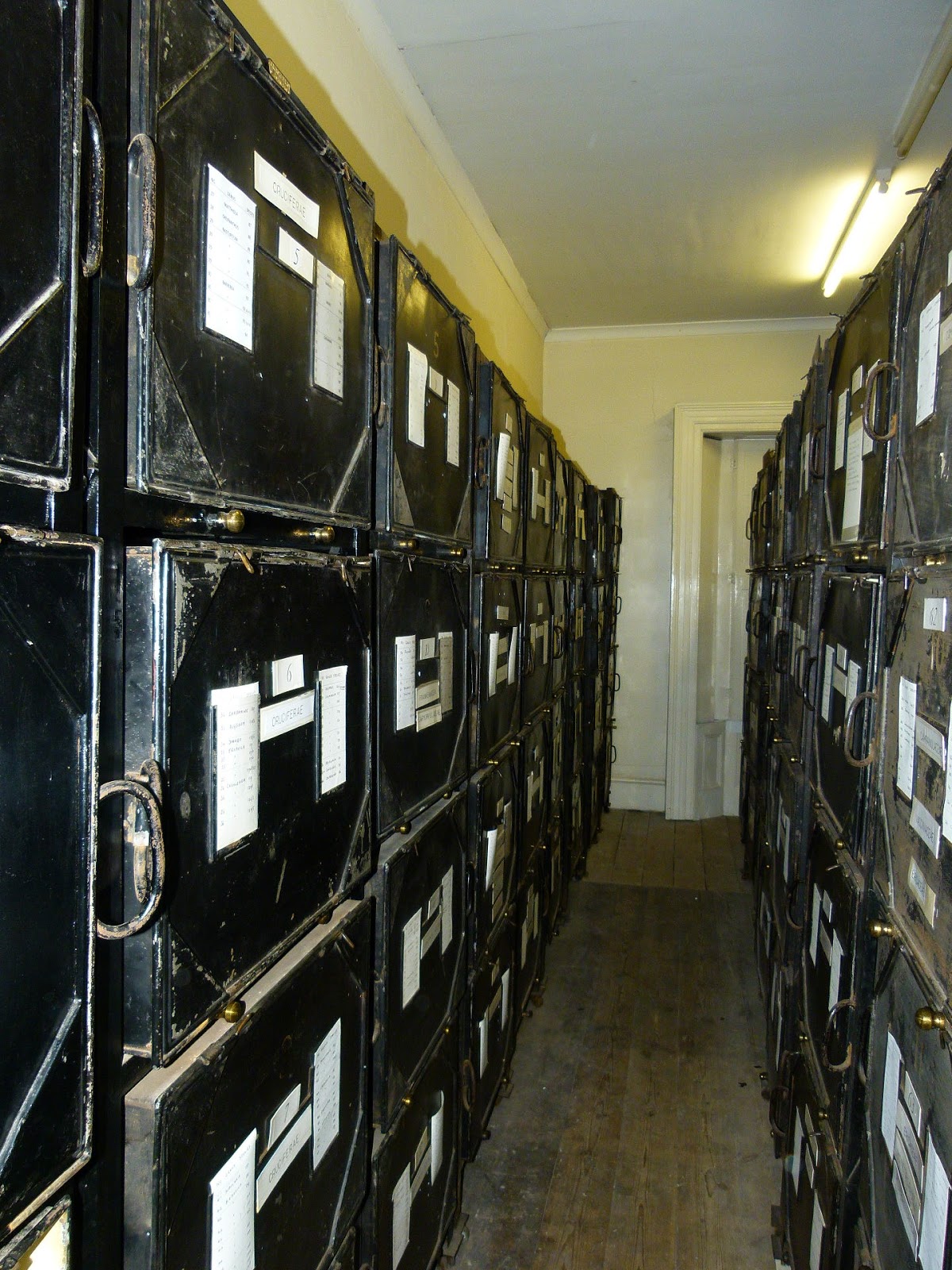
... Mr. Hume who lives in a most picturesque situation high up on Jakko, the house being about 7800 feet above the level of the sea. From my bedroom window I had a fine view of the snowy range. ... at last I stood in the celebrated museum and gazed at the dozens upon dozens of tin cases which filled the room ... quite three times as large as our meeting-room at the Zoological Society, and, of course, much more lofty. Throughout this large room went three rows of table-cases with glass tops, in which were arranged a series of the birds of India sufficient for the identification of each species, while underneath these table-cases were enormous cabinets made of tin, with trays inside, containing series of the birds represented in the table-cases above. All the specimens were carefully done up in brown-paper cases, each labelled outside with full particulars of the specimen within. Fancy the labour this represents with 60,000 specimens! The tin cabinets were all of materials of the best quality, specially ordered from England, and put together by the best Calcutta workmen. At each end of the room were racks reaching up to the ceiling, and containing immense tin cases full of birds. As one of these racks had to be taken down during the repairs of the north end of the museum, the entire space between the table-cases was taken up by the tin cases formerly housed in it, so that there was literally no space to walk between the rows. On the western side of the museum was the library, reached by a descent of three stops—a cheerful room, furnished with large tables, and containing, besides the egg-cabinets, a well-chosen set of working volumes. ... In a few minutes an immense series of specimens could be spread out on the tables, while all the books were at hand for immediate reference. ... we went below into the basement, which consisted of eight great rooms, six of them full, from floor to ceilings of cases of birds, while at the back of the house two large verandahs were piled high with cases full of large birds, such as Pelicans, Cranes, Vultures, &c.
I was certainly not hoping to find Hume's home as described but the situation turned out to be a lot worse. The first thing I did was to contact Professor Sriram Mehrotra, a senior historian who has published on the origins of the Indian National Congress. Prof. Mehrotra explained that Rothney Castle had long been altered with only the front facade retained along with the wood-framed conservatories. He said I could go and ask the caretaker for permission to see the grounds. He was sorry that he could not accompany me as it was physically demanding and he said that "the place moved him to tears." Professor Mehrotra also told me about how he had decided to live in Shimla simply because of his interest in Hume! I left him and walked to Christ Church and took the left branch going up to Jakhoo with some hopes. I met the caretaker of Rothney Castle in the garden where she was walking her dogs on a flat lawn, probably the same garden at the end of which there once had been a star-shaped flower bed, scene of the infamous brooch incident with Madame Blavatsky (see the theosophy section in Hume's biography on Wikipedia). It was a bit of a disappointment however as the caretaker informed me that I could not see the grounds unless the owner who lived in Delhi permitted it. Rothney Castle has changed hands so many times that it probably has nothing to match with what Bowdler-Sharpe saw and the grounds may very soon be entirely unrecognizable but for the name plaque at the entrance. Another patch of land in front of Rothney Castle was being prepared for what might become a multi-storeyed building. A botanist friend had shown me a 19th century painting of Shimla made by Constance Frederica Gordon-Cumming. In her painting, the only building visible on Jakko Hill behind Christ Church is Rothney Castle. The vegetation on Shimla has definitely become denser with trees blocking the views.
 
So there ended my hopes of adding good views (free-licensed images are still misunderstood in India) of Rothney Castle to the Wikipedia article on Hume. I did however get a couple of photographs from the roadside. In 2014, I managed to visit the South London Botanical Institute which was the last of Hume's enterprises. This visit enabled the addition a few pictures of his herbarium collections as well as an illustration of his bookplate which carries his personal motto.

Clearly Shimla empowered Hume, provided a stimulating environment which included several local collaborators. Who were his local collaborators in Shimla? I have only recently discovered (and notes with references are now added to the Wikipedia entry for R. C. Tytler) that Robert (of Tytler's warbler fame - although named by W E Brooks) and Harriet Tytler (of Mt. Harriet fame) had established a kind of natural history museum at Bonnie Moon in Shimla with  Lord Mayo's support. The museum closed down after Robert's death in 1872, and it is said that Harriet offered the bird specimens to the government. It would appear that at least some part of this collection went to Hume. It is said that the collection was packed away in boxes around 1873. The collection later came into possession of Mr B. Bevan-Petman who apparently passed it on to the Lahore Central Museum in 1917.

Hume's idea of mapping rainfall
to examine patterns of avian distribution
It was under Lord Mayo that Hume rose in the government hierarchy. Hume was not averse to utilizing his power as Secretary of State to further his interests in birds. He organized the Lakshadweep survey with the assistance of the navy ostensibly to examine sites for a lighthouse. He made use of government machinery in the fisheries department (Francis Day) to help his Sind survey. He used the newly formed meteorological division of his own agricultural department to generate rainfall maps for use in Stray Feathers. He was probably the first to note the connection between rainfall and bird distributions, something that only Sharpe saw any special merit in. Perhaps placing specimens on those large tables described by Sharpe allowed Hume to see geographic trends.

Hume was also able to appreciate geology (in his youth he had studied with Mantell ), earth history and avian evolution. Hume had several geologists contributing to ornithology including Stoliczka and Ball. One wonders if he took an interest in paleontology given his proximity to the Shiwalik ranges. Hume invited Richard Lydekker to publish a major note on avian osteology for the benefit of amateur ornithologists. Hume also had enough time to speculate on matters of avian biology. A couple of years ago I came across this bit that Hume wrote in the first of his Nests and Eggs volumes (published post-ornith-humously in 1889):

Nests and Eggs of Indian birds. Vol 1. p. 199
 
I wrote immediately to Tim Birkhead, the expert on evolutionary aspects of bird reproduction and someone with an excellent view of ornithological history (his Ten Thousand Birds is a must read for anyone interested in the subject) and he agreed that Hume had been an early and insightful observer to have suggested female sperm storage.

Shimla life was clearly a lot of hob-nobbing and people like Lord Mayo were spending huge amounts of time and money just hosting parties. Turns out that Lord Mayo even went to Paris to recruit a chef and brought in an Italian,  Federico Peliti. (His great-grandson has a nice website!) Unlike Hume, Peliti rose in fame after Lord Mayo's death by setting up a cafe which became the heart of Shimla's social life and gossip. Lady Lytton (Lord Lytton was the one who demoted Hume!) recorded that Simla folk "...foregathered four days a week for prayer meetings, and the rest of the time was spent in writing poisonous official notes about each other." Another observer recorded that "in Simla you could not hear your own voice for  the grinding of axes. But in 1884 the grinders were few. In the course of my service I saw much of Simla society,  and I think it would compare most favourably with any other town of English-speaking people of the same size. It was bright and gay. We all lived, so to speak, in glass houses. The little bungalows perched on the mountainside wherever there was a ledge, with their winding paths under the pine trees, leading to our only road, the Mall." (Lawrence, Sir Walter Roper (1928) The India We Served.)

A view from Peliti's (1922).
Peliti's other contribution was in photography and it seems like he worked with Felice Beato who also influenced Harriet Tytler and her photography. I asked a couple of Shimla folks about the historic location of Peliti's cafe and they said it had become the Grand Hotel (now a government guest house). I subsequently found that Peliti did indeed start Peliti's Grand Hotel, which was destroyed in a fire in 1922, but the centre of Shimla's social life, his cafe, was actually next to the Combermere Bridge (it ran over a water storage tank and is today the location of the lift that runs between the Mall and the Cart Road). A photograph taken from "Peliti's" clearly lends support for this location as do descriptions in Thacker's New Guide to Simla (1925). A poem celebrating Peliti's was published in Punch magazine in 1919. Rudyard Kipling was a fan of Peliti's but Hume was no fan of Kipling (Kipling seems to have held a spiteful view of liberals - "Pagett MP" has been identified by some as being based on W.S.Caine, a friend of Hume; Hume for his part had a lifelong disdain for journalists. Kipling's boss, E.K. Robinson started the British Naturalists' Association while E.K.R.'s brother Philip probably influenced Eha.

While Hume most likely stayed well away from Peliti's, we see that a kind of naturalists social network existed within the government. About Lord Mayo we read: 
Lord Mayo and the Natural History of India - His Excellency Lord Mayo, the Viceroy of India, has been making a very valuable collection of natural historical objects, illustrative of the fauna, ornithology, &c., of the Indian Empire. Some portion of these valuable acquisitions, principally birds and some insects, have been brought to England, and are now at 49 Wigmore Street, London, whence they will shortly be removed. - Pertshire Advertiser, 29 December 1870.
Another news report states:
The Early of Mayo's collection of Indian birds, &c.

Amidst the cares of empire, the Earl of Mayo, the present ruler of India, has found time to form a valuable collection of objects illustrative of the natural history of the East, and especially of India. Some of these were brought over by the Countess when she visited England a short time since, and entrusted to the hands of Mr Edwin Ward, F.Z.S., for setting and arrangement, under the particular direction of the Countess herself. This portion, which consists chiefly of birds and insects, was to be seen yesterday at 49, Wigmore street, and, with the other objects accumulated in Mr Ward's establishment, presented a very striking picture. There are two library screens formed from the plumage of the grand argus pheasant- the head forward, the wing feathers extended in circular shape, those of the tail rising high above the rest. The peculiarities of the plumage have been extremely well preserved. These, though surrounded by other birds of more brilliant covering, preserved in screen pattern also, are most noticeable, and have been much admired. There are likewise two drawing-room screens of smaller Indian birds (thrush size) and insects. They are contained in glass cases, with frames of imitation bamboo, gilt. These birds are of varied and bright colours, and some of them are very rare. The Countess, who returned to India last month, will no doubt, add to the collection when she next comes back to England, as both the Earl and herself appear to take a great interest in Illustrating the fauna and ornithology of India. The most noticeable object, however, in Mr. Ward's establishment is the representation of a fight between two tigers of great size. The gloss, grace, and spirit of the animals are very well preserved. The group is intended as a present to the Prince of Wales. It does not belong to the Mayo Collection. - The Northern Standard, January 7, 1871
And Hume's subsequent superior was Lord Northbrook about whom we read:
University and City Intelligence. - Lord Northbrook has presented to the University a valuable collection of skins of the game birds of India collected for him by Mr. A.O.Hume, C.B., a distinguished Indian ornithologist. Lord Northbrook, in a letter to Dr. Acland, assures him that the collection is very perfect, if not unique. A Decree was passed accepting the offer, and requesting the Vice-Chancellor to convey the thanks of the University to the donor. - Oxford Journal, 10 February 1877
Papilio mayo
Clearly Lord Mayo and his influence on naturalists in India is not sufficiently well understood. Perhaps that would explain the beautiful butterfly named after him shortly after his murder. It appears that Hume did not have this kind of hobby association with Lord Lytton, little wonder perhaps that he fared so badly!

Despite Hume's sharpness on many matters there were bits that come across as odd. In one article on the flight of birds he observes the soaring of crows and vultures behind his house as he sits in the morning looking towards Mahassu. He points out that these soaring birds would appear early on warm days and late on cold days but he misses the role of thermals and mixes physics with metaphysics, going for a kind of Grand Unification Theory:

And then claims that crows, like saints, sages and yogis are capable of "aethrobacy".
This naturally became a target of ridicule. We have already seen the comments of E.H. Hankin on this. Hankin wrote that if levitation was achieved by "living an absolutely pure life and intense religious concentration" the hill crow must be indulging in "irreligious sentiments when trying to descend to earth without  the help of gravity." Hankin despite his studies does not give enough credit for the forces of lift produced by thermals and his own observations were critiqued by Gilbert Walker, the brilliant mathematican who applied his mind to large scale weather patterns apart from conducting some amazing research on the dynamics of boomerangs. His boomerang research had begun even in his undergraduate years and had earned him the nickname of Boomerang Walker. On my visit to Shimla, I went for a long walk down the quiet road winding through dense woodland and beside streams to Annandale (now apparently called Anna-Dale), the only large flat ground in Shimla where Sir Gilbert Walker conducted his weekend research on boomerangs. Walker's boomerang research mentions a collaboration with Oscar Eckenstein and there are some strange threads connecting Eckenstein, his collaborator Aleister Crowley and Hume's daughter Maria Jane Burnley who would later join the Hermetic Order of the Golden Dawn. But that is just speculation!
1872 Map showing Rothney Castle

The steep road just below Rothney Castle

Excavation for new constructions just below and across the road from Rothney Castle

The embankment collapsing below the guard hut

The lower entrance, concrete constructions replace the old building

The guard hut and home are probably the only heritage structures left


I got back from Annandale and then walked down to Phagli on the southern slope of Shimla to see the place where my paternal grandfather once lived. It is not a coincidence that Shimla and my name are derived from the local deity Shyamaladevi (a version of Kali).


The South London Botanical Institute

After returning to England, Hume took an interest in botany. He made herbarium collections and in 1910 he established the South London Botanical Institute and left money in his will for its upkeep. The SLBI is housed in a quiet residential area. Here are some pictures I took in 2014, most can be found on Wikipedia.


Dr Roy Vickery displaying some of Hume's herbarium specimens

Specially designed cases for storing the herbarium sheets.

The entrance to the South London Botanical Institute

A herbarium sheet from the Hume collection

 
Hume's bookplate with personal motto - Industria et Perseverentia

An ornate clock which apparently adorned Rothney Castle
A special cover released by Shimla postal circle in 2012

Further reading
 Postscript

 An antique book shop had a set of Hume's Nests and Eggs (Second edition) and it bore the signature of "R.W.D. Morgan" - it appears that there was a BNHS member of that name from Calcutta c. 1933. It is unclear if it is the same person as Rhodes Morgan, who was a Hume correspondent and forest officer in Wynaad/Malabar who helped William Ruxton Davison.
Update:  Henry Noltie of RBGE pointed out to me privately that this is cannot be the forester Rhodes Morgan who died in 1919! - September, 2016.

Incidentally, the Simla naturalists' Society must have had its home in Chapslee Estate, which was where Ilbert lived and I had the privilege of having a look at the interiors of one of this last remaining heritage mansion in Shimla. The society evidently had numerous lulls and starts with the movements of interested members.
 
The Bombay Gazette, 3 June 1887 page 4


Saturday, October 20, 2012

The power of networks-a 19th century tale

A couple of weeks ago I received a rather surprising email request from the Natural History Museum in London. The request was for some data on the correspondence network of Allan Octavian Hume. Many years ago, I had put together all the names of correspondents cited in his (and Marshall's) three volume "Game birds of India, Burmah and Ceylon" along with their locations. Putting this on a map gave a view of how Hume managed to get information from across India without actually having to expend too much of his own personal energies to obtain the data (mainly in the form of specimens). In hindsight, that map was rather poorly prepared. 
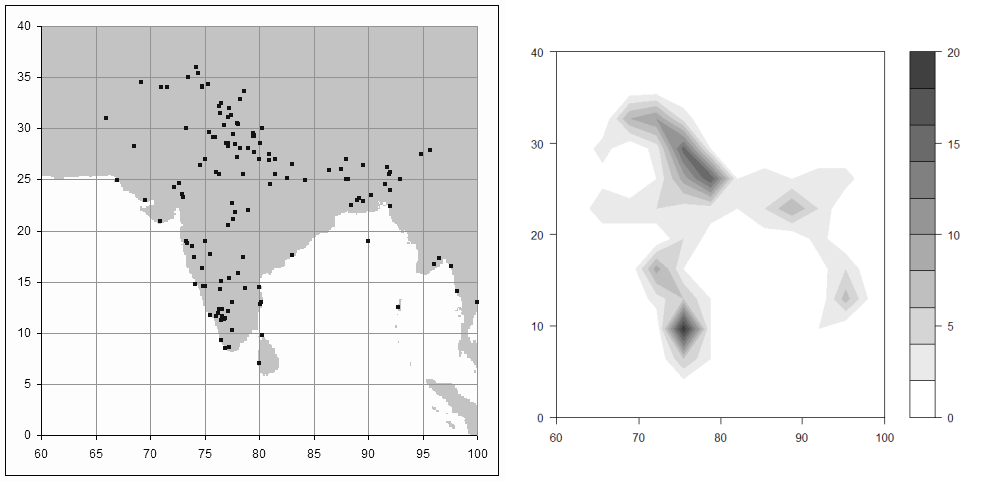
Scatter plot and a density plot showing the distribution and numbers of Hume correspondents
The rather exceptional body of work that Hume produced included an enormous collection of (about 82,000) bird specimens and associated information. Around 1884 he donated this entire collection to the British Museum (today the Natural History Museum). This was prompted by the theft of his life-time of notes and manuscripts, an event that led him to give up ornithology. He then diverted his energies towards the Indian National Congress (which too he gave up due to the infighting and lack of enthusiasm among Indians). Anyway, I discovered the raw data used to create the map and found it worth re-examining. So this time round I was able to unify the plots and include labels, but it involved a lot of jugglery with tools that included Excel, R, GIMP and Inkscape. The data that is accessible for a researcher in India is actually extremely limited and someone with access to the actual specimens in the Natural History Museum should be able to do an enormously better job.

The dataset can be downloaded here
Many of Hume's contributors were in the Indian Civil Services or officers in the Army. These were evidently positions in which there was a lot of leisure and travel, allowing them to send specimens and notes to Hume, who then duly compiled them in his own amazing journal - Stray Feathers - 10 volumes of which were produced before he gave up ornithology. An index volume was added by Charles Chubb of the British Museum. All of these volumes are now available online. In an earlier publication I had mentioned that the map suggests why Hume did not bump into either the Eastern Ghats form of Abbott's Babbler or Jerdon's Courser. Even today, central and eastern India are dark regions, where few people observe birds.

These contributors sent information from locations where they were posted at different times in their career while some had their own network of contacts who sent in specimens from elsewhere. Although the vast majority were in the army or civil services, their background appear to have been quite varied and one can only imagine the the kind of correspondence they must have had. Some were sharpshooters or sportsmen, like Duncan Home (DC Home) who died in the 1857 uprising and Colonel McMaster (McMaster also wrote under the pen-name of "Vagrant" for hunting periodicals like The Field).  There were other influences which are not directly evident. Many of them were trained in medicine at Edinburgh University which had its  roots in ideas that emerged from the Scottish Enlightenment. They often shared common teachers, for instance T C Jerdon who followed the fanciful Quinarian system, and Charles Darwin, who was to drive the last nails into the coffin of that system, both studied under a Professor Robert Jameson in Edinburgh, but that is not to say that the Professor's classes were interesting. Darwin actually wrote that "[T]he sole effect they produced on me was the determination never as long as I lived to read a book on Geology, or in any way to study the science." Jameson had however been involved with groups such as the Plinian Society and Wernerian Natural History Society, and the interactions among the participants in the lectures of these groups had influences on geology as well zoology in India. Jerdon was senior to Hume in ornithology and they held each other in high esteem.

Apart from these old-boys networks, there were also family ties. Robert Wardlaw Ramsay (RGW Ramsay on the map) for instance was a good friend of Hume but his uncle Lord Hay, an ornithological collector of eminence was considered by Hume as a mere "cabinet ornithologist" and the two sparred in their correspondence in the Ibis. Hume's cousin, another Edinburgh physician, was Edward Balfour, the founder of several museums, compiler of the Cyclopedia of India and a pioneer of forest conservation. Balfour founded the Madras museum where he was succeeded by Dr. George Bidie (Dr. G Bidie on the map above was also an Edinburgh physician) as curator (Superintendent was the official term used). Balfour was based in Madras which was also home to other indologists and polymaths like Walter Elliot (after whom we have the Madras treeshrew Anathana ellioti). Elliot's interests in zoology were secondary to his interest in numismatics, epigraphy and language. Elliot was mostly based out of Madras and this was the centre of a scholarly group that published in the Madras Journal of Literature and Science. Elliot's sister-in-law was married to PL Sclater. Sclater was the founder of the ornithological journal The Ibis. Elliot's interest in Indian culture was possibly triggered by an immersive experience, early in his India career, as a prisoner of Kittur Rani Chennamma. Elliot wrote an obituary of Jerdon and his own was written by Hugh Cleghorn (also an Edinburgh physician). Cleghorn can pretty much be considered the founding spirit behind the idea of a forest department in India in which he was followed by Colonel R. H. Beddome (after whom we have Beddome's keelback ) who seems to have given most of his attention to the reptiles and amphibians.
Every journal of the period had to examine if  they could survive and whether
they might be stepping on the toes of the Journal of the Asiatic Society of Bengal

Another older scholarly group, The Asiatic Society of Bengal, had its centre in Calcutta. Their early research also revolved around epigraphy and numismatics and their journal was founded by the polymath, James Prinsep. Shortlived though its editor was, it seems that the interests of the journal depended on its key people and zoology was rarely covered until Edward Blyth became one of its underpaid staff. Blyth wrote many bird related papers, so much so that he complained to others about how he was sidelined and "accused of being an ornithologist"! Both Blyth and Hume corresponded with another orientalist in the hills - B H Hodgson in Nepal. A family friend of Hodgson's was Thomas Malthus, the man who also influenced Darwin. Hodgson's life in India was however quite isolated but he seems to have kept up an enormous amount of correspondence and was extremely productive in his writing. He was also a friend of JD Hooker, the botanist, who was in turn a common friend of Darwin. Hodgson too seems to have at least in later life put his zoological pursuit behind his other interests, so much so that he became an expert on the Tibetan language and Buddhist philosophy. Hodgson however collected a large number of animal specimens. He also employed native artists to illustrate many of these specimens. About 1700 of these plates were lent to Hume and it would appear that little is known about their fate. Many naturalists in India appear to have employed native artists but most do not give them credit. Jerdon for instance trained artists from Trichy (such as C V Kistnarajoo) but they often remain anonymous in his plates. An interesting exception here is a botanist friend of Cleghorn and Jerdon - Robert Wight (Edinburgh physician again!). Wight found two exceptional artists by the name of Govindoo and Rungiah and they produced illustrations that Wight appreciated so much that he even named an orchid genus after Govindoo - Govindooia (now Tropidia). Wight's botany expanded on the earlier work of William Roxburgh (Edinburgh physician!), a botanist who followed Colonel Robert Kyd at the botanical garden in Calcutta. Roxburgh succeeded Patrick Russell (Edinburgh physician famous for Russell's viper) as "Naturalist" at Madras. There were also some other earlier positions as "Naturalist" such as in the court of the Nawab of Arcot where Roxburgh's friend was Johann Gerhard König, a student of Linnaeus. (Heard of curry leaf Murraya koenigii ?)

Botany seems to have found itself a professional role thanks to the economic value of plants. Colonel Kyd (after whose family the locality of Kidderpore in Calcutta derives) for instance was able to sell the idea of botanical gardens to the East India Company without much trouble. Another bunch of professionals who also took an interest in zoology (esp. molluscs) were the geologists. F.R. Mallet, W Theobald, T Oldham (Irish but studied under that same boring Professor Jameson in Edinburgh - the Oldham on the map however is a Captain Oldham who may have been a relative, Oldham's son was also a geologist) and V Ball (whose father was an astronomer) among others were members of the Geological Survey of India - an organization that seems to have been dominated by Irishmen (H B Medlicott of Gondwanaland fame and his brother, JG Medlicott) although it also took in non-Irish paleontologists like F. Stoliczka. Stoliczka is probably the most famous victim of altitude sickness and on that fatal expedition,  was accompanied by Dr John Scully who appears on the Hume correspondence map. The passing of both Stoliczka and Blyth are recorded in volume 2 of Hume's Stray Feathers. Zoology had a difficult start as a profession and many of the names we have come across so far joined hands to influence the creation of  The Fauna of British India. These included JD Hooker, Darwin, Huxley, J. Lubbock, WH Flower and PL Sclater. The editor they chose was the geologist WT Blanford. Blanford's brother HF Blanford was the founding spirit behind meteorology in India. The Indian Museum which came about from the museum of the Asiatic Society of Bengal where Blyth worked became the corpus on which the Zoological Survey of India worked. Staff at the Indian Museum included Dr J. Anderson (Again Edinburgh physician!). Later workers here included PL Sclater's son, WL Sclater. Another museum worker was JA Murray at Karachi, who wrote a book, rather rare in its genre, called the Edible and game birds of British India !

Army officers, botanists, geologist and men of medicine might appear to be the primary contributors but that is not the end. W. E. Brooks was a remarkable engineer in the railways and he seems to have had his own interesting circle of friends (including Mr. Hancock) but most importantly he seems to have quietly proceeded on the path of listening to bird song and examining differences between species. Through his method he made great progress in warbler identification as well as in separating members of the crow family. Unfortunately it seems that his pioneering approach was not accepted by Hume who saw skins as being the only reliable artefact. Brooks was so influenced by Hume that he named his youngest son after him. Allan Brooks became one of the great bird artists and an ornithologist in his own right as well and in a little note (Condor 44:157) he writes: "... I am reminded of a similar controversy far back in the last century between my father, the late W. E. Brooks and my paternal sponsor, the late Allan Hume in the pages of the latter’s “Stray Feathers.” The controversy concerned the separation of the Hill Crow, Corvus intermedius, from the Jungle Crow, C. culminatus; my father insisted that their voices were quite distinct but Hume would clinch his argument for their identity with the claim that as the skins could not talk the birds could not be separated. ..." Other railways engineer - naturalist include H.R.P. Carter from Madras / Coonoor, H. P. Le Messurier (incorrectly noted as "R.P."), and Henry Wenden from Poona.

Other minority professions include the missionaries - one member of which was Rev. SB Fairbank (after whom we have Trochalopteron fairbanki) from the Palni hills. GP Sanderson, the son of a clergyman was later to write a lot on the big-game of southern India, so much so that Rudyard Kipling may have used him as a model for his Petersen Sahib. The hills of Kodaikanal, Ootacamund and Simla were of course sanatoria frequented by wealthy colonial officers and they have more than a fair share of correspondents. One interesting member of this group is Miss Cockburn, among the few women who contributed notes to Hume. She was also a bit of an artist and her bird paintings from the Nilgiris were used in a calendar produced by the Natural History Museum. Her father, M D Cockburn, was the district collector of Salem and Catherine falls near Kotagiri is named after her mother. Their family was also involved in introducing coffee and a small number of coffee and tea planters also contributed to ornithology. One of these was Louis Mandelli from Darjeeling. He seems to have been a bit of a bird collector who exchanged specimens with Hume. He is perhaps among the few that held a very negative opinion of Hume who he claimed was stealing credit for discoveries and for being unfair in his specimen exchanges. Very little is known about Mandelli and he appears to have led a troubled life that ended in suicide. Another contributor J. Gammie was in charge of the government run cinchona plantations at Mangphu. The cinchona enterprise was within the government system that Hume oversaw as secretary of state.  JD Inverarity (Surat), a magistrate and others including Charles Swinhoe were later to found the Bombay Natural History Society. Charles Swinhoe's brother was Robert Swinhoe in Hong Kong, a diplomat. In this diplomat class of contributors we may include R. Schomburgk and OB St. John, their contributions being valuable for their travel to obscure locations. A. H. Hildebrand (Hildebrande on the map) was the first Superintendent of the Shan States and was responsible for the discovery of Impatiens psittacina, which went viral on the Internet in recent times. Others who travelled on work included H H Godwin-Austen (Godwin-Austen on the map and of K2/Mt. Godwin-Austen fame), H J Elwes (who visited Hume in 1880 along with F D Godman of Godman-Salvin fame) and A W Chennell (Chennell on the map, also collected insect specimens, some like Urolabida chennelli were named after him by W.L. Distant) who worked with the (Topographical) Survey of India. Oddly, the teaching establishment is also in a minority - Professor Harold Littledale at Baroda College stands out.

This map might give the wrong impression that India has been well examined for birds. No, this is only about how it was searched for "new" species - new in the sense that they were not known to the European experts - museum curators and collectors. That era is gone, now is the time where continuous monitoring and life-history studies have become the trend across the world, but that means local effort. Local effort needs support and training; which simply cannot happen if the best books are impossibly expensive and data, even that which is held by government bodies, is locked away in museums or stowed away in private collections. The situation is not improved by self-styled experts who sit smugly in their offices, jet across the country to make slick movies or write travelogues in glossy magazines either. Even in the 19th century it was recognized that knowledge was lacking in spite of this widespread collection of specimens. Brian Hodgson wrote in 1873:

"I may as well attempt to supply the deficiency for the benefit of local inquirers, who, I suspect, are hardly sufficiently alive to that legerdemain of the closet-naturalist, whereby they are cheated of the whole merit of their labours by him who does no more than annex a few words of doggrel Latin to the numerous facts painfully elaborated by costly and continuous attention. How long assiduous local research is to be deliberately deprived of those aids of library and museum which it ought to be the chief duty of learned Societies at home to furnish, I know not. But the candid will, in the meanwhile, make all allowances for the necessary errors cleaving to attempts at technical Zoology, in the want of such aids. Whilst the face of our land is darkened with skin-hunters, deputed by learned Societies to incumber science with ill-ascertained species, no English zoological association has a single travelling naturalist* in India; nor has one such body yet sought to invigorate local research, numerous as now are the gentlemen in India with opportunities and inclination for observation such us need but the appropriate aid of those bodies to render the investigations of these gentlemen truly efficient towards all the higher ends which the Societies in question are constituted to forward !"

*
The French, who are far quicker-witted than we Beotian islanders, have had two such agents in India ever since I came to it. But the travelling naturalist is in no condition to compete with the fixed local student, if the latter receive the obvious helps from home. For many years past we have had the great and wealthy Zoological Societies in London, which, however, have not yet found out that the phenomena of animate nature must be observed where they exist !

To this day, there exists no body that seeks to invigorate local research in India! Millions are of course spent on the the state forest departments, the ZSI, BSI and the GSI; government organizations that emerged from the interactions of these networks have all isolated themselves from mainstream research as well as from the public that supports them with taxes. And so ends this unfinished tale of connections in 19th century ornithology. This year happens to be the centenary of Hume's death and a commemorative event is scheduled in London next week. Perhaps some of my readers will be fortunate to be a part of it.

A growing series of postscripts

16-Aug-2013 Feilden in Burma seems to be Henry Wemyss Feilden (1838-1921) [Ibis obituary 1921]
06-June-2014 The talks from the Hume centenary can be heard at the SLBI website.
29-Jan-2015 R M Adam from Agra, also at Sambhur was Robert McNeiledge (or Macneilledge) Adam (1836/37 - 11 January 1913). He served in the Inland Customs department and was involved in salt taxes - in the same department as Hume. Seems to have retired around 1877 when he was working in the Madras Presidency(!) - appears to have been among those strongly opposed to the Ilbert Bill.
31-Jan-2015 - a note on Professor Harold Littledale from The Cornishman 29 May 1930, p.6.:
Death of Dr. Harold Littledale
Dr. Harold Littledale, Emeritus Professor of English Language and Literature at University College, Cardiff died at his residence at Southbourne, Bournemouth on Sunday, May 11th, at the age of 77. He was the father of Mrs Clarence Paull of Roskear, Camborne. He edited various English texts, but his chief claim to remembrance is the influence he exerted on the problem of Indian primary education by the advice and guidance he gave the Gaekwar of Baroda in introducing to India soil the principle of compulsion.
Born to a Dublin solicitor on October 3, 1853, he was educated at Armagh Royal School and Trinity College, Dublin. Here he graduated in arts and was in 1876 senior moderator. in later years Dublin conferred upon him the degree of Litt.D. His best years were spent in Baroda State, where on the educational side he had a large share in bringing in the new progressive order following the deposition of Malaharao Gaekwar and the accession of the present Maharaj Sayaji Rao Gaekwar. He went out in 1879 as Vice-Principal and Professor of History and English Literature at Baroda College and his influence told in making the young ruler so keen in intellectual pursuits and conversation with the college professors. The two men formed a close friendship, and in later years Littledale was appointed Director of Vernacular Instruction in the State. It was while he held this post that the foundations were laid of the compulsory system introduced in Baroda many years before the principle found expression in the Statute book of any province of British India. The idea was derided as wholly inapplicable to Indian conditions; but it is now generally accepted in provincial legislation though its application is much restricted on financial and other grounds. 
Littledale spent much of his leisure in Himalayan travel and the study of the flora and fauna of India making many valuable contributions to the "Journal" of the Bombay Natural History Society. He was a Fellow of the University of Bombay. Retiring from India after 20 years in Baroda he was appointed Professor of English Language and Literature at the University College of South Wales and Monmouth, Cardiff. In addition to his editing of various texts, he wrote occasionally on English literature and natural history. He was also interested in folkore. He was made Emeritus Professor in 1921.

---
January 2017 - Littledale married Annapurna Turkhud, second daughter of Dr Atmaram Pandurang Turkhud on 11 November 1880 (poor Tagore was also apparently in love with Annapurna!). Dr Atmaram Pandurang was one of the Indian founding members of the BNHS! Ana however died young and Littledale married again in 1892 - "A marriage will shortly take place between Mr. Harold Littledale, of Baroda College, India, eldest son of the late Mr. William F. Littledale, of Whaley Abbey, Rathdrum, County Wicklow, and Sybil Frances Hanbury, fourth daughter of Mr. Edgar Hanbury, of Eastrop Grange, Highworth, Wilts" - The Colonies and India, 24 Dec 1892. p.34

In August 2014, I visited the library of the Natural History Museum at London and examined two of the books by M.B.L. Cockburn and it turns out that the images found online do not show the pencil writings on the margin. The critical notes on the accuracy of the illustrations and other statements suggest that the books had gone through the hands of A.O. Hume. It may even have come into the NHM collections via Hume.
A picture of Anthus similis by Miss Cockburn
In the corner in pencil - "I particularly want specimens"

Pencilled "good"


October 2016: I visited the grave of Margaret Cockburn in Kotagiri along with Dr Henry Noltie. The graves of all the Cockburn family members are placed together.


5-May-2018: The somewhat young forest department (in the establishment of which his cousin Balfour was involved) would have been a good source for Hume to make use of but the only person who seems to  have contributed in some scale is T.F. Bourdillon. Hume named the eared nightjar after him. A portrait of Bourdillon hangs at the teak museum at Nilambur - the artist is unknown and it seems to show a few quills of cinchona which suggests that Hume and Bourdillon may have also interacted via the cinchona project (like with J.A. Gammie) which would have been within the ambit of his department.

30-Jan-2020: Added an entry for E. Bonavia - a collaborator from Etawah. https://en.wikipedia.org/wiki/Emanuel_Bonavia

5-Apr-2020: Added an entry for the civil servant G.W. Vidal - a collaborator from the Konkan region, better known for his contribution to the game of badminton - https://en.wikipedia.org/wiki/George_William_Vidal 

5-Jul-2020: Added an entry for Hume's successor as secretary to the department of revenue and agriculture - https://en.wikipedia.org/wiki/Edward_Charles_Buck
 
Captain A. Grahame Young (2 August 1834 - 2 November 1905) - buried at Jhiri, Himachal Pradesh seems to have also been interested in rearing Lepidoptera, Kulu folklore (communicated to the Asiatic Society of Bengal).

5-Mar-2022: Updated a Wikidata entry for Col. Maurice Tweedie (1838-1923), Superintendent of Police, Lucknow. https://www.wikidata.org/wiki/Q76201917

21-Mar-2022: Just noticed that my search for Hume coadjutors began in 2004 with an enquiry to the late Ed Moulton.


26 March 2022: Thanks to queries on several collectors / authors received from Aasheesh Pittie, I was surprised to see that many more than I had considered of Hume's collectors were directly under his official department - the inland customs - who were involved in collecting salt tax and doing patrols along the Great Hedge. These include Robert MacNeilledge Adam (R.M. Adam, 1836 - 11 January 1913); Walter (Charles) Nathaniel Chill (W. N. Chill; 27 March 1842 - ?). Adam, it would appear was actually from an indigo plantation family in Bihar (Tirhoot) and may even have been appointed into the salt commissioner position by Hume's influence after finding him a useful collector of specimens.