click hide image

Showing posts with label books. Show all posts

Wednesday, March 10, 2021

An inedible tale


Many years ago, I had access to a copy of this peculiarly titled book on the birds of India. It had some beautiful lithographs, possibly hand coloured, and evidently faded into strange and muddy shades of brown. Fortunately, today, there is a nice scan of the book available online via the Biodiversity Heritage Library and safely deposited on the Internet Archive. Some of us had created an entry at Wikipedia for its author J.A. Murray - and around 2006 it had been expanded as James Augustus Murray and at that time the library of the Natural History Museum in London had conflated the two in their catalogue index too. Fortunately it was easy to see that there was no connection to the lexicographer Sir James Augustus Murray and the errors have since been fixed but painfully little was known about James Alexander Murray!

The Asiatic Society of Mumbai has done an excellent job of digitizing its collections and making them available at a very reasonable subscription price. The search engine and the OCR also work rather well and after running some searches on GranthSanjeevani I stumbled on the rather sordid tale of our Murray. It turns out that he founded a Victoria Natural History Institute which aimed to make natural history specimens available for sale and he was rapidly trying to expand this organization across India. Rather too rapidly and ambitiously it would appear. He had people across the country paying him to become heads of branches and then went into severe debt. This finally led to his being charged with cheating and some of the court hearings appear in the newspaper reports of the time. They reveal that Murray was once a librarian at the Kurrachee Municipal Library from where he was discharged dishonourably after it was discovered that he was trying to sell off duplicates of old books. Moving back to Mumbai where he was born, possibly of mixed British Indian parentage (described as "Eurasian"), he tried to set up an organization to make use of his taxidermic skills and knowledge of natural history. A report from the Bangalore Museum notes with hope that they might obtain new exhibits through the newly opened branches of the Victoria Natural History Institute in Mysore and Bangalore. Phipson of the BNHS, it would appear, had been kind enough to lend money to Murray and perhaps even provided housing to him until he failed to pay his rents. Phipson was called to court as a witness. The court with L.H. Bayley presiding finally sentenced Murray to five years of rigorous imprisonment whereupon he appears to have been broken and the man was lost forever to history.


The Bombay Gazette, 17 April 1893 p. 4 


Friday, October 23, 2020

Some little-known bird books from India - Torfrida

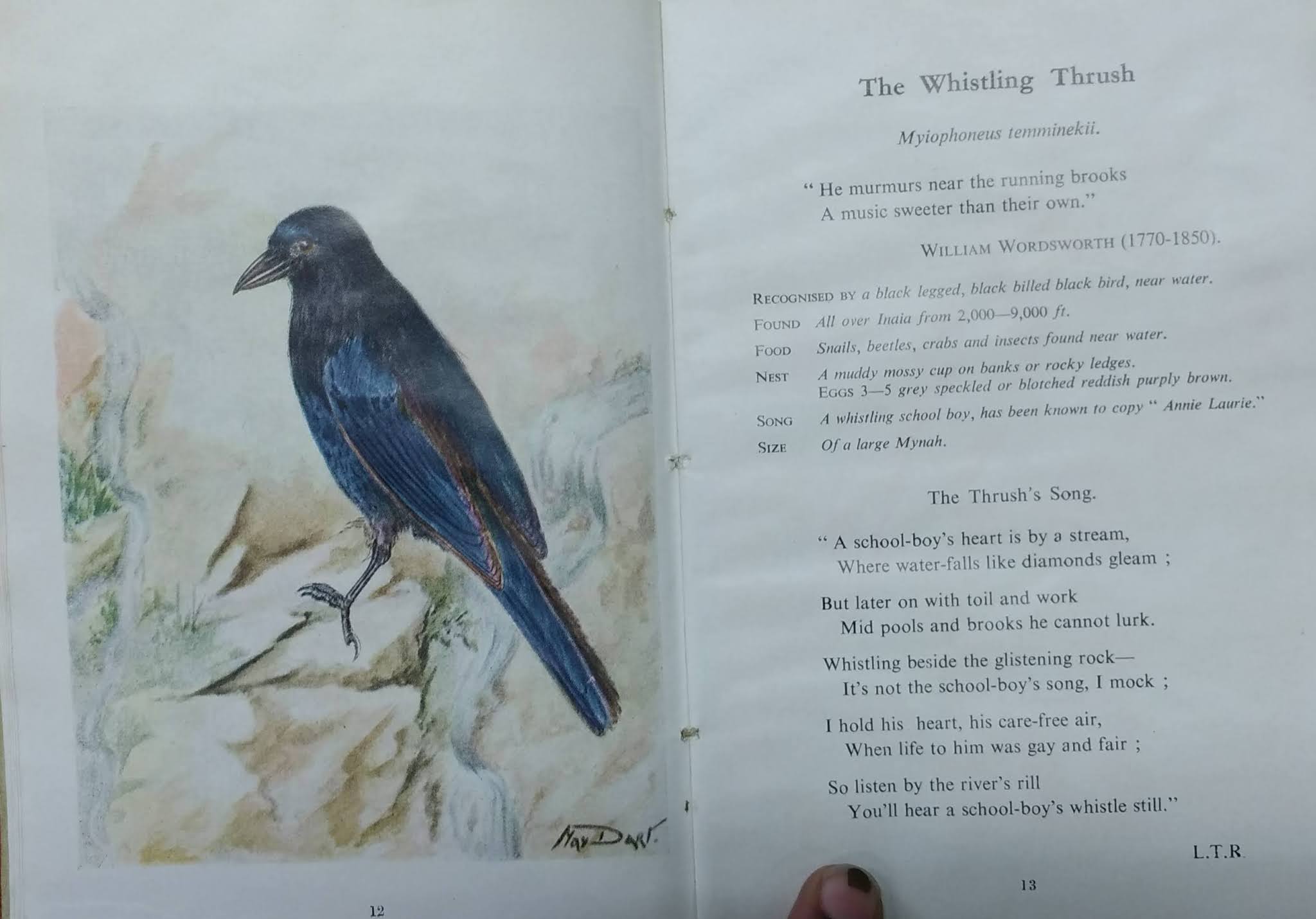
Among the little-known bird books of India, and of a rather unique genre, are Nurseries of Heaven  - More birds of India (1944) and Nurseries of Heaven - Birds (before 1944) written by someone with the pen-name "Torfrida" and illustrated by a Mrs May Dart who evidently lived in Wellington in the Nilgiris. This is not the only book written by this writer-illustrator pair, they also wrote Nurseries of Heaven - Wild Flowers of India. The flower and bird books deal principally with the Nilgiris. In 1944 the pair also wrote Flowering Trees of India (the geographic scope of that book seems wider). All the books appear to be a mixture of poetry, etymology, literary references, illustrations, fables, and a wee bit of original observation thrown in. These are all small pamphlets, presumably printed for children, possibly made for distribution in the local church.

The book is perhaps among the few Anglo Indian works with an aesthetic appreciation of birds [and not centered around humour like the writings of Phil Robinson, Eha or Dewar]. It also provides insights into Colonial life in the Nilgiris. I was fortunate to examine the contents of More Birds of India in a rather rare copy held by the Percy Fitzpatrick Institute of Ornithology at Cape Town in 2018. More information on May Dart and the mysterious Torfrida would be nice to have!

The first pamphlet on birds


The cover illustration is actually pasted into the frame


A few sample pages from the More Birds of India are included here to give a taste of the writing.


Some of her writing may need to be examined in detail. In her flower book she claims that the name "Portia tree" for Thespesia populnea is from the Tamil Puvassai! Some claims are outright incorrect like the idea that Osbeckia is called "Tipu China" from "Tibet China", that would in fact be from the old name Tibouchina.

Tuesday, June 23, 2020

Some American links to Indian ornithology

One of the joys of being in India is the complete lack of access to a good library, and that makes one keep a list of books to find so that you know how to make the best of limited time when one get an opportunity to visit a well-stocked library. It took me nearly ten years before I finally managed to browse through Max Nicholson's Art of Birdwatching (1931) on a brief visit to the library of the Zoological Society of London. I had been looking for the context in which he had talked about how a so-called "open mind" was absolutely useless for scientific enquiry [a belief that starkly contradicts the argumentative Indian].
"One cannot observe without a theory, and what seems the simplest of ornithological tasks - to go out of doors and look out for something worth recording - is in reality one of the hardest… It is a mistake to imagine that complete impartiality and freedom from preconceived ideas is the qualification for the perfect observer. The cow has a remarkably open mind, yet it has never been found to reach a high degree of civilisation."

Nicholson also inspired another writer across the Atlantic. This was Joseph Hickey, a student of literature who moved to ornithology. I had heard of his work through a rather tenuous series of connections.

From The Auk
One of the leading lights of bird study and popularization in India, Dr Joseph George, a major influence on the Bangalore bird-enthusiasts circle, had undertaken several of his earliest and pioneering studies on bird populations in Dehra Dun. In 1948, a Mrs M.D. Wright conducted a census of birds in Dehra Dun and wrote out her observations in the Journal of the Bombay Natural History Society. One of her inspirations was the book by Joseph Hickey, A Guide to Birdwatching (1943). It is unclear if Dr George actually took part in her census but she influenced his own studies in Dehra Dun (since he cites her work) and they doubtless met and I strongly believe that Dr George actually read this book too given his own censuses of birds in Dehra Dun. It was not until a few weeks ago that I got my hands on Hickey's book thanks to the Internet Archive and their emergency pandemic-response library which allows in-copyright books to be borrowed and read online. Now Hickey was influenced by many giants including Ernst Mayr and Aldo Leopold. He recounted among his ornithological mantras, the one from Ernst Mayr about having a long term line of enquiry while watching birds - in Mayr's words "everybody's got to have a problem". On the first person Hickey met on the field watching birds, he writes:
The pleasures of meeting a kindred spirit are much more subjective but they are nonetheless real and they often ripen into lifelong friendships. In grade school it never occurred to my chums or to me that bird books were written for anyone other than boys, and that grown men and women liked to watch flickers and killdeers just the way we did. Our beloved scoutmaster, the Reverend Basil Hall, had given some of us a helping hand, but bird study still seemed like a boys' game. It was an almost stupefying shock when Richard A. Herbert and I, aged 14, quite by accident found an elegantly dressed gentleman watching a chickadee one February day in New York City's Bronx Park. Charles Johnston, who looked not unlike Charles Evans Hughes to us, had been a distinguished member of the British Civil Service in India. He was kindly and apparently ready to answer questions. He answered them for two full hours, probably with no little amusement. The decades between us seemed to vanish and from that point on, our bird study took on dignity and purpose. He helped us many times more in the years that followed.
I tell this story to illustrate how an interest in ornithology can span any barrier, and how people of widely diverse cultures can rapidly find a common bond of understanding. There are several ways to get in touch with other bird students. One is to attend meetings.

Now an Indian Civil Servant interested in birds had to be examined and I searched the internet for Charles Johnston and found one that was interested in theosophy (but the Wikipedia entry then had no mention of any interest in natural history). I found also that a Johnston had been active in New York birding circles but was not sure if the two were the same until I found an entry on the Theosophy Wiki. The other major Theosophist (at least briefly) and ornithologist was Hume and I had to check for encounters between the two. It seems that the two could not have been in great contact. Johnston  married the niece of Madame Blavatsky (with whom Hume had fallen out) and entered the Indian Civil Service only in 1888, well after Hume's exit from government service. Johnston worked only for two years before suffering from malaria led to his resignation and he moved to the United States in 1896 after treatment in Austria. His close friends in New York included fellow theosophists W. Q. Judge and Clement Acton Griscom, Jr. (1868-1918) who was the father of the ornithologist Ludlow Griscom. It would appear (esp. from the absence of any mention in the Bombay Natural History Society journal) that Johnston began his serious bird studies only in the United States and may well have been an important influence in Griscom's life. Allan Cruickshank's Birds around New York city (1942) includes many notes by Johnston, who is described as an "experienced and meticulous observer" (p. 289).

Recommended reading
  • Hickey, Joseph (1975). A guide to bird watching. New York:Dover. [This Internet Archive copy (which can be borrowed) is signed by Hickey. This book was his master's work, under the supervision of Aldo Leopold!]
Postscript
Dr Joseph George  (1st October 1921 – 9th July 2012) was educated at St Joseph's College, Trichy and at St. John's College, Agra, He researched polymer chemistry under Herman Francis Marks  at the Brooklyn Polytechnic Research Institute between 1946 and 1948, returning to the Forest Research Institute at Dehra Dun. He worked for a while at the CBRI, Roorkee and at IPIRI, Bangalore.

Saturday, April 30, 2011

Hunting and wilderness writings

Punch lampooning sport-hunters
A query from a friend led me to look for old hunting literature from India and the list (excluding the better-known Corbett / Anderson works) of materials available on the Internet Archive turned out to be quite long. It is interesting how perceptions of hunting differed even in the pre-conservation era. As early as 1910 Punch magazine had lampooned hunting literature.

Hunting in India was used almost as an incentive for recruiting young and adventurous lads into the service of the East India Company. Sramek (2006) gives a good summary of how hunting converged with ideas of masculinity, bravery, superiority, morality, and so on. Hunting was supposed to build "character". According to Henry Shakespear, hunting would make the sons of the British readers not only "fit for their duty as soldiers," but would also prevent them from "tak[ing] to the gaming-table, or to an excess of feasting, rioting ... debauchery" and other "frivolous pursuits or effeminate pleasures".

Sramek, Joseph (2006) "Face Him like a Briton": Tiger Hunting, Imperialism, and British Masculinity in Colonial India, 1800-1875. Victorian Studies 48(4):659-680.
J.C. Faunthorpe published posthumously

 
Edzard Friedrich Ludwig von Innhausen und Knyphausen
sitting on a bear he shot in India (1906)


Here is an index (will be updated now and then) of material from the Internet Archive related to hunting, natural history and wilderness from India.  This skips material that lacks a personal narrative such as botanical and zoological works. It would seem that India was far wilder and exciting when travel was tougher.

The following are not primarily on aspects of Indian wilderness but are included here (mainly for personal research).
PS: Apparently there was a journal called "The Indian Field" whose editor for a while was a W.S. Burke. This unfortunately is not readily found in Indian libraries and hopefully someone will find it and digitize it for the Internet Archive. Another serial was the "Indian Sporting Review".
23-Jan-2014 - subsequent to the comment by Milan Mandal - I have added some Kenneth Anderson, Jim Corbett and R.W. Burton books, the archive links are however a little problematic as some could represent material still in copyright. The Internet Archive claims that they can hold it as they are registered as a library in the United States of America, however this might not stand in the courts of some other countries.
12-Dec-2014 - Ameen Ahmed mailed me a list of online sources that he had found which led to some additions.
1-Mar-2017 - there is another bibliography here - Stockum, C.M. (1914) Sport. Attempt at a bibliography of books and periodicals published during 1890-1912. New York: Dodd & Livingston.
23-March-2021 - there is a bibliography by R.W. Burton in the JBNHS -

2025 - here is a booklet for hunters in India which was owned by Salim Ali - his own hunting notes also added. (Courtesy: Archives at NCBS)


 2026: A fishing tackle store in Delhi / Calcutta - from Cecil Lang