click hide image

Showing posts with label birds. Show all posts

Friday, October 23, 2020

Some little-known bird books from India - Torfrida

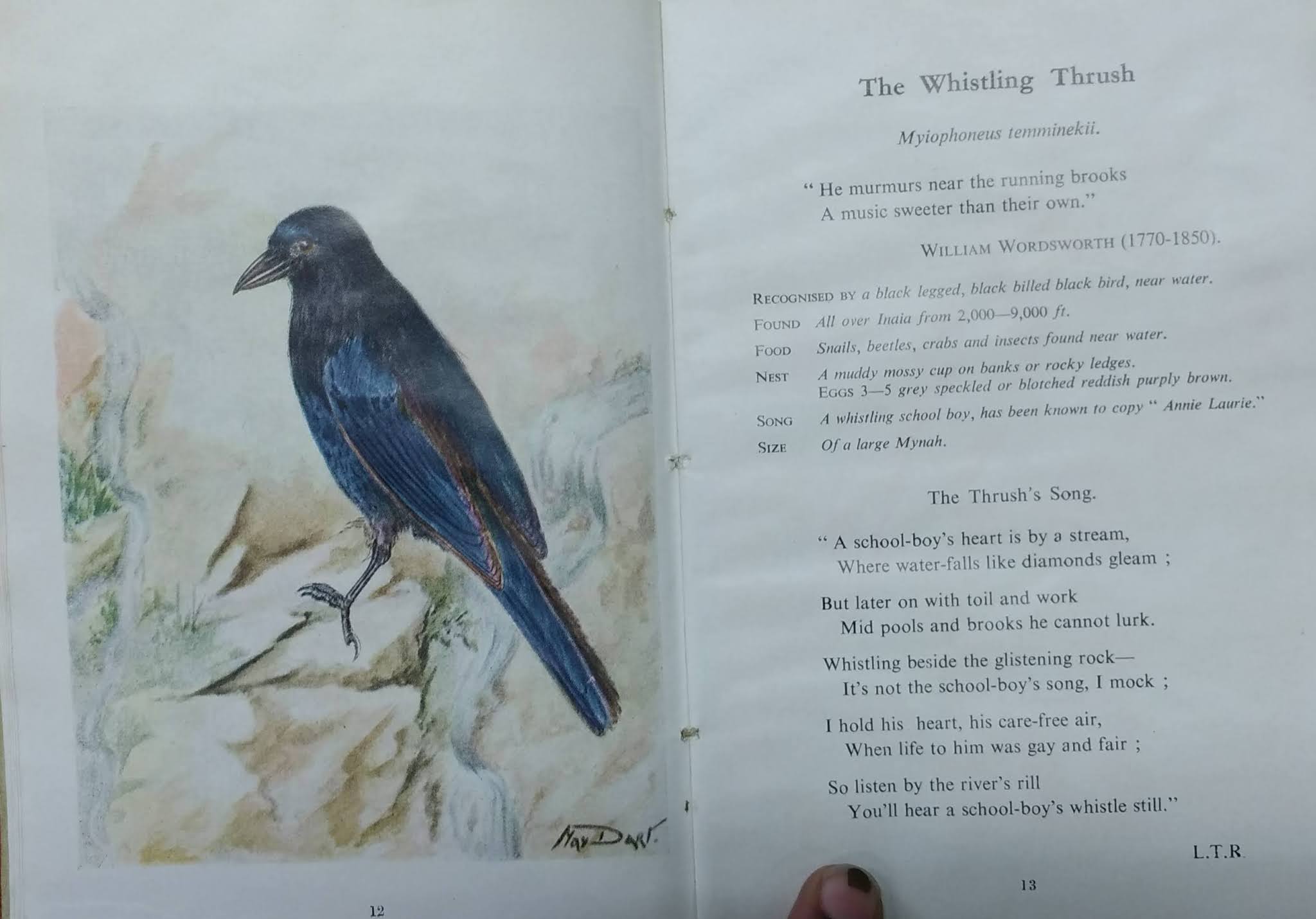
Among the little-known bird books of India, and of a rather unique genre, are Nurseries of Heaven  - More birds of India (1944) and Nurseries of Heaven - Birds (before 1944) written by someone with the pen-name "Torfrida" and illustrated by a Mrs May Dart who evidently lived in Wellington in the Nilgiris. This is not the only book written by this writer-illustrator pair, they also wrote Nurseries of Heaven - Wild Flowers of India. The flower and bird books deal principally with the Nilgiris. In 1944 the pair also wrote Flowering Trees of India (the geographic scope of that book seems wider). All the books appear to be a mixture of poetry, etymology, literary references, illustrations, fables, and a wee bit of original observation thrown in. These are all small pamphlets, presumably printed for children, possibly made for distribution in the local church.

The book is perhaps among the few Anglo Indian works with an aesthetic appreciation of birds [and not centered around humour like the writings of Phil Robinson, Eha or Dewar]. It also provides insights into Colonial life in the Nilgiris. I was fortunate to examine the contents of More Birds of India in a rather rare copy held by the Percy Fitzpatrick Institute of Ornithology at Cape Town in 2018. More information on May Dart and the mysterious Torfrida would be nice to have!

The first pamphlet on birds


The cover illustration is actually pasted into the frame


A few sample pages from the More Birds of India are included here to give a taste of the writing.


Some of her writing may need to be examined in detail. In her flower book she claims that the name "Portia tree" for Thespesia populnea is from the Tamil Puvassai! Some claims are outright incorrect like the idea that Osbeckia is called "Tipu China" from "Tibet China", that would in fact be from the old name Tibouchina.

Tuesday, February 24, 2015

The use and abuse of birds in India

It is clear that that the earliest human settlers in India would have tried various sources of food including eggs and bird meat. Finding the former or catching the latter would have required observational skills and a great deal of knowledge of bird habits. The skills required would have been far greater before the advent of fire-arms. With increased hunting, population pressures and the availability of alternate food sources these skills have been lost along along with a form of indigenous knowledge. Some of these techniques have been documented by travellers and later colonial naturalists. 

One of the earliest illustrations of hunting in India is from around 1596 in a book edited by A. Philippo Gallaeo with art by Jan Van der Straet [=Joannes Stradanus] (1596) Venationes   Ferarum,   Avium, Piscium. A copy of this treatise on hunting can be found on the wonderful French digital library. One of the less fantastic scenes is one that shows the hunting of ducks/geese from the head of the Indus river. There are numerous other techniques illustrated including the use of owls to attract mobbing birds, throw nets, clap nets and nooses, falconry, traps and deadfalls, stalking with cattle as cover.


"Anseram agreste genus stagnante in aqua capit Indus.
Ipse cucurbita habet tectum caput illecebris
Allicit: esuriens anser visas involat escae.
Indus pascentem facile capit arte volucrem." 
This describes use of cucurbits/gourds as a floating mask under which the hunter hides and swimming among the birds, he pulls them underwater. Later observers describe how earthen pots are floated in water for a few days until the birds get used to them. A hunter then swims with his head in one to get close to the birds. (Folkard, 1864)

Another plate describes fishing with what definitely appear to be pelicans. May perhaps have been practiced given that fishing with anhingas has also been reported.(Stonor, 1948)
Fishing with pelicans(?)


An account on the bird market at Lucknow published in the Pioneer and mentioned in the Western Daily Press (5 Dec 1889 p.6) has this bit on folk medicine. The brain of the male sparrow was supposed to cure various diseases. The blood of an owl was supposed to make someone who drinks it insane. Eating crow was supposed to keep your hair black and prolong life! The Indian roller was used in rites and set free after plucking a feather. The feather was worn as an amulet that warded away the evil eye. Birds of good and bad omen were apparently in great demand. 

One of the people who documented the birds involved in superstitious beliefs in southern India was Edgar Thurston. Thurston was one of the later successors of Edward Balfour at the Madras Museum, a mad enthusiast for the mix of scientific racism and physical anthropology that was in vogue in that period. Strangely enough, he seems to have joined hands with Hamilton Davey, one of A.O. Hume's associates involved with the South London Botanical Institute upon his return to England. Anyway Thurston describes some bizarre folk beliefs such as the idea that a person who saw crows copulating would die unless a close relative broke into tears. He documents a case where a boy sent his father a telegram purportedly informing the father of the son's death - so as to jerk some tears and prevent imminent death (Thurston: 69)! 

A Ba:l chhathri (horsehair nooses on a trellis)

Harper writes in 1903 on bird-catchers (and again from Lucknow!) and their technique of using jointed bamboo sticks extended slowly over a bird before catching it in the birdlime smeared on the tip. A bird-catching technique that is popularly known in the scientific literature as the "Bal-chatri" and widely used by raptor researchers has its origin in India. It is amazing that the etymology of the name of this trap was widely misquoted in literature until William S. Clark visited India and heard the correct pronunciation from some Indians and published a note on its etymology in 1992. Some of us listened to his talk in Bangalore that same year.

We have already seen the sad story of the plume trade and its impact on India.
Trafalgar Square minus its pigeons

Another story of interest is that of the pigeons. In August 2014 I visited London and walking down to Trafalgar Square I was quite surprised by the actions taken to rid it of pigeons. A little more than a century ago, pigeons became quite an obsession for a man named W.B.Tegetmeier. He was interested in living a very frugal life, a Bohemian who raced pigeons and enjoyed cock-fights until he rose into the higher rungs of the local social ladder especially through his association with Charles Darwin. Tegetmeier recognized the value of homing pigeons as carriers of messages and he was instrumental in getting the army interested. One of the offshoots of that was the setting up pigeon posts in India. The Lincolnshire Echo notes in a news piece published on 13 December 1894 that the 19th Hussars had established the Assaye Flying Club in Bangalore with the aim of demonstrating the use of homing pigeons in war. There was later on something called an India Pigeon Service in the North-West Frontier. Not many might be proud of being an I.P.S. officer today but the Lancashire Evening Post (3 August 1945) carries a report on a proud local, Sergeant T. Walker of Kendal, working with the Service in the North West Province. It states that "no patrol now leaves any of the frontier forts without pigeons as an aid to their endless watch on the activities of the warrior tribesmen." (Those warrior tribes, incidentally, were brought upon the British by the "work" of Charles Napier, whose statue also stands in Trafalgar Square)
Quail trappers with decoy birds. From Harper (1903)

One of the strategies for ridding Trafalgar Square of its pigeons was the use of falcons. Falconry, it would seem was a Persian introduction to India as it was to Europe. There is however a single claim to the contrary based supposedly on a Sanskrit text called Shyenavinod by a Raja Somabhupati and dated to 1029 AD. The original and the provenance of this text is unclear/not demonstrated and it is much more likely that this is a contemporary of Syainika Sastra (available online) translated into English in 1910 and based on Sanskrit text by a Kumaoni Raja, it turns out that this is actually dated to a post Mohammedan conquest period. The translator even notes that the Syainika Sastra uses words from Turkish and Persian. One the most detailed sources on falconry in India is by Colonel Emilius Delme Radcliffe. Radcliffe also wrote the entry on falconry in the ninth edition of Encylopaedia Brittanica. However other methods of catching birds with birds probably existed in antiquity. The use of decoy birds to attract male partridges and quails seems to be traditionally well understood.
Syainika Sastra

An extract from Edward Balfour's Cyclopaedia of India and of Eastern and Southern Asia on birds was printed separately as Birds of Eastern and Southern Asia (I had made a request for this through the Biodiversity Heritage Library and it has recently been made available online from a copy in the Natural History Museum at Tring) and it has some very interesting bits of historical (and ethno-ornithological) information. A later botanical encyclopaedist, George Watt also puts in some interesting summaries on the trade value of birds and their derivatives. I was particularly interested in the bits on guano extraction which however is included under "manures" (p. 769) which states that guano was extracted mainly from Kurnool and the Andaman and Nicobar Islands suggesting that the former was mainly bat guano and the latter mainly that of edible nest swiftlets.

References

Postscript: 

On the topic of bird trappers and their knowledge

6 April 2023 - An interesting interview of the itinerant Hakki Pikkis - https://www.youtube.com/watch?v=AxYocVsiTM4 - note the imitation and knowledge of antiphonal duetting in Grey Francolin - at 6:09 and the calls of female Grey Junglefowl at 10:38. 

June 2025 - On Indian resistance to hunting/killing  - see  Rashkow, Ezra (2015). Resistance to Hunting in Pre-independence India: Religious environmentalism, ecological nationalism or cultural conservation? Modern Asian Studies 49(2):270-301.


Saturday, December 25, 2010

Itchy backs and tickly toons

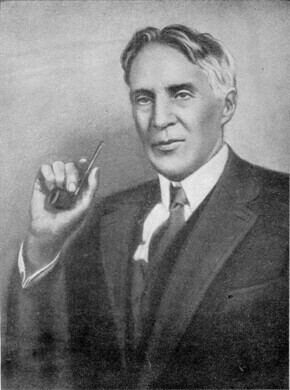
Robert William Wood
Some years ago, I had been to the Brahmagiris in Coorg. The rolling sholas are spectacular and it has a way of bursting into view with special effect that is enhanced by the climb that one has to make. Anyway in the weeks after  my return returned, I developed an itch on my back with eruptions on the skin that kept made me miserable for almost two months. The dermatologist I went to tried out antifungals, antibacterials and when the right remedy was found it quickly subsided but it did raise doubts about the quality of medical diagnostics. When I mentioned this to my birding  physician friend Dr. NS Prashanth, he mentioned that it should have been quite easy to identify a fungal infection using a Wood's lamp, something that every doctor would apparently have in their kit. A Wood's lamp essentially produces ultraviolet light and some fungi glow in UV. The process is termed fluorescence - the fungi convert light in the UV range into light in the visible wavelengths - and should not be confused with bioluminescence which is also seen in some fungi. Wood's lamp is just like our everyday "tubelight" (technically a fluorescent tube - a glass tube internally lined with a fluorescent chemical) but made of a special glass called Wood's glass. Wood's glass is made of Barium silicate with nickel oxide - which makes it very opaque to visible light but letting UV through.
First published in 1907 the introduction reads:

For some are guided by tradition.
While others use their intuition,
And  even I make no pretense
Of having more than common sense
Indeed these strange homologies
Are in most flornithologies,
And I have freely drawn upon
The works of Gray and Audubon,
Avoiding though the frequent blunders
Of those who study Nature's wonders.

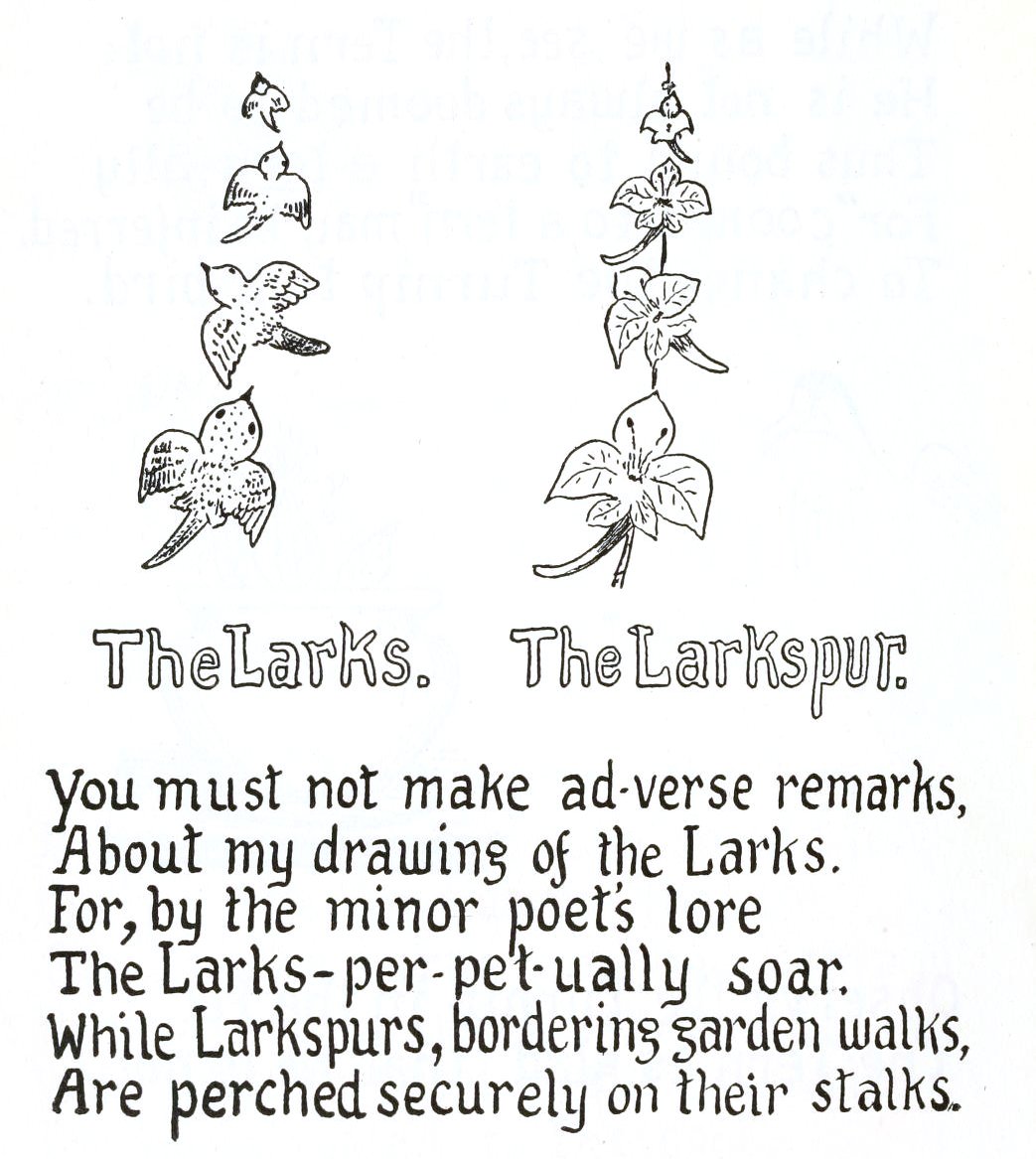
Looking up, thanks to Wikipedia for showing the connectedness of things , I found that this Wood was  Robert William Wood (May 2, 1868 – August 11, 1955), a physicist who had a keen interest in UV and IR photography. He also apparently was debunker of frauds and when the journal Nature sent him to investigate something called N-rays he did the little trick of removing a vital prism in the experiment and the discoverer of the rays was still able to produce unaltered results demonstrating plainly that the setup was fake.  Wood liked to amuse people and one trick was to carefully toss sodium into a pond and act as if he was spitting to shock onlookers with explosive  effect ! H L Mencken apparently called him the "wild man of Baltimore" ! Strangely however I had already bumped into his Lear-esque verse and cartoons, long before learning about his other achievements. Pure entertainment that he created to amuse his children, but may well reflect to some extent the poor opinion that physicists in that era tended to have of biology. Indeed one physicist famously compared biology of that time to stamp-collecting. Wikipedia has an article on the "Nature fakers controversy" where this work has been pointed out as a parody of a long controversy at around that time in the United States of America that arose from the conflict between science and sentiment in popular nature writing. The controversy was due to a large number of nature writers of the time conflating fact and fiction. For instance one writer talked about birds applying a mud cast to their legs and another wrote about wolves hunting caribou by tearing their hearts out. This was finally settled and even involved Theodore Roosevelt, their hunting President, who decided that such fake writing should not be included as part of the compulsory reading for children. One protester even wrote a letter to Roosevelt to remove other "fake natural history" such as that written by Charles Darwin !

A pick below of some of the pages (thanks  to the Internet Archive) from Wood's satirical book follows.


References

Friday, September 24, 2010

When life is shi#

A skipper on bird dropping
People using the phrase need to watch out for they may very well be describing a life of heavenly bliss ! There are a whole lot of animals that depend entirely on the excretions of others. Scatology must be one of those subjects that universities are not advertising about but there are lots of amazing questions out there waiting to be researched. In some habitats there are very few sources of nutrition available, particularly for organisms with limited locomotion. A cave salamander has been found to be dependent on bat guano. A 2008 article discusses the antiquity of coprophagy in the beetles of the family Scarabaeidae - the dung beetles. It seems like they only took to this diet after the rise of the mammals , making it a relatively recent trend, evolutionarily speaking. The paper notes that herbivorous dinosaur dung is unlikely to have supported dung beetles due to the high nitrogen content - the result of the urinary and excretory tract merging into a cloaca. The feature is present in the birds and a study of beetle fauna in an oil bird cave found just one Scarabaeid, but that one fed on decaying plant matter. Coprophagy is however shown by many other insect groups and interestingly it is rather rare among the lepidoptera (as a primary diet)- two pyralids are known to live on mammalian droppings. Interestingly many adult butterflies will visit animal faeces, but this is related to special functions and do not appear to be part of their regular diet. The uninitiated are usually shocked when they see some of the prettiest butterflies they have ever seen perched on poop. Entomologists  however use the attraction to get closer to some of the rarer butterflies by baiting them. Skipper butterflies (Hesperiidae) have a particular fancy for bird droppings and some South American species are known to follow army ants which in turn are followed by ant-birds to get to the bird droppings !

Painting by J B Fraser with Greater Adjutants
An exhibition of old illustrations of India at the National Gallery of Modern Art caught my attention recently. An old (1819) watercolour by James Baillie Fraser showed Adjutant storks sitting over buildings in Calcutta, While researching the subject, I decided to improve the Wikipedia article on the Greater Adjutant Stork and realized in the process that this rather ugly-looking bird is essentially endangered by improved sanitation. At one time, there were thousands of this bird all over northern India, particularly in the city of Calcutta. They were busy feeding on the dead bodies disposed into the Ganges and disposing off offal, animal and human excreta with such efficiency that the Calcutta Municipal corporation of that time decided to make them their mascot, two birds facing each other became a part of the corporation logo. Their populations however rapidly declined during the Nineteenth Century and kept dropping to become the endangered bird that it is today. The best places to see them in India now are apparently garbage dumps in Assam and the only major breeding areas are in the Brahmaputra valley.

Other scavengers have declined sharply too- the most famous being the vultures - once found along the avenues of Delhi and floating in thermals in large numbers, they are almost absent today and the cause  is usually attributed to the non-steroidal anti-inflammatory drug Diclofenac. Interestingly these hit the vultures of the genus Gyps the most. There is however a smaller vulture - the Egyptian Vulture (Neophron percnopterus) which has also declined across its range and some Spanish scientists have suggested that they might have been affected by antibiotics - which apparently depress their innate immune system. Now this black-and-white vulture has a bright yellow bare facial skin and it seems that the birds derive the colour from carotenoids derived from a diet of mammal excreta. The usual ideas is that the fitter males have a brighter face and females choose them as their mates and it seems like this might have the cost of exposing their immune systems to the onslaught of bacteria. And having a weak immunity could be bad under those circumstances - so it seems like antibiotics, pain-killers and sanitation are not without ill-effects for some.

As another aside one should note that the ancient Egyptians who revered both the dung beetles and vultures  introduced some innovations in sanitation and it is comforting to see that there are scholars looking at these aspects of daily human life.

Further reading
  • Arillo, Antonio & Ortuño, Vicente M. (2008) Did dinosaurs have any relation with dung-beetles? (The origin of coprophagy). Journal of Natural History 42(19): 1405-1408
Postscript
  • Another blog post on an allied theme 
  • Campos-Arceiz, A., 2009. Shit happens (to be Useful)! Use of elephant dung as habitat by amphibians Biotropica. 41(4):406-407.