click hide image

Showing posts with label insects. Show all posts

Sunday, June 7, 2026

Invert life

 I have recently been trying to work on the draft for a book that serves as a simple introduction to observing insects in India. Keeping it short is a REAL struggle! In wrangling with my thoughts I have tried to keep it short and reduce polemics! And yet.... Anyway, I do not know how much of it I might have to trim out. Here is an uncensored draft for a section (that may or may not have a place in that book!). I have tried feeding it to AI to rework sections but nothing was satisfactory. Unautomated human feedback and gut reactions are welcome. 

How and what do we know about the insects of India

If you took a picture of any insect in say England or in any country in western Europe and posted it on the iNaturalist website, you will probably see it being identified to species within a couple of days. If you tried the same with an insect from India, the situation would be quite different. You might get the identification to family level, sometimes to the genus and most likely no further. You might see an expert who deals with just that family or group and comment that your photo likely represents an undescribed species or that specimens would be needed. This difference in knowledge availability (of just a narrow taxonomic kind) on local life forms has been variously attributed to historic influences that include a supposed cultural abhorrence for killing, a lack of support for curiosity-based questioning, the difficulties of maintaining reference collections in the humid tropics, the lack of learned societies (amid a caste- and class- fragmented elite within a largely unequal and oppressed society), or other factors placed under the rather large umbrella of colonialism. Overall, we can agree that historic forces have played a role in our collective ignorance of the smaller life-forms around us.

People posting photos to a place like iNaturalist expect the name of an insect. Typically this is a Latin binomial as the large majority of insects do not have species specific names in English or even other languages. Names in Indian languages for some groups have been contrived and these are unlikely to be established unless there is a multi-generational culture of study and use among speakers of that language and possibly also a culture of writing, printing, librarianship, and archival. The naming of insects under the binomial system depends on institutions such as natural history museums, collections in universities, specialists supported by universities and libraries. Historically, the idea of collecting species, pinning them with labels and giving them a binomial name rose to popularity among the upper classes with large homes, with both fashion and religion playing roles. Wealthy collectors with leisure maintained private cabinets of curiosity and admiring the variety of organisms was seen as a form of admiration of God’s wisdom. The growth of colonialism made Europe's capitals into centres for harvesting and centralizing specimens from around the world with long and wide networks that included native collectors, colonial officials, ship captains, army officers, priests, physicians, and natural history traders. All this was aided by the growth of Learned Societies, the printing industry, and a class of people with leisure. This private industry involving wealthy individual amateurs gradually became more inclusive, shifted down the wealth-class, with the growth of public-funded museums, universities, research institutions, diversification of research, and specialization in the biological sciences. Today, the old-fashioned taxonomists quest for describing new species is looked down upon as a form of “stamp-collecting” and most modern institutional researchers examine speciation in an evolutionary light and describe new species mostly as a side effect of studying evolution or ecology. Curiosity and biophilia however are still a common connecting thread.

The seemingly easy act of giving a binomial name and categorizing an insect is based on the slow and irregular accretion of thousands of specimens by thousands of individuals (sometimes through a chain of hands - a field collector who passes it on to another and so on) over more than two centuries with specimens in institutions acting as a memory safeguard along with publications held in libraries, allowing verifiability across generations of humans. The act of formally describing species also involves inventing and clarifying terms for the anatomy and morphology of insects. Rules of priority and care for precision, long-term preservation of type specimens, and other aspects were slowly  standardized. Specialists aired and exchanged ideas available in print across time and space through their writings in journals, so libraries have had a major role, and the socio-cultural role of public libraries, societies, universities, and museums cannot be down-played. The creation and maintenance of these vital spaces is driven by culture, politics, and economics.

Economics drives the study of insects in other ways too. The colonial Indian experience with famines and epidemics led to support for research in agriculture and public health. Some groups of insects have been studied thanks to support by institutions begun in British India. In that period, it was generally understood that the key to managing pests was in finding a weak link or dependency in their life-cycle that could be made use of in management practices. This encouraged the application of natural history observations and biological research techniques. Much of that research happened in an age when potent insecticides did not exist. Today, potent and non-selective insecticides are used in prophylactic sprays (sprays applied on crops even when no obvious infestation is seen - often a mandatory part of a contract-farming package driven by a cartel of seed and agro-chemical businesses), killing life forms indiscriminately with extreme efficiency, and posing long-term risks that are either overlooked or deliberately hidden. The possibility for mindless use of such chemicals, often supported by a powerful chemical industry lobby has reduced support for the need to study insects. It has also reduced the “value” of the little collective entomological expertise that was developed in the past.

An obsession with economic growth hinders the recruitment of young people into curiosity-driven education and research. The study of local insects and indeed the observational study of most other life forms has not had sufficient support. Much of the teaching in India is old-fashioned and based on rigid syllabi and textbooks, rather than being driven by questions and curiosity. Curiosity outside academia has few places to go. Inside India's siloed academic spaces, a class- and caste-ridden academic hierarchy often seeks to rise and separate itself from the general public. The lack of an open culture also limits interdisciplinary discourse and perhaps predictably, there is little locally-rooted research. A system of rewards that academics have chosen leads them to seek repute mostly among western peers and there is no quest to develop local peer groups.

Against this backdrop of limited support from specialists within the country, there has been a ground up movement enabled by the internet and there has been a growth in amateur interest among certain classes. Self-organized groups on Facebook, WhatsApp and systems like iNaturalist with thousands of participants are mostly ignored by public-funded research and education institutions in India. While these have done a great deal for education, these internet platforms are without problems. There have been cases of opportunistic prospecting for new species and there are many who indulge in what has been called “helicopter research”. The National Biodiversity Act was created to protect against it but much of it is unimplementable, given the forces involved in making laws, and the poverty of expertise in the bureaucracy. Fortunately for ordinary Indian citizens, the constitution says it is the fundamental duty of every citizen “to develop the scientific temper” and that should in theory keep us safe.

When Carl Linnaeus, born in a biologically low-diversity temperate zone, established the system of binomial nomenclature, he believed that every species had been created by god (specifically a Christian one, and by extension that they had to fit on a certain ship) thereby assuming that there were a reasonably small and finite number of them. The idea that species were created by a god effectively ended (at least for the scientifically inclined) in 1859 with the publication of Darwin’s Origin of Species. Today, it is rather unfortunate that most biology teachers avoid debates on creation and evolution that would require the questioning of religion and tradition. The study of life forms is an active form of learning and requires the questioning of passively received ideas.

Now the study of insects is certainly not limited to giving them a binomial name. It is just the librarianship of life forms. A first step in literacy, an aid to allow people to study and compare notes on what they think is the same entity. Learning more about the life of the insect on your own can be incredibly challenging and also very thrilling. This is an area where ordinary people have an edge over museum specialists in far-away locations. Specimen identification based on reference collections often relies on the forms of adult insects, often in damaged and discoloured conditions. In the vast majority, the immature stages are completely unknown. There are an infinite number of contexts in which one can examine insects and what they do. Looking at them does not need the permission of a Colonial forest department that gate-keeps the wilderness. There is no shortage of them in the backyard, and they are endlessly fascinating in the diversity of form and habits. They are the most significant herbivores on the planet and have altered the way plants live for millions of years before the arrival of land vertebrates. Their study has applications in so many fields – people have studied them to make computers more reliable, systems more resilient, looked at their colors and structures for inspired applications in chemistry and physics. Being easy indicators of ecology, they are indicators of changes around us, and yet we have a studied ignorance of these – the smaller majority – of life forms around us.


Wednesday, September 17, 2025

A focus on the process rather than product

A few weeks back, many of us read the rather stunning case of an ant in the genus Messor from Sicily that produced two kinds of male offspring, one of them apparently of a completely different species! Given the number of eyebrows that such a finding raises, it is clear that this research took a good while before it was finally published! The complicated genetics was however not entirely unexpected. This made me wonder about the teaching of genetics in classrooms, the kind of finality and perfection that textbook concepts are made to appear like is perhaps a myth that teachers could do well to dispel early in life. Unfortunately it seems that teaching and testing in education is as fascist and authoritarian as the rest of the social environment. 

Some years ago, on a trip to Nandi Hills, I had the good fortune of being able to browse an old guest book. One of the comments that caught my attention was this one.

A little digging revealed that this was Spencer Wharton Brown, a geneticist who at that point did not even have a Wikipedia entry (of course that gap was fixed). He actually was so prominent in his time that he had the nickname "Mr Chromosome". It would appear that he must have been a visitor to the Indian Institute of Science - considering that some years later he did publish a paper with an Indian coauthor - Chandra, H. Sharat; Brown, Spencer W. (1975). "Chromosome imprinting and the mammalian X chromosome". Nature. 253 (5488). My friend Karthik Ramaswamy, then at the Archives of the IISc (now no longer an extant function!), tried to examine this a bit more.

Now Brown apparently decided to use scale insects as his model for genetics studies and was it a good choice?! In scale insects, there appears to be such stuff as post zygotic deletion of the male genome!  Sadly, Spencer Brown was murdered somewhat mysteriously!

Anyway, the lesson here seems to be that the whole system of genetic control including the influence of peptides (maternal environment), silencing RNA, epigenetics, Lamarckism, etc. calls for a more cautious approach to the teaching of biology in general. But looking at these findings should make one appreciate gene-centric views of evolution.  

  • Brown, S.W. (1963) The Comstockiella system of chromosome behavior in the armored scale insects (Coccoidea:Diaspididae). Chromosoma 14:360–406. https://dx.doi.org/10.1007/BF00326785 
  • Brown, Spencer W., and Giovanni DeLotto. (1950) Cytology and sex ratios of an African species of armored scale insect (Coccoidea-Diaspididae). The American Naturalist 93.873: 369-379. 
  • Brown, Spencer W. (1960) Spontaneous chromosome fragmentation in the armored scale insects (Coccoïdea‐Diaspididae). Journal of Morphology 106.2: 159-185. 
  • Hartl, Daniel L., and Spencer W. Brown (1970) The origin of male haploid genetic systems and their expected sex ratio. Theoretical Population Biology 1.2:165-190. 
  • Ross, Laura, Ido Pen, and David M. Shuker (2010) Genomic conflict in scale insects: the causes and consequences of bizarre genetic systems. Biological Reviews 85.4:807-828. 

Friday, May 25, 2012

The Small Majority

The title of this blog is shamelessly lifted (and modified) from a book by Piotr Nasrecki called the The Smaller Majority - a pretty book that will open the eyes of those who travel long distances to see or photograph big animals. The late Stephen Jay Gould said
"Don't accept the chauvinistic tradition that labels our era the age of mammals. This is the age of arthropods. They outnumber us by any criterion – by species, by individuals, by prospects for evolutionary continuation."
At one point I decided that they were worthy of study and decided to pursue a degree in the agricultural sciences, one of the few places in India where one could obtain a formal training in entomology. After a lot of study and reading I still find myself overwhelmed by the diversity. People who begin to observe nature by starting off with the birds and imagine that insect identification should be similar and they ask "which book do you use ?" and I say none. It leads to something that goes a bit like a Lewis Carroll dialogue because one really has to resort not to one book but a whole library full of books and little articles scattered across journals. And at the end of it one still needs to be satisfied with the possibility of not knowing what species something that you hold in your hand is.

Amazingly, there are now a growing band of organizations that do short trainings to which people flock in the hope of becoming experts. Since such expertise eludes me in spite of years of reading on-and-off, I thought I should put together some of the sources available. I am concentrating mainly on resources that are easy to find, especially on the Internet. There are however some really good modern works, albeit expensive that the more serious insect observers should consider.

An overview of Insect classification


Fondly called "Brues&Melander" and despite being archaic (published in 1932!) (particularly for some higher level groupings) is still very usable and provides good overall structure and feature information, but once you find a group, it is best to research it on the Internet search to see if things have changed.

Indian Insects

Indian Insect Life by Harold Maxwell-Lefroy is another archaic work (1909) and yet worthy of a careful browse. Lefroy was the first "Imperial Entomologist" in India and was a prolific author whose life was cut short when he died breathing poisonous fumes in his laboratory.


Some South Indian Insects - Another old work published after Maxwell-Lefroy, is by T B Fletcher (who became Imperial Entomologist of India with almost no formal training).

Beetles of the Himalayas

 
Printable notes

Here are some PDF files that are good to print and keep until you know all the insect orders.

Cornell class notes
Notes - an identification key
http://famuentomology.com/All_Orders_With_Audio.pdf - insects and some non-insects
http://entnemdept.ufl.edu/choate/insectid.pdf - another illustrated key (13 pages) 

An old book
How to know the insects

Once you get an idea of the insect groups, you will be able to look at specialist sources like the Fauna of British India - but to fully utilize them you need to have access to specimens, a binocular microscope, and time for a lot of reading - or if you are luckly you may find someone with the expertise needed at your nearby university.

A species that too many people ask about!
If you are a complete beginner and just want to know what something is, there are electronic forums where you can ask - remember, the chances are high that the insect you see is really common and hundreds of people before you would have asked what it was. See if you can find it on the forum before you post.


Here are some possibilities -
1) https://www.facebook.com/groups/InsectIndia/  - a Facebook group
2) http://tech.groups.yahoo.com/group/InsectIndia/ - a Yahoo mail group
3) http://bugguide.net/ - a site that deals with North American insects but good to see the images there
4) You can ask any question on the Wikipedia reference desk - but posting images takes a bit of learning - but if you do donate your photos here - they might become part of future reference material
5) http://anic.ento.csiro.au/insectfamilies/ - an Australian website on insects 
6) PS: Since writing this - there is now iNaturalist which has become the GOTO site

If you know the group - then there are specialist websites where you can find more information - here are some examples
1) http://www.diptera.info - for flies (Diptera - the "true flies") - has both a gallery of collated information as well as a Q&A forum
2) http://hymis.de - for Hymenoptera (wasps, bees and ants) - has a Q&A forum (English accepted)

Any India specific site? Afraid not. (Unless you have an extra lifetime to spare and want to file an RTI with the Zoological Survey of India, who are in theory expected to be the information clearing house for Indian biota !)

And if you still need help - ask me and I will try and point the way ...

Postscript: 2015 September - ZSI has since made a lot of their content available - online
2025 - iNaturalist is the place to go to now

Thursday, May 5, 2011

Life in the cracks and crevices

In the past, taking pictures was a challenge and most of our records were only textual notes that we exchanged when we met, and things have changed so much. For the old-time naturalists, photography has been more of a tool rather than an end and it is remarkable how good even the average photograph with a low-end digital camera is these days. One does regret not having these gizmos in the past. Most of these pictures were taken using a rather low-end aim-and-shoot digital camera (A 3.2 megapixel Nikon CoolPix E3700). Putting together these old pictures surprised me a bit especially to see the total volume of images which have a way of accumulating rapidly. out of control. Fortunately I release most of my images under creative commons licenses and include notes and metadata. Posting them on Wikimedia Commons, allows me to keep notes and categorize them while many get identified or go through revisions when group experts find them and these images  take a life of their own, making their way into books and newspapers with enquiries landing at your desk from around the world. The benefit to illustrate Wikipedia articles naturally does not need explication and such material is longer lived than the average blog, personal  or even organizational website. Anyway, here is a random assortment of free critter images (read that as you may) that have visited and live alongside. None of these are rare (in Bangalore) and are probably right around your home as well.
Ramanella variegata

A couple of years ago we had Ramanella variegata breeding in our water sump - one of these pretty frogs had a favourite PVC tube into which he would croak like a Tuvan throat singer in the mornings. The acoustics inside the tube were perhaps enjoyable, although some studies on frogs have suggested that males might try to cheat in the competition for mates by choosing locations where they sound mightier.  Unfortunately,  these frogs have not turned up this year even after the first few rains but still look forward to having these pretty residents breeding around.
Scanning you with advanced spectrometry
Jumping spiders are lynx eyed although the term "lynx spider" is used for the Oxyopidae. They turn around to take a close look at you but the most interesting times are when they meet others. That is when you see them wave their palps and forelegs in well defined semaphore patterns. They have extremely sharp vision and are said to have the ability to distinguish colours (extending to UV) and detect polarization as well. One rather fascinating species named Bagheera kiplingi is even thought to break from the basic spider characteristic in being herbivorous.

Heterorrhina elegans - no green pigment
The rainy weather brings numerous insects that have a short breeding period. These include brilliant beetles that have led the largest part of their lives underground as curly white grubs. Some can appear in rather large numbers especially when they swarm at chosen trees. Among these are the emerald green scarabs. It is amazing that they have evolved such cuticular microstructures that produce green colours entirely without the need for specific pigments. 

A change in the angle of lighting turns emerald to gold. The colour is produced by diffracting incident light, amplifying some frequencies, decimating others and letting only a part reach your eye. Naturally lots of people want to be able to replicate such microstructures for applications in human life such as for car exteriors but that would not be much of an innovation as it would still be for attracting mates.

A lycid beetle
I never seem to get the Lycidae identity right at first go. These rather soft-bodied beetles are found mainly on plants. As adults some are thought to feed on nectar or not to feed at all. The larvae are predaceous and bear a strong resemblance to the larvae of the firefly beetles and their rather primitive appearance has given them the name of "trilobite larva". The Lycidae belong to the same groups as the click-beetles and the thorax ends in a sharp point in this particular specimen although it does not function as in the click-beetles for flipping them back on their legs.

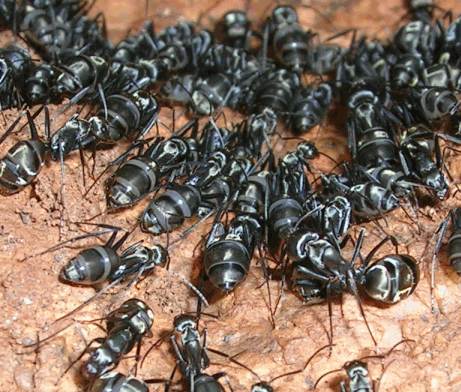
Camponotus sericeus under a rock
The space under pots and stones is  great for species that need a well regulated temperature and humidity.  Here one can often find numbers of land crustaceans, annelids and insects. This colony of ants lived in the space below a rock. The queen was apparently somewhere and the workers at the centre were taking care of larvae and pupae. The entire nest is just planar and in the narrow space, perhaps ideal as a study species.

Myrmicaria brunnea at sugar lick
Some ants have a taste for sugar - Myrmicaria brunnea - apparently just cannot resist it. A little water around a crystal of sugar attracts them in droves and they line up along the edge of the sweet waterholes and lap them up. Their sweet tooth leads them to harvest honeydew secreted by bugs. Apparently most members of the genus hold the gaster facing downwards as evident in the picture.

Mantis nymph (2 mm long)
Ants are so successful that numerous other tiny insects have evolved to appear like them. This effectively keeps away predators, and even tiny predators at like this nymph of a mantis are at risk. These are not the only ant like predators. Invariably to be found running on the wall, are also the ant mimic spiders.

Delias eucharis
Flying insects tend to be more interesting, as they can come in from much further off and are not dependent on the food resources within your home. This Common Jezebel butterfly Delias eucharis appears to be freshly emerged. The larvae breed on the parasitic mistletoe plants, the trees around my home are devoid of mistletoe, so it is a bit of a mystery.

Wasp possibly Phimenes sp.
Potter wasps are beautifully marked. Despite their distinct colours, the taxonomy of the Indian species is uncertain. I recently found one picking up clay from an older nest for use in a fresh nest. A leaky tap or a watery patch in the soil is a great attraction for them.

Camponotus with micro-livestock
A recent outbreak of scale insects led to a number of species of plants being covered in scales. These scale insects suck up fluid from the plants and share their secretions with ants. The ants keep away predators and move the scales around to new plants leading to a rather effective utilization of the vegetation by the ants.

Spalgis epius
But the defence by ants of these scale insects does not seem to be perfect. Their livestock, sooner or later become the target of pathogens, parasitoids and predators. One of the predators of these scales is, rather surprisingly, the caterpillar of a butterfly called the apefly. The name comes from the appearance of its pupa.

Platynotus excavatus doing a headstand
Coming down to ground level introduces us to a number of other visitors.  This Tenebrionid beetle was on the ground in the typical posture that many take. Some species in the Namib desert, adopt this posture termed as "fog-basking" to let moisture condense on their elytra. Some species even have ridges along the sides that lead the drops of water right to their mouths. The idea has even been adopted in some parts of the world to squeeze water out of the morning breeze to meet the water needs of people. Perhaps this beetle has something to offer for thirsty Bangalore.

Acknowledgements
The identification of insects is tricky and it takes a long while to orient oneself with the basic groupings and things get better over time.  Many thanks are due to the faculty and friends, especially Prof. C. A. Viraktamath, at the department of entomology at the University of Agricultural Sciences in Bangalore for many of the species level identifications above.

Friday, September 24, 2010

When life is shi#

A skipper on bird dropping
People using the phrase need to watch out for they may very well be describing a life of heavenly bliss ! There are a whole lot of animals that depend entirely on the excretions of others. Scatology must be one of those subjects that universities are not advertising about but there are lots of amazing questions out there waiting to be researched. In some habitats there are very few sources of nutrition available, particularly for organisms with limited locomotion. A cave salamander has been found to be dependent on bat guano. A 2008 article discusses the antiquity of coprophagy in the beetles of the family Scarabaeidae - the dung beetles. It seems like they only took to this diet after the rise of the mammals , making it a relatively recent trend, evolutionarily speaking. The paper notes that herbivorous dinosaur dung is unlikely to have supported dung beetles due to the high nitrogen content - the result of the urinary and excretory tract merging into a cloaca. The feature is present in the birds and a study of beetle fauna in an oil bird cave found just one Scarabaeid, but that one fed on decaying plant matter. Coprophagy is however shown by many other insect groups and interestingly it is rather rare among the lepidoptera (as a primary diet)- two pyralids are known to live on mammalian droppings. Interestingly many adult butterflies will visit animal faeces, but this is related to special functions and do not appear to be part of their regular diet. The uninitiated are usually shocked when they see some of the prettiest butterflies they have ever seen perched on poop. Entomologists  however use the attraction to get closer to some of the rarer butterflies by baiting them. Skipper butterflies (Hesperiidae) have a particular fancy for bird droppings and some South American species are known to follow army ants which in turn are followed by ant-birds to get to the bird droppings !

Painting by J B Fraser with Greater Adjutants
An exhibition of old illustrations of India at the National Gallery of Modern Art caught my attention recently. An old (1819) watercolour by James Baillie Fraser showed Adjutant storks sitting over buildings in Calcutta, While researching the subject, I decided to improve the Wikipedia article on the Greater Adjutant Stork and realized in the process that this rather ugly-looking bird is essentially endangered by improved sanitation. At one time, there were thousands of this bird all over northern India, particularly in the city of Calcutta. They were busy feeding on the dead bodies disposed into the Ganges and disposing off offal, animal and human excreta with such efficiency that the Calcutta Municipal corporation of that time decided to make them their mascot, two birds facing each other became a part of the corporation logo. Their populations however rapidly declined during the Nineteenth Century and kept dropping to become the endangered bird that it is today. The best places to see them in India now are apparently garbage dumps in Assam and the only major breeding areas are in the Brahmaputra valley.

Other scavengers have declined sharply too- the most famous being the vultures - once found along the avenues of Delhi and floating in thermals in large numbers, they are almost absent today and the cause  is usually attributed to the non-steroidal anti-inflammatory drug Diclofenac. Interestingly these hit the vultures of the genus Gyps the most. There is however a smaller vulture - the Egyptian Vulture (Neophron percnopterus) which has also declined across its range and some Spanish scientists have suggested that they might have been affected by antibiotics - which apparently depress their innate immune system. Now this black-and-white vulture has a bright yellow bare facial skin and it seems that the birds derive the colour from carotenoids derived from a diet of mammal excreta. The usual ideas is that the fitter males have a brighter face and females choose them as their mates and it seems like this might have the cost of exposing their immune systems to the onslaught of bacteria. And having a weak immunity could be bad under those circumstances - so it seems like antibiotics, pain-killers and sanitation are not without ill-effects for some.

As another aside one should note that the ancient Egyptians who revered both the dung beetles and vultures  introduced some innovations in sanitation and it is comforting to see that there are scholars looking at these aspects of daily human life.

Further reading
  • Arillo, Antonio & Ortuño, Vicente M. (2008) Did dinosaurs have any relation with dung-beetles? (The origin of coprophagy). Journal of Natural History 42(19): 1405-1408
Postscript
  • Another blog post on an allied theme 
  • Campos-Arceiz, A., 2009. Shit happens (to be Useful)! Use of elephant dung as habitat by amphibians Biotropica. 41(4):406-407.

Wednesday, September 15, 2010

Turning over a new leaf

The hoi polloi views insects as pesky fellow passengers on this crazy ball in space and science degrees hardly have an effect on most people. However insects are perhaps one of the most interesting fellow passengers around and more than make up for the annoyance of a few biters and blood-suckers. They came out of the waters a long time before the branching of life-forms with internal skeletons. Which means that they have had that much more time encountering the problems of life and solving them using "evolutionary algorithms". What interesting answers and questions might they have figured out ? (apart from perhaps finding that the answer is 42!)

Galls on Pongamia leaves
How does one find food on a planet like this ? There is so much green stuff and yet humans in a forest find so little that is edible. What has gone wrong here ? For someone who thinks about insects and plants, the real questions are not about how to keep the insects away from plants but about how plants keep them away and stay green in spite of the onslaught. Not every plant-eating insect feeds on every plant species and the few that are found in numbers on any plant has evolved such an array of tools to deal with their dinner and dining table.

Here are some Pongamia pinnata leaves I found not so long ago. One usually finds little outgrowths on the leaves. These are mostly insect galls, but galls may also be formed by fungi. If you cut an insect-gall you will likely find a central hollow, perhaps an exit hole on the base or tip and if you are lucky, a tiny larva somewhere. That could most likely belong to one of numerous wasps or flies and you will surely be hard-pressed to find anyone who can identify the species. Galls are not always shaped like this - they can be spherical, formed at the tip of a branch and botanists have been known to sometimes describe the gall as the characteristic fruit of a new found tree species. What exactly is happening is something to consider - is the plant trying to isolate the insect like a cyst forms to engulf a foreign body or is the insect manipulating the biochemistry of the plant to make it produce tasty tissue around it ? Turns out that the latter is often the case and sometimes the gall-inducer seems to be capable of inducing galls with very specific shapes, colours and structures (this article with illustrations is particularly worthy of reading).

Ficus at Hebbal with leaves eaten away
Anyone who has worked with plant-tissue culture can tell you what a complex and sensitive cocktail of auxins, cytokinins and other compounds have to be delivered to get a bunch of cells to grow into something that resembles a plant. Now, given that the structure is essentially an insect induced "fruit", there must be a few that people can eat and after some research I came upon the "Mulga apple" (apparently on Acacia aneura) of Australia but the number of cases of edible galls seems rather low. I have a rather vague recollection of seeing swellings on nettles in the Uttaranchal Himalayas and some comments on their edibility (if anyone has eaten this or knows more please do let me know). Now plants are not taking such damage lying down and they have come up with their own defences. (some years ago some of us worked on this article on Wikipedia and hopefully it is still readable) Turns out that the biggest human use of galls is in the extraction of tannins - and tannic acid - a mixture of potent chemicals used to treat leather (tanning leather), at least in the past. And printing ink was once made by treating rust with gall extracts ! Tannins are essentially anti-insect chemicals and in some plants, the tannin content goes up rapidly when the plant is physically damaged by insects this can have an effect on the insects. Now if the insects are such experts in plant biochemistry, perhaps the plants have in turn figured out the most critical insect biochemical gears into which their molecular spanners should be thrown. Given that these are potent chemicals tailored through evolutionary time-scales, there must be something in these Chinese cocktails worthy of some serious scientific attention.

Leaf mine - note widening with age of miner
The birdwatcher's of Bangalore hold regular field outings at Hebbal and Lalbagh on the first and second Sundays of each month. On one of the Hebbal outings around June and July we came across this Ficus, the leaves with holes, the ground below covered in tea-like frass and you could hear the fall of caterpillar droppings. The caterpillars were extremely pretty, moving along the trunk in large numbers, presumably the last instars looking for a place to pupate. Unfortunately we have been unable to obtain any further identification of this lepidopteran caterpillar. With the monsoon rains, the tree has now shed all its leaves. Now leaf-shedding is actually a bit of a story of its own and there are numerous theories on when a tree "ought" to shed its leaves "if its purpose" was to achieve something and one such function, teleologically speaking, is to get rid of pesky insects. But surely dropping leaves is not a good strategy to get rid of that eat leaves . At least certainly not without withdrawing all the best nutrients.

The caterpillars on the Ficus (unidentified)
Perhaps the easiest insect targets to get rid off by leaf-shedding would be things like galls and leaf miners. Life miners, usually moth or fly larvae live in the layer of the leaf and feed under the protection of the leaf surface, no rain, no drying and perhaps some protection from parasites and predators.
So, next time you have something to ponder over when you see a fallen leaf...

Turns out that some studies suggest that leaf dropping does not kill many leaf-miners and so seems unlikely while others point out that gall infestation induces early leaf shedding.

Postscript

Also discovered Huitlacoche caused by Ustilago maydis

2026: The caterpillars are of Phauda sp.