click hide image

Showing posts with label entomology. Show all posts

Sunday, June 7, 2026

Invert life

 I have recently been trying to work on the draft for a book that serves as a simple introduction to observing insects in India. Keeping it short is a REAL struggle! In wrangling with my thoughts I have tried to keep it short and reduce polemics! And yet.... Anyway, I do not know how much of it I might have to trim out. Here is an uncensored draft for a section (that may or may not have a place in that book!). I have tried feeding it to AI to rework sections but nothing was satisfactory. Unautomated human feedback and gut reactions are welcome. 

How and what do we know about the insects of India

If you took a picture of any insect in say England or in any country in western Europe and posted it on the iNaturalist website, you will probably see it being identified to species within a couple of days. If you tried the same with an insect from India, the situation would be quite different. You might get the identification to family level, sometimes to the genus and most likely no further. You might see an expert who deals with just that family or group and comment that your photo likely represents an undescribed species or that specimens would be needed. This difference in knowledge availability (of just a narrow taxonomic kind) on local life forms has been variously attributed to historic influences that include a supposed cultural abhorrence for killing, a lack of support for curiosity-based questioning, the difficulties of maintaining reference collections in the humid tropics, the lack of learned societies (amid a caste- and class- fragmented elite within a largely unequal and oppressed society), or other factors placed under the rather large umbrella of colonialism. Overall, we can agree that historic forces have played a role in our collective ignorance of the smaller life-forms around us.

People posting photos to a place like iNaturalist expect the name of an insect. Typically this is a Latin binomial as the large majority of insects do not have species specific names in English or even other languages. Names in Indian languages for some groups have been contrived and these are unlikely to be established unless there is a multi-generational culture of study and use among speakers of that language and possibly also a culture of writing, printing, librarianship, and archival. The naming of insects under the binomial system depends on institutions such as natural history museums, collections in universities, specialists supported by universities and libraries. Historically, the idea of collecting species, pinning them with labels and giving them a binomial name rose to popularity among the upper classes with large homes, with both fashion and religion playing roles. Wealthy collectors with leisure maintained private cabinets of curiosity and admiring the variety of organisms was seen as a form of admiration of God’s wisdom. The growth of colonialism made Europe's capitals into centres for harvesting and centralizing specimens from around the world with long and wide networks that included native collectors, colonial officials, ship captains, army officers, priests, physicians, and natural history traders. All this was aided by the growth of Learned Societies, the printing industry, and a class of people with leisure. This private industry involving wealthy individual amateurs gradually became more inclusive, shifted down the wealth-class, with the growth of public-funded museums, universities, research institutions, diversification of research, and specialization in the biological sciences. Today, the old-fashioned taxonomists quest for describing new species is looked down upon as a form of “stamp-collecting” and most modern institutional researchers examine speciation in an evolutionary light and describe new species mostly as a side effect of studying evolution or ecology. Curiosity and biophilia however are still a common connecting thread.

The seemingly easy act of giving a binomial name and categorizing an insect is based on the slow and irregular accretion of thousands of specimens by thousands of individuals (sometimes through a chain of hands - a field collector who passes it on to another and so on) over more than two centuries with specimens in institutions acting as a memory safeguard along with publications held in libraries, allowing verifiability across generations of humans. The act of formally describing species also involves inventing and clarifying terms for the anatomy and morphology of insects. Rules of priority and care for precision, long-term preservation of type specimens, and other aspects were slowly  standardized. Specialists aired and exchanged ideas available in print across time and space through their writings in journals, so libraries have had a major role, and the socio-cultural role of public libraries, societies, universities, and museums cannot be down-played. The creation and maintenance of these vital spaces is driven by culture, politics, and economics.

Economics drives the study of insects in other ways too. The colonial Indian experience with famines and epidemics led to support for research in agriculture and public health. Some groups of insects have been studied thanks to support by institutions begun in British India. In that period, it was generally understood that the key to managing pests was in finding a weak link or dependency in their life-cycle that could be made use of in management practices. This encouraged the application of natural history observations and biological research techniques. Much of that research happened in an age when potent insecticides did not exist. Today, potent and non-selective insecticides are used in prophylactic sprays (sprays applied on crops even when no obvious infestation is seen - often a mandatory part of a contract-farming package driven by a cartel of seed and agro-chemical businesses), killing life forms indiscriminately with extreme efficiency, and posing long-term risks that are either overlooked or deliberately hidden. The possibility for mindless use of such chemicals, often supported by a powerful chemical industry lobby has reduced support for the need to study insects. It has also reduced the “value” of the little collective entomological expertise that was developed in the past.

An obsession with economic growth hinders the recruitment of young people into curiosity-driven education and research. The study of local insects and indeed the observational study of most other life forms has not had sufficient support. Much of the teaching in India is old-fashioned and based on rigid syllabi and textbooks, rather than being driven by questions and curiosity. Curiosity outside academia has few places to go. Inside India's siloed academic spaces, a class- and caste-ridden academic hierarchy often seeks to rise and separate itself from the general public. The lack of an open culture also limits interdisciplinary discourse and perhaps predictably, there is little locally-rooted research. A system of rewards that academics have chosen leads them to seek repute mostly among western peers and there is no quest to develop local peer groups.

Against this backdrop of limited support from specialists within the country, there has been a ground up movement enabled by the internet and there has been a growth in amateur interest among certain classes. Self-organized groups on Facebook, WhatsApp and systems like iNaturalist with thousands of participants are mostly ignored by public-funded research and education institutions in India. While these have done a great deal for education, these internet platforms are without problems. There have been cases of opportunistic prospecting for new species and there are many who indulge in what has been called “helicopter research”. The National Biodiversity Act was created to protect against it but much of it is unimplementable, given the forces involved in making laws, and the poverty of expertise in the bureaucracy. Fortunately for ordinary Indian citizens, the constitution says it is the fundamental duty of every citizen “to develop the scientific temper” and that should in theory keep us safe.

When Carl Linnaeus, born in a biologically low-diversity temperate zone, established the system of binomial nomenclature, he believed that every species had been created by god (specifically a Christian one, and by extension that they had to fit on a certain ship) thereby assuming that there were a reasonably small and finite number of them. The idea that species were created by a god effectively ended (at least for the scientifically inclined) in 1859 with the publication of Darwin’s Origin of Species. Today, it is rather unfortunate that most biology teachers avoid debates on creation and evolution that would require the questioning of religion and tradition. The study of life forms is an active form of learning and requires the questioning of passively received ideas.

Now the study of insects is certainly not limited to giving them a binomial name. It is just the librarianship of life forms. A first step in literacy, an aid to allow people to study and compare notes on what they think is the same entity. Learning more about the life of the insect on your own can be incredibly challenging and also very thrilling. This is an area where ordinary people have an edge over museum specialists in far-away locations. Specimen identification based on reference collections often relies on the forms of adult insects, often in damaged and discoloured conditions. In the vast majority, the immature stages are completely unknown. There are an infinite number of contexts in which one can examine insects and what they do. Looking at them does not need the permission of a Colonial forest department that gate-keeps the wilderness. There is no shortage of them in the backyard, and they are endlessly fascinating in the diversity of form and habits. They are the most significant herbivores on the planet and have altered the way plants live for millions of years before the arrival of land vertebrates. Their study has applications in so many fields – people have studied them to make computers more reliable, systems more resilient, looked at their colors and structures for inspired applications in chemistry and physics. Being easy indicators of ecology, they are indicators of changes around us, and yet we have a studied ignorance of these – the smaller majority – of life forms around us.


Wednesday, September 16, 2020

A little-known naturalist from Chikkaballapur

Bangalore has historically, being an administrative centre with a mild climate, had a fair share of colonial natural history collectors and naturalists. We know a fair bit about the botanists who walked this region and a bit about hunters of larger game but rather little about those who studied insects. A few years ago I became aware of the Campbell brothers from Ireland (but of Scottish origin). It took some time to put together the Wikipedia entries on them which is where more straightforward biographical details may be found.

After a trip to the Nandi Hills [to examine a large number of heritage Eucalyptus trees (nearly 200 years old) that the Horticulture Department had decided to cut down to the stump, supposedly because falling branches were seen by the Archaeological Survey of India as a threat to heritage buildings nearby], some of us decided to visit Chikballapur to examine the place of work of  Dr Thomas Vincent Campbell (1863-16 December 1930) - "T.V." as he was known to his friends was a missionary doctor with the London Missionary Society and had worked briefly at Jammalamadugu where his older brother William Howard Campbell (20 September 1859 - 18 February 1910) had worked as a missionary. Another brother back in Derry, David Callender Campbell (1860-1926) was also a keen observer of moths and a botanist. In their younger days in Derry, they and their siblings had put together a "family" museum of natural history that was said to be among the best in the region! William was the oldest of nine siblings and appears to have been the sturdiest considering that he was a champion rugby player at Edinburgh University. He moved to Cuddapah in 1884 and he may well have been the first person to see Jerdon's courser in life - Jerdon, Hume, and others appear to have dealt only with specimens obtained from local hunters. William collected moths and many of them appear to have gone to Lord Rothschild and nearly 60 taxa were described on their basis by Hampson. In 1909, he was to become director United Theological College Bangalore but ill health (sprue) forced him to return to Europe and he died in 1910 in Italy. His Cuddapah-born son Sir David Callender Campbell (1891 – 1963) became a prominent Northern Ireland politician. William's life is covered in some detail by Alan Knox while examining the only known egg of Jerdon's courser. A biography (a bit hagiographic though) of William in Telugu also exists.

T.V.'s life on the other hand was hard to find information on, we knew of his insect specimens. He was in contact with E.A. Butler who specialized in the life histories of insects and T.V. seems to have taken off after him and not only colllected bugs (ie Hemiptera) but made notes on them which were used by Distant in the Fauna of British India. Several insects that T.V. collected have never been seen again. T.V. moved to Chikaballapur and worked at the Ralph Wardlaw Thompson Memorial Hospital which is now just known as the CSI Hospital and largely in disrepair. The hospital in its heyday was among the few in the region and treated a large number of patients. After suffering from tuberculosis, he also established a TB sanatorium at Madanapalli. Campbell treated nearly a thousand cases of cataract and was awarded a Kaisar-i-Hind medal for work in 1908. Campbell appears to have made a very large collection of insects from Cuddapah, Chikballapur, and from the Ooty area (where he would have spent summers). Many of these are now in the Natural History Museum in London and a good number are type specimens (ie, the specimens on the basis of which new species were described). Professor C.A. Viraktamath, entomologist and specialist on the leafhoppers, has for many years searched for a supposedly wingless Gunhilda noctua which was collected from the Nilgiris. Based on T.V.'s connections, I believe the place to look for them would be somewhere in the vicinity of the church in Ketti. Considering the massive alteration in habitats, there is a slight chance that the species has gone extinct but it is doubtful that it was so narrow in its distribution.
 
W.H. Campbell

 
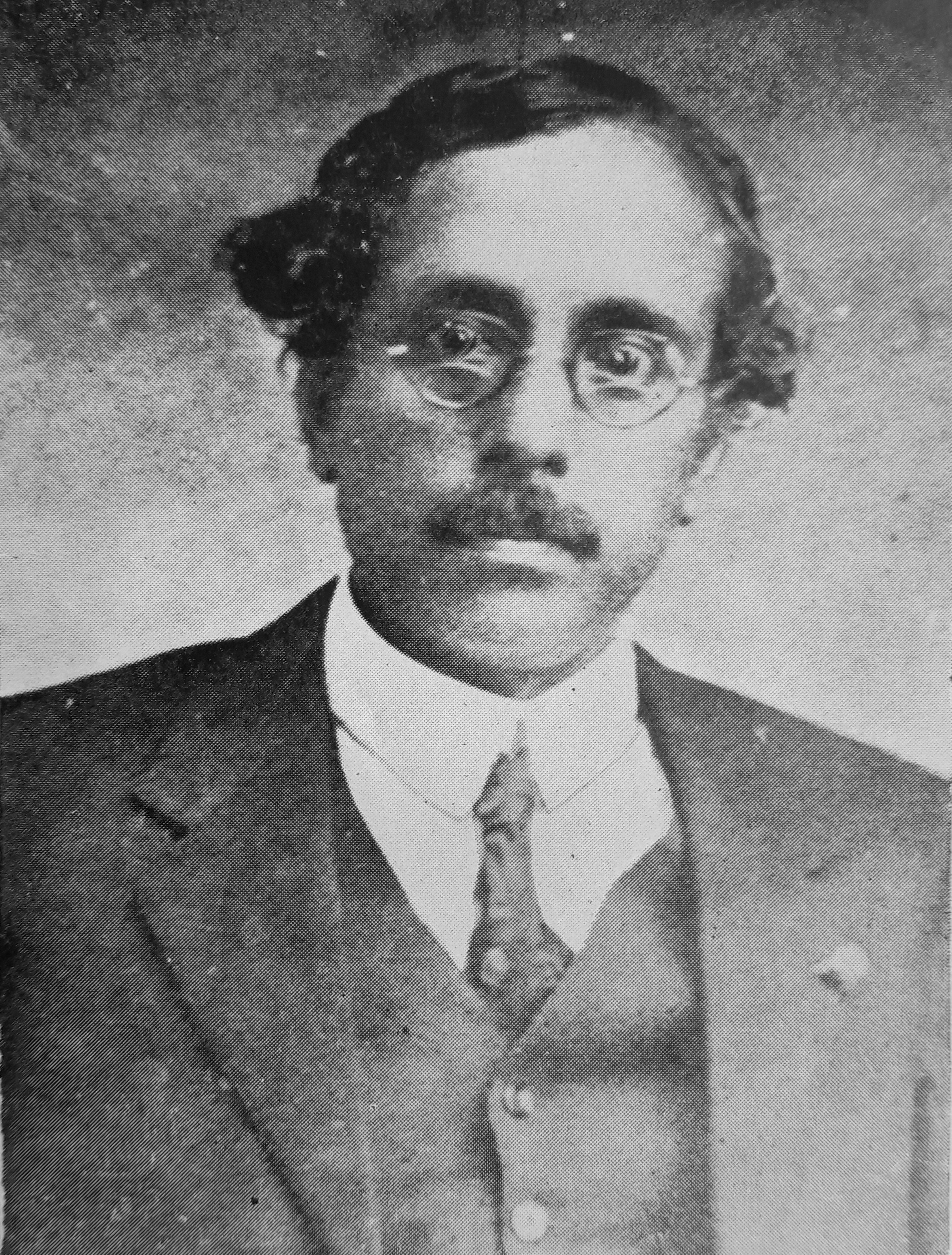
Dr T.V. Campbell
T.V.'s former home in Chikaballapur

Dr TV attending to patients in Chikaballapur, c. 1912

A lane inside the hospital premises named after T.V.

Foundation stone of the hospital

The Wardlaw Thompson Hospital c. 1914

Gunhilda noctua - a monotypic genus never seen
since T.V. found them for W.L. Distant to describe in 1918
from The Fauna of British India. Rhynchota Vol.II

The Wikipedia entries can be found at T.V. Campbell and W.H. Campbell. Many people helped in the development of these articles. Roy Vickery kindly obtained a hard to find obituary of T.V., Alan Knox sent me some additional sources on W.H.C. and Susan Daniel, librarian at the United Theological College was extremely helpful. Arun Nandvar drove and S. Subramanya joined our little adventure in Chikaballapur. Dr Eric Lott made enquiries with the SOAS and LMS archives but found little. My entomologist friends and mentors, Prashanth Mohanraj and Yeshwanth H.M. shared their enthusiasm in discovering more about T.V. 

POSTSCRIPT - April 2022: S. Subramanya and I visited Jammalamadugu (and nearby places including Buchupalli where WHC had found a large pelicanry). It seems that the hospital that TVC began continues to prosper. It seems to have gained the favour of the political class thanks to the association of the former Chief Minister Dr Y S R Reddy who was not only born in the Campbell Hospital but worked there too. Apparently very little is known of the work of W.H. Campbell who seems to have largely been active as a missionary. The village of Buchupalli where he had described a large pelicanry seems to have no signs of any large water birds and absolutely no memory among its current day residents (who might be three or four generations down from those that lived in the 1890s).


The CSI Campbell Hospital

The entrance

Inscription below the statue with a gratuitous knighthood!

Dr TV holds a disarticulated stethoscope!


Thursday, March 14, 2019

A buggy history

—I suppose you are an entomologist?—I said with a note of interrogation.
—Not quite so ambitious as that, sir. I should like to put my eyes on the individual entitled to that name! A society may call itself an Entomological Society, but the man who arrogates such a broad title as that to himself, in the present state of science, is a pretender, sir, a dilettante, an impostor! No man can be truly called an entomologist, sir; the subject is too vast for any single human intelligence to grasp.
The Poet at the Breakfast Table (1872) by Oliver Wendell Holmes, Sr. 

A collection of biographies
with surprising gaps (ex. A.D. Imms)
The history of Indian interest in insects has been approached by many writers and there are several bits and pieces available in journals and various insights distributed across books. There are numerous ways of looking at how people viewed insects over time. One of these (cover picture on right) is a collection of biographies, some of which are uncited verbatim accounts from obituaries (and not even within quotation marks). This collation is by B.R. Subba Rao who also provides a few historical threads to tie together the biographies. Keeping Indian expectations in view, both Subba Rao and the agricultural entomologist M.A. Husain play to the crowd in their early histories. Husain wrote in pre-Independence times where there was a need for Indians to assert themselves before their colonial masters. They begin with mentions of insects in ancient Indian texts and as can be expected there are mentions of honey, shellac, bees, ants, and a few nuisance insects. Husain takes the fact that the term Satpada षट्पद or six-legs existed in the 1st century Amarakosa to make the claim that Indians were far ahead of time because Latreille's Hexapoda, the supposed analogy, was proposed only in 1825. Such one-upmanship (or quests for past superiority in the face of current backwardness?) misses the fact that science is not just about terms but  also about structures and one can only assume that these authors failed to find the development of such structures in the ancient texts that they examined. Cedric Dover, with his part-Indian and British ancestry, interestingly, also notes the Sanskrit literature but declares that he is not competent enough to examine the subject carefully. The identification of species in old texts also leave one wondering about the accuracy of translations. For instance K.N. Dave translates a verse from the Atharva-veda and suggests an early date for knowledge on shellac. Dave's work has been re-examined by an entomologist, Mahdihassan. Another organism known in ancient texts as the indragopa (Indra's cowherd) supposedly appears after the rains. Some Sanskrit scholars have, remarkably enough, identified it, with a confidence that no coccidologist ever had, as the cochineal insect (the species Dactylopius coccus is South American!), while others identify it as a lac insect, a firefly(!) or as Trombidium (red velvet mites) - the last for matching blood red colour mentioned in a text attributed to Susrutha. To be fair, ambiguities in translation are not limited to those dealing with Indian writing. Dikairon (Δικαιρον), supposedly a highly-valued and potent poison from India was mentioned in the work Indika by Ctesias 398 - 397 BC. One writer said it was the droppings of a bird. Valentine Ball thought it was derived from a scarab beetle. Jeffrey Lockwood claimed that it came from the rove beetles Paederus sp. And finally a Spanish scholar states that all this was a gross misunderstanding and that Dikairon was not a poison, and - believe it or not - was a masticated mix of betel leaves, arecanut, and lime! 
 
One gets a far more reliable idea of ancient knowledge and traditions from practitioners, forest dwellers, the traditional honey-harvesting tribes, and similar people that have been gathering materials such as shellac and beeswax. Unfortunately, many of these traditions and their practitioners are threatened by modern laws, economics, and cultural prejudice. These practitioners are being driven out of the forests where they live, and their knowledge was hardly ever captured in writing. The writers of the ancient Sanskrit texts were probably associated with temple-towns and other semi-urban clusters and it seems like the knowledge of forest dwellers was never considered merit-worthy by the book writing class of that period.

A more meaningful overview of entomology may be gained by reading and synthesizing a large number of historical bits, and there are a growing number of such pieces. A 1973 book published by the Annual Reviews Inc. should be of some interest. I have appended a selection of sources that are useful in piecing together a historic view of entomology in India. It helps however to have a broad skeleton on which to attach these bits and minutiae. Here, there are truly verbose and terminology-filled systems developed by historians of science (for example, see ANT). I prefer an approach that is free of a jargon overload or the need to cite French intellectuals. The growth of entomology can be examined along three lines - cataloguing - the collection of artefacts and the assignment of names, communication and vocabulary-building - social actions involving the formation of groups of interested people who work together building common structure with the aid of fixing records in journals often managed beyond individual lifetimes by scholarly societies, and pattern-finding a stage when hypotheses are made, and predictions tested. I like to think that anyone learning entomology also goes through these activities, often in this sequence. Professionalization makes it easier for people to get to the later stages. This process is aided by having comprehensive texts, keys, identification guides and manuals, systems of collections and curators. The skills involved in the production - ways to prepare specimens, observe, illustrate, or describe are often not captured by the books themselves and that is where institutions play (or ought to play) an important role.

Cataloguing

The cataloguing phase of knowledge gathering, especially of the (larger and more conspicuous) insect species of India grew rapidly thanks to the craze for natural history cabinets of the wealthy (made socially meritorious by the idea that appreciating the works of the Creator was as good as attending church)  in Britain and Europe and their ability to tap into networks of collectors working within the colonial enterprise. The cataloguing phase can be divided into the non-scientific cabinet-of-curiosity style especially followed before Darwin and the more scientific forms. The idea that insects could be preserved by drying and kept for reference by pinning, [See Barnard 2018] the system of binomial names, the idea of designating type specimens that could be inspected by anyone describing new species, the system of priority in assigning names were some of the innovations and cultural rules created to aid cataloguing. These rules were enforced by scholarly societies, their members (which would later lead to such things as codes of nomenclature suggested by rule makers like Strickland, now dealt with by committees that oversee the  ICZN Code) and their journals. It would be wrong to assume that the cataloguing phase is purely historic and no longer needed. It is a phase that is constantly involved in the creation of new knowledge. Labels, catalogues, and referencing whether in science or librarianship are essential for all subsequent work to be discovered and are essential to science based on building on the work of others, climbing the shoulders of giants to see further. Cataloguing was probably what the physicists derided as "stamp-collecting".

Communication and vocabulary building

The other phase involves social activities, the creation of specialist language, groups, and "culture". The methods and tools adopted by specialists also helps in producing associations and the identification of boundaries that could spawn new associations. The formation of groups of people based on interests is something that ethnographers and sociologists have examined in the context of science. Textbooks, taxonomic monographs, and major syntheses also help in building community - they make it possible for new entrants to rapidly move on to joining the earlier formed groups of experts. Whereas some of the early learned societies were spawned by people with wealth and leisure, some of the later societies have had other economic forces in their support.

Like species, interest groups too specialize and split to cover more specific niches, such as those that deal with applied areas such as agriculture, medicine, veterinary science and forensics. There can also be interest in behaviour, and evolution which, though having applications, are often do not find economic support.

Pattern finding

The pattern finding phase when reached allows a field to become professional - with paid services offered by practitioners. It is the phase in which science flexes its muscle, specialists gain social status, and are able to make livelihoods out of their interest. Lefroy (1904) cites economic entomology in India as beginning with E.C. Cotes [Cotes' career in entomology was cut short by his marriage to the famous Canadian journalist Sara Duncan in 1889 and he shifted to writing] in the Indian Museum in 1888. But he surprisingly does not mention any earlier attempts, and one finds that Edward Balfour, that encyclopaedic-surgeon of Madras collated a list of insect pests in 1887 and drew inspiration from Eleanor Ormerod who hints at the idea of getting government support, noting that it would cost very little given that she herself worked with no remuneration to provide a service for agriculture in England. Her letters were also forwarded to the Secretary of State for India and it is quite possible that Cotes' appointment was a direct result.

Eleanor Ormerod, an unexpected influence
in the rise of economic entomology in India

As can be imagined, economics, society, and the way science is supported - royal patronage, family, state, "free markets", crowd-sourcing, or mixes of these - impact the way an individual or a field progresses. Entomology was among the first fields of zoology that managed to gain economic value with the possibility of paid employment. David Lack, who later became an influential ornithologist, was wisely guided by his father to pursue entomology as it was the only field of zoology with jobs. Lack however found his apprenticeship (in Germany, 1929!) involving pinning specimens "extremely boring".

Indian reflections on the history of entomology

A rather interesting analysis of Indian science is made by the first native Indian entomologist, with the official title of "entomologist" in the state of Mysore - K. Kunhikannan. Kunhikannan was deputed to pursue a Ph.D. at Stanford (for some unknown reason two pre-Independence Indian entomologists trained in Stanford rather than England - see postscript) through his superior Leslie Coleman. At Stanford, Kunhikannan gave a talk on Science in India. He noted in that 1923 talk :
In the field of natural sciences the Hindus did not make any progress. The classifications of animals and plants are very crude. It seems to me possible that this singular lack of interest in this branch of knowledge was due to the love of animal life. It is difficult for Westerners to realise how deep it is among Indians. The observant traveller will come across people trailing sugar as they walk along streets so that ants may have a supply, and there are priests in certain sects who veil that face while reading sacred books that they may avoid drawing in with their breath and killing any small unwary insects. [Note: Salim Ali expressed a similar view ]
Kunhikannan died at the rather young age of 47


He then examines science sponsored by state institutions, by universities and then by individuals. About the last he writes:
Though I deal with it last it is the first in importance. Under it has to be included all the work done by individuals who are not in Government employment or who being government servants devote their leisure hours to science. A number of missionaries come under this category. They have done considerable work mainly in the natural sciences. There are also medical men who devote their leisure hours to science. The discovery of the transmission of malaria was made not during the course of Government work. These men have not received much encouragement for research or reward for research, but they deserve the highest praise., European officials in other walks of life have made signal contributions to science. The fascinating volumes of E. H. Aitken and Douglas Dewar are the result of observations made in the field of natural history in the course of official duties. Men like these have formed themselves into an association, and a journal is published by the Bombay Natural History Association[sic], in which valuable observations are recorded from time to time. That publication has been running for over a quarter of a century, and its volumes are a mine of interesting information with regard to the natural history of India.
This then is a brief survey of the work done in India. As you will see it is very little, regard being had to the extent of the country and the size of her population. I have tried to explain why Indians' contribution is as yet so little, how education has been defective and how opportunities have been few. Men do not go after scientific research when reward is so little and facilities so few. But there are those who will say that science must be pursued for its own sake. That view is narrow and does not take into account the origin and course of scientific research. Men began to pursue science for the sake of material progress. The Arab alchemists started chemistry in the hope of discovering a method of making gold. So it has been all along and even now in the 20th century the cry is often heard that scientific research is pursued with too little regard for its immediate usefulness to man. The passion for science for its own sake has developed largely as a result of the enormous growth of each of the sciences beyond the grasp of individual minds so that a division between pure and applied science has become necessary. The charge therefore that Indians have failed to pursue science for its own sake is not justified. Science flourishes where the application of its results makes possible the advancement of the individual and the community as a whole. It requires a leisured class free from anxieties of obtaining livelihood or capable of appreciating the value of scientific work. Such a class does not exist in India. The leisured classes in India are not yet educated sufficiently to honour scientific men.
It is interesting that leisure is noted as important for scientific advance. Edward Balfour, also commented that Indians were "too close to subsistence to reflect accurately on their environment!"  (apparently in The Vydian and the Hakim, what do they know of medicine? (1875) which unfortunately is not available online)

Kunhikannan may be among the few Indian scientists who dabbled in cultural history, and political theorizing. He wrote two rather interesting books The West (1927) and A Civilization at Bay (1931, posthumously published) which defended Indian cultural norms while also suggesting areas for reform. While reading these works one has to remind oneself that he was working under Europeans and may not have been able to discuss such topics with many Indians. An anonymous writer who penned a  prefatory memoir of his life in his posthumously published book notes that he was reserved and had only a small number of people to talk to outside of his professional work. Kunhikannan came from the Thiyya community which initially preferred English rule to that of natives but changed their mind in later times. Kunhikannan's beliefs also appear to follow the same trend.

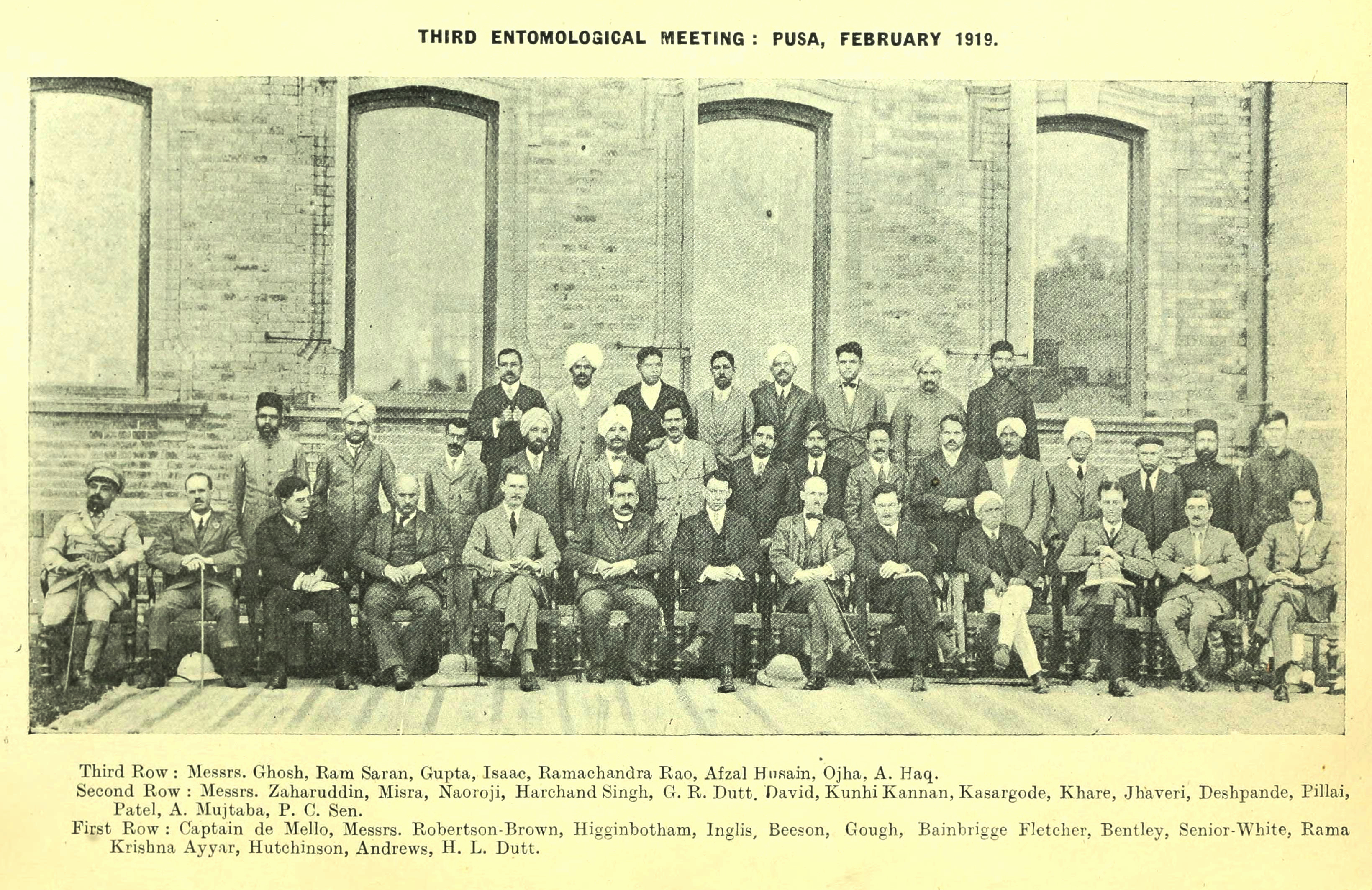
Entomologists meeting at Pusa in 1919
Third row: C.C. Ghosh (assistant entomologist), Ram Saran ("field man"), Gupta, P.V. Isaac, Y. Ramachandra Rao, Afzal Husain, Ojha, A. Haq
Second row: M. Zaharuddin, C.S. Misra, D. Naoroji, Harchand Singh, G.R. Dutt (Gobind Ram Dutt - Personal Assistant to the Imperial Entomologist. Studied several solitary wasps.), E.S. David (Entomological Assistant, United Provinces), K. Kunhi Kannan, Ramrao S. Kasergode (Assistant Professor of Entomology, Poona), J.L.Khare (lecturer in entomology, Nagpur), T.N. Jhaveri (assistant entomologist, Bombay), V.G.Deshpande, R. Madhavan Pillai (Entomological Assistant, Travancore), Patel, Ahmad Mujtaba (head fieldman), P.C. Sen
First row: Capt. Froilano de Mello, W Robertson-Brown (agricultural officer, NWFP), S. Higginbotham, C.M. Inglis, C.F.C. Beeson, Dr Lewis Henry Gough (entomologist in Egypt), Bainbrigge Fletcher, Charles A. Bentley (malariologist, Bengal), Senior-White, T.V. Rama Krishna Ayyar, C.M. Hutchinson, E. A. Andrews, H.L.Dutt


Entomologists meeting at Pusa in 1923
Fifth row (standing) Mukerjee, G.D.Ojha, Bashir, Torabaz Khan, D.P. Singh
Fourth row (standing) M.O.T. Iyengar (a malariologist), R.N. Singh, S. Sultan Ahmad, G.D. Misra, Sharma, Ahmad Mujtaba, Mohammad Shaffi
Third row (standing) Rao Sahib Y Rama Chandra Rao, D Naoroji, G.R.Dutt, Rai Bahadur C.S. Misra, SCJ Bennett (bacteriologist, Muktesar), P.V. Isaac, T.M. Timoney, Harchand Singh, S.K.Sen
Second row (seated) Mr M. Afzal Husain, Major RWG Hingston, Dr C F C Beeson, T. Bainbrigge Fletcher, P.B. Richards, J.T. Edwards, Major J.A. Sinton
First row (seated) Rai Sahib PN Das (veterinary department Orissa), B B Bose, Ram Saran, R.V. Pillai, M.B. Menon, V.R. Phadke (veterinary college, Bombay)
 

Note: As usual, these notes are spin-offs from researching and writing Wikipedia entries. It is remarkable that even some people in high offices, such as P.V. Isaac, the last Imperial Entomologist, grandfather of noted writer Arundhati Roy, are largely unknown (except as the near-fictional Pappachi in Roy's God of Small Things)

Further reading
An index to entomologists who worked in India or described a significant number of species from India - with links to Wikipedia (where possible - the gap in coverage of entomologists in general is large)
(woefully incomplete - feel free to let me know of additional candidates)

Carl Linnaeus - Johan Christian Fabricius - Edward Donovan - John Gerard Koenig - John Obadiah Westwood - Frederick William Hope - George Alexander James Rothney - Thomas de Grey Walsingham - Henry John Elwes - Victor Motschulsky - Charles Swinhoe - John William Yerbury - Edward Yerbury Watson - Peter Cameron - Charles George Nurse - H.C. Tytler - Arthur Henry Eyre Mosse - W.H. Evans - Frederic Moore - John Henry Leech - Charles Augustus de Niceville - Thomas Nelson Annandale - R.C. Wroughton -  T.R.D. Bell - Francis Buchanan-Hamilton - James Wood-Mason - Frederic Charles Fraser  - R.W. Hingston - Auguste Forel - James Davidson - E.H. Aitken -  O.C. Ollenbach - Frank Hannyngton - Martin Ephraim Mosley - Hamilton J. Druce  - Thomas Vincent Campbell - Gilbert Edward James Nixon - Malcolm Cameron - G.F. Hampson - Martin Jacoby - W.F. Kirby - W.L. Distant -  C.T. Bingham - G.J. Arrow - Claude Morley - Malcolm Burr - Samarendra Maulik - Guy Marshall
 
 - C. Brooke Worth - Kumar Krishna - M.O.T. Iyengar - K. Kunhikannan - Cedric Dover

PS: Thanks to Prof C.A. Viraktamath, I became aware of a new book-  Gunathilagaraj, K.; Chitra, N.; Kuttalam, S.; Ramaraju, K. (2018). Dr. T.V. Ramakrishna Ayyar: The Entomologist. Coimbatore: Tamil Nadu Agricultural University. - this suggests that TVRA went to Stanford at the suggestion of Kunhikannan.

Feb-2025: See dedication to Ormerod in Maxwell-Lefroy's Indian Insect Pests (1906).

2025: Found a book called The British Foundation of Indian Entomology (2023) - by Michael Darby. Includes bits on Howlett, including his portrait, lifted straight out of Wikipedia - something that took several years until I discovered that portrait while browsing an obscure Indian agriculture periodical! 

Friday, September 23, 2016

Maude Lina West Cleghorn: A little-known amateur entomologist

I recently came across the works of Miss Maude Lina West Cleghorn and was surprised by the breadth of her entomology research conducted in Calcutta. Miss Cleghorn actively studied insect pollination as an amateur and apparently some government-supported studies on the genetics of voltinism in silkworm in the early 1900s. Remarkably little is known of her despite being a Fellow of the (Royal) Entomological Society, the Linnean Society and the Zoological Society of London. Enquiries with the Linnean Society reveal that she was elected Fellow on the 4th of December 1913, nominated by Isaac Henry Burkill (director of the Botanic Gardens at Singapore); David Hooper (economic botanist with the Botanical Survey of India) and Lawrence Lewton-Brain (director of agriculture, Federated Malay States). Her address was given as 57, Ballygunge Circular Road, Calcutta and a bit before that period at 12, Alipore Road. All that can be found is that she died in 1946 - a single line mentioning her death (as Associate Member - a class created in 1835 which according to the byelaws- "Associate Members shall be persons well known for their literary or scientific attainments, but who are not likely to apply to become Ordinary Members.") is found in the Journal of the Asiatic Society of Bengal for 1949.

Among Miss Cleghorn's studies is one on the longevity of insects, specifically silkworm. She notes in passing that a  Hypolimnas bolina lived for 92 days but she examines the longevity in relation to the season in which the pupae eclose. The graphs are very elegant summaries of her findings (Edward Tufte would admire the simple lines rather than broad bars).

Miss Cleghorn notes that adults emerging in the rainy season are short-lived

She also studied insect-pollination in some detail and especially interesting is her description of trap pollination in two species of Araceae. The first study was in 1913 on Colocasia (Kachu) and she described how cross pollination was enforced by a combination of protogyny and the timing with which the flower trapped and released carrion flies. She followed up this with a study the next year on Typhonium trilobatum (and she uses the local name Ghet-Khechu!) which has a spadix that releases a strong smell of rotting carrion in the evening and keeps the beetles overnight inside the cavity formed by the spathe. It attracts beetles including those in the Coprinae (Scarabaeidae) - and two species are identified Onthophagus tarandus and Caccobius dimiunitivus - the voucher specimens from these flowers were deposited in the Pusa collection and these life-history notes are included with some care in the Fauna of British India (Arrow, Gilbert John (1931) The Fauna of British India. Coleoptera Lammelicornia. Part III (Coprinae). London: Taylor and Francis. pp. 143-144, 181-182.)
Trap mechanism in Typhonium for beetles.

Burkill, who seconded Cleghorn for Fellow of the Linnean Society, has a very interesting review of pollination mechanisms in Indian plants and he confirms Cleghorn's observations.

Observations of flowers on the trees with field-glasses and close ups of some flowers.
Fig. 1.—Rough sketch made from bunch actually growing on the tree, and observe 1 through field-glasses, showing young buds as seen on the morning of the 14th March.
Fig. 2.—Rough sketch of the same bunch on the morning of the 16th March, which shows the buds taking up the drooping position but with no styles projecting.
Fig. 3.—Sketch of the same bunch in Figs. I and 2, drawn on the morning of the 19th March. It shows the buds more pendant, and in two or three of the buds the styles appeared to be protruding slightly as far as could be made out with the glasses.
Fig 4.—Rough sketch of two bunches on the tree with buds older than those shown in Figs. 1, 2, and 3. Sketched on the morning of the 12th March. Three buds on the right bunch had styles protruding. On the left bunch one of the flowers was beginning to " ripen."  On the 13th March two more flowers on the left bunch were becoming fleshy.
Fig. 5.—The same two bunches as shown in Fig. 4, but sketched on the 14th March. The left bunch had four flowers with ripe corollas while the right bunch had two. On the l6th March only one ripe flower was left on the right bunch. On the 19th March two of the younger buds of the bunch on the right had become fleshy and had styles protruding.
Fig. 6.—Sketch of two buds on a flowering branch as they appeared on the 2nd April.
Fig. 7.—The same buds sketched on the 5th April. But B which was of the same age as A when cut on the 2nd April was shedding pollen on the evening of the 5th April. The corolla at this stage is almost completely covered by the sepals.
Fig. 8.—Bud-like flower in  first  stage   sketched   on   the evening of   the 5th April.    When lightly tapped, pollen was shed  through the pore-like openings and when the style was touched through the tip of the corolla tube.
Fig. 8a.—Slightly enlarged drawing of flower in the first stage with the tip of one of the sepals turned back to show the opening through which the pollen is shed. There were two other openings just under the tip of the opposite sepals but they were not so large.

Fig. 9 —Section of flower in the first stage. At this stage the anthers are ripe and the stigma sticky and when tapped or shaken at night it produces a shower of pollen. Sketched at 2 a.m. on the 29th March.
Fig. 10.—Section of flower in second stage with much enlarged fleshy corolla, and pollen shed.    Natural size.
Fig. 11.—Sketch of fully "ripe" flower with the much enlarged and fleshy corolla. In this stage the style is about half an inch longer than it was in the first stage. Natural size.
Figs. 12-17 give sketches of a bud and flowers of different ages. The flowering branch was cut at 6-30 p.m. on the 9th April and the flowers were examined almost immediately after.
[In taking the exact measurement of the lengths of the sepals, corollas and styles the sections became slightly distorted and wider.    The exact lengths are shown in the drawings.]
Fig. 12.—Sepals much  longer than petals, style only little longer than the sepals.    Anthers immature and no pollen shed when tapped.
Fig. 13.—Pollen being shed and fleshy part of corolla still completely hidden under sepals.
Fig. 14.—Pollen being shed. Style and petal slightly longer than that of flower shown in Fig. 13.
Fig. 15.—Fleshy part slightly thicker than that in Fig. 13. Appears to be a bit older than that in Fig. 13.
Fig. 16.—Section of old flower in which corolla has fallen off. The style was much longer than the old style of that in Fig- 15, but the sepals were of the same length.
Fig. 17.—Section of old flower showing corolla shed and ovary slightly larger. Sepals the same length as that in Fig. 15, but style found to be exactly 1 cm longer.
Figs. 18-31 give the sections of all the flowers found on a bunch which was examined about 8 a.m. Altogether there were fourteen flowers and none were destroyed by bats.
Fig. 18.—Quite a young bud.
Fig. 19.—Flower in first stage shedding pollen.
Fig. 21.—Most of the pollen shed.
Fig. 26.—Pollen shed thickly.
Figs. 29.-31.—Old flowers which have lost their fleshy corollas.
Fig. 32 shows two stamens enlarged about twice the natural size.

She seems to have maintained an interest in floral biology and pollination for long and her last publication appears to be in 1922 when she wrote on Mahua (Madhuca longifolia) noted its  uniqueness and the fact that contemporary botany texts miss out details. She notes that contrary to some illustrations, the Mahua flower never opens up. She notes that (emphasis mine) - "the mechanism found ... in which a large portion of the actual flower is edible is a rather costly and uncertain one...and appears to be rare among plants. The only other plant with this type of mechanism, recorded so far, is Fracinclea, [Freycinetia] a pandanus-like plant of Java, which is pollinated by bats while visiting the flowers for the edible bracts." She observed flowers using field-glasses and drew diagrams to demonstrate how the pollen were dispersed through a pore on the side of the otherwise closed bud-like or berry-like flower. The pollen collects inside the closed corolla cup of the hanging flowers in the initial stage and bats going to feed on them get the underside of their wings dusted with pollen. As the flower matures the anthers wither and the corolla becomes fleshy and the stigma becomes receptive. Once the corolla is eaten the stigma is exposed and the bats deposit pollen on them. This aging mechanism ensures cross-pollination.

It seems likely from the names listed in the pages of the Journal that some of Miss Cleghorn's relatives attended the monthly meetings of the Asiatic Society of Bengal. Cleghorn also took an interest in other taxa, there is a mention of her maintaining a live Kaloula pulchra. Harold Maxwell-Lefroy (Imperial Entomologist) in 1916 notes that Miss Cleghorn was to be offered the work on cross-breeding silkworm. It appears that from 1910, "it was decided to prepare a scheme to employ Miss Cleghorn". A visit to Pusa is noted. It seems that she worked on cross-breeding European silkworm which produced high quality silk and produced just one generation a year (univoltine) and Indian varieties that produced multiple generations in a year (multi/polyvoltine) but coarser silk. Cleghorn conducted a series of breeding experiments to examine the heritability of multivoltinism and her conclusion was that multivoltinism was a dominant trait in females but recessive in males.

There is a mention of a Mr J(ames?). Cleghorn, an executive engineer at Cuttack who curiously was engaged in sericulture research. According to a Memorandum by a certain Liotard : "In Cuttack, sericulture has been carried out as an experiment since 1877 at Government expense, under the supervision of the Executive Engineer of the Mahanadi Division." and there is a comment by Mukerji, N.G. in his 1903 A monograph on the silk fabrics of Bengal-:
The reference here is no doubt to the experiments of Mr. J. Cleghorn of the Public Works Department. Mr. Cleghorn's experiments were not altogether fruitless. He published his studies of the life-history of the parasitic fly, and brought to light the great destruction caused by it. He produced some valuable races of beautifully white cocoons, both annual and polyvoltine. He also claimed to have discovered a simple means of avoiding or destroying the fly-pest. But as he could not be induced to part with his secret for less than a lakh of rupees, nothing is known with regard to his method of coping with one of the chief enemies of sericulture in Bengal. The fine races of cocoons he was rearing in conjunction with the Secretary of the Agri-Horticultural Society were not given out to the world either, and Mr. Cleghorn's researches and experiments have, therefore, left little of practical value behind. 
The fly mentioned here is of course Exorista bombycis (Tachinidae) and Mr Cleghorn clearly I wonder if this might be is Miss Cleghorn's father, perhaps a clever but money-minded man. (PS: details of family confirmed later)

Hopefully someone in a better position to research her life will do justice to this very observant and insightful amateur entomologist whose contributions to pollination biology are almost unknown. I bumped into this remarkable and little-known researcher while looking up on Hugh Cleghorn - one of the pioneers of forestry in India- on whom a most comprehensive biography has just been published by Henry Noltie.

Acknowledgements

Thanks are due to Lynda Brooks at the Linnean Society for tracking down some details and to Ann Sylph at the Zoological Society of London for checking their archives.


References
Postscript 
 
FamilySearch has the following information. Maud Lina West Cleghorn was christened at Buxar on 14 December 1882, her parents were the civil engineer James Price Cleghorn and Letitia Gertrude (married 18 December 1881), daughter of William O'Brien West. Ancestry.com states that she was born on 30 September 1882  and died in 1946.

James Price Cleghorn took out a patent on food preservation in 1903 which may also have been based on his daughter's research.

All attempts to contact people at the Asiatic Society Calcutta have failed - no bounce on the emails and not even a simple - sorry-I-cannot-help response. Incredible levels that "learned societies" have reached today!
 
Would be amazing if someone in Kolkata can go and look for her grave in the Park Street Cemetery and get the dates and inscription on it.

25-November-2024: My article is now available in The Linnean 40(2):34-39.