click hide image

Showing posts with label history of science. Show all posts

Wednesday, August 11, 2021

Annandale's Zoology

Many of India's leading zoologists died well before they reached the age of fifty. Nelson Annandale was one of them. Annandale trained in anthropology, and in a way was responsible for getting Mahalanobis to develop multivariate statistical approaches by providing him a real-world problem involving the classification of skulls based on measurements. Annandale gave a rather interesting talk on the Ethics of Zoology. It is so hard to come by that I suspect few Indian zoologists have ever read it. As the founder of the Zoological Survey of India, Annandale's note is definitely an important one for anyone interested in the history of Indian zoology. Given the difficulty in locating it, I have decided to post it here verbatim (it can also be found here).

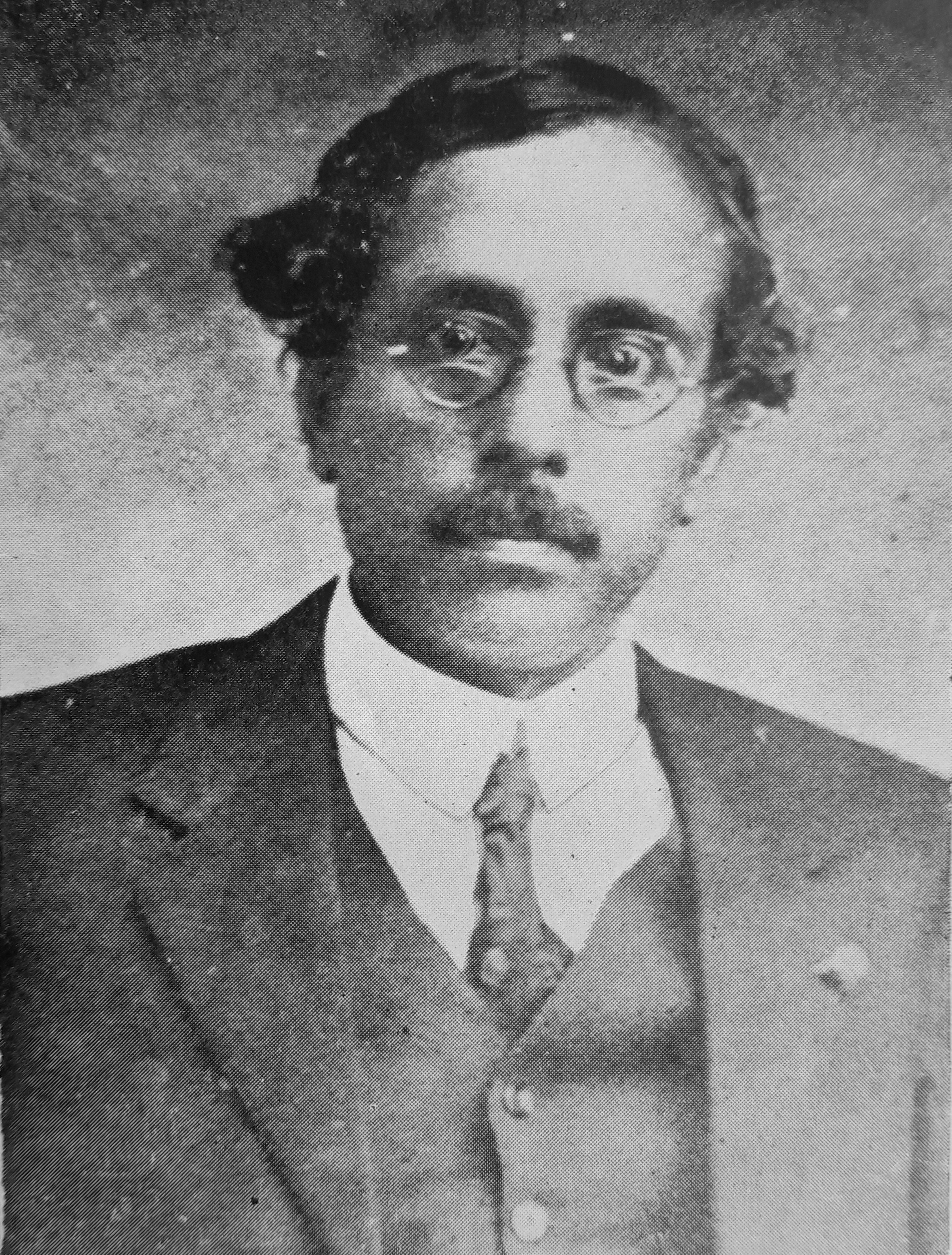
T. N. Annandale, c. 1907

Citation: Annandale,  N. 1922. Ethics  of Zoology.  Calcutta  Review (March):423-438.


Ethics of Zoology.

by Nelson Annandale

Address delivered to the Zoological Section of the Ninth Annual Meeting of the Indian Science Congress at Madras: February 1922.

In his introduction to the eighty-third section of the Ain-i-Akbari Shaik Abulfazal wrote of Akbar:

"His Majesty has taught men something new and practical and has made an excellent rule, which protects the animal, guards the stores, teaches equity, reveals the excellent, and stimulates the lazy man" (Blochmann's Ain-i-Akbari, Vol. I. p. 217)

Let us constitute ourselves humble followers of Akbar and strive to find a rule that will at once protect this animal, guard the stores of zoological learning, maintain equity between zoologists and stimulate the excellent, if not the lazy, man to sound zoological research.

Sir William Jones in his inaugural discourse to the Asiatick Society, delivered in Calcutta in 1781, omitted zoology from the proposed agenda of the Society. Nine years later, in his tenth address, he explained the reason. “Could the figure, instincts, and qualities of birds, beasts, insects, reptiles, and fishes,” he said, “ be ascertained, either on the plan of Buffon, or on that of Linnaeus, without giving pain to the objects of our examination, few studies would afford us more solid instruction or more exquisite delight.”

He went on to state that he could not conceive of the feelings of a naturalist who could occasion the misery of an innocent bird, “or, deprive even a butterfly of its natural enjoyment, because it has the misfortune to be rare or beautiful.” He then gave the following translation of a couplet of Firdausi :—

"Ah I spare yon emmet, rich in hoarded grain;
 He lives with pleasure, and he dies with pain."
 [Ed. emmet is a Germanic origin word for ant]

Elementary as was Sir William Jones’s concept of zoology, his opinion as a scholar and a poet cannot be dismissed lightly. There is. as the French say. nothing that kills like ridicule, but ridicule kills only when its object is really ridiculous. To laugh at what is true and solid is to exhibit lack of sympathy and sense.

There seems to me, however, to be some confusion of thought in Sir William Jones's statement, which I have not quoted in full, and, moreover, he has ignored the fundamental difference in the point of view of a man whose attitude towards animals is entirely religious as a believer in the transmigration of souls and the accumulation of merit, and that of one whose dislike of cruelty is ethical and aesthetic. Firdausi’s couplet expresses the views of the latter, the edicts of Asoka those of the former, for the edicts are directed not against cruelty to animals but against the destruction of life.
 
 No decent zoologist is cruel to animals. Indeed among civilized men there is something antagonistic to human sanity in deliberate cruelty; it is essentially morbid and unnatural. But there is another kind of cruelty, due mainly to lack of imagination and carelessness. It is difficult in watching a carter twisting the tail of his ox to believe that his motive is entirely free from vicious pleasure, but that it is mainly due to a lack of the intellectual ability to picture to himself the feelings of the ox we may concede. Curiously enough this minor type of cruelty is often prevalent among those to whom the religious motive is all-important.
 
 It is a custom in Japan to throw the laboratories of the Imperial Universities open to the public once a year, and to provide a popular exhibition of scientific apparatus and preparations. In 1915 I happened to be in a Japanese university town in which an exhibition of the kind was in progress. The main exhibit in the physiological laboratory was a living rabbit firmly tied down and out open in such a way as to illustrate the beating of the heart. Even supposing that the rabbit was completely anesthetized, the exhibit was a disgusting one from a Western point of view, and would probably have caused a riot in London, even before the police intervened; but in Japan, women and children examined it with perfect equanimity, and my friends of the University staff could not see anything wrong. And yet these very professors and lecturers were in the habit every year of holding a solemn service of expiation in one of the great Buddhist monasteries of the city for the souls of the animals which had been dissected in their laboratories.
 
It is an interesting speculation whether the Japanese crowd would hare viewed the vivisected rabbit with the same equanimity if it had chanced to be one of the animals of which the representation in painting is permitted by the narrow canons of Japanese art. I must confess that my own objections to the exhibition were just as much aesthetic as moral.
 
The study of zoology in India has not, as a matter of practice, been much affected by the edicts of Asoka, and the remarks of Sir William Jones on the supposed; cruelty involved in zoology had no more than a temporary effect on the history of the Asiatic Society. Indeed, it seemed at times as if the stone the builder had rejected had become the headstone of the corner, for in the days of Blyth and again in those of Alcock, zoological papers were amongst the most important published in the Society’s Journal. Nevertheless, it is as well that in our zoological work we should keep in mind both Firdausi and Piyadasi.
 
I need not waste your time on the crank who loves her dog and hates mankind.

Scientific work is plain-sailing as long as a man can do it alone. It is when he has to consider others that the strain and difficulty begin. There is one point, small in itself but still important, in which I notice that my younger colleagues experience peculiar difficulty, namely, in acknowledging the help they have received from their seniors. The matter is not so simple as it seems. Two pitfalls must be avoided, that of flattery on the one hand and that of plagiarism on the other. For Indians there is the added difficulty of a foreign language. There is nothing more difficult than to pay a graceful compliment in a language not one's own. Delicacy of feeling, moreover, is often necessary to distinguish between a common courtesy and subtle flattery. The best way out of the difficulty is to say frankly what help has been received and to express gratitude in as few words as possible.

The question of plagiarism is even more difficult in scientific research than in literature. If Shakespeare, as some of my younger colleagues would argue, was justified in appropriating a commonplace plot and transmuting it into a work of genius, we also are justified in using the ideas of others as our own. Unfortunately few of us are Shakespeares, or Darwins. Darwin was one of the must modest of men, and always scrupulous in acknowledging assistance of any kind, even, or perhaps especially, from those whose lights were much less than his own. In acknowledging help, whether from the written or the spoken word, we cannot do better than accept the introductory part of the Origin of Species as our guide.

But this does not dispose of the more general question of plagiarism. How much may be legitimately appropriated, or may anything be appropriated at all ? In the Roman Church St. Alphonso of Liguori, the one modern Doctor of the Church, is accepted as the final referee on ethical questions. He was bold enough to draw up a tariff of mortal sin in theft. He ruled that in certain circumstances a respectable man who stole a shilling from a working man, or fourteen shillings from a crowned bead, did not commit a mortal sin ; but that to steal even a few far things from a beggar was always a mortal sin. In scientific ethics we have no such authority as St. Alphonso; but the rule that nothing whatever should be taken from any living person without due acknowledgment is a good one. We must steal not at all, either from king or beggar. There are, however, in science as in literature many ideas and phrases so universally understood and accepted that to trace them to a personal origin is not only unnecessary but also a little ridiculous. Even such ideas and phrases, if attributed to an author, should be attributed correctly. For example, the saying that the practical man practises the follies of his ancestors is often attributed to Huxley, but really came in the first instance from Disraeli, in whose Coningsby it is placed, with many other self-evident sentiments, in the mouth of the wise Jew Sidonia.


The mention of Huxley leads me to a point almost universally ignored at the present day in the ethics of zoology— the importance of literary style in the presentation of scientific facts and ideas. If anything is worth saying it is worth saying well. You have all heard of Buffon, who used to put on his court dress and his sword whenever he sat down to write. Such external ceremony is perhaps contrary to the spirit of this age and, therefore, may appear to some of us to have been mere affection on Buffon's part; which it certainly was not. Scientific facts, however, are worthy of respect, and should be treated with due decorum. Style has been defined as saying things in an appropriate manner. It is not appropriate to couch a plain statement of facts in highly figurative or elaborate language. Plain facts must be stated plainly. Our aim in zoological literature must be chaste simplicity, but journalese is not simple, nor is it chaste. Superfluous words, words used to startle or confound without thought of their precise meaning, in short all idle words, merely recall the saying that language was given to man to conceal his thought. If, however, you adopt the telegraphic style in description—and nowadays economy in print is always desirable for financial reasons—do so only in mere diagnosis, and in diagnosis be adequate, and be consistent. It is neither economical nor grammatical to write in describing an insect :
"body black ; the legs are brown"

I would advise every zoologist to study Sir Arthur Quiller-Couch’s lectures on The Art of Writing English. He will find some hard sayings. With many others, I have found the statement that a case can only mean a box not a little disconcerting, but the fact that such statements make us feel uncomfortable proves that they contain an element of truth.


Apart from literary style in the writing of zoological papers, the question of the mechanical preparation of the manuscript for the press is one of ethical significance. As editor of the Records and Memoirs of the Indian Museum I often receive manuscripts that need many hours' careful and troublesome work before they can be sent to the printer. But for the fact that Dr. Kemp is kind enough to relieve me of much of this drudgery, I would scarcely hesitate to refuse even to consider a great part of the matter submitted for publication. Carelessness or ignorance as to punctuation and the use of capitals is rife, and few authors take any trouble in indicating the use of italics or other special type. It is surprising how few zoologists know even such elementary rules as that of the proper use of brackets with the name of the authors of species. These names should never be enclosed in brackets, unless the name of the genus of the species has been changed since the latter was first described. These may seem trivial points, but their neglect indicates not only carelessness, but selfishness and lack of understanding.

Zoology has become so complicated that few of us nowadays are more than “Scarabees.” This is an immoral state, not only because no man in these strenuous times has the right to narrow his interests to a single family of beetles, but also because the whole of biology is at present encumbered with uncoordinated details that clog the machinery of progress instead of acting as motive power.

In zoology, however, as in all branches of knowledge, it is worse than being narrow-minded to assume an interest if we have it not. One of the, most unpleasant persons I ever met was a young student who emerged from a very dirty house in Iceland and remarked : "Good-morning! Do you think Lord Verulam wrote the plays of Shakespeare?" He took no more interest in the Shakespeare-Bacon controversy than I did in Icelandic politics, but wished to. impress the foreigner. You may apply this parable to zoology as you like.

In recent years zoological controversy, like most other branches of criticism, has grown more refined, but we are still far from that urbane irony which an American critic' regards as one of the highest manifestations of the literary spirit in modern England, Courtesy is apt to degenerate into irresponsible and often irrelevant insinuations, such as, in Europe, slackness in war, or, in this country, ।an anti-Indian-spirit. In some branches of zoology, notably in pure taxonomy, opinions are so varied that no general Consensus seems possible. I have observed a tendency,among young zoologists in India to treat conclusions, based presumably on ascertained facts, somewhat lightly, in order to avoid controversy—as in the case of a young man who brought to a friend of mine a paper in which far-reaching conclusions were derived from somewhat meagre research. My friend pointed out that the evidence hardly justified the conclusions.
“Oh,” said the author, but I can change the conclusions ! ”
On the other hand, it is quite unnecessary to call a man a liar because you disagree with him on some controversial point, or even on some matter of observation. All men cannot think, or even see, alike, and because a man is senior, or belongs to a different race, he is not necessarily wrong.

If the majority of zoologists were endowed, with a sense of humour (which, after all, as Thackeray has pointed out, is essentially the same thing as a sense of proportion) much controversy would be avoided altogether, the real point at issue not being any point of fact or even of interpretation but merely so me personal fad, jealousy or spite. I was once buying some sleeping-mats in the Malay State of Kelantan. The man who had brought them for sale stated that it had taken him two months to make them. I turned to another Malay who was standing by -an uneducated man, but endowed with the ready wit and delicacy of feeling so characteristic of the Malay race—and enquired if this could be true. "Doubtless, Tuan," was the reply, "but perhaps he only worked one day in each month." The retort was a retort courteous ; no offence was caused and the bargain was concluded in a manner satisfactory to all concerned.

The true test in all controversy is the inner feelings of the disputants. So long as a man respects his opponent, and feels no bitterness towards him, controversy is a good thing; but in scientific controversy there must be no reservations, no quibbling. We must play with all our cards on the table. A plan I have adopted in the Records of The Indian Museum seems to me a good one. Some years ago I published a paper in the Memoirs of the Asiatic Society of Bengal in which I pointed out that there was considerable diversity in the frogs usually grouped under the name Rana tigrina. I, therefore, suggested that several distinct species should be recognised. Dr. G. A. Boulenger , then in charge of the Reptiles and Batrachia in the British Museum and still recognised as the leading herpetologist in Europe, did not agree with me. He paid me the great compliment of sending me a paper for publication in the Records of the Indian Museum, refuting my claim for the specific recognition of the different forms of Rana tigrina, which he regarded as merely races or varieties.

In certain points Dr. Boulenger was evidently right and I wrong. So I wrote a second note expressing my views as modified by Dr. Boulenger's argument. Of this I sent the manuscript to him; and he replied in a third note. The three notes were then published together as a kind of dialogue, so that all the facts and arguments of the case were submitted to the zoological world together, without the slightest bitterness, loss of mutual respect, or ill-feeling on the part of either the senior or the junior author. Far otherwise was it with the famous controversy on the proper generic name of the bed-bug that raged round the world some years ago, from Hawaii to Belgium and from England to Canada.

In setting forth this ideal of urbane controversy I do not mean to say that there are not oases in which the experienced zoologist does well to be angry. Dishonest or grossly careless work, work done merely for the sake of effect or to satisfy the investigator’s personal ambition or further his official promotion, must always meet with unqualified condemnation, in which there is no room for mutual respect.

In the official document whereby the Zoological Survey of India was constituted in 1916 our relations with the technical departments are laid down as being those of ”cooperation without subordination.” The thanks of all Indian zoologists are due to the man who discovered this formula. I do not know his name. The formula implies not only the recognition of pure zoology on the part of the Government of India, but also its independence of direct economic aims. I have nothing to say against applied science, provided that it be science at all, but the term is often “applied” to something akin to the Holy Roman Empire, which has been described as neither holy, Roman, nor an empire.

Even in the purely physical branches, in which the mathematical demonstration of facts is possible, "practical results ” often rest on a very small basis of research. The whole affair is in fact an inverted pyramid, liable to topple over at any moment and overwhelm its supporters. As soon as the question of life enters into applied science the matter becomes vastly more complex, and just as the life of the animal is more complex than that of the plant, so is applied zoology more difficult than applied botany. Some day we may know something about life, and understand how a plant or an animal lives, how and why it reacts to its environment. At present we know practically nothing. The great triumphs of applied biology are empirical, such as the discovery of the value of Cinchona bark ages before the malaria parasite was known. And yet they are triumphs of pure research, for research is only experiment and its interpretation. The practical knowledge of the primitive fisherman or agriculturist is based unconsciously on the experience of a thousand years. At present all we can do in a laboratory or a museum is to speed up experience, to attempt to learn in a few months or years what the peasant has taken centuries to learn, and has sometimes learned wrong in the end.

Applied zoology should be, and perhaps some day may become, the great philanthropic agent of the world. At present, it is often a wolf in sheep’s clothing, a devil masquerading as an angel of light. No government or commercial body can resist the temptation of demanding results, and in India we hear of even professors expecting from their students a research a month. Such demands often meet with a ready response, especially from the young and ignorant. This can only result in a furtive and subtle dishonesty fatal to all true progress. I am firmly convinced that applied zoology is at present, with our inadequate apparatus of research, largely a chimera, indiscriminate faith in which is akin to that in the stories told in the Physiologus and its successors, the medieval bestiaries of Western Europe, about such animals as the elephant and the leopard. These stories were not written in the interests of material truth, but with a strictly moral or religious aim. They completely ignored facts, but yet were based on existing things. It was not until considerable numbers of Europeans went into the countries in which the libelled animals led their own unmoral lives that the true facts became apparent, and I do not think that either the morals of Europe or the interests of zoology suffered in the revelation.

In his History of English Literature from the Beginning to the Norman Conquest Stopford Brooke translates an account of the leopard from an early poem on the Panther, the Whale and the Partidge. The panther lives, we learn, “ In the far lands in deep hollows......... , glittering in a many coloured coat like Joseph’s, a friend to all, save to that envenomed scat her, the Dragon.” After feeding (on what we are not told), he sleeps for three nights. When he awakes, “a lofty, sweet, ringing sound comes from his mouth, and with the song a most delightful steam of sweet-smelling breath, more grateful than all the blooms of herbs and blossoms of the trees.” This mystic aroma is compared by the early English poet to the hope of divine salvation.   

However fair the flowers of applied zoology may ‘seem, the ripened fruits are often Dead Sea apples, disappointing as the breath of the leopard, not to mention his unfriendly disposition, must have been to the first lettered Englishman who stumbled upon him in the jungle and awoke him from his slumbers.
Virgil in his Georgics wrote what was accepted for centuries by the learned as a manual of practical agriculture poetically expressed. Among other processes he described the manufacture of a swarm of bees from the carcase of a heifer. Imagine the poet reclining in his cool verandah with a manuscript of Hesiod half-unrolled on his lap, and pausing in his dictation to gaze over the countryside and muse for a moment on his own love for the simple farmer’s life. Fortunately for his reputation as a practical agriculturist his (or rather Hesiod’s) process for the abiogenetic production of honey-bees, which involved the slaughter of a prime heifer, was as unsound economically as it was biologically impossible. No one tried the experiment, and so the process was accepted from generation to generation as practical. In fact, the lighthearted, and doubtless illiterate, Samson, who slew a lion on his way to visit his lady-love and afterwards found a comb of wild honey in the skeleton, and made a riddle of it to puzzle the Philistines, was much the more practical man of the two. In modern times the man who introduced mongooses into the West Indies, rabbits into Australia or sparrows into North America, doubtless thought that he had accomplished a great work of applied biology—at first.

In discussions on the value of zoological work there is nothing that makes me more indignant than the saying that this or that piece of Indian research is good work—for India. This usually means that it is of inferior quality, but must not be judged too hardly because it has been done either by an Indian or by an Englishman working amidst Indian difficulties. We Indian zoologists, to judge by the work of our predecessors—Hodgson, Blyth, Stoliczka, Blanford, Alcock and many others—have no reason to claim indulgence. There can be nothing more fatal to Indian science than to aim at a low ideal, and no greater insult can be paid to any branch of scientific effort than to judge it from a racial or a geographical standpoint. Zoology is often regarded in India as the Cinderella of the sciences, and it is, therefore, necessary on occasion for zoologists to mingle the meekness of the dove with the subtlety of the serpent. Some years ago, in my zeal to bring about a certain unity of purpose in the administration of the Indian Museum, I incurred the accusation of latent kaiserism from one of my colleagues. I replied that it seemed to me improbable that the youngest and poorest of the scientific departments under the Government of India would arise from the mud like Pharaoh’s lean kine and swallow its more prosperous brethren. However effective such replies may be for the moment, the necessity for them does not tend to edification. One branch of science may be poorer in loaves and fishes than another, but all are equal.

Zoology is so closely connected with other branches of biology, and so dependent- in the last resort on geology, chemistry, physics and mathematics, that in my own work I find it frequently necessary to apply to members of other departments for special information. My experience has been that such information is always given in a most ungrudging and generous spirit when applied for personally, but that any official move towards closer co-operation is met with suspicion. I am heterodox enough to believe that the first duty of every scientific department, whether official or otherwise, should be to assist all scientific men in their work, and especially in their research ; but to the gods, alas, it has seemed otherwise. The gods of Olympus led a free and joyous life, feasting on nectar and ambrosia : in files and official etiquette the gods of the Himalaya have found more congenial fare. A witty Chairman of the Trustees of the Indian Museum, in which four Imperial survey departments are concerned, once remarked that the chief difficulty in its administration was that the parts were so much greater than the whole. Hypertrophy of the departmental consciousness is a disease to which we heads of scientific departments are by no means immune; a disease, moreover, which the Board of Scientific Advice, despite its zeal in preventing “the overlapping of functions” has failed to cure. In placing zoology on a sound basis in India, individual effort alone is of any avail, but the effort though individual must be unselfish, it must not be inspired by any kind of bitterness or self-seeking. We must realize with a sigh that the intelligence of a committee is often much lower than that of its least intelligent member.

Even a committee, however, is preferable to individual patronage. I am of the opinion that private donations to science often do more harm than good, not only because of the conditions that usually hedge them round but also because they weaken individual effort in research. Unlike Art, Science abhors patronage and flourishes in hardship and opposition. We are told that in ancient Greece Alexander the Great was the patron of Aristotle, and yet that scientific thought was absolutely free. By the time of Alexander, however, the intellectual light of Greece was fading out, and democracy, the most official form of Government known to mankind, had already found, its supreme victim in Socrates, the philosopher whose test for all things was truth.

At all periods and in all countries of the modern world— whether it be in the dealings of Pope Urban with Galileo or in those of the British Government with scientific men in the early part of the War—ignorant members of the official hierarchy—and even a high official of the most excellent administration may be very ignorant of science—have attempted to treat science much as St. Columba treated the practical experience of St. Oran. The story is told in full in a comparatively late Irish life of Columba and is barely hinted at in more authentic documents. It seems to me, however, to bear in its primitive simplicity the impress of truth. No mere hagiologist would ever have invented such a story. Here is the story. An important religious work was to be under taken on the island of Iona and it had been decided that one man must die for the community and become its guardian spirit. St. Columba called for volunteers and St. Oran, who is said to have been his brother, offered himself. St. Oran was accordingly buried alive. After three days St. Columba caused the grave to be opened. St. Oran, was not dead, but thought he was. He opened his eyes and said, “ There is no mystery in death and Hell is not like what it was said to be." St. Columba, doubtless thinking that his brother was possessed of a devil, cried out in alarm, “ Earth, earth on the eyes of Oran, lest he blab more ! ” And so it was done. “ Earth on the eyes of Oran ” has become a proverb in Gaelic.

I had recently in London an opportunity of discussing the position of zoology in this country with one of the greatest of living zoologists. He maintained that zoology should not be encouraged in India until India was in a position to do independent work. By independent work he meant research independent of official control. Apart from all personal considerations, I was unable to agree with him, for I see no way of fostering zoological research at present in India hut through the agency of Government. It is quite true that no branch of science can be said to be on a sound basis unless it is independent, and that the flame of research must burn feebly so long as it is not fed by the spirit of individuality. Moreover, the age has not yet come in which the true value of the independence of science will be appreciated by the powers that be. Science and officialdom are as antagonistic as the mongoose and the snake, but officialdom in its dangerous form is a matter of the spirit rather than of material conditions. To confound government with officialdom is a mistake. No government that consisted merely of officialdom could exist for a month, I prefer to regard red-tape as the excreta of government. It is unfair to judge any organism by its excreta, nor is it fair to confound the Imperial policy with the tactics of some harassed secretary afflicted with a dysentery of notes and minutes and trembling at the name of the Finance Department. Zoology throughout the world owes a great debt to the Government of India as the only government that has founded a zoological survey on a basis of pure research. At the present time zoological posts sanctioned in previous years are kept vacant in Great Britain in the interests of so-called economy, while in India the Government is at any rate attempting to place zoological research on a sound financial basis. The constitution of the Indian Museum is now, especially in the matter of zoology, much more liberal than that of the British Museum from which it was originally copied. We have, therefore, in India justification for the hope of a brighter age; With faith in our calling and hope in its future we zoologists are in a very strong position.

In the whole course of human history there is nothing that has caused more waste of genius, the rarest and most precious of human possessions, than the opposition of officialdom to the progress of knowledge; but even in our struggle with the spirit of officialdom we must preserve two essential qualities, reason and good humour—which does not exclude a sympathetic understanding of shortcomings, both our own and those of others. The lack of reason in scientific men has done almost as much harm as the ignorance and stupidity of officials. Charity is not only a virtue but also a very powerful weapon in the cause of science, which is the cause of truth. The Scot’s half-reverential pity for the Devil (the great Adversary, but for all that the "puir De'il"), has done good work for morality and efficiency. The fever of fanaticism is all-powerful in initiative, hot in the end produces without-fail an antitoxin of officialdom. Science can afford to be magnanimous, and the petty politics of the passing hour need not concern us. Truth is great and will prevail. Whatever may he our political views, whatever our race, or creed, or caste, Pope’s words stand true in science:—

“ For Forms of Government, let fools contest;
What’er is best administered is best ;
For Modes of Faith let graceless zealots fight.;
His can’t be wrong whose life is in the right ;
In Faith and Hope the World will disagree,
But all Mankind's concern is Charity.”


N. Annandale

Postscript: As someone who thinks organizations like the ZSI have long outlived its usefulness to Indian citizens (at least in the form in which it exists), it is also worth reading some of the people who fought for its retention after Independence. Among them was H. Munro Fox - who makes the following claims (all arguably not true now) "In Indian universities zoology has not been so much developed as some of the other sciences. ... In addition there are in India very few field naturalists. ..." [in Fox, H. M. (1947). The Zoological Survey of India. Nature, 159(4052):865–866. http://dx.doi.org/10.1038/159865a0

If we look upon collections like the ZSI as a form of librarianship in maintaining a library of life - then we see that it is wrongly staffed. It needs people with the right skills to maintain artefacts (do they really only have to be dead specimens?), index them, and help provide access to the people who need it - on demand. As a slightly different form of librarianship, that of life, perhaps needs effort into keeping living copies - and so needs to be associated with stewardship of the land. As long as the ZSI keeps recruiting just zoologists (isolated from students and university environments), it will continue to rot from colonial thinking processes.

Wednesday, January 27, 2021

Birds and Indian agriculture - turf wars

Alongside the activism against the plume trade in Victorian England, there was a widespread interest in understanding the "value" of birds to Indian agriculture possibly since many birds were trapped for the trade coinciding with famines in India. It was also a period when the British Empire intensified agricultural research efforts. Recall that professional agricultural entomology in India was influenced by Eleanor Ormerod who suggested that if she could do as much as she did voluntarily for English agriculture, a lot could be done with a paid position in India! Ormerod, oddly enough, was engaged in a campaign to eradicate the sparrow in England when other upper class ladies were clamouring for the protection of birds. While Reverend F.O. Morris and some other male conservationists wrote letters noting  her deviation from expected feminine conduct and requested her to show "compassion ... and fulfil her duty as a woman", there were farmers who agreed with her and argued on Christian foundations that although sparrows "...  were created for some wise purpose. Such was undoubtedly the case in the original order. But the Great Creator made man to rule over the fowls of the air and the beasts of the field, leaving it to his judgment to destroy such that were found more destructive than beneficial." [Bradshaw, 2014; Holmes, 2016] As early as 1892, the idea that some careful examination was needed was mooted and the phrase "economic ornithology" was introduced by Earl Cathcart

It is unclear how the bird-agriculture question spilled over into India but an early attempt to look at Indian birds from an agricultural perspective was by Charles William Mason, an entomologist. In 1907, Mason offered tubes and instructions for collectors of birds to provide him with the contents of the gut and gizzards of birds that had been shot. The idea at the time was that based on the diet, birds could be classified into three neat classes as being beneficial, injurious, or neutral to agriculture. Very little is known of the life of Mason, he joined the research institute at Pusa as a supernumerary entomologist working under Harold Maxwell Lefroy and left India in 1910 to study at Wye, and the US before moving to work in Nyasaland where he died of black-water fever (malaria) on 28 November 1917 at Namiwawa. Mason's intensive work on the examination of the contents of the guts of 1325 birds shot mainly around Pusa in Bihar may perhaps be among the few of its kind. Mason did not publish much before leaving India. Lefroy himself left India in 1911 but the interest in birds continued with his successor T.B. Fletcher who encouraged the a planter and naturalist Charles Inglis to conduct studies in relation to agriculture. The two wrote a series of illustrated articles on birds in the Agricultural Journal of India but it appears that the professional entomologists (note that Fletcher himself would easily qualify as an amateur by modern standards) were unimpressed. A reprint of the series was made as Birds of an Indian Garden (1924). 

Inglis later spent his energies editing the Journal of the Darjeeling Natural History Society and managing the society's museum in Darjeeling. His journal includes interesting discussions between Inglis and S C Law. Law was an avid aviculturist who obtained birds from the wild. Inglis met Law and his trappers in Darjeeling with a number of sunbirds and in a subsequent note Law documented their sad fate resulting from their aggressive behaviour. At the 1923 meeting organized by Fletcher he notes "the amateur entomologists, whom we are always glad to see and to help as far as possible, are also represented by Major Kingston and Mr. Inglis." 

Present at the same meeting was a professionally employed south Indian entomologist from Coimbatore, P. Susainathan. Susainathan had written an interesting note on the birds of the Coimbatore region from a standpoint of economic ornithology called "Bird Friends and Foes" (1921). Susainathan later worked in Iraq and at some point decided he was better off catching insects for taxonomic specialists and began perhaps a career unique in India, at least for an Indian (there were professional collectors like William Doherty who made much larger collections, pers. comm. Michael Geiser, NHM London). He advertised in various entomological magazines and offered to send specimens from India within the group that they were interested in. The Wikipedia biography covers the key bits on him and his family members who continued in the collection enterprise. There are nearly forty insect species with names like nathani or susainathani, nathanae, and nathanorum (of Mr Nathan, of Mrs Nathan, of the Nathans). Susainathan's book has a description of the sparrow which includes the term "aerial rat" which recalls Ormerod's usage of "avian rat".

The Nathan family in the 1970s - photo from Karl Werner (1956-2007)
P. Susainathan is second from right in the back row.
Scan courtesy of Juergen Wiesner

It is worth recording that professional entomologists appear to have guarded the field of economic entomology as far as its applications to agriculture went. When Salim Ali made an application to the ICAR to study birds (see linked document in the National Archives of India),  Baini Prashad of the ZSI was largely supportive, but the proposal was essentially nixed by the Imperial Entomologist at that point of time (viz. Hem Singh Pruthi, although the letter seems to have been forwarded to the government by F.J.F. Shaw). Pruthi's comments are worth noting for the tone of protection of the professional turf (apart from some casual sexism):

The most suitable man for undertaking the study of Insectivorous birds is one who is primarily a good entomologist and possesses some knowledge of birds in addition. He should be familiar with the habits of the Insect fauna of the area and be able to identify himself the stomach contents of the birds immediately after their death. The chief man should have a taxidermist to assist him in the preservation of the birds, which can be got named by specialists afterwards.
There has been a great deal of writing on the professionalization of science and most of what is written in traditional (or should it be professional?) history of science departments would appear to show professionalization as a positive and progressive step and few studies if ever look at the negatives  such as how profession-defenders define the boundaries of subjects, block so-called outsiders, and thereby prevent possible enrichment and growth.

Further reading

Postscript April 2023: Mr S. R. Nayak who worked in the BNHS showed me a very interesting collection of visiting cards that Salim Ali owned and in it was a rather interesting card. One can almost imagine Ali commenting on the title (occupation) used here. Yash Pal Beri was trained as an agricultural entomologist and appears to have been the founding member of the IARI agricultural ornithology group which was later joined by R. K. Bhatnagar and others. Bhatnagar retired around 1997 and he gave me his collection of issues of the Newsletter of Birdwatchers which are now digitized on the Internet Archive.

Beri's card from Salim Ali's card collection
(now in the NCBS archives)

PS: November 2024 - P. Susainathan's grandson sent me a biography of Susainathan and others in the family that collected insects. With his permission I put it up on the Internet Archive where you can find it.

Wednesday, May 27, 2020

Science in disasters and disasters in science

Locusts are powerful agents in history, and just like malaria and other diseases (especially those that affected empire) they helped fund a lot of biological research, both in India and elsewhere. Unlike India, with a short institutional memory, aided by governments that simply cannot maintain archives (or even actively erases inconvenient material), the Chinese rulers maintained meticulous records of locust (Locusta migratoria) damage that go back about 1900 years. As India slowly dismantles long-term government organizations to be replaced by supposedly more profitable contract-only private entities it is worth looking at some pioneers in locust research and what was achieved.

Locust reporting in China (A geographical), B (annual trend), C (decadal trend) over 2000 years
Among the interesting findings was a strong 30-year cycle, as also 10-year cycles - recalling
the era of sunspottery and perhaps an overemphasis on what are now called BEL cycles.

The golden years of locust research were in the two decades following 1945 thanks to an exiled upper-class Russian, Sir Boris Uvarov. Nadia Waloff, herself a Russian emigre, writes in her biography of Uvarov (perhaps they were distantly related) that in the 20 years before his death there were nearly 7000 research papers (that is nearly 1 article a day!) published on locusts, largely from the London based Anti-Locust Research Centre (ALRC). The ALRC itself had been founded by Uvarov, who migrated shortly after the 1917 revolution to England.

Uvarov's Russian passport
From Fedotova, Anastasia; Kouprianov, Alexei (2016). Archival research reveals the true date of birth of the father of locust phase theory, Sir Boris Uvarov, FRS. Euroasian Entomological Journal. 15(4):321–327.
The Russian class struggle of 1917 led to scientists (who were mostly from the upper classes) being either made ineligible for continued work at universities or worse. "White Russians" who conspicuously supported the Tsars or, in the later period, opposed leaders like Stalin routinely ended up in the Gulags, often vanishing without a trace. A few escaped to other parts and found work, Uvarov being among the lucky ones. He became interested in natural history at a very young age thanks to a present from his father of a Russian translation of the German 6 tome  work Tierleben by Alfred Brehm. He then studied entomology, preferring interactive learning at the informal Russian Entomological Society, to the formal courses offered by Mikhail Rimsky-Korsakov (the entomologist son of the famous Russian composer, of flight of the bumble-bee fame). Uvarov's exit to England was possible because of chance encounters with wartime English entomologists, but he had also established a name already in Russia. Prior to his research, it was thought that the migratory locusts were a distinct species but he identified ecological conditions that altered a sedentary grasshopper that looks quite different, and found in smaller numbers to produce young with altered form that became gregarious and migratory. This has been called the Phase Theory (and of course theory does not mean hypothesis) and in a very far-sighted approach he and his team would later work out causes and mechanisms ranging from the spectrum of the ultimate to the proximate - looking at ecology, endocrine function, sensory functions etc. and how reduced "social distance" converted a sedentary high-fecundity breeder to a long-winged less-fecund migratory form. Waloff herself examined the polymorphism of winged- and wingless-ness in various groups of insects and compared them with ideas on ecological stability (and perhaps they were precursors to ideas on r-K selection). They also boldly experimented with new techniques such as using radioactive isotopes to study dispersion (albeit in bugs).

The ALRC had recognized the locust problem as being something that needed collaboration across artificial borders like nations (in other words, not atmanirbharata). Several Indian researchers also took part in this international network of locust research. These included H S Pruthi (who established the institutional framework for collaboration after Indian Independence), Afzal Hussain (now considered the father of entomology in Pakistan)  and Y Ramachandra Rao (who retired to live in Bangalore). With the end of the Second World War and colonialism, research shifted from colonial sponsors to the United Nations, an attempt at a democratic trans-national institution.

From Haskell, P.T. (1970). The future of locust and grasshopper control. Outlook on Agriculture 6(4):166-174.
The range of influence of Schistocerca gregaria

Now, it is hard to imagine what might have happened to Uvarov if he had stayed on in Russia. The future for people who understood Darwinian evolution and were capable of synthesizing it with ideas from genetics was positively bleak. Russian science went from this class struggle which evicted traditional intellectual actors from the leisure class (often assisted by royal patronage) [with access to books, intellectual circles (often with entry bars), space to hold material, and ability to buy tools] to a more accessible system with tax-payer funded universities, supported by libraries, museums, journals run by democratized organizations, and other infrastructure. The transition was truly ugly and sad. On its way it had to encounter demagogues like Trofim Lysenko who drew an easy to understand (simple but wrong) connection between the idea of genes determining organism outcomes, to eugenics, and to fascism - and that simple communication to the powers-that-be led to the killing of many scientists, and the removal of many into the margins. Lysenko's appeals were what ordinary people wanted to hear, he came from a working class upbringing unlike the supposed snobs he was up against and, in his breeding experiments with wheat, or in his tree-planting methodologies (to combat a famine that was thought to be climate-induced) he made use of ideas that organisms could change their characteristics when faced with challenges, the idea that outcomes were not limited by genes - ideas which had a social appeal that fitted with egalitarianism.
A S Serebrovsky (c. 1925) who worked on chicken
breeding, conservation, genetics, and evolution -
a little-known figure in science.

It would be wasteful to write more here about the political history of Soviet science as there are numerous works on the topic. It is worth noting however that Russian scientists, contrary to Mayr's version of biological history, had indeed synthesized ideas on evolution with ideas from genetics. Unfortunately there seems to be little written about it in English, but it includes scientists like Nikolai Koltsov (who was probably poisoned), and many of his students including A S Serebrovsky (who is credited with coining the word gene pool, producing an early evolutionary synthesis, and thinking up the sterile male technique of pest management - fortunately he was spared his life - Mayr credits Dobzhansky (escaped to the West) among others in the synthesis but many of his ideas may well have come from Serebrovsky), Efroimson, Simon Levit (killed), Izrail Agol (killed), Nikolai Vavilov (killed) ... the list goes on.

India is now in a very interesting phase where ordinary plants, cow dung, and urine, with miraculous properties are touted as cures for coronaviruses. We will soon see similar claims to rid us of locusts. These are claims that appeal to those without resources. These claims are made by many including politicians and while they receive sniggers from the English speakers across social media, it is hard not to sense that this is a reaction against the snobbery of the English speaking and scientific upper classes. There is an opportunity for progressive thought and action in this disaster but it is not going to be an easy one, most certainly not if gross inequalities cannot be seen and tackled.

Further reading

Sunday, August 4, 2019

On a germ trail

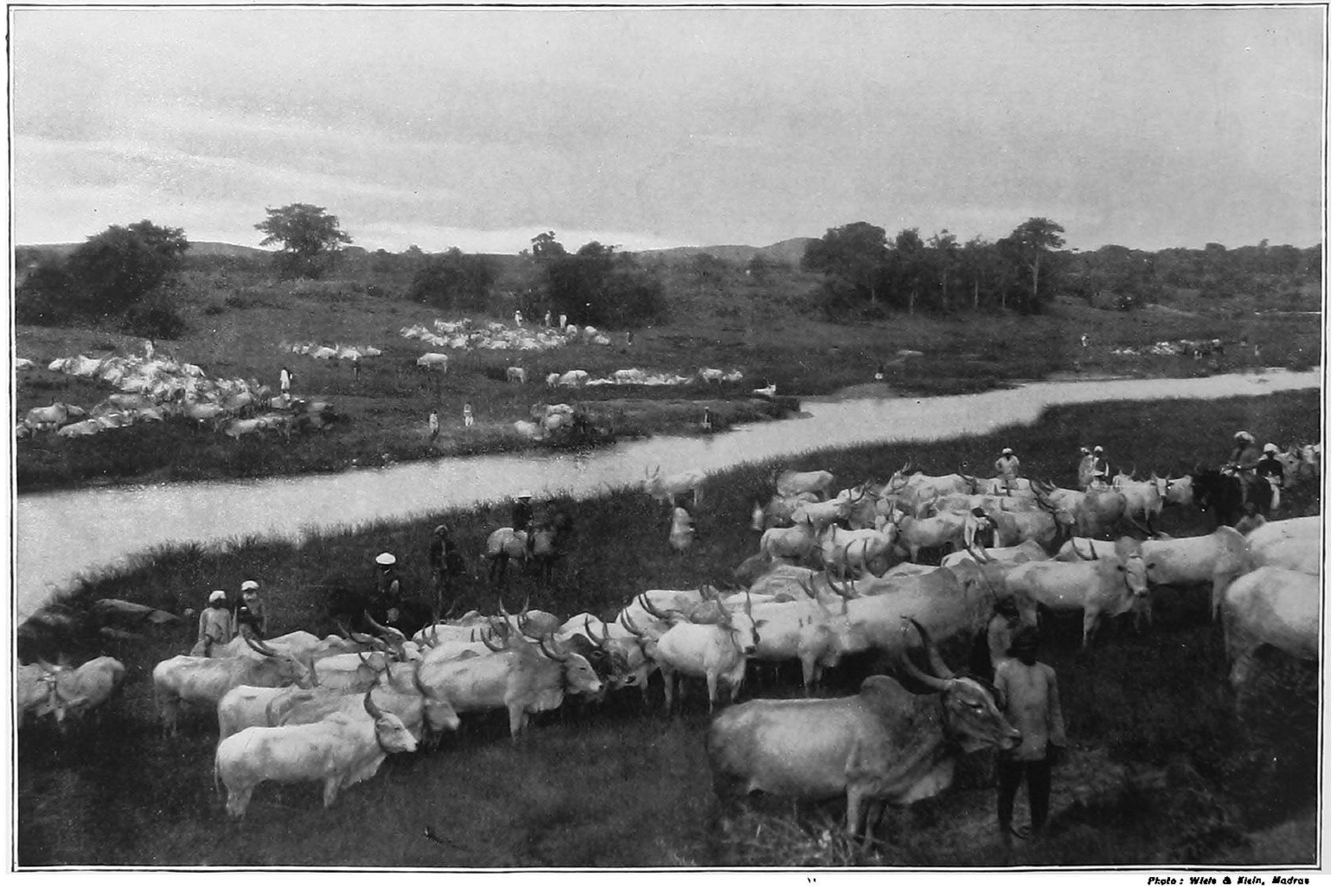
Hidden away in the little Himalayan town of Mukteshwar is a fascinating bit of science history. Cattle and livestock really mattered a lot in the pre-engine past, especially for transport and power,  on farms and in cities but also and especially for people in power. Hyder Ali and Tipu were famed and feared for their ability to move their guns rapidly, most famously, making use of bullocks, of the Amrut Mahal and Hallikar breeds. The subsequent British conquerors saw the value and maintained large numbers of them, at the Commissariat farm in Hunsur for instance.
The Commissariat Farm, Hunsur
Photo by Wiele & Klein, from: The Queen's Empire. A pictorial and descriptive record. Volume 2.
Cassell and Co. London (1899). [p. 261]
The original photo caption given below, while being racy, was most definitely inaccurate,
these were not maintained for beef :

BEEF   FOR   THE   BRITISH   ARMY.
It is said that the Turkish soldier will live and fight upon a handful of dates and a cup of water, the Greek upon a few olives and a pound of bread—an excellent thing for the commissariats of the two armies concerned, no doubt! But though Turk and Greek will be satisfied with this Spartan fare, the British soldier will not—not if he can help it, that is to say. Sometimes he cannot help it, and then it is only just to him to admit that he bears himself at a pinch as a soldier should, and is satisfied with what he can get. But what the British soldier wants is beef, and plenty of it : and he is a wise and provident commander who will contrive that his men shall get what they want. Here we see that the Indian Government has realised this truth. The picture represents the great Commissariat Farm at Hunsur in Mysore, where the shapely long-horned bullocks are kept for the use of the army.
Report of the cattle plague commission
led by J.H.B. Hallen (1871)


Imagine the situation when cattle die off in their millions - the estimated deaths of cows and buffaloes in 1870 was 1 million. Around 1871, it rang alarm bells high enough to have a committee examining the situation. Britain had had a major "cattle plague" outbreak in 1865 and so the matter was not unknown to the public. The generic term for the mass deaths was "murrain", a rather old-fashioned word that refers to an epidemic disease in sheep and cattle derived from the French word morine, or "pestilence," with roots in Latin mori "to die." A commission headed by Staff Veterinary Surgeon J.H.B. Hallen went across what would best be called the "cow belt" of India and noted among other things that the cattle in the hills were doing better and that rivers helped isolate the disease. Remarkably there were two little-known Indians members - Mirza Mahomed Ali Jan (a deputy collector) and Hem Chunder Kerr (a magistrate and collector). The report includes 6 maps with spots where the outbreaks occurred in each year from 1860 to 1866 and the spatial approach to epidemiology is dominant. This is perhaps unsurprising given that the work of John Snow would have been fresh in medical minds. One point in the report that caught my eye was "Increasing civilization, which means in India clearing of jungle, making of roads, extended agriculture, more communication with other parts, buying and selling, &c, provides greater facilities for the spread of contagious diseases of stock." The committee identified the largest number of deaths to be caused by rinderpest. Rinderpest has a very long history and the its attacks in Europe are quite well documented. There had been two veterinary congresses in Europe that looked at rinderpest. One of the early researchers was John Burdon Sanderson (a maternal grand-uncle of J.B.S. Haldane) who noted that the blood of infected cattle was capable of infecting others even before the source individual showed any symptoms of the disease. He also examined the relationship to smallpox and cowpox through cross-vaccination and examination for resistance. C.A. Spinage in his brilliant book (but with a European focus) on The Cattle Plague - A History (2003) notes that rinderpest belongs to the Paramyxoviruses, a morbillivirus which probably existed in Pleistocene Bovids and perhaps the first relative that jumped to humans was measles, and was associated with the domestication of cattle. The English believed that the origin of rinderpest lay in Russia. The Russians believed it came from the Mongols.
Gods slaandehand over Nederland, door de pest-siekte onder het rund vee
[God's lashing hand over the Netherlands, due to the plague disease among cattle]
Woodcut by Jan Smits (1745) - cattle epidemics evoked theological explanations
The British government made a grant of £5,000 in 1865 for research into rinderpest which was apparently the biggest ever investment in medical research upto that point of time. This was also a period when there was epidemic cholera epidemic, mainly affecting the working class, and it was noted that hardly any money was spent on it. (Spinage:328) The result of the rewards was that a very wide variety of cures were proffered and Spinage provides an amusing overview. One cure claim came from a Mr. M. Worms of Ceylon and involved garlic, onion, and asafoetida. Worms was somehow related to Baron Rothschild and the cure was apparently tested on some of Rothschild's cattle with some surprising recoveries. Inoculation as in small pox treatments were tried by many and they often resulted in infection and death of the animals.

As for the India scene, it appears that the British government did not do much based on the Hallen committee report. There were attempts to regulate the movement of cattle but it seems that the idea that it could be prevented through inoculation or vaccination had to wait. In the 1865 outbreak in Britain, one of the control measures was the killing and destruction of infected cattle at the point of import. This finally brought an end to outbreaks in 1867. Several physicians in India tried experiments in inoculation. In India natural immunity was noted and animals that overcame the disease were valued by their owners. In India natural immunity was noted and animals that overcame the disease were valued by their owners. In 1890 Robert Koch was called into service in the Cape region on the suggestion of Dr J. Beck. In 1897 Koch announced that bile from infected animals could induce resistance on inoculation. Koch was then sent on to India to examine the plague leaving behind a William Kolle to continue experiments in a disused mine building at Kimberley belonging to the De Beers. Around the same time experiments were conducted by Herbert Watkins-Pitchford and Arnold Theiler who found that serum from cattle that recovered worked as an effective inoculation. They however failed to publish and received little credit. Koch, a German, beating the English researchers was a cause of hurt pride.

The Brown Institution was destroyed in 1944
by German bombing
Interesting to see how much national pride was involved in all this. The French had established an Imperial Bacteriological Institute at Constantinople with Louis Pasteur as their leading light. This was mostly headed by Pasteur Institute Alumni. Maurice Nicolle and Adil-Bey were involved in rinderpest research. They demonstrated that the causal agent was small enough to pass through bacterial filters. In India, Alfred Lingard was chosen in 1890 to examine the problems of livestock diseases and to find solutions. Lingard had gained his research experience at the Brown Animal Sanatory Institution - whose workers included John Burdon Sanderson. About six years earlier, Robert Koch, a German, had caused more embarrassment to the British establishment by identifying the cholera causing bacteria in Calcutta. Koch had however not demonstrated that his bacteria isolate could cause disease in uninfected animals - thereby failing one of the required tests for causality that now goes by the name of Koch's postulates. There were several critiques by British researchers who had been working for a while on cholera in India - these included David Douglas Cunningham (who was also a keen naturalist and wrote a couple of general natural history books as well) and T.R. Lewis (who had spent some time with German researchers).  The British government (the bureaucrats were especially worried about quarantine measures for cholera and had a preference for old-fashioned miasma theories of disease) felt the need for a committee to examine the conflict between the English and German claims - and they presumably chose someone with a knowledge of German for it -  Emanuel Edward Klein assisted by Heneage Gibbes. Klein was also from the Brown Animal Sanatory Institution and had worked with Burdon Sanderson. Now Klein, the Brown Institution, Burdon Sanderson and many of the British physiologists had come under the attack of the anti-vivisection movement. During the court proceedings that examined claims of cruelty to animals by the anti-vivisectionists, Klein, an east European (of Jewish descent) with his poor knowledge of English had made rather shocking statements that served as fodder for some science fiction written in that period with evil characters bearing a close resemblance to Klein! Even Lingard had been accused of cruelty, feeding chickens with the lungs of tuberculosis patients, to examine if the disease could be transmitted. E.H. Hankin, the man behind the Ganges bacteriophages had also been associated with the vivisection-researchers and the British Indian press had even called him a vivisector who had escaped to India.

Lingard initially worked in Pune but he found the climate unsatisfactory for working on anti-rinderpest sera. In 1893 he moved the laboratory in the then remote mountain town of Mukteshwar (or Muktesar as the British records have it) and his first lab burnt down in a fire. In 1897 Lingard invited Koch and others to visit and Koch's bile method was demonstrated. The institution, then given the grand name of Imperial Bacteriological Laboratory was rebuilt and it continues to exist as a unit of the Indian Veterinary Research Institute. Lingard was able to produce rinderpest serum in this facility - producing 468,853 doses between 1900 and 1905 and the mortality of inoculated cattle was as low as 0.43%. The institute grew to produce 1,388,560 doses by 1914-15. Remarkably, several countries joined hands in 1921 to attack rinderpest and other livestock diseases and it is claimed that rinderpest is now the second virus (after smallpox) to have been eradicated. The Muktesar institution and its surroundings were also greatly modified with dense plantations of deodar and other conifers. Today this quiet little village centered around a temple to Shiva is visited by waves of tourists and all along the route one can see the horrifying effects of land being converted for housing and apartments.


The Imperial Bacteriological Laboratory c. 1912 (rebuilt after the fire)
In 2019, the commemorative column can be seen.
Upper corridor
A large autoclave made by Manlove & Alliott, Nottingham.
Stone marker
A cold storage room built into the hillside
Koch in 1897 at Muktesar
Seated: Lingard, Koch, Pfeiffer, Gaffky

The habitat c. 1910. One of the parasitologists, a Dr Bhalerao,
described parasites from king cobras shot in the area.

The crags behind the Mukteshwar institute, Chauli-ki-Jhali, a hole in a jutting sheet of rock (behind and not visible)
is a local tourist attraction.
Here then are portraits of three scientists who were tainted in the vivisection debate in Britain, but who were able to work in India without much trouble.
E.H. Hankin

Alfred Lingard

Emanuel Edward Klein


The cattle plague period coincides nicely with some of the largest reported numbers of Greater Adjutant storks and perhaps also a period when vultures prospered, feeding on the dead cattle. We have already seen that Hankin was quite interested in vultures. Cunningham notes the decline in adjutants in his Some Indian Friends and Acquaintances (1903). The anti-vivisection movement, like other minority British movements such as the vegetarian movement, found friends among many educated Indians, and we know of the participation of such people as Dr Pranjivan Mehta in it thanks to the work of the late Dr. S. R. Mehrotra. There was also an anti-vaccination movement, and we know it caused (and continues to cause) enough conflict in the case of humans but there appears to be little literature related to opposition to their use on livestock in India.

Further reading
Thanks are due to Dr Muthuchelvan and his colleague for an impromptu guided tour of IVRI, Mukteshwar.
Postscripts:
The Imperial Bacteriologist - Alfred Lingard in this case in 1906 - was apparently made "Conservator" for the "Muktesar Reserve Forest" and the 10 members of the "Muktesar Shikar Club" were given exemption from fees to shoot carnivores on their land in 1928. See National Archives of India document.
Klein, Gibbes and D.D. Cunningham were also joined by H.V. Carter (who contributed illustrations to Gray's Anatomy - more here).
28-1-2024: The Hebbal Serum Institute (another institution built during Leslie Coleman's tenure) was established in Bangalore around 1927 and produced two million doses of serum from 1927 to 1939.

Thursday, March 14, 2019

A buggy history

—I suppose you are an entomologist?—I said with a note of interrogation.
—Not quite so ambitious as that, sir. I should like to put my eyes on the individual entitled to that name! A society may call itself an Entomological Society, but the man who arrogates such a broad title as that to himself, in the present state of science, is a pretender, sir, a dilettante, an impostor! No man can be truly called an entomologist, sir; the subject is too vast for any single human intelligence to grasp.
The Poet at the Breakfast Table (1872) by Oliver Wendell Holmes, Sr. 

A collection of biographies
with surprising gaps (ex. A.D. Imms)
The history of Indian interest in insects has been approached by many writers and there are several bits and pieces available in journals and various insights distributed across books. There are numerous ways of looking at how people viewed insects over time. One of these (cover picture on right) is a collection of biographies, some of which are uncited verbatim accounts from obituaries (and not even within quotation marks). This collation is by B.R. Subba Rao who also provides a few historical threads to tie together the biographies. Keeping Indian expectations in view, both Subba Rao and the agricultural entomologist M.A. Husain play to the crowd in their early histories. Husain wrote in pre-Independence times where there was a need for Indians to assert themselves before their colonial masters. They begin with mentions of insects in ancient Indian texts and as can be expected there are mentions of honey, shellac, bees, ants, and a few nuisance insects. Husain takes the fact that the term Satpada षट्पद or six-legs existed in the 1st century Amarakosa to make the claim that Indians were far ahead of time because Latreille's Hexapoda, the supposed analogy, was proposed only in 1825. Such one-upmanship (or quests for past superiority in the face of current backwardness?) misses the fact that science is not just about terms but  also about structures and one can only assume that these authors failed to find the development of such structures in the ancient texts that they examined. Cedric Dover, with his part-Indian and British ancestry, interestingly, also notes the Sanskrit literature but declares that he is not competent enough to examine the subject carefully. The identification of species in old texts also leave one wondering about the accuracy of translations. For instance K.N. Dave translates a verse from the Atharva-veda and suggests an early date for knowledge on shellac. Dave's work has been re-examined by an entomologist, Mahdihassan. Another organism known in ancient texts as the indragopa (Indra's cowherd) supposedly appears after the rains. Some Sanskrit scholars have, remarkably enough, identified it, with a confidence that no coccidologist ever had, as the cochineal insect (the species Dactylopius coccus is South American!), while others identify it as a lac insect, a firefly(!) or as Trombidium (red velvet mites) - the last for matching blood red colour mentioned in a text attributed to Susrutha. To be fair, ambiguities in translation are not limited to those dealing with Indian writing. Dikairon (Δικαιρον), supposedly a highly-valued and potent poison from India was mentioned in the work Indika by Ctesias 398 - 397 BC. One writer said it was the droppings of a bird. Valentine Ball thought it was derived from a scarab beetle. Jeffrey Lockwood claimed that it came from the rove beetles Paederus sp. And finally a Spanish scholar states that all this was a gross misunderstanding and that Dikairon was not a poison, and - believe it or not - was a masticated mix of betel leaves, arecanut, and lime! 
 
One gets a far more reliable idea of ancient knowledge and traditions from practitioners, forest dwellers, the traditional honey-harvesting tribes, and similar people that have been gathering materials such as shellac and beeswax. Unfortunately, many of these traditions and their practitioners are threatened by modern laws, economics, and cultural prejudice. These practitioners are being driven out of the forests where they live, and their knowledge was hardly ever captured in writing. The writers of the ancient Sanskrit texts were probably associated with temple-towns and other semi-urban clusters and it seems like the knowledge of forest dwellers was never considered merit-worthy by the book writing class of that period.

A more meaningful overview of entomology may be gained by reading and synthesizing a large number of historical bits, and there are a growing number of such pieces. A 1973 book published by the Annual Reviews Inc. should be of some interest. I have appended a selection of sources that are useful in piecing together a historic view of entomology in India. It helps however to have a broad skeleton on which to attach these bits and minutiae. Here, there are truly verbose and terminology-filled systems developed by historians of science (for example, see ANT). I prefer an approach that is free of a jargon overload or the need to cite French intellectuals. The growth of entomology can be examined along three lines - cataloguing - the collection of artefacts and the assignment of names, communication and vocabulary-building - social actions involving the formation of groups of interested people who work together building common structure with the aid of fixing records in journals often managed beyond individual lifetimes by scholarly societies, and pattern-finding a stage when hypotheses are made, and predictions tested. I like to think that anyone learning entomology also goes through these activities, often in this sequence. Professionalization makes it easier for people to get to the later stages. This process is aided by having comprehensive texts, keys, identification guides and manuals, systems of collections and curators. The skills involved in the production - ways to prepare specimens, observe, illustrate, or describe are often not captured by the books themselves and that is where institutions play (or ought to play) an important role.

Cataloguing

The cataloguing phase of knowledge gathering, especially of the (larger and more conspicuous) insect species of India grew rapidly thanks to the craze for natural history cabinets of the wealthy (made socially meritorious by the idea that appreciating the works of the Creator was as good as attending church)  in Britain and Europe and their ability to tap into networks of collectors working within the colonial enterprise. The cataloguing phase can be divided into the non-scientific cabinet-of-curiosity style especially followed before Darwin and the more scientific forms. The idea that insects could be preserved by drying and kept for reference by pinning, [See Barnard 2018] the system of binomial names, the idea of designating type specimens that could be inspected by anyone describing new species, the system of priority in assigning names were some of the innovations and cultural rules created to aid cataloguing. These rules were enforced by scholarly societies, their members (which would later lead to such things as codes of nomenclature suggested by rule makers like Strickland, now dealt with by committees that oversee the  ICZN Code) and their journals. It would be wrong to assume that the cataloguing phase is purely historic and no longer needed. It is a phase that is constantly involved in the creation of new knowledge. Labels, catalogues, and referencing whether in science or librarianship are essential for all subsequent work to be discovered and are essential to science based on building on the work of others, climbing the shoulders of giants to see further. Cataloguing was probably what the physicists derided as "stamp-collecting".

Communication and vocabulary building

The other phase involves social activities, the creation of specialist language, groups, and "culture". The methods and tools adopted by specialists also helps in producing associations and the identification of boundaries that could spawn new associations. The formation of groups of people based on interests is something that ethnographers and sociologists have examined in the context of science. Textbooks, taxonomic monographs, and major syntheses also help in building community - they make it possible for new entrants to rapidly move on to joining the earlier formed groups of experts. Whereas some of the early learned societies were spawned by people with wealth and leisure, some of the later societies have had other economic forces in their support.

Like species, interest groups too specialize and split to cover more specific niches, such as those that deal with applied areas such as agriculture, medicine, veterinary science and forensics. There can also be interest in behaviour, and evolution which, though having applications, are often do not find economic support.

Pattern finding

The pattern finding phase when reached allows a field to become professional - with paid services offered by practitioners. It is the phase in which science flexes its muscle, specialists gain social status, and are able to make livelihoods out of their interest. Lefroy (1904) cites economic entomology in India as beginning with E.C. Cotes [Cotes' career in entomology was cut short by his marriage to the famous Canadian journalist Sara Duncan in 1889 and he shifted to writing] in the Indian Museum in 1888. But he surprisingly does not mention any earlier attempts, and one finds that Edward Balfour, that encyclopaedic-surgeon of Madras collated a list of insect pests in 1887 and drew inspiration from Eleanor Ormerod who hints at the idea of getting government support, noting that it would cost very little given that she herself worked with no remuneration to provide a service for agriculture in England. Her letters were also forwarded to the Secretary of State for India and it is quite possible that Cotes' appointment was a direct result.

Eleanor Ormerod, an unexpected influence
in the rise of economic entomology in India

As can be imagined, economics, society, and the way science is supported - royal patronage, family, state, "free markets", crowd-sourcing, or mixes of these - impact the way an individual or a field progresses. Entomology was among the first fields of zoology that managed to gain economic value with the possibility of paid employment. David Lack, who later became an influential ornithologist, was wisely guided by his father to pursue entomology as it was the only field of zoology with jobs. Lack however found his apprenticeship (in Germany, 1929!) involving pinning specimens "extremely boring".

Indian reflections on the history of entomology

A rather interesting analysis of Indian science is made by the first native Indian entomologist, with the official title of "entomologist" in the state of Mysore - K. Kunhikannan. Kunhikannan was deputed to pursue a Ph.D. at Stanford (for some unknown reason two pre-Independence Indian entomologists trained in Stanford rather than England - see postscript) through his superior Leslie Coleman. At Stanford, Kunhikannan gave a talk on Science in India. He noted in that 1923 talk :
In the field of natural sciences the Hindus did not make any progress. The classifications of animals and plants are very crude. It seems to me possible that this singular lack of interest in this branch of knowledge was due to the love of animal life. It is difficult for Westerners to realise how deep it is among Indians. The observant traveller will come across people trailing sugar as they walk along streets so that ants may have a supply, and there are priests in certain sects who veil that face while reading sacred books that they may avoid drawing in with their breath and killing any small unwary insects. [Note: Salim Ali expressed a similar view ]
Kunhikannan died at the rather young age of 47


He then examines science sponsored by state institutions, by universities and then by individuals. About the last he writes:
Though I deal with it last it is the first in importance. Under it has to be included all the work done by individuals who are not in Government employment or who being government servants devote their leisure hours to science. A number of missionaries come under this category. They have done considerable work mainly in the natural sciences. There are also medical men who devote their leisure hours to science. The discovery of the transmission of malaria was made not during the course of Government work. These men have not received much encouragement for research or reward for research, but they deserve the highest praise., European officials in other walks of life have made signal contributions to science. The fascinating volumes of E. H. Aitken and Douglas Dewar are the result of observations made in the field of natural history in the course of official duties. Men like these have formed themselves into an association, and a journal is published by the Bombay Natural History Association[sic], in which valuable observations are recorded from time to time. That publication has been running for over a quarter of a century, and its volumes are a mine of interesting information with regard to the natural history of India.
This then is a brief survey of the work done in India. As you will see it is very little, regard being had to the extent of the country and the size of her population. I have tried to explain why Indians' contribution is as yet so little, how education has been defective and how opportunities have been few. Men do not go after scientific research when reward is so little and facilities so few. But there are those who will say that science must be pursued for its own sake. That view is narrow and does not take into account the origin and course of scientific research. Men began to pursue science for the sake of material progress. The Arab alchemists started chemistry in the hope of discovering a method of making gold. So it has been all along and even now in the 20th century the cry is often heard that scientific research is pursued with too little regard for its immediate usefulness to man. The passion for science for its own sake has developed largely as a result of the enormous growth of each of the sciences beyond the grasp of individual minds so that a division between pure and applied science has become necessary. The charge therefore that Indians have failed to pursue science for its own sake is not justified. Science flourishes where the application of its results makes possible the advancement of the individual and the community as a whole. It requires a leisured class free from anxieties of obtaining livelihood or capable of appreciating the value of scientific work. Such a class does not exist in India. The leisured classes in India are not yet educated sufficiently to honour scientific men.
It is interesting that leisure is noted as important for scientific advance. Edward Balfour, also commented that Indians were "too close to subsistence to reflect accurately on their environment!"  (apparently in The Vydian and the Hakim, what do they know of medicine? (1875) which unfortunately is not available online)

Kunhikannan may be among the few Indian scientists who dabbled in cultural history, and political theorizing. He wrote two rather interesting books The West (1927) and A Civilization at Bay (1931, posthumously published) which defended Indian cultural norms while also suggesting areas for reform. While reading these works one has to remind oneself that he was working under Europeans and may not have been able to discuss such topics with many Indians. An anonymous writer who penned a  prefatory memoir of his life in his posthumously published book notes that he was reserved and had only a small number of people to talk to outside of his professional work. Kunhikannan came from the Thiyya community which initially preferred English rule to that of natives but changed their mind in later times. Kunhikannan's beliefs also appear to follow the same trend.

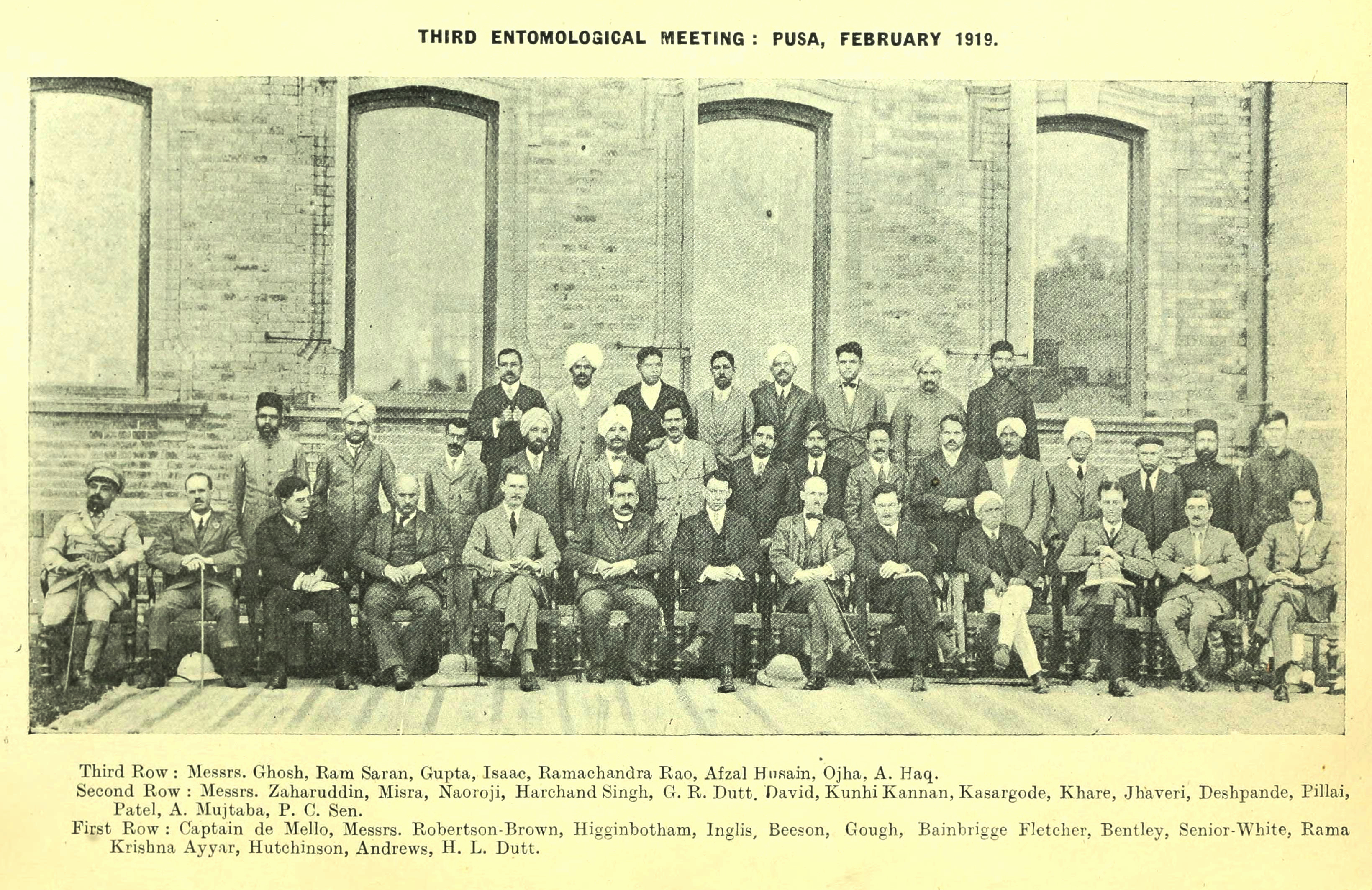
Entomologists meeting at Pusa in 1919
Third row: C.C. Ghosh (assistant entomologist), Ram Saran ("field man"), Gupta, P.V. Isaac, Y. Ramachandra Rao, Afzal Husain, Ojha, A. Haq
Second row: M. Zaharuddin, C.S. Misra, D. Naoroji, Harchand Singh, G.R. Dutt (Gobind Ram Dutt - Personal Assistant to the Imperial Entomologist. Studied several solitary wasps.), E.S. David (Entomological Assistant, United Provinces), K. Kunhi Kannan, Ramrao S. Kasergode (Assistant Professor of Entomology, Poona), J.L.Khare (lecturer in entomology, Nagpur), T.N. Jhaveri (assistant entomologist, Bombay), V.G.Deshpande, R. Madhavan Pillai (Entomological Assistant, Travancore), Patel, Ahmad Mujtaba (head fieldman), P.C. Sen
First row: Capt. Froilano de Mello, W Robertson-Brown (agricultural officer, NWFP), S. Higginbotham, C.M. Inglis, C.F.C. Beeson, Dr Lewis Henry Gough (entomologist in Egypt), Bainbrigge Fletcher, Charles A. Bentley (malariologist, Bengal), Senior-White, T.V. Rama Krishna Ayyar, C.M. Hutchinson, E. A. Andrews, H.L.Dutt


Entomologists meeting at Pusa in 1923
Fifth row (standing) Mukerjee, G.D.Ojha, Bashir, Torabaz Khan, D.P. Singh
Fourth row (standing) M.O.T. Iyengar (a malariologist), R.N. Singh, S. Sultan Ahmad, G.D. Misra, Sharma, Ahmad Mujtaba, Mohammad Shaffi
Third row (standing) Rao Sahib Y Rama Chandra Rao, D Naoroji, G.R.Dutt, Rai Bahadur C.S. Misra, SCJ Bennett (bacteriologist, Muktesar), P.V. Isaac, T.M. Timoney, Harchand Singh, S.K.Sen
Second row (seated) Mr M. Afzal Husain, Major RWG Hingston, Dr C F C Beeson, T. Bainbrigge Fletcher, P.B. Richards, J.T. Edwards, Major J.A. Sinton
First row (seated) Rai Sahib PN Das (veterinary department Orissa), B B Bose, Ram Saran, R.V. Pillai, M.B. Menon, V.R. Phadke (veterinary college, Bombay)
 

Note: As usual, these notes are spin-offs from researching and writing Wikipedia entries. It is remarkable that even some people in high offices, such as P.V. Isaac, the last Imperial Entomologist, grandfather of noted writer Arundhati Roy, are largely unknown (except as the near-fictional Pappachi in Roy's God of Small Things)

Further reading
An index to entomologists who worked in India or described a significant number of species from India - with links to Wikipedia (where possible - the gap in coverage of entomologists in general is large)
(woefully incomplete - feel free to let me know of additional candidates)

Carl Linnaeus - Johan Christian Fabricius - Edward Donovan - John Gerard Koenig - John Obadiah Westwood - Frederick William Hope - George Alexander James Rothney - Thomas de Grey Walsingham - Henry John Elwes - Victor Motschulsky - Charles Swinhoe - John William Yerbury - Edward Yerbury Watson - Peter Cameron - Charles George Nurse - H.C. Tytler - Arthur Henry Eyre Mosse - W.H. Evans - Frederic Moore - John Henry Leech - Charles Augustus de Niceville - Thomas Nelson Annandale - R.C. WroughtonT.R.D. Bell - Francis Buchanan-Hamilton - James Wood-Mason - Frederic Charles Fraser  - R.W. Hingston - Auguste Forel - James Davidson - E.H. AitkenO.C. Ollenbach - Frank Hannyngton - Martin Ephraim Mosley - Hamilton J. Druce  - Thomas Vincent Campbell - Gilbert Edward James Nixon - Malcolm Cameron - G.F. Hampson - Martin Jacoby - W.F. Kirby - W.L. DistantC.T. Bingham - G.J. Arrow - Claude Morley - Malcolm Burr - Samarendra Maulik - Guy Marshall
 
 - C. Brooke Worth - Kumar Krishna - M.O.T. Iyengar - K. Kunhikannan - Cedric Dover

PS: Thanks to Prof C.A. Viraktamath, I became aware of a new book-  Gunathilagaraj, K.; Chitra, N.; Kuttalam, S.; Ramaraju, K. (2018). Dr. T.V. Ramakrishna Ayyar: The Entomologist. Coimbatore: Tamil Nadu Agricultural University. - this suggests that TVRA went to Stanford at the suggestion of Kunhikannan.

Feb-2025: See dedication to Ormerod in Maxwell-Lefroy's Indian Insect Pests (1906).

2025: Found a book called The British Foundation of Indian Entomology (2023) - by Michael Darby. Includes bits on Howlett, including his portrait, lifted straight out of Wikipedia - something that took several years until I discovered that portrait while browsing an obscure Indian agriculture periodical!