click hide image

Showing posts with label biodiversity heritage library. Show all posts

Sunday, July 10, 2022

The pseudonymous shikari

 Early colonial Indian shikar literature is filled with authors hiding behind pseudonyms like "Civilian", "Mountaineer", "Hawkeye", "Silver hackle", "Felix", or "Maori", and I have often wondered whether this was more than just fashion. Perhaps the authors truly wanted to keep their whereabouts private lest their employers or others find fault with them. At least in the case of "Mountaineer", there seems to have been a real need for staying low. I was surprised to find that there are at least two major biographies of "Mountaineer" which I think do not deal sufficiently with his life in the Indian wilderness and are easily missed if one does not make the connection between Frederick "Pahari" Wilson and Shikari Wilson alias Mountaineer. 
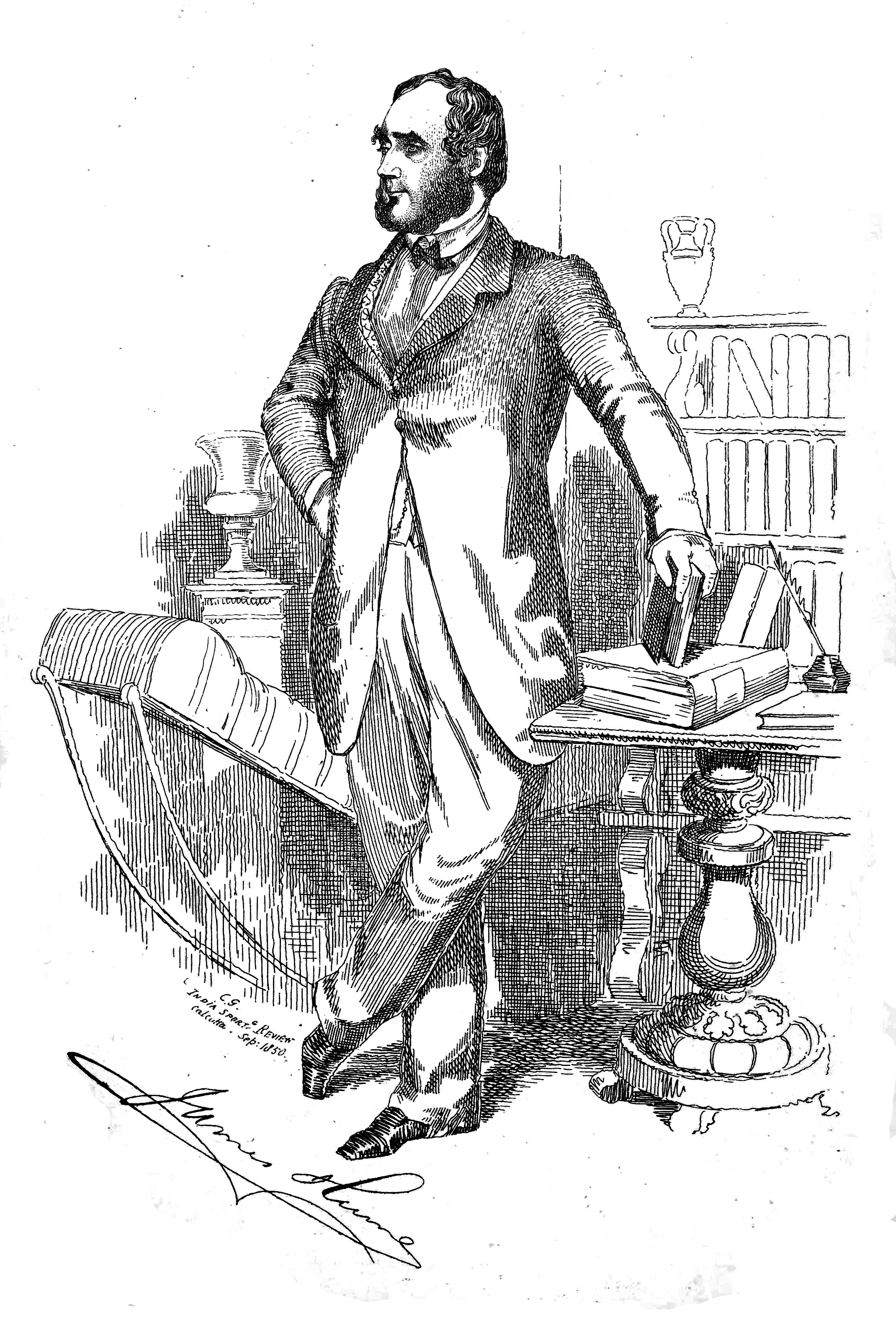
James Hume, A. O. Hume's cousin, sketched by the
Calcutta artist and animal rights pioneer
Colesworthey Grant

Frederick Wilson left life in the East India Company army and went AWOL, supposedly with just five rupees and his brown bess, to hide away in the Himalayas, well before the 1857 uprising. It would appear that he made himself useful during 1857 and received a pardon after which he moved back into the company of his own countrymen. Much of the romanticism associated with him is for his having gone native and styling himself the Raja of Harsil. Wilson made money by denuding the Himalayan forests, cutting down old growth forests and floating timber down the rivers, setting up sawmills in the lower valleys and selling them off to feed the voracious appetite of the early railways. He shot wildlife freely and wrote about his exploits under the pen-name "Mountaineer" - the largest output being to the India Sporting Review - now a very hard-to-find periodical. This magazine was edited by James Hume, a magistrate in Calcutta, with whom the young Allan O. Hume stayed when he first arrived in India in 1849. Now the historian S. R. Mehrotra who passed away a few years ago noted that it was with his Calcutta cousin that he saw the first protest of the Europeans against changing laws. And his cousin James was among the few who did not support the Europeans. (I am unable to see the historical context of the so-called white mutiny of 1849 that Mehrotra refers to) Shikari Wilson was clearly a close friend of James Hume and still later Allan as well. Wilson is said to have shot 1000 to 1500 male monals a year for the sale of their plumage during the height of the plume trade. Brooks travelled along the Bhagirathi river valley in 1875 and noted that monal populations could recover now that Wilson had left them alone! Brooks also recorded the price paid for a monal - Rupees 2 and 8 annas.
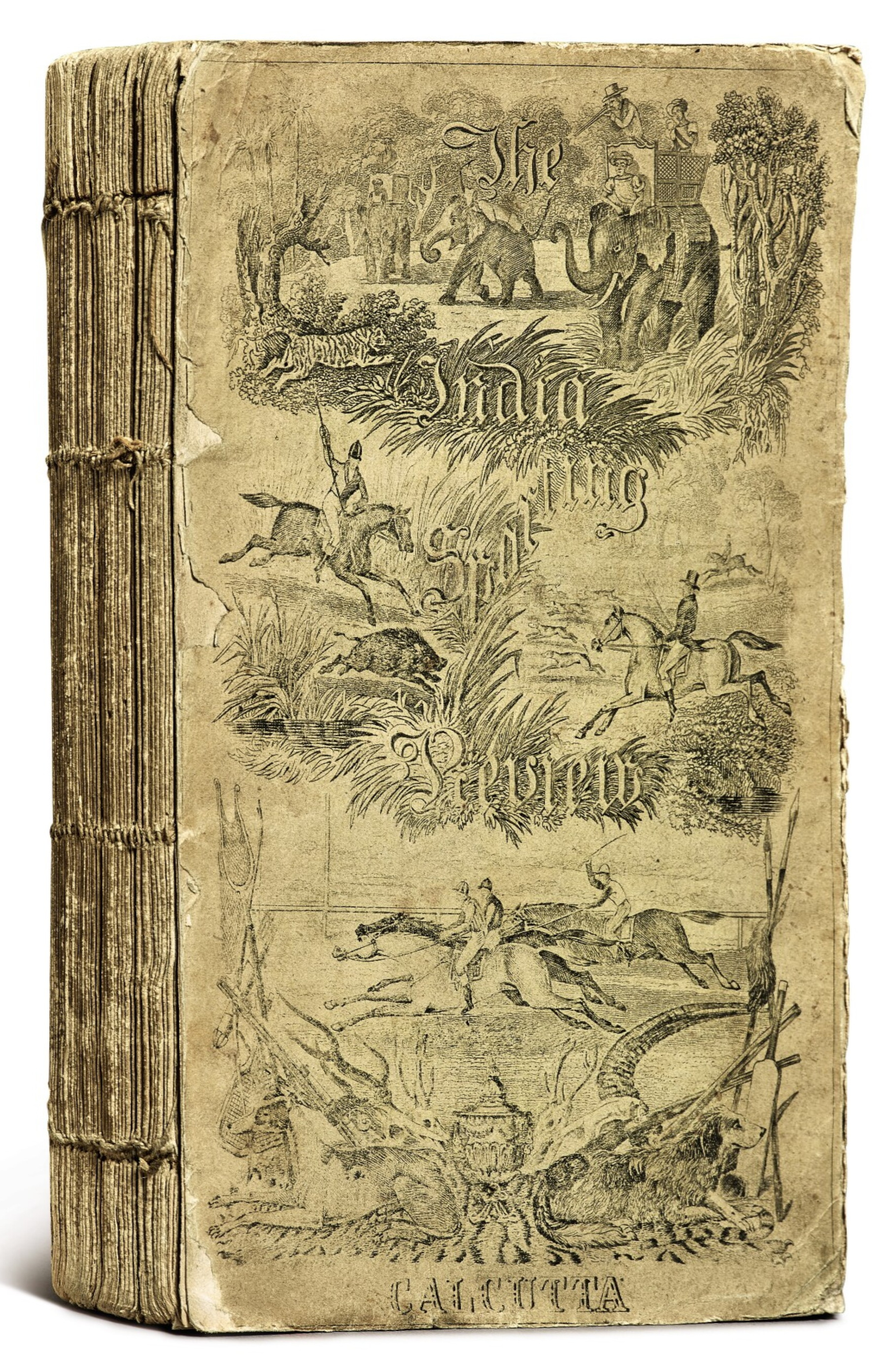
The India Sporting Review
A work that ought to be digitized for posterity

Attempts to get the Biodiversity Heritage Library to locate a set of the India Sporting Review have all failed. It is however claimed by cricket historian Boria Majumdar that he has a complete set of the India Sporting Review as part of the Fannatic Sports Museum. It would be amazing indeed if this set could be digitized for wider research access. Then perhaps we will all be able to read more of Mountaineer Wilson.


Frederick "Pahadi" Wilson's bungalow in Harsil
which burned down in 1997
The figures in the foreground are Wilson and his brother-in-law
Mungetu Chand.
 

Journalist Robert Hutchinson wrote book on Wilson after hearing about him from Sundarlal Bahuguna and D.C. Kala wrote another book on Hulson Sahib. Jack Gibson of Doon School found Wilson coinage being used for gambling when hiking in the region in 1938. Ruskin Bond knew the last descendant of Wilson. Few however seem to have actually looked at Wilson's environmental impact carefully enough.

Tuesday, June 23, 2020

Some American links to Indian ornithology

One of the joys of being in India is the complete lack of access to a good library, and that makes one keep a list of books to find so that you know how to make the best of limited time when one get an opportunity to visit a well-stocked library. It took me nearly ten years before I finally managed to browse through Max Nicholson's Art of Birdwatching (1931) on a brief visit to the library of the Zoological Society of London. I had been looking for the context in which he had talked about how a so-called "open mind" was absolutely useless for scientific enquiry [a belief that starkly contradicts the argumentative Indian].
"One cannot observe without a theory, and what seems the simplest of ornithological tasks - to go out of doors and look out for something worth recording - is in reality one of the hardest… It is a mistake to imagine that complete impartiality and freedom from preconceived ideas is the qualification for the perfect observer. The cow has a remarkably open mind, yet it has never been found to reach a high degree of civilisation."

Nicholson also inspired another writer across the Atlantic. This was Joseph Hickey, a student of literature who moved to ornithology. I had heard of his work through a rather tenuous series of connections.

From The Auk
One of the leading lights of bird study and popularization in India, Dr Joseph George, a major influence on the Bangalore bird-enthusiasts circle, had undertaken several of his earliest and pioneering studies on bird populations in Dehra Dun. In 1948, a Mrs M.D. Wright conducted a census of birds in Dehra Dun and wrote out her observations in the Journal of the Bombay Natural History Society. One of her inspirations was the book by Joseph Hickey, A Guide to Birdwatching (1943). It is unclear if Dr George actually took part in her census but she influenced his own studies in Dehra Dun (since he cites her work) and they doubtless met and I strongly believe that Dr George actually read this book too given his own censuses of birds in Dehra Dun. It was not until a few weeks ago that I got my hands on Hickey's book thanks to the Internet Archive and their emergency pandemic-response library which allows in-copyright books to be borrowed and read online. Now Hickey was influenced by many giants including Ernst Mayr and Aldo Leopold. He recounted among his ornithological mantras, the one from Ernst Mayr about having a long term line of enquiry while watching birds - in Mayr's words "everybody's got to have a problem". On the first person Hickey met on the field watching birds, he writes:
The pleasures of meeting a kindred spirit are much more subjective but they are nonetheless real and they often ripen into lifelong friendships. In grade school it never occurred to my chums or to me that bird books were written for anyone other than boys, and that grown men and women liked to watch flickers and killdeers just the way we did. Our beloved scoutmaster, the Reverend Basil Hall, had given some of us a helping hand, but bird study still seemed like a boys' game. It was an almost stupefying shock when Richard A. Herbert and I, aged 14, quite by accident found an elegantly dressed gentleman watching a chickadee one February day in New York City's Bronx Park. Charles Johnston, who looked not unlike Charles Evans Hughes to us, had been a distinguished member of the British Civil Service in India. He was kindly and apparently ready to answer questions. He answered them for two full hours, probably with no little amusement. The decades between us seemed to vanish and from that point on, our bird study took on dignity and purpose. He helped us many times more in the years that followed.
I tell this story to illustrate how an interest in ornithology can span any barrier, and how people of widely diverse cultures can rapidly find a common bond of understanding. There are several ways to get in touch with other bird students. One is to attend meetings.

Now an Indian Civil Servant interested in birds had to be examined and I searched the internet for Charles Johnston and found one that was interested in theosophy (but the Wikipedia entry then had no mention of any interest in natural history). I found also that a Johnston had been active in New York birding circles but was not sure if the two were the same until I found an entry on the Theosophy Wiki. The other major Theosophist (at least briefly) and ornithologist was Hume and I had to check for encounters between the two. It seems that the two could not have been in great contact. Johnston  married the niece of Madame Blavatsky (with whom Hume had fallen out) and entered the Indian Civil Service only in 1888, well after Hume's exit from government service. Johnston worked only for two years before suffering from malaria led to his resignation and he moved to the United States in 1896 after treatment in Austria. His close friends in New York included fellow theosophists W. Q. Judge and Clement Acton Griscom, Jr. (1868-1918) who was the father of the ornithologist Ludlow Griscom. It would appear (esp. from the absence of any mention in the Bombay Natural History Society journal) that Johnston began his serious bird studies only in the United States and may well have been an important influence in Griscom's life. Allan Cruickshank's Birds around New York city (1942) includes many notes by Johnston, who is described as an "experienced and meticulous observer" (p. 289).

Recommended reading
  • Hickey, Joseph (1975). A guide to bird watching. New York:Dover. [This Internet Archive copy (which can be borrowed) is signed by Hickey. This book was his master's work, under the supervision of Aldo Leopold!]
Postscript
Dr Joseph George  (1st October 1921 – 9th July 2012) was educated at St Joseph's College, Trichy and at St. John's College, Agra, He researched polymer chemistry under Herman Francis Marks  at the Brooklyn Polytechnic Research Institute between 1946 and 1948, returning to the Forest Research Institute at Dehra Dun. He worked for a while at the CBRI, Roorkee and at IPIRI, Bangalore.

Sunday, January 6, 2019

A forgotten upheaval

Among the many amazing stories from India that went into the pages of science is that of Sindri fort. It is hardly mentioned in India anymore but it was of interest to Charles Lyell whose work was significant for Charles Darwin. This fort sank along with a large area around it on 16 January 1819 around 6.45 PM when the region was struck by an earthquake that also caused a tsunami. While this region sank, the northern edges a few kilometers away rose up. It formed a feature that was named as Allah Bund. It apparently became, for a while, a standard textbook example demonstrating a dynamic earth, one that was no longer God's static creation but one where sudden and catastrophic changes could occur. Some years ago, when I learned about the significance of this location in the history of geology and evolutionary thought, I decided that it needed a bit more coverage and began an entry in Wikipedia - Sindri Fort. When referring to geographical entities, Wikipedia articles can also be marked by coordinates (so as to show up on maps) but I had a lot of trouble figuring out where this fort stood, and having never been anywhere near Gujarat, I had set it aside after some fruitless searches across the largely featureless Rann of Kutch as seen on Google Earth. Today, I happened to look up the work of a geologist A.B. Wynne and found that he had mapped the region in 1869 (along with the very meticulous people from the Survey of India). Fortunately, the Memoirs of the Geological Survey have recently been scanned by the Biodiversity Heritage Library and are readily available online. I downloaded the four map pages and stitched them into one large map which I then uploaded the map to Wikimedia Commons (the shared image repository of Wikipedias in various languages) at https://commons.wikimedia.org/wiki/File:Kutch_geology.jpg and then altered the metadata template from one for information to "map" instead - this then allowed the image to be transferred to the MapWarper (an open-source system) installation at https://warper.wmflabs.org/ - finding a few corresponding points on the old map and a geo-referenced base map allowed me to overlay the image atop Google Earth by exporting a kml file of the alignment.
 
Wynne's 1869 map of the region (stitched)

 
I then looked up Google Earth to see what lay under the location of the ruins of the Sindri Fort indicated on the old map from 1869 and not very far (within a kilometer) from the marked location, lo and behold, there were faint traces of a structure which would be right where Sindri Fort stood. So here it is for anyone interested. It is quite possible that the location is well-known to locals, but it was still quite thrilling that one could work this out from afar thanks to the accessibility of information. It would not have been possible but for a combination of Wikipedia, the Biodiversity Heritage Library, the Internet Archive, Google Earth, the Warper project, and the numerous people behind all these who are working not just as researchers but as research enablers.


It would seem that this was not visible until the imagery of 2013 became available.

More information

Sunday, December 4, 2011

Trichinopoly talc

Some months ago, I needed to look at an old work on Indian birds - Illustrations of Indian Ornithology printed in 1847 at Madras. It was privately published by Dr Thomas Caverhill Jerdon who is most famously associated with Jerdon's Courser. Being privately published meant that very few copies of the book were printed. If any are left in Indian collections, they are most likely in a bad state if not vandalized and sold off to collectors and in any case these are inaccessible to ordinary citizens interested in researching them. This work included paintings made by Indian artists. In An Indian Olio (1888), Lt-Gen. E F Burton (page 61)  mentions that Jerdon hired native artists at Trichinopoly and taught them to produce natural history illustrations. These artists traditionally painted on talc (actually mica which came from Bihar and Bengal) and rice paper, making portraits of local chiefs and royalty. For samples of these mica paintings from Trichinopoly see here and here. The author noted further that :
Under Dr. Jerdon's teaching these people became apt in faithful and laborious representations of the feathered tribes, and attained a really high pitch of excellence. With true Hindoo patience, every feather - nay, every vane and cirrus of each feather - was separately and truly shown; the pictured bird was a laboured and exact presentment of the bird itself. These were painted on rice paper or on sheets of talc.
These comments made me want to see these paintings badly. The Biodiversity Heritage Library is an incredible project. Despite being an enormous project, they have a place where the lay public can make requests and I made one. A few days ago, I noticed that the Library had scanned this work and it was all suddenly accessible. Some of the plates are signed by C V Kistnarajoo while several others appear to have been redone in London. Jerdon however noted that all the originals were made by "natives".

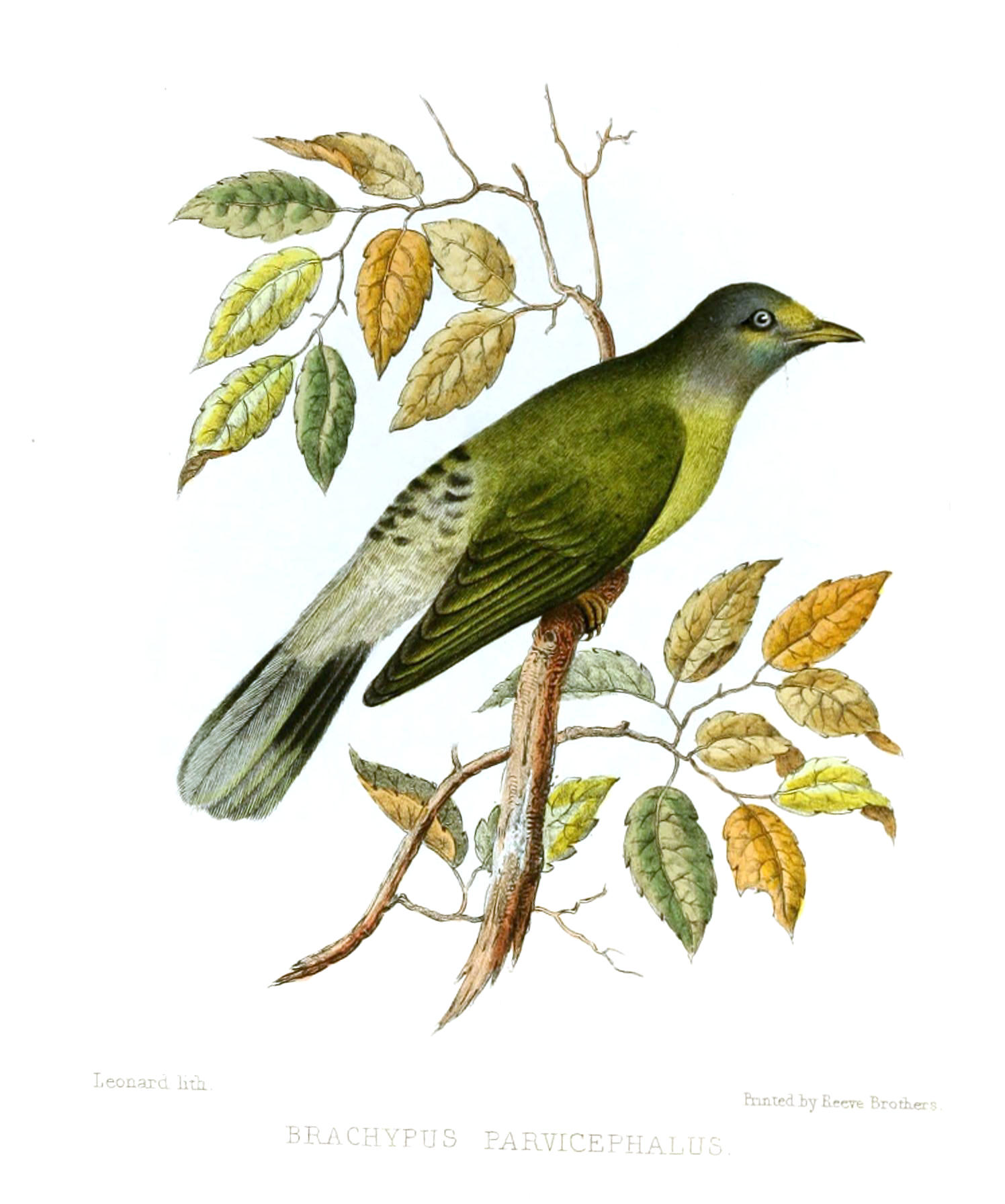
Among these interesting paintings is one of the Grey-headed Bulbul and is captioned as "Brachypus parvicephalus" - a spelling that does not even seem to be noted in major taxonomic synopses. This could however be an error of the artist (a certain Leonard) as the text uses "poioicephalus". Interestingly a French work from around the same time - on the voyage of the Bonita - described the species under the name of Ixos fisquetti, again a name missed in taxonomic works. Burton's description of the paintings needs to be interpreted on the basis of the styles of the time and the technology used for printing. These pictures, at least the lithographs, are not very spectacular by modern standards or even by the later standards set by Keulemans, Smit and Wolf. But I am impressed by how well the shades of blue have been retained since 1847. The images shown here are digitally enhanced and include white level corrections and increased contrast.

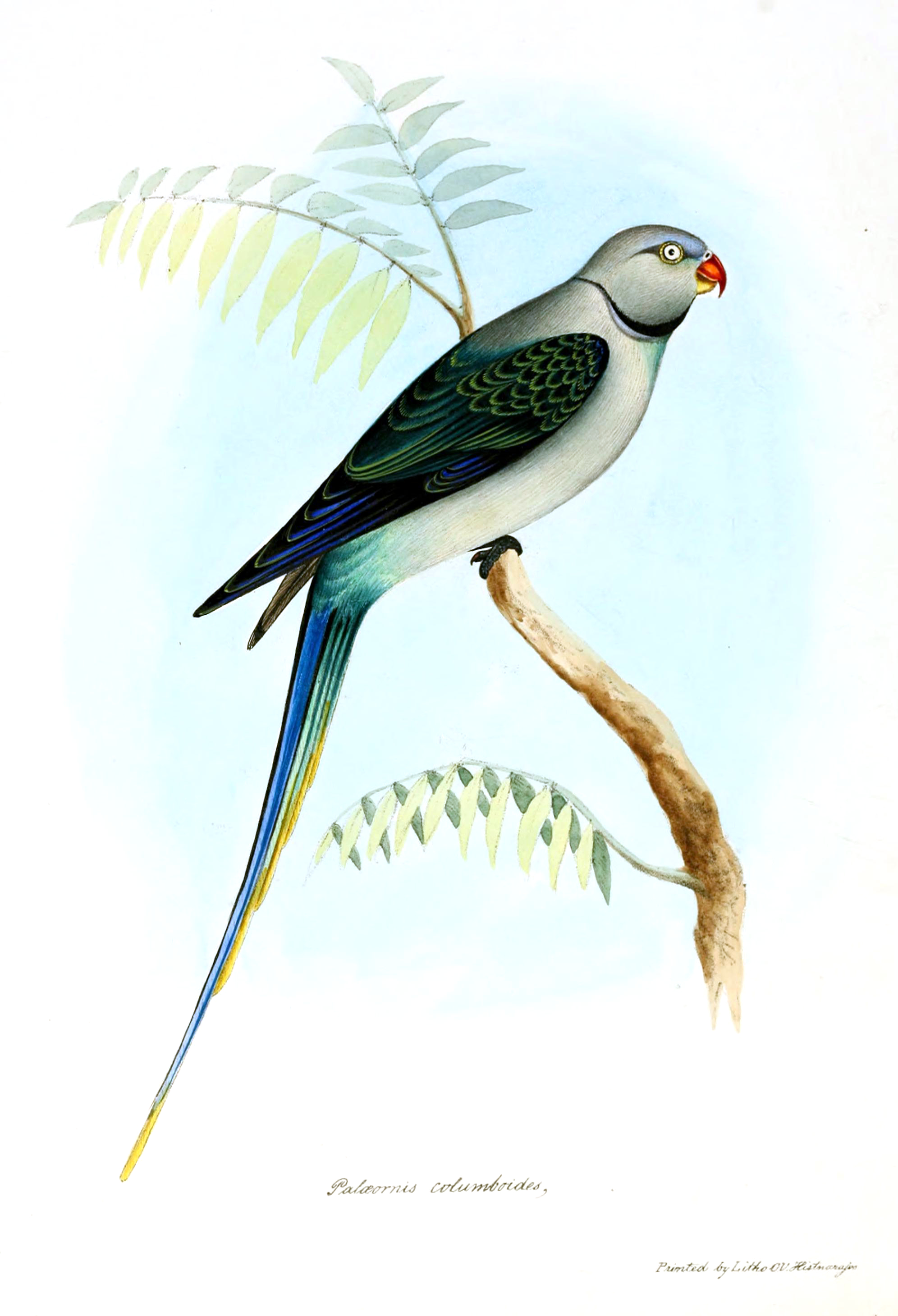
My choice for the best of Kistnarajoo's work would be for the Blue-winged Parakeet Psittacula columboides - which makes use of a range of blue shades.

One of the species that Jerdon described was once common in Bangalore. Its identity had however troubled many Bangalore birders in the past. It is now known as Mirafra affinis - only recently reinstated as a full species (formerly as Mirafra assamica affinis) and known as Jerdon's Bushlark. A recent trip to Pune courtesy of Colonel Ashwin Baindur allowed me to see what was I think was a proper Mirafra erythroptera - at least it was quite distinctly different in call and appearance from the commonest bushlark in Bangalore. Jerdon's notes in his Illustrations state that the two are entirely distinguishable from the shape and dimensions of the beak. Jerdon also seems to have guessed the southern boundary of M. erythroptera quite accurately.

Publishing these works probably contributed to Jerdon being pushed into debt and it is said that he died insolvent. We however owe a debt to Jerdon for all these works. He was instrumental in rallying, along with big names like Darwin and Hooker, for the project that produced the Fauna of British India - a work that continues to be indispensable even today. Jerdon was also a part of the scholarly group that brought in ideas of conservation leading to the establishment of the forest department in India. His role was noted in a widely cited article (Grove, Richard H. (1992). “The Origins of Western Environmentalism,” Scientific American 267(1, July), 42-47) which included a photograph of Jerdon and others taken by Samuel Bourne. Jerdon has not been forgotten yet, and there has just been a publication of an interesting piece of detective work on that same photograph to determine the identities of the people in it - Notie, HJ (2011) A botanical group in Lahore, 1864. Archives of natural history. 38(2):267-277.


White-cheeked Barbet

Pink-headed Duck

White-winged Tit

For more images see Wikimedia Commons.

Postscript

Many years ago, I came across a handwritten manuscript called the "Lepidoptera of Kanara" written by a certain Samuel Neville Ward. I also knew of Jerdon's name for the Pied Thrush (Zoothera wardii) (more info on the Wikipedia link) which he named after a S. N. Ward of the Madras Civil Service. And this year (2012) I happened to notice a memorial at the entrance of the St. Stephen's Church at Ootacamund to the son of this S. N. Ward! Apparently S. N. Ward was a magistrate at Sirsi and he presented his illustrations of lepidopteran caterpillars on their host plants to the NHM.

Memorial for S N Ward's son
Zoothera wardii based on a drawing
by S. N. Ward, background by Samuel Best
S. N. Ward has been said to have been born in 1813 and died 1897. A news report - Morning Post 23 July 1887 notes the death of Mary Catherine on the 16th at Clive Dale, Steyning, wife of S. N. Ward, late of the Madras Civil Service.

Memorial to Samuel Best from St. George's Cathedral Madras. Best drew the background for Jerdon's illustration of the pied thrush.

Samuel Best (c. 1808-5 October 1851) Captain, Madras Engineers: entered the service in 1826 : Secretary to the Board of Revenue in the P.W.D., 1842 : planned the Singapore fortifications, and was made Superintendent of roads in Madras, 1845 : under him road-making was very well managed under fixed rules : he executed many important works in the Madras Presidency : such as the Southern Trunk Road and the Goolcheroo Pass : and made valuable contributions to the Madras Literary Transactions and the Madras Engineering papers : died of jungle fever at Chitore on his return from the hills, Oct. 5, 1851.