click hide image

Showing posts with label bangalore. Show all posts

Tuesday, August 23, 2022

IPS: The Indian Pigeon Service


A dear friend shared this documentary "War of the Birds" which includes some rather interesting stories on pigeons used in World War II. This led me to revisit something that I had come across in the past rather briefly. There was an Indian Pigeon Service which was part of the Signal Corps which was active towards the 1940s. Rather little has been written about them - although there was a manual that is unfortunately not available in online archives "Indian Pigeon Service. A manual of instruction on the use of homing pigeons in India and South East Asia. Booklet, Feb 1945 - published by the Chief of the General Staff, Delhi, Feb 1945"- and some letters have been reproduced here and here.

But this makes another bit even more surprising - there were attempts much earlier on introducing homing pigeons in the army and those early experiments were done in Bangalore by the 19th Hussars who set up something called the Assaye Flying Club, a report on which was made in the Lincolnshire Echo of 13 December 1894! 

Perhaps someone with access to army archives can find more.


Tuesday, April 7, 2020

Ornithologists in cartoons

From: The Graphic. 25 April 1874.
It is said that the modern version of badminton evolved from a game played in Poona (some sources name the game itself as Poona). When I saw this picture from 1874 about five years ago, I gave little thought to it. Revisiting it after five years after some research on one of A.O. Hume's ornithological collaborators, I have a strong hunch that one of the people depicted in the picture is recognizable although it is not going to be easy to confirm this.

I recently created a Wikipedia entry for a British administrator who worked in the Bombay Presidency, G.W. Vidal, when I came across a genealogy website (whose maintainer unfortunately was uncontactable by email) with notes on his life that included a photograph in profile and a cartoon. The photograph was apparently taken by Vidal himself, a keen amateur photographer apart from being a snake and bird enthusiast. Like naturalists of that epoch, many of his specimens were shot, skinned or pickled and sent off to museums or specialists. He was an active collaborator of Hume and contributed a long note in Stray Feathers on the birds of Ratnagiri District, where he was a senior ICS official. He continued to contribute notes after the ornithological exit of Hume, to the Journal of the Bombay Natural History Society. This gives further support for an idea I have suggested before that a key stimulus for the formation of the BNHS was the end of Stray Feathers. Vidal's mother has the claim for being the first women novelist of Australia. Interestingly one of his daughters, Norah, married Major Robert Mitchell Betham (2 May 1864 – 14 March 1940), another keen amateur ornithologist born in Dapoli, who is well-known in Bangalore birding circles for being the first to note Lesser Floricans in the region. Now Vidal was involved in popularizing badminton in India, apparently creating some of the rules that allowed matches to be played. The man at the left in the sketch in the 1874 edition of The Graphic looks quite like Vidal, but who knows! What do you think?

PS: Vidal sent bird specimens to Hume, and at least two subspecies have been named from his specimens after him - Perdicula asiatica vidali and Todiramphus chloris vidali.

For more information on Vidal, do take a look at the Wikipedia entry. More information from readers is welcome as usual.

PS: 26-July-2020: It would appear that an old Fives court (Fives was something like squash played with the bare hand) near Sholapur was also of some ornithological interest [on lesser florican]:
I think I can safely say that there is only one place in India where this bird has been shot, and where I have shot it during every month in the year, and that is Sholapur. There was a grass and baubul jungle near the old Fives court on the Bijapur Road which always contained florican. - "Felix" (1906). Recollections of a Bison & Tiger Hunter. London:J.M. Dent & Co. p. 183.

Saturday, April 19, 2014

A not-so-great hedge

Many would have heard about the "Great Hedge of India" or the book on it by Roy Moxham. This was supposedly a British innovation started in 1803, meant primarily to block the free movement (a.k.a. "smuggling") of salt so as to be able to impose a salt tax or customs duty. It was also referred to as the  "Customs Hedge" (e.g. in Hume's Nests and Eggs ... ). The idea of live hedges appears however to be much older in India and is probably lifted from the Mysore and Madras regions.

Bound-Hedge, s. A corruption of boundary-hedge, and applied in old military writers to the thick plantation of bamboo or prickly-pear which used to surround native forts.
 1792-"A Bound Hedge, formed of a wide belt of thorny plants (at Seringapatam)."- Wilks, Historical Sketches, iii. 217. [Hobson-Jobson]

Dr. M.B. Krishna recently forwarded an old map of Bangalore (originally from the British Library collection)  made in 1800 by a certain James Ross (more on this man in the footnote) under the command of Colin Mackenzie (who pops up yet again!) and it shows a nearly circular hedge marked as the "Bound Hedge of the Cusba of Bangalore". A little research showed that this defence was a widespread practice in the Mysore and Coromandel regions. Thorny plants and some Euphorbia patches are found around the Nandi Hills and Savandurga and it is possible that some of them are really old remnants worthy of special protection. The hedge around Bangalore is perhaps less known.

Here is the relevant part of this very interesting map. The lake at the top with the bund along the road is presumably Hebbal lake. "Yesmunjepoor" is probably Yeshwanthpur.

The Bound Hedge of the Cusba of Bangalore (1800)

It seems like Bangalore just grew over this, leaving no remnants of this hedge. It would seem like the hedge either passed through or went very close to the campus of the Indian Institute of Science. There were some patches of Acacia and bad land that may have been part of this but it is also likely that some of these were cleared up to become parts of roads that we have today. 

Looking up more on this "bound hedge" led to several bits and it seems to be very specific to India. Most deal with the "bound hedge" around Tipu's fort at Srirangapatnam or the one around Pondicherry. Sidney (1868) writes about the "bound hedge" around Madras, which apparently was being extended around 1758 according to Barlow (1921) but may have been even older as it finds mention in 1748 in the diary of Ananda Ranga Pillai.

It is said that the town of Conjevaram was surrounded by a bound hedge "chiefly of agave americana" (Hamilton, 1820) but that sounds like an unlikely jump for a New World plant for that point of time. For a more detailed botanical description of the bound hedge at Srirangapatnam, see Pennant:

"The Bound hedge, the frequent concomitant of the fortresses of Hindoostan, appears here in great strength. It is the practice in the Polygar system of defence, and copied by the civilized natives from the wild warriors of the forests. Of the latter, the fort of Calicoil and that of Palam Courchy are strong examples.... These local defences are formed of every thorny tree or caustic plant of the climate. Palmira trees, or the Borassus flabelliformis, are the primary. These are planted to the depth of from thirty to fifty feet. In the interstices of the trees, which are very closely placed, are confusedly sown or set, the following plants. Pandanus odoratissimus, or wild pine; see my preceding volume, p.241; Cactus tuna, Euphorbia Tiraculla, or milky hedge. The juice of this is so caustic as to scald not only the human skin, but the hide of a horse, on whom it may fall in forcing through this infernal hedge. Several other sorts of Euphorbia; The Aloe littoralis of Koenig, Convolvulus muricatus, and other Convolvuli. The Mimosa cinerea, horrida, instia, and another, as yet undescribed, armed with most dreadful thorns. The Guiliadina unite their powers; intermixed is the Guiliadina Bonducella, G. bonduc, and another not laid before the public, to which Koenig gives the epithet lacinians, which it fully merits. The Calamus rotang, or rattan, and the Arundo bambo, often assist in the impenetrability. The last is remarked to be admirable for the purpose, since nothing equals it in resisting the edge of the ax, or the subtile fury of fire. ..."
Note: I have unfortunately not yet actually read Moxham's book and would like to know if he mentions bound hedges. There is also apparently an MS by William Sargeant on the topic.

25 May 2014: James Ross (aged 23) was apparently someone who ran afoul of his superiors. He was one among several "Native boys" (India born Europeans) who had been trained at the surveying school in Madras. He was accused of several misdeeds during his service. Hunting instead of doing his work, mistreating servants and others and last but not least of seducing a dancing girl at Nanjangud. His superior John Mather ordered him to release the girl from the home the pair had been found in and Ross threatened violence. Ross was finally sent back to Madras with an armed escort! (Robb, 1998)

October 2014: I met Roy Moxham in London on 11 August 2014 and he was aware of bound-hedges.

Further reading

Thursday, April 7, 2011

Missing beans

I recently heard of a dealer of antique maps - Geographicus - there was no way I would have heard of them but for something remarkable that they did. They scanned up their treasures and, since these ancient maps were in public domain, released them for use on Wikimedia Commons. These maps are amazing sources of history! These original works with their historical purposes - probably to guide early traders find stuff to ship back to their homes. One of the maps I have been marvelling is this one from 1733. The full map by Homann's heirs can be found here but here is a crop of a region of interest. It includes places like Dharmapuri and the entire region holding 95 million people today is yet to be discovered.
 
Homann heirs 1733 map (no roads)

Come 1748 and the town of boiled beans is still not on their map! 1794 and Bengaluru (correct spelling!) appears in Jefferys map. Note that there are no major roads leading to it but then it seems like the Germans were not very interested in actual business. This was around the same time that the English were mapping the region so as not to get beaten again by Tipu.
Portion of 1794 Jeffreys map

The 1800 map by Faden Rennell shows road networks and it is clear that they are well established - note the neighbouring town of Pedda Ballapuram. In 1808 we see Chinna Ballapuram nearby.
1808 map
There must be many interesting things to study in these maps, rivers gone dry, towns coalescing, names  and boundaries changing and so on. Perhaps we can have more original geography classes (looking back, I cannot even figure out if there was a guiding philosophy in the teaching of geography) now that the compilation of geographical knowledge itself becomes more visible. 

Credits: courtesy of Geographicus, via Wikimedia Commons

Index to the maps 
(Make sure you click on the "full resolution" link below the images on these pages)


1652 - Nicholas Sanson
1733 - Homann heirs (South India)
1740 - Matthias Seuter (India, German view)
1748 - Homann heirs
1756 - Bellin (Kollam fort) 
1759 - La Rouge (French Coromandel - include Kallamedu - Pt. Calimere)
1764 - Jacques-Nicolas Bellin (French map of Bombay)
1768 - Jeffreys
1770 - Rigobert Bonne (northern India)
1775 - Jean-Baptiste d'Après de Mannevillette (maritime map, south India, Sri Lanka)
1776 - Rennell (Bihar, Bengal)
1777 - Rennell (Delhi)
1780 - Bonne-Raynal (northern India)
1780 - Bonne-Raynal (southern India)
1780 - Bonne (Maldives)
1780 - Rigobert Bonne (French map, northern India)
1784 - Tiefenthaler (Ganges)
1793 - William Faden
1799 - Clement Cruttwell
1800 - James Rennell
1804 - German version of Rennell's southern India map with notes on Tippu Saheb
1806 - John Cary (used by Bishop Reginald Heber)
1808 - Charles Smith
1814 - John Thomson (southern India)
1814 - Thomson (with details of Ganga)
1814 - Thomson (northern India, Nepal)
1818 - John Pinkerton
1821 - Matthew Carey (with English take-over dates)
1827 - Anthony Finley
1834 - Penny Cyclopaedia (Society for diffusion of useful knowledge)
1834 - Bombay Goa
1837 - Malte-Brun (French map with low resolution of detail)
1838 - James Wyld (S. India with rivers, roads)
1842 - Calcutta
1852 - Levasseur (S Asia)
1853 - S A Mitchell (princely state boundaries) 
1855 - Justus Perthes (includes India of Ptolemy and Eratosthenes)
1855 - Colton
1862 - A J Johnson
1863 - Edward Weller (map of Delhi - useful for readers of The Last Mughal)
1864 - S A Mitchell (Asia including Tibet)
1864 - A J Johnson (Hindostan)
1865 - A J Johnson
1865 - Karl Spruner von Merz
1879 - Bombay Harbour
1895 - Times of India (Bombay)

Note:
The reference to beans in the title is just a joke. One of the silliest and demonstrably ludicrous stories on the origin of the name "Bengaluru" is that some King went around the region and was fed with boiled beans that he liked and therefore gave rise to "Benda KaaLu Ooru"!

Further reading

Sunday, September 5, 2010

Why look like an ant?

Aint an ant

This morning, I found this ant-like chap on the wall. Anyone who does not look carefully might pass it off as an ant but anyone who knows a bit about the elbowed antennae of the ant family would know it was not. But what was it ?

It had a slender neck and the long rostrum suggestive of a Reduviid of which this could have been a nymph but how wrong can one be !

Turns out that this is Dulichius inflatus, a bug of the family Alydidae. And it is not a nymph, but an adult and it is (nearly) wingless!

"Some ant like forms are the most remarkable, and Mr Wroughton recently exhibited to the London Entomological Society an Indian Coreid which associates with the Ant Polyrhachis spiniger and is furnished with spines on the pronotum &c., resembling almost exactly those possessed by the Ant" - W L Distant, Rhynchota, Fauna of British India
Elbowed antennae ?

Looking up the entry in the Fauna of British India, one learns that it was described by W F Kirby. And a later specimen produced by R C Wroughton of the now largely defunct Bombay Natural History Society was described as Dulichius wroughtoni which became a junior synonym. Wroughton notes that the species is commonly found under rocks along with colonies of Polyrhachis spiniger (which seems to be synonym of P. lacteipennis) and that the spine structure varies widely across individuals !

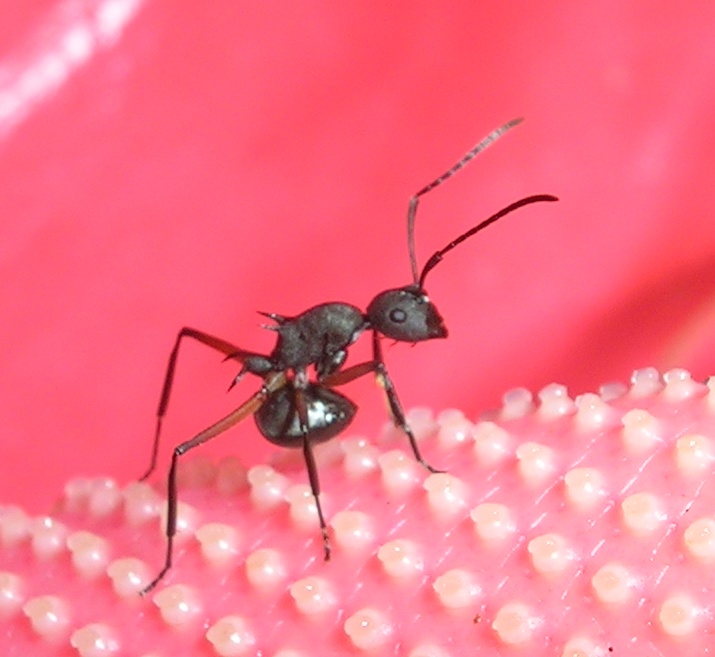
A real Polyrhachis
What can one do after obtaining an identification from the few taxonomists left in India and researching the literature using the name? One could create a Wikipedia entry for a start and that makes one learn a little more too, sometimes it can be a bit of a consolation, especially when one finds out that W F Kirby, entomologist who described the species also thought it was a Reduviid ! A later amateur entomologist and physician from Finland, Bergroth who saw a specimen from Wroughton described the species as Dulichius wroughtoni and then came across Kirby's own description and decided that Kirby's had priority. However his note on Kirby is quite interesting, particularly as it comes from an amateur evaluating a self-professed expert at a museum of that time-period:

Mr. Kirby has had the kindness to send me a copy of his work on the Heteroptera and Homoptera of Ceylon (Journ. Linn. Soc. XXIV, pag. 72—176, with 3 plates). The author says in the introduetion, that he has thought his paper „would be rendering a real service to science". I think no serious hemipterist will be of the same opinion. As the author is assistant in the British Museum, one schould expect to find informations on the real systematic position of the many dubious Hemiptera deseribed from Ceylon by Walker, and it is therefore with great regret we find Mr. Kirby's work to be entirely in Walker's style and almost without any scientific value Mr. Kirby further says, that he will not create many new genera, 'until those already proposed have undergone a thorough and much-needed revision, which at present I have no time to "attempt".' It is to be hoped, that Mr. Kirby never will find time to a such revision, as it seems to be unknown to him, that the genera of Hemiptera have already undergone a thorough and most excellent revision by Stäl.


Postscript
Happened to visit one of the websites where photographers dump their pictures and found some rather excellent photos in the chaotic pile. Interestingly one from Bangalore seems to have been taken around the same time. Seems like the rains might be important factor for some aspect of their life cycle:

Photo 1
Photo 2

Also discovered a photograph of a Polyrhachis that I had taken - here sitting, perhaps in a defensive posture, on the spadix of a pink Anthurium - now added above.

Sunday, August 22, 2010

Flies for a rainy day

I do pity unlearned gentlemen on a rainy day
- Lucius Cary, Viscount Falkland, 1654  

(Photographs and text by L. Shyamal)

Telostylinus sp.
It has rained quite a bit the past few days in Bangalore. Mealybugs took their toll in the dry spell, killing off a papaya in a strip of land that urban dwellers think of as a garden. The fallen rotting stump of the old papaya was wet and was the arena for these dancers. They stand erect on their long legs and are aptly called stilt-legged flies.

Caged by the male
It took me some effort to identify these flies to family - I initially thought they were Micropezidae but a little enquiry led to learning something - the usual thing actually - i was mistaken. They were Neriidae - and as a consolation, they were indeed at one time considered a subfamily Neriinae within the Micropezidae. Anyway, there is a lot happening among these flies. They stand on the fallen log, run around in spurts, chasing the other guys. The big guys show off by standing tall and when any challenger appears, they try to prove who is the boss. And then when miss Neriidae appears, he walks protectively over her and she walks under the cage formed by his legs until she allows him to copulate. After this, the male continues to follow her, sometimes well until she oviposits (sorry, lays would be simple English, but some old habits persist).

Two satellite males grappling
Who stands tall ?
The centres of most aggregations are females. You can tell them by the lower profile that they adopt and their more bulging abdomens. The ovipositor of the females and the aedeagi of the males are also usually apparent. When a male gets a position near a female, other males dart in and out, trying to take over the position. The defensive male only makes quick darts and continues to stay near the female. Sometimes two satellite males will take their fight for dominance to a position well away from the females and the food/oviposition resource. The initial display involves the use of quick and alternating left and right wing flicks. This is followed by quick steps in the direction of the opponent. The high intensity conflict involves the two males standing face to face and using their mouth parts (yep !), legs and shoulders placed against each other and the aim seems to be for the dominant individual to wrestle the other to a lower level. It involves rapid movements and only high speed macrophotography may do justice to documenting this behaviour. On a secondary note, it appears that as usual, most of the entomological literature on the Neriidae is purely of a taxonomic nature and it seems few have spent much time observing these extremely interesting flies in life. Being mainly tropical, one of the best insect books (BDT as it is called), which is American-centric, spends just a few sentences on the family.

Both the Micropezidae and the Neriidae are slender and long-bodied flies. The former however usually have a much reduced first pair of legs. These are often waved in front of them like antennae and in some sense they can appear a bit like an ichneumonid wasp looking for its victim. In the Micropezidae, the base of the forelegs (the coxa) is somewhat separated from the hind pair of legs. And the hair-like arista on the antenna arises at the tip in the Neriidae but is dorsal in the Micropezidae.

Kneeling at bird dropping
As if to help me, I found a bit of bird dropping on the ground that had been partially dissolved by the rains. Feeding at this feast this was a "typical" Micropezid fly. With long legs, both the Micropezids and Neriids need to tip down to get their mouthparts to the food and these giraffe-like flies are quite alert during feeding and are easily disturbed. This Micropezid took off from its "copropizza" and landed on a leaf nearby and allowed me to take a couple of pictures that show the key features. The picture is not of too high a resolution, limited by my humble compact digital camera (an old Nikon Coolpix E 3700 that has contributed well to public domain). The Micropezids have shortened forelegs and they wave them rapidly in front of the heads giving one the impression that they are really antennae, especially resembling that of the small parasitic wasps. You can almost see in the picture on the right, the fly rubbing its hands in glee perhaps !
The White-stockinged Micropezid

I am hoping to check out the fallen papaya in the coming few weeks for the larvae and pupae of the Neriid fly. The last instar larvae have the curious ability to escape from disturbances by making leaps.

Further reading

Acknowledgements

In writing this little note I have had the benefit of identification help from Professor C A Viraktamath at the UAS, Bangalore. I have also been much enthused by the diptera.info forum and of course Wikipedia. I have added some of these images to Wikipedia and have attempted to improve the referencing of the article on Neriidae. It is quite surprising that there are few available resources that do justice to these and other critters that live right next door.

Postscript
Close up using Panasonic DMC-FZ100 + Raynox DCR-250

An identification has been made as Telostylinus cf. lineolatus (courtesy Dr Kumar Ghorpade)