click hide image

Thursday, July 15, 2021

Long before Salim Ali - an Indian bird collector 1906-9

Hidden away in the annals of systematic ornithology is the name of P. N. Krishnasamy Naidoo, Merchant on Victoria Street, Mahe, Seychelles around 1907 and living on Rue La Fague, St. Andre, Reunion in 1908. From the Indian diaspora, literate in French, Naidoo probably moved from Mauritius but little is known about his life. It appears that he began to collect bird specimens on the Indian Ocean islands for Lord Walter Rothschild and his assistant Ernst Hartert. Almost nothing is known about him beyond the few letters he wrote that are preserved in the Natural History Museum at London and the bird specimens he collected which are now in the American Museum of Natural History.

Naidoo collected nearly 450 skins of birds all of which are now at the American Museum of Natural History, part of their acquisition from Lord Rothschild, who was forced to make a distress sale of his collections to silence an unknown woman blackmailer. Suprisingly all the Naidoo birds landed in the American part while the letters of Naidoo are at the Natural History Museum in London. Some of the beautifully handwritten letters in French sent by Naidoo to Rothschild and Hartert tell of large payments being made for the bird specimens that he collected. For some of the island parakeets, Rothschild offered 30 pounds per specimen. [Kemp (2017) on Rothschild in the New Scientist calls him a useless banker who spent a mountain of cash to buy nature]

As always, every finding raises more questions, how did Naidoo get to be trained in skinning birds and preparing specimens? What was his own knowledge of the birds of the Indian Ocean Islands? 

A collection of the specimens that Naidoo collected along with the species, dates and locations can be found from the American Museum of Natural History website. Examination of some of his letters at the NHM London archives has not revealed much on his life. 

A chapter remains to be written on this interesting marginal character in ornithological history.

Notes:

Thanks are due to a number of people for helping unearth the precious little that we know about Naidoo - Robert Prys-Jones, Alison Harding, Kathryn Rooke, (NHM-London); Pat Matyot (who suggested that Naidoo may have come from a family of indentured labourers that left Mattur in Tamil Nadu to settle in Mauritius with some becoming successful entrepreneurs - like Govindasamy Krishnasamy Thambi Naidoo who financially supported Mahatma Gandhi); and Malavika Vyawahare (via Abhay Thakur, IFS).

Wednesday, March 10, 2021

An inedible tale


Many years ago, I had access to a copy of this peculiarly titled book on the birds of India. It had some beautiful lithographs, possibly hand coloured, and evidently faded into strange and muddy shades of brown. Fortunately, today, there is a nice scan of the book available online via the Biodiversity Heritage Library and safely deposited on the Internet Archive. Some of us had created an entry at Wikipedia for its author J.A. Murray - and around 2006 it had been expanded as James Augustus Murray and at that time the library of the Natural History Museum in London had conflated the two in their catalogue index too. Fortunately it was easy to see that there was no connection to the lexicographer Sir James Augustus Murray and the errors have since been fixed but painfully little was known about James Alexander Murray!

The Asiatic Society of Mumbai has done an excellent job of digitizing its collections and making them available at a very reasonable subscription price. The search engine and the OCR also work rather well and after running some searches on GranthSanjeevani I stumbled on the rather sordid tale of our Murray. It turns out that he founded a Victoria Natural History Institute which aimed to make natural history specimens available for sale and he was rapidly trying to expand this organization across India. Rather too rapidly and ambitiously it would appear. He had people across the country paying him to become heads of branches and then went into severe debt. This finally led to his being charged with cheating and some of the court hearings appear in the newspaper reports of the time. They reveal that Murray was once a librarian at the Kurrachee Municipal Library from where he was discharged dishonourably after it was discovered that he was trying to sell off duplicates of old books. Moving back to Mumbai where he was born, possibly of mixed British Indian parentage (described as "Eurasian"), he tried to set up an organization to make use of his taxidermic skills and knowledge of natural history. A report from the Bangalore Museum notes with hope that they might obtain new exhibits through the newly opened branches of the Victoria Natural History Institute in Mysore and Bangalore. Phipson of the BNHS, it would appear, had been kind enough to lend money to Murray and perhaps even provided housing to him until he failed to pay his rents. Phipson was called to court as a witness. The court with L.H. Bayley presiding finally sentenced Murray to five years of rigorous imprisonment whereupon he appears to have been broken and the man was lost forever to history.


The Bombay Gazette, 17 April 1893 p. 4 


Wednesday, January 27, 2021

Birds and Indian agriculture - turf wars

Alongside the activism against the plume trade in Victorian England, there was a widespread interest in understanding the "value" of birds to Indian agriculture possibly since many birds were trapped for the trade coinciding with famines in India. It was also a period when the British Empire intensified agricultural research efforts. Recall that professional agricultural entomology in India was influenced by Eleanor Ormerod who suggested that if she could do as much as she did voluntarily for English agriculture, a lot could be done with a paid position in India! Ormerod, oddly enough, was engaged in a campaign to eradicate the sparrow in England when other upper class ladies were clamouring for the protection of birds. While Reverend F.O. Morris and some other male conservationists wrote letters noting  her deviation from expected feminine conduct and requested her to show "compassion ... and fulfil her duty as a woman", there were farmers who agreed with her and argued on Christian foundations that although sparrows "...  were created for some wise purpose. Such was undoubtedly the case in the original order. But the Great Creator made man to rule over the fowls of the air and the beasts of the field, leaving it to his judgment to destroy such that were found more destructive than beneficial." [Bradshaw, 2014; Holmes, 2016] As early as 1892, the idea that some careful examination was needed was mooted and the phrase "economic ornithology" was introduced by Earl Cathcart. 

It is unclear how the bird-agriculture question spilled over into India but an early attempt to look at Indian birds from an agricultural perspective was by Charles William Mason, an entomologist. In 1907, Mason offered tubes and instructions for collectors of birds to provide him with the contents of the gut and gizzards of birds that had been shot. The idea at the time was that based on the diet, birds could be classified into three neat classes as being beneficial, injurious, or neutral to agriculture. Very little is known of the life of Mason, he joined the research institute at Pusa as a supernumerary entomologist working under Harold Maxwell Lefroy and left India in 1910 to study at Wye, and the US before moving to work in Nyasaland where he died of black-water fever (malaria) on 28 November 1917 at Namiwawa. Mason's intensive work on the examination of the contents of the guts of 1325 birds shot mainly around Pusa in Bihar may perhaps be among the few of its kind. Mason did not publish much before leaving India. Lefroy himself left India in 1911 but the interest in birds continued with his successor T.B. Fletcher who encouraged the a planter and naturalist Charles Inglis to conduct studies in relation to agriculture. The two wrote a series of illustrated articles on birds in the Agricultural Journal of India but it appears that the professional entomologists (note that Fletcher himself would easily qualify as an amateur by modern standards) were unimpressed. A reprint of the series was made as Birds of an Indian Garden (1924). 

Inglis later spent his energies editing the Journal of the Darjeeling Natural History Society and managing the society's museum in Darjeeling. His journal includes interesting discussions between Inglis and S C Law. Law was an avid aviculturist who obtained birds from the wild. Inglis met Law and his trappers in Darjeeling with a number of sunbirds and in a subsequent note Law documented their sad fate resulting from their aggressive behaviour. At the 1923 meeting organized by Fletcher he notes "the amateur entomologists, whom we are always glad to see and to help as far as possible, are also represented by Major Kingston and Mr. Inglis." 

Present at the same meeting was a professionally employed south Indian entomologist from Coimbatore, P. Susainathan. Susainathan had written an interesting note on the birds of the Coimbatore region from a standpoint of economic ornithology called "Bird Friends and Foes" (1921). Susainathan later worked in Iraq and at some point decided he was better off catching insects for taxonomic specialists and began perhaps a career unique in India, at least for an Indian (there were professional collectors like William Doherty who made much larger collections, pers. comm. Michael Geiser, NHM London). He advertised in various entomological magazines and offered to send specimens from India within the group that they were interested in. The Wikipedia biography covers the key bits on him and his family members who continued in the collection enterprise. There are nearly forty insect species with names like nathani or susainathani, nathanae, and nathanorum (of Mr Nathan, of Mrs Nathan, of the Nathans). Susainathan's book has a description of the sparrow which includes the term "aerial rat" which recalls Ormerod's usage of "avian rat".

The Nathan family in the 1970s - photo from Karl Werner (1956-2007)
P. Susainathan is second from right in the back row.
Scan courtesy of Juergen Wiesner

It is worth recording that professional entomologists appear to have guarded the field of economic entomology as far as its applications to agriculture went. When Salim Ali made an application to the ICAR to study birds (see linked document in the National Archives of India),  Baini Prashad of the ZSI was largely supportive, but the proposal was essentially nixed by the Imperial Entomologist at that point of time (viz. Hem Singh Pruthi, although the letter seems to have been forwarded to the government by F.J.F. Shaw). Pruthi's comments are worth noting for the tone of protection of the professional turf (apart from some casual sexism):

The most suitable man for undertaking the study of Insectivorous birds is one who is primarily a good entomologist and possesses some knowledge of birds in addition. He should be familiar with the habits of the Insect fauna of the area and be able to identify himself the stomach contents of the birds immediately after their death. The chief man should have a taxidermist to assist him in the preservation of the birds, which can be got named by specialists afterwards.
There has been a great deal of writing on the professionalization of science and most of what is written in traditional (or should it be professional?) history of science departments would appear to show professionalization as a positive and progressive step and few studies if ever look at the negatives  such as how profession-defenders define the boundaries of subjects, block so-called outsiders, and thereby prevent possible enrichment and growth.

Further reading

Postscript April 2023: Mr S. R. Nayak who worked in the BNHS showed me a very interesting collection of visiting cards that Salim Ali owned and in it was a rather interesting card. One can almost imagine Ali commenting on the title (occupation) used here. Yash Pal Beri was trained as an agricultural entomologist and appears to have been the founding member of the IARI agricultural ornithology group which was later joined by R. K. Bhatnagar and others. Bhatnagar retired around 1997 and he gave me his collection of issues of the Newsletter of Birdwatchers which are now digitized on the Internet Archive.

Beri's card from Salim Ali's card collection
(now in the NCBS archives)

PS: November 2024 - P. Susainathan's grandson sent me a biography of Susainathan and others in the family that collected insects. With his permission I put it up on the Internet Archive where you can find it.

Friday, October 23, 2020

Some little-known bird books from India - Torfrida

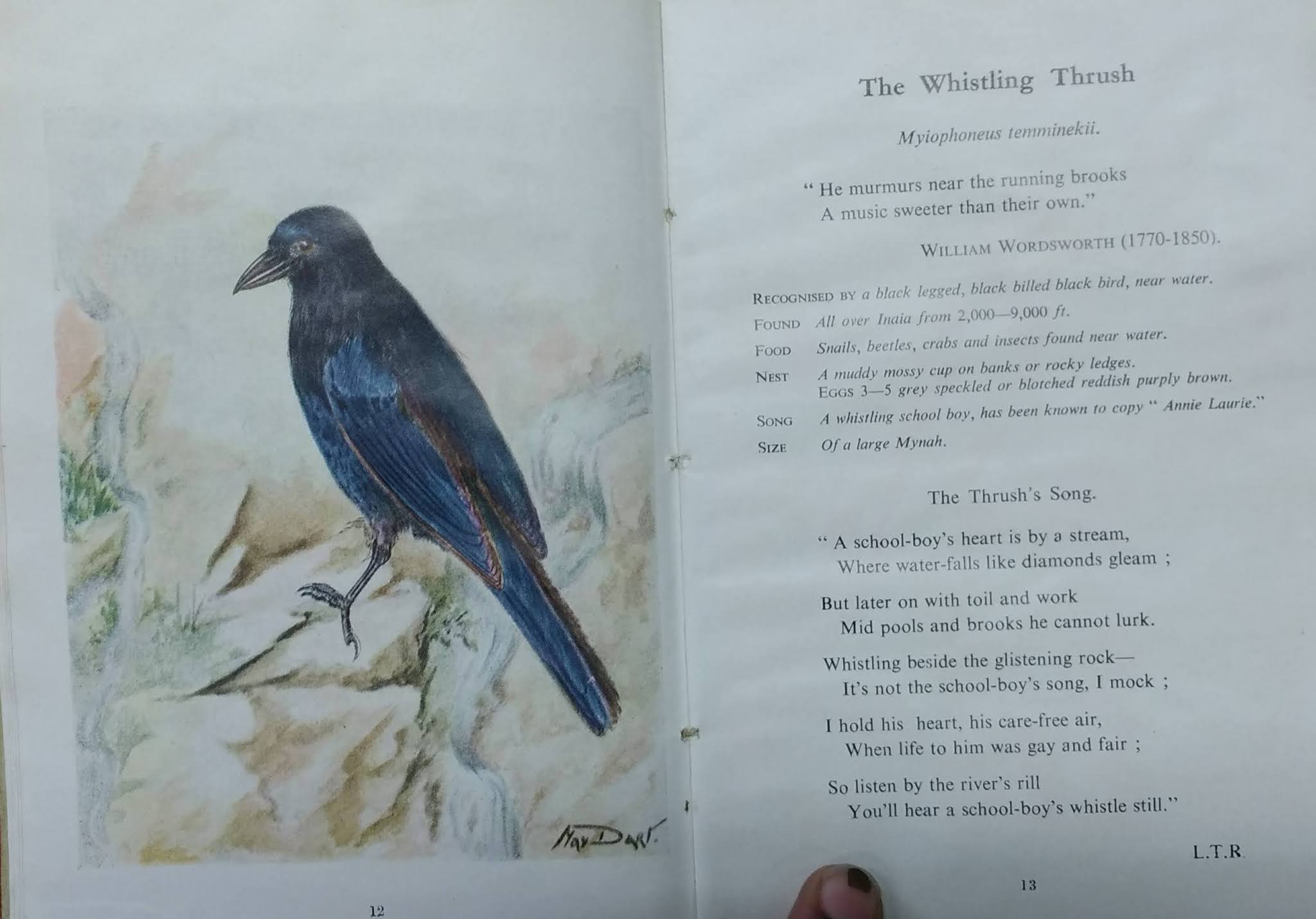
Among the little-known bird books of India, and of a rather unique genre, are Nurseries of Heaven  - More birds of India (1944) and Nurseries of Heaven - Birds (before 1944) written by someone with the pen-name "Torfrida" and illustrated by a Mrs May Dart who evidently lived in Wellington in the Nilgiris. This is not the only book written by this writer-illustrator pair, they also wrote Nurseries of Heaven - Wild Flowers of India. The flower and bird books deal principally with the Nilgiris. In 1944 the pair also wrote Flowering Trees of India (the geographic scope of that book seems wider). All the books appear to be a mixture of poetry, etymology, literary references, illustrations, fables, and a wee bit of original observation thrown in. These are all small pamphlets, presumably printed for children, possibly made for distribution in the local church.

The book is perhaps among the few Anglo Indian works with an aesthetic appreciation of birds [and not centered around humour like the writings of Phil Robinson, Eha or Dewar]. It also provides insights into Colonial life in the Nilgiris. I was fortunate to examine the contents of More Birds of India in a rather rare copy held by the Percy Fitzpatrick Institute of Ornithology at Cape Town in 2018. More information on May Dart and the mysterious Torfrida would be nice to have!

The first pamphlet on birds


The cover illustration is actually pasted into the frame


A few sample pages from the More Birds of India are included here to give a taste of the writing.


Some of her writing may need to be examined in detail. In her flower book she claims that the name "Portia tree" for Thespesia populnea is from the Tamil Puvassai! Some claims are outright incorrect like the idea that Osbeckia is called "Tipu China" from "Tibet China", that would in fact be from the old name Tibouchina.

Wednesday, September 16, 2020

A little-known naturalist from Chikkaballapur

Bangalore has historically, being an administrative centre with a mild climate, had a fair share of colonial natural history collectors and naturalists. We know a fair bit about the botanists who walked this region and a bit about hunters of larger game but rather little about those who studied insects. A few years ago I became aware of the Campbell brothers from Ireland (but of Scottish origin). It took some time to put together the Wikipedia entries on them which is where more straightforward biographical details may be found.

After a trip to the Nandi Hills [to examine a large number of heritage Eucalyptus trees (nearly 200 years old) that the Horticulture Department had decided to cut down to the stump, supposedly because falling branches were seen by the Archaeological Survey of India as a threat to heritage buildings nearby], some of us decided to visit Chikballapur to examine the place of work of  Dr Thomas Vincent Campbell (1863-16 December 1930) - "T.V." as he was known to his friends was a missionary doctor with the London Missionary Society and had worked briefly at Jammalamadugu where his older brother William Howard Campbell (20 September 1859 - 18 February 1910) had worked as a missionary. Another brother back in Derry, David Callender Campbell (1860-1926) was also a keen observer of moths and a botanist. In their younger days in Derry, they and their siblings had put together a "family" museum of natural history that was said to be among the best in the region! William was the oldest of nine siblings and appears to have been the sturdiest considering that he was a champion rugby player at Edinburgh University. He moved to Cuddapah in 1884 and he may well have been the first person to see Jerdon's courser in life - Jerdon, Hume, and others appear to have dealt only with specimens obtained from local hunters. William collected moths and many of them appear to have gone to Lord Rothschild and nearly 60 taxa were described on their basis by Hampson. In 1909, he was to become director United Theological College Bangalore but ill health (sprue) forced him to return to Europe and he died in 1910 in Italy. His Cuddapah-born son Sir David Callender Campbell (1891 – 1963) became a prominent Northern Ireland politician. William's life is covered in some detail by Alan Knox while examining the only known egg of Jerdon's courser. A biography (a bit hagiographic though) of William in Telugu also exists.

T.V.'s life on the other hand was hard to find information on, we knew of his insect specimens. He was in contact with E.A. Butler who specialized in the life histories of insects and T.V. seems to have taken off after him and not only colllected bugs (ie Hemiptera) but made notes on them which were used by Distant in the Fauna of British India. Several insects that T.V. collected have never been seen again. T.V. moved to Chikaballapur and worked at the Ralph Wardlaw Thompson Memorial Hospital which is now just known as the CSI Hospital and largely in disrepair. The hospital in its heyday was among the few in the region and treated a large number of patients. After suffering from tuberculosis, he also established a TB sanatorium at Madanapalli. Campbell treated nearly a thousand cases of cataract and was awarded a Kaisar-i-Hind medal for work in 1908. Campbell appears to have made a very large collection of insects from Cuddapah, Chikballapur, and from the Ooty area (where he would have spent summers). Many of these are now in the Natural History Museum in London and a good number are type specimens (ie, the specimens on the basis of which new species were described). Professor C.A. Viraktamath, entomologist and specialist on the leafhoppers, has for many years searched for a supposedly wingless Gunhilda noctua which was collected from the Nilgiris. Based on T.V.'s connections, I believe the place to look for them would be somewhere in the vicinity of the church in Ketti. Considering the massive alteration in habitats, there is a slight chance that the species has gone extinct but it is doubtful that it was so narrow in its distribution.
 
W.H. Campbell

 
Dr T.V. Campbell
T.V.'s former home in Chikaballapur

Dr TV attending to patients in Chikaballapur, c. 1912

A lane inside the hospital premises named after T.V.

Foundation stone of the hospital

The Wardlaw Thompson Hospital c. 1914

Gunhilda noctua - a monotypic genus never seen
since T.V. found them for W.L. Distant to describe in 1918
from The Fauna of British India. Rhynchota Vol.II

The Wikipedia entries can be found at T.V. Campbell and W.H. Campbell. Many people helped in the development of these articles. Roy Vickery kindly obtained a hard to find obituary of T.V., Alan Knox sent me some additional sources on W.H.C. and Susan Daniel, librarian at the United Theological College was extremely helpful. Arun Nandvar drove and S. Subramanya joined our little adventure in Chikaballapur. Dr Eric Lott made enquiries with the SOAS and LMS archives but found little. My entomologist friends and mentors, Prashanth Mohanraj and Yeshwanth H.M. shared their enthusiasm in discovering more about T.V. 

POSTSCRIPT - April 2022: S. Subramanya and I visited Jammalamadugu (and nearby places including Buchupalli where WHC had found a large pelicanry). It seems that the hospital that TVC began continues to prosper. It seems to have gained the favour of the political class thanks to the association of the former Chief Minister Dr Y S R Reddy who was not only born in the Campbell Hospital but worked there too. Apparently very little is known of the work of W.H. Campbell who seems to have largely been active as a missionary. The village of Buchupalli where he had described a large pelicanry seems to have no signs of any large water birds and absolutely no memory among its current day residents (who might be three or four generations down from those that lived in the 1890s).


The CSI Campbell Hospital

The entrance

Inscription below the statue with a gratuitous knighthood!

Dr TV holds a disarticulated stethoscope!