click hide image

Saturday, February 4, 2017

Research techniques - Wikipedian ways

Over the years, I have been using Wikipedia, as a kind of public research note book. I sometimes fail to keep careful notes and I regret it. For instance, some years ago I was reading through some scanned materials on an archive and came across a record of the Great Indian Hornbill in the Kolli Hills in Tamil Nadu. It was carefully noted by some British medical officer who was visiting the place and he commented on the presence of the species in the region as part of a report that he submitted on the sanitary and medical conditions of the district. Google searches did not see or index the document and I thought I would find the content when I wanted it but I have never managed since to find it again. Imagine how useful it would have been to me and others if I had put in a reference to it in the Wikipedia article on the hornbill species with a comment on its past distribution. 
https://en.wikipedia.org/wiki/Samuel_B._Fairbank

Not long ago, someone on the email list Taxacom-L sought information on Samuel B. Fairbank - a collector of specimens in India. I knew the name as he was one of the collaborators of Allan Octavian Hume (who even named a species after him) and decided that I knew enough to respond to the request for information. I looked around on the Internet and found that there was enough material scattered around to put together a decent biography (I even found a portrait photo whose copyright had thankfully expired) and it led to a Wikipedia entry that should spare anyone else looking for it the effort that I put in. Of course one follows the normal Wikipedia/reseach requirements of adding citations to the original sources so that anyone interested in more information or in verifying the sources can double check it.

These additions to Wikipedia may strike you as something that is not very different from what an ant does when it (actually usually she) goes out foraging - when she finds food, she eats a bit and then returns to the nest leaving behind a trail marker on the ground that says "this way for food". Other ants that are walking by spot the message written on the ground and if interested go on and help harvest the food resource. The ants that find the food again add a trail marker - now the strength of the trail marker chemical indicates veracity and possibly the amount of food available. This kind of one-to-many communication between individuals mediated via environmental cues has a term - stigmergy. Now the ant colony has been termed as a "super organism", a kind of distributed animal, with eyes, legs and even a brain that is distributed across little seemingly independent entities. Now there is a lot of research on how super-organisms work - it is an area of considerable interest in computer science because - the system is extremely resilient to damage - a colony goes on as if nothing has happened if you went and crushed a whole bunch of ants underfoot. How far this metaphor helps in understanding the organic growth of Wikipedia is uncertain but it certainly seems to be a useful way of conveying the idea of how contributors work. From a biomimicry perspective it could even inspire ways of designing the interface and system of Wikipedia - imagine if visitors could mark their attention to specific lines and the links that the followed. Subsequent visitors could perhaps see links that led to particularly useful additional articles or references.

I sometimes run workshops to recruit new people to contribute to Wikipedia and my usual spiel does not include any talk on "how to edit" Wikipedia but deals with why contribute and about how to incorporate Wikipedia into one's normal day-to-day activities. I sometimes take pictures from walks, record bird calls and research topics for my own learning. I compare what I learn with what Wikipedia has to say and where it fails, I try and fix defects. This does not actually come in the way of my learning process or work much but I like to think that it helps others who may come looking for the same kinds of things.

Incorporating Wikipedia into normal learning practice - should only need a small incremental effort.

The real problem in some parts of the world, such as in India, is that not everyone has access to good enough routes to learning - experts are often inaccessible and libraries are often poorly stocked even if they happen to be available. Of course there are privileged contributors who do have access to better information sources than others but these are the people that often look at Wikipedia and complain about its shortcomings - it seems likely therefore that the under-privileged might be better at contributing. In recent times, Russian underground sites like sci-hub have altered the ecosystem in a kind of revolution but there are also legal channels like the Wikipedia Reference Exchange that really go a long way to aiding research.

Of course there are an endless array of ways in which one could contribute - by translating from one language to another - if you are proficient in two languages - there is the gap finder which allows you to find what entries are on one language and missing on another - http://recommend.wmflabs.org/ . If you are interested in challenging your research abilities and want to see how good you are at telling good and reliable resources from websites with "alternative facts and news" then you should try finding references for dubious or uncited content from https://tools.wmflabs.org/citationhunt/en .

One of the real problems with Indian editors on Wikipedia is that a large number of them support their additions with newspaper and media mentions and many of them do not know what reliable sources mean. Information literacy is key and having more scholarly information resources is important. I have therefore tried to compile a list of digital libraries and resources (especially those with India related content).

Here they are in no particular order:
Although all of these are accessible, you may need little tricks like finding the right keywords to search, using the right google operators in some cases and for some people finding references for obscure things is fun. And some of us, like me, will be happy to help others in their research. With this idea, I created a Facebook group where you can seek references or content hidden behind a paywall. This assistance is provided in the hope that you can summarize your research findings on Wikipedia and make life easier for the ants that walk by in the future.
 
Postscript (December 2022): I discovered the hornbill record from the Kolli hills, it was actually by William King of the GSI. The citation was added to the Wikipedia entry!

Tuesday, December 6, 2016

Gin, tonic, and ornithology

The tomb of Willam Graham McIvor in the
St Stephen's Church cemetery in Ooty.
It is widely held that gin and tonic was an invention to get soldiers in British India swallow some bitter quinine to keep away malaria. It might have been an even more bitter pill to swallow for those who believed that miasmas caused disease. The refusal to believe that minute living organisms caused disease was convenient in some ways, it meant you could ward away disease by living in healthy places such as the hills and dressing  in flannel to avoid chilling as cold weather favoured the miasma. It also meant that quarantine (etymologically the Italian root referred to 40 days based on the incubation of plague) delays in (already slow) ship journeys could be avoided.

The story of quinine in India is an interesting one and has some surprising connections to ornithology in India that I was exploring on a recent visit to the Nilgiris.

The story behind malaria, cinchona and quinine is so fascinating that the sheer number of publications on the history of cinchona is staggering (there are several bibliographic compilations on the topic!). Looking at the literature for India suggests that vast changes in landscape have been caused just so that people (at least the ones that did not have sickle cells and other forms of evolved resistance to malaria) could enter new regions which they further altered by building roads and habitations. "Malarious" regions, mainly forests, were probably large pockets of natural protection for biodiversity. Malaria literally means bad air and the theory was that diseases were spread by miasmas (gases or mists) and this partly justified the idea of treating higher elevations as safe sanataria. There was even the field of "medical topography" that dealt with the spatial distribution of disease and although they might have erred on causal factors, the practitioners did attempt to collate evidence. The sheer number of people involved in researching and fighting the problem (often dying in the process) of diseases (particularly malaria, plague and cholera) and the spin-offs to the sciences of botany, entomology, chemistry and oddly ornithology is just incredible. Scientific pursuits that saved human lives earned a halo of nobility. Seen in this light, the public repute of the botanist is sadly a lot lower than it was before.

The cinchona introduction program was part of a solution to a problem coming in the way of the colonial quest for more lands. The Spanish had discovered the effectiveness of Cinchona bark in curing malarial fever and their extraction of the bark led to near complete destruction of trees in some regions and then the British Empire saw the problem of dependence on dwindling South American supplies and rising costs.

Detail on the tomb of McIvor with Cinchona carvings

Clements Markham is the man who takes a lot of credit for the cinchona program in India. He was knighted for this achievement but the idea that cinchona could be grown in the Nilgiris was first floated by John Forbes Royle. Royle "inferred from a comparison of soil and climate with the geographical distribution of cinchonaceous [=Rubiaceae] plants, that the quinine yielding cinchonas might be cultivated on the slopes of the Neilgherries, and of the Southern Himalayas, in the same way that I had inferred that Chinese tea plants might be cultivated in the Northern Himalayas." (27 June 1852)

Markham, a chronicler, explorer, geographer and writer also attempted to bring back the spelling Chinchona to correctly reflect its etymology - the plant is named after Lady Ana de Osorio, countess of Chinchón, wife of the Viceroy of Peru, who was (according to a very dubious version) in 1638 afflicted with a "tertian" fever while in Lima. Don Francisco Lopez de Canizares, heard of her illness and sent a parcel of bark that was used by the natives around Quito to treat fevers (worth remembering that South America was by and large malaria free, although it may have had one form of malaria, until Columbus and European movement c. 1492). The Countess recovered rather miraculously and word of the drug travelled rapidly. She took back bark to Spain to distribute among the sick there and it soon came to be known as Pulvis Comitissae (the Countess' powder) among the druggists. Linnaeus came to hear of the plant via the French and though he intended to name the genus after the Countess, he spelt it wrong (in the 1767 edition it even got printed as "Cinhona"). The Spanish botanists Ruiz Lopez and José Antonio Pavón Jiménez noted the spelling mistake and described several species in the genus but the spelling stuck and many were upset that it credited "cinchon", a policeman's belt, instead of their dear Countess. Markham's attempts at taxonomic emendation of the spelling were not as successful as his mission to introduce cinchona into India.

Markham's map of the "Chinchona" plantations.
By the 1800s, the Spanish trade in Cinchona had managed to depauperate the forests of South America. Removal of the bark in unsustainable ways by uprooting the tree and strip barking or girdling killed off the trees [Alexander Humboldt noted in 1799 that for obtaining 11,000 Spanish pounds nearly 800 or 900 Cinchona trees were cut down every year]. Meanwhile the front-line warriors of the British Empire were  falling to malaria at an estimated 2 million a year and were at the mercy of Spanish supplies with the few trees left being closely guarded in South America. Markham's main role was to help solve the problem of malaria in British India and this even required covert actors - among them Charles Ledger who managed to smuggle some seeds of Cinchona to Kew. Other explorers were Dr. Spruce and Mr. Robert Cross who went after Loxa bark (Cinchona officinalis Linn.; syn. C. condaminea) and "Red Bark" (C. succirubra Pavon) in Ecuador while Mr. Pritchett searched in northern Peru; and  Markham and John Weir explored  the Calisaya region in Bolivia for Cinchona calisaya.

An illustration from 1862. The European man sitting in the group is Sir William Denison (after whom Francis Day named the pretty fish - "Miss Kerala" (Sahyadria denisonii ). To Denison's left and holding a spade is McIvor. McIvor helped transport trout for Day's project to introduce them into the Nilgiris. Day started off as an ornithologist before taking an interest in fish. He supported Hume's Sind bird survey.
Markham and his team managed to get some plants and these were established at Kew in greenhouses. Wardian cases were then used to transport the plants to India. It was however one thing to grow them inside a controlled environment and entirely another to grow them in a large enough scale. And that was where the skills and experimental approaches of William McIvor paid off. It was another saga to extract the active ingredient and produce concentrated drug that could be stored and transported where it was needed. Botanists, chemists and administrators, all got into action in this project and it is interesting that Sir George King (knighted for the quinine work) who headed the Calcutta botanical gardens and the cinchona project in Darjeeling (Mungpoo) credits A.O. Hume for his role in supporting the project. King was knighted for his role in setting up a system of quinine delivery via the postal system that would work out cheap enough anywhere in India. Markham writes about Hume's role in his 1880 book:

...result was due in no small degree to the action of Mr. A.O.Hume C.B, the Secretary to the Government of India in the Department of Revenue, Agriculture, and Commerce.

...
Mr. Hume saw that two millions of Her Majesty's subjects were annually living in India of low malarious fevers, of which fully half might he saved if we could put the chinchona febrifuge retail into every pansari's shop at 1 rupee per ounce. He calculated that ten tons a year at least should be forthcoming, or, on an average, 100 grains per man. Mr. Hume felt strongly on the subject, because he had had great practical experience of malarious fevers; because he had proved, in thousands of cases, that the chinchona febrifuge is a real remedy; and because we had triumphed over the cultivation difficulty, and could, at comparatively very moderate cost, ensure in ten years a bark crop sufficient to produce the ten tons required. He felt that nothing stood between us and the saving of countless multitudes from death, or grievous suffering, but an economical process of manufacture; and that, rightly considered, this is infinitely more important than any other question before the Government of India. It involves simply the possible saving of a million lives and of an immensity of suffering such as few can adequately realise. He urged that nothing should be allowed to come in the way of this great work, that it should not be paltered with, but that it should be taken in hand at once, in the very best way that could be discovered, and with the ablest instruments money and trouble could procure.


Davison could speak Tamil, "Burmese",
Malay and Hindi!
One of George King's assistants was a lad named William Ruxton Davison. King noticed that he had an eye for natural history and although Davison had trained in a bit of chemistry in the Nilgiris, he had moved into botany at Calcutta. Davison was born in Myanmar but after his father's death, he grew up as a boy in Ootacamund, schooled briefly under "Pope Iyer" (at his own school although he gave it up later and moved to Bishop Cotton's in Bangalore where he earned a reputation for caning students). King recommended Davison to Hume, and under Hume's training, he became one of the foremost ornithological observers of his time - although his method was in the old collection tradition - indeed much of Hume's collection was in fact made by Davison (while Hume was away on official work). Davison seems to have had a keen eye for ferns as well and he made collections of these for Hume's little-known botanical collection (now apparently with the BSI). Hume's botanical interest would be rekindled when Hume retired to London. After Hume's retirement from ornithology, Davison moved to Singapore (then called the Straits settlement) to head the Raffle's Museum. Davison seems to have done well here but after his wife's sudden death which occurred while he was out on an expedition, his mental health took a downturn. Suffering from depression, he is thought to have committed suicide (or in any case died) from an overdose of opium. This tragic story has only recently been unravelled by historian Kevin Tan in his book on the Singapore Natural History Museum (2015).

Apart from Davison, Hume had another major ornithological correspondent in J. Gammie at Mungpoo, Darjeeling who was in charge of the cinchona plantations. It appears that Gammie was a major collector of fauna and specimens from Mungpoo have gotten around the world since. (Some years ago there was a query for locality information for a specimen of Bengalia (a kleptoparasitic fly) from Mungpoo). There is very little known about J. A. Gammie though his son, George Alexander Gammie (1864-1935) is a better known botanist. Gammie senior collected plants, birds, insects, and reptiles for various collaborators and correspondents. He is remembered in Lycodon gammiei.
An odd cinchona tree
(presumably C. succirubra) in Ooty
being admired by Henry Noltie.

The cinchona project was obviously not a complete success as malaria managed to keep a grip (and still does today with the potential to save some wilderness areas) and the next big wave of work on the disease was by the surgeons and physicians of the Indian Medical Service. Many of them, with a completely new level of training in biology, contributed to the study of natural curiosities and contributed beyond their professional area of research.

The cinchona project had its impact well beyond India - even in its ornithology spin-offs. Imagine my surprise when I found that a comprehensive bibliography of cinchona cultivation was compiled in 1945 by R.E. Moreau, the brilliant ornithologist who worked in Africa as an accountant.

Note: Please note that tonic water today does not have the quinine levels needed for therapeutic use, so no it is not beneficial to your health! You can however have some fun by shining ultraviolet light on tonic-water and watch it fluoresce.

Postscript: There is an interesting paper on malaria research and birds - pointing out how birds were used for testing anti-malarials while also playing a key role in the plasmodia research of Ronald Ross. (Manwell, Reginald D. (1949) Malaria, birds and war. American Scientist 37(1):60-68.)

Further reading

Friday, November 4, 2016

Birds and landscape histories

Finds tongues in trees, books in the running brooks,
Sermons in stones, and good in everything.
I would not change it. 

Most traditional historians do not see much use for science but there are now growing branches of science that are essentially about determining histories. These include histories of climate, habitat connectivity, and the evolution of organisms. The field of phylogeography attempts to look at the distributions and evolutionary relationships of a cluster of inter-related species to see patterns in their diversification, examine timing and relationship to environmental or climatic changes. Past vegetation  can be guessed by the signs left by plants through pollen deposits in certain kinds of preserving environments like peat bogs. A cylindrical core extracted from the bog tells us something about the vegetation of the older period, the deeper layers being older, with the time itself estimated by carbon dating. Every organism has a book in the form of DNA and the lines in this book are constantly being edited with copy pasting as the organisms reproduce and accumulate mutations (typos and copying errors). By looking at the edit history of specific sections of DNA across sample individuals, it is possible to reconstruct a chronological sequence of the edits (the way to establish what is recent versus what is older requires a trick that requires prior knowledge, a sample of a script that is decidedly older - an individual known as an outgroup). In addition to regular nuclear DNA, there is DNA in the mitochondria which passes from mother to offspring and this is generally conserved with occassional changes caused by mutations (largely but introgression is known). The history of mutation accumulation can help reconstruct chronologies. There are of course many little problems, histories lost through extinction of lineages, and corrupted histories resulting from unrelated DNA being inserted by viruses or bacteria that break expectations of linearity. Histories of human movement have been found by examining DNA across peoples.

Histories at different scales and for varying epochs can be read from diverse sources. Igneous rocks can tell the pressure, temperature and rate of cooling around them by the sizes of the crystals formed within them and their mineral compositions. Sedimentary rocks hold fossils in the leaves of their pages. Trees keep note of fires and environmental conditions in their rings. Bubbles trapped in polar ice have been the source of atmospheric composition history.

The sources for history therefore go well beyond what archaeologists and traditional historians would want to preserve. It is a pity however that these other sources get so little attention among historians. 
 
Few can appreciate the oddity of this specimen from Antharasanthe near H.D. Kote, Karnataka

I recently visited the Regional Museum of Natural History at Mysore along with Dr Robert Prys-Jones of the Natural History Museum at Tring and thanks to his presence, I was, reluctantly, allowed to go behind the scenes and take a peek at some bird specimens that Salim Ali had collected in the late 1930s. [I had been at the RMNH many years ago with the late S.A. Hussain when this collection was moved there and I have since always been irritated by government officials preventing access to such collections across India. We arguably have a system worse than colonialism!] One of the specimens that caught my attention was of a black-headed babbler / dark-fronted babbler (Rhophocichla atriceps). It was collected by Salim Ali in 1939 from Antharasanthe. I have passed through Antharasanthe many times in recent years and for someone who knows the bird and the kind of habitat in which it is normally found, it is simply mind-boggling to imagine that Antharasanthe once had dense forests with a dark and dense undergrowth. This is something that few can appreciate and it requires a knowledge of the bird in question.

Clearly not all sources of history can be appreciated or understood by traditionally trained historians. There is a classic example of such ineptitude provided by Delhi-based historians Romila Thapar and Valmik Thapar who, in their book Exotic Aliens – The Lion and Cheetah in India, claim that lions and cheetahs in India were introduced from Africa in fairly recent times by local rulers. This of course can easily be dismissed by looking at DNA evidence and the book of course has since been repeatedly and confidently dismissed by scientists.

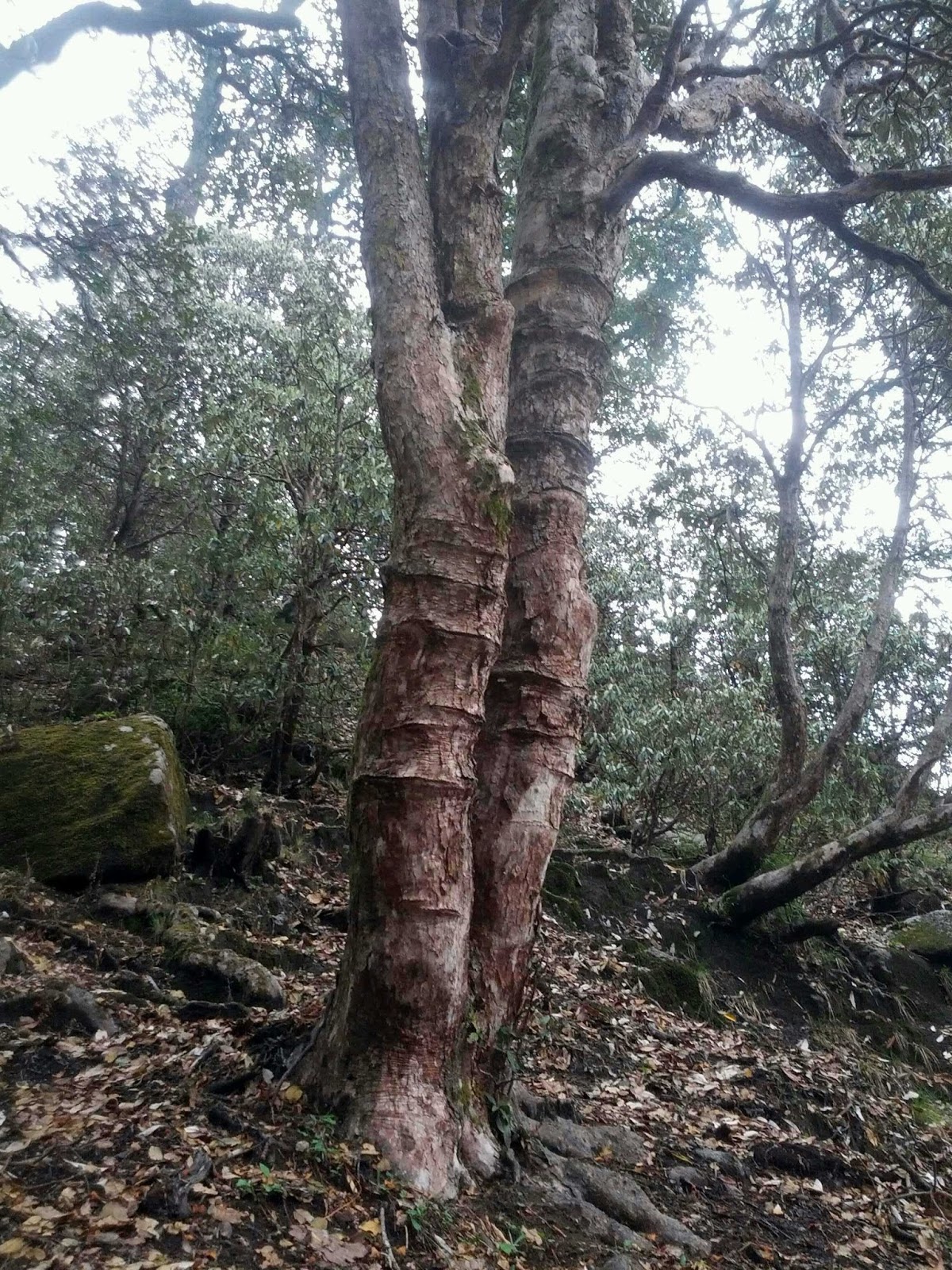
In April 2016 I had the privilege of walking along a Himalayan hillside with Emmanuel Theophilus and S. Subramanya and we came across trees with curious swollen rings on their trunks. Observing them closely showed that there were series of punctures made over these rings by woodpeckers. There are a group of woodpeckers in North America that are called sapsuckers - they all belong to the genus Sphyrapicus and have the habit of making punctures on trees and waiting for sweet sap to fill them up. They revisit these holes and sip the sap that collects. Now there is just one species in Asia that has the same habit - the rufous-bellied woodpecker and even called the rufous-bellied sapsucker (Dendrocopos hyperythrus) - and it leaves a trace on the trees. They are not produced by single individuals but by generations of them. The trees which are at least a century old have rings that are tapped repeatedly and the calluses grow quite wide due to the repeated injury. Not all trees seem to respond to the damage in the same way and the most significant callusing was found in karsu oak and rhododendrons (they are massive trees here, worth mentioning for readers familiar only with rhododendrons from higher latitudes). Interestingly Green-tailed sunbirds (Aethopyga nipalensis) seem to be secondary sapsuckers and they hover and steal sap from the same puncture sites.

Emmanuel Theophilus points to calluses on karsu oak Quercus semecarpifolia

Callus rings on a Rhododendron


Rings from at a distance. 
Close up of a ring showing a fresh line of punctures.


Perhaps there are places in the Himalayas where the woodpeckers have left their traces and vanished since and hopefully those histories that are not lost to the timber trade.

There is then a case for historians to learn a bit of ornithology and there is of course a case to be made for ornithologists to know a little bit of history. The latter is probably harder considering that hordes  contribute to such systems a ebird with no standards for the recording of habitat conditions. It is as if they assume that habitats are static. If anything has been learned by looking at old bird literature it is the inability to guess what kind of a habitat a bird formerly used. Standards for describing habitats that can guide future work and that which can be analyzed quantitatively has to be evolved locally, it involves democratizing citizen science websites and therein lies the problem. History, even of humans, is important for software designers, as much as it is for scientists.
 
Postscript: 5-Sep-2024 found this - Baral, H.S. 2023. Ecosystem engineering: Rufous-bellied woodpecker Dendrocopos hyperythrus (Vigors, 1831) modifying tree shapes of Himalayan broadleaved forests. Nepalese Journal of Zoology, 7(2):1–7.

Friday, September 23, 2016

Maude Lina West Cleghorn: A little-known amateur entomologist

I recently came across the works of Miss Maude Lina West Cleghorn and was surprised by the breadth of her entomology research conducted in Calcutta. Miss Cleghorn actively studied insect pollination as an amateur and apparently some government-supported studies on the genetics of voltinism in silkworm in the early 1900s. Remarkably little is known of her despite being a Fellow of the (Royal) Entomological Society, the Linnean Society and the Zoological Society of London. Enquiries with the Linnean Society reveal that she was elected Fellow on the 4th of December 1913, nominated by Isaac Henry Burkill (director of the Botanic Gardens at Singapore); David Hooper (economic botanist with the Botanical Survey of India) and Lawrence Lewton-Brain (director of agriculture, Federated Malay States). Her address was given as 57, Ballygunge Circular Road, Calcutta and a bit before that period at 12, Alipore Road. All that can be found is that she died in 1946 - a single line mentioning her death (as Associate Member - a class created in 1835 which according to the byelaws- "Associate Members shall be persons well known for their literary or scientific attainments, but who are not likely to apply to become Ordinary Members.") is found in the Journal of the Asiatic Society of Bengal for 1949.

Among Miss Cleghorn's studies is one on the longevity of insects, specifically silkworm. She notes in passing that a  Hypolimnas bolina lived for 92 days but she examines the longevity in relation to the season in which the pupae eclose. The graphs are very elegant summaries of her findings (Edward Tufte would admire the simple lines rather than broad bars).

Miss Cleghorn notes that adults emerging in the rainy season are short-lived

She also studied insect-pollination in some detail and especially interesting is her description of trap pollination in two species of Araceae. The first study was in 1913 on Colocasia (Kachu) and she described how cross pollination was enforced by a combination of protogyny and the timing with which the flower trapped and released carrion flies. She followed up this with a study the next year on Typhonium trilobatum (and she uses the local name Ghet-Khechu!) which has a spadix that releases a strong smell of rotting carrion in the evening and keeps the beetles overnight inside the cavity formed by the spathe. It attracts beetles including those in the Coprinae (Scarabaeidae) - and two species are identified Onthophagus tarandus and Caccobius dimiunitivus - the voucher specimens from these flowers were deposited in the Pusa collection and these life-history notes are included with some care in the Fauna of British India (Arrow, Gilbert John (1931) The Fauna of British India. Coleoptera Lammelicornia. Part III (Coprinae). London: Taylor and Francis. pp. 143-144, 181-182.)
Trap mechanism in Typhonium for beetles.

Burkill, who seconded Cleghorn for Fellow of the Linnean Society, has a very interesting review of pollination mechanisms in Indian plants and he confirms Cleghorn's observations.

Observations of flowers on the trees with field-glasses and close ups of some flowers.
Fig. 1.—Rough sketch made from bunch actually growing on the tree, and observe 1 through field-glasses, showing young buds as seen on the morning of the 14th March.
Fig. 2.—Rough sketch of the same bunch on the morning of the 16th March, which shows the buds taking up the drooping position but with no styles projecting.
Fig. 3.—Sketch of the same bunch in Figs. I and 2, drawn on the morning of the 19th March. It shows the buds more pendant, and in two or three of the buds the styles appeared to be protruding slightly as far as could be made out with the glasses.
Fig 4.—Rough sketch of two bunches on the tree with buds older than those shown in Figs. 1, 2, and 3. Sketched on the morning of the 12th March. Three buds on the right bunch had styles protruding. On the left bunch one of the flowers was beginning to " ripen."  On the 13th March two more flowers on the left bunch were becoming fleshy.
Fig. 5.—The same two bunches as shown in Fig. 4, but sketched on the 14th March. The left bunch had four flowers with ripe corollas while the right bunch had two. On the l6th March only one ripe flower was left on the right bunch. On the 19th March two of the younger buds of the bunch on the right had become fleshy and had styles protruding.
Fig. 6.—Sketch of two buds on a flowering branch as they appeared on the 2nd April.
Fig. 7.—The same buds sketched on the 5th April. But B which was of the same age as A when cut on the 2nd April was shedding pollen on the evening of the 5th April. The corolla at this stage is almost completely covered by the sepals.
Fig. 8.—Bud-like flower in  first  stage   sketched   on   the evening of   the 5th April.    When lightly tapped, pollen was shed  through the pore-like openings and when the style was touched through the tip of the corolla tube.
Fig. 8a.—Slightly enlarged drawing of flower in the first stage with the tip of one of the sepals turned back to show the opening through which the pollen is shed. There were two other openings just under the tip of the opposite sepals but they were not so large.

Fig. 9 —Section of flower in the first stage. At this stage the anthers are ripe and the stigma sticky and when tapped or shaken at night it produces a shower of pollen. Sketched at 2 a.m. on the 29th March.
Fig. 10.—Section of flower in second stage with much enlarged fleshy corolla, and pollen shed.    Natural size.
Fig. 11.—Sketch of fully "ripe" flower with the much enlarged and fleshy corolla. In this stage the style is about half an inch longer than it was in the first stage. Natural size.
Figs. 12-17 give sketches of a bud and flowers of different ages. The flowering branch was cut at 6-30 p.m. on the 9th April and the flowers were examined almost immediately after.
[In taking the exact measurement of the lengths of the sepals, corollas and styles the sections became slightly distorted and wider.    The exact lengths are shown in the drawings.]
Fig. 12.—Sepals much  longer than petals, style only little longer than the sepals.    Anthers immature and no pollen shed when tapped.
Fig. 13.—Pollen being shed and fleshy part of corolla still completely hidden under sepals.
Fig. 14.—Pollen being shed. Style and petal slightly longer than that of flower shown in Fig. 13.
Fig. 15.—Fleshy part slightly thicker than that in Fig. 13. Appears to be a bit older than that in Fig. 13.
Fig. 16.—Section of old flower in which corolla has fallen off. The style was much longer than the old style of that in Fig- 15, but the sepals were of the same length.
Fig. 17.—Section of old flower showing corolla shed and ovary slightly larger. Sepals the same length as that in Fig. 15, but style found to be exactly 1 cm longer.
Figs. 18-31 give the sections of all the flowers found on a bunch which was examined about 8 a.m. Altogether there were fourteen flowers and none were destroyed by bats.
Fig. 18.—Quite a young bud.
Fig. 19.—Flower in first stage shedding pollen.
Fig. 21.—Most of the pollen shed.
Fig. 26.—Pollen shed thickly.
Figs. 29.-31.—Old flowers which have lost their fleshy corollas.
Fig. 32 shows two stamens enlarged about twice the natural size.

She seems to have maintained an interest in floral biology and pollination for long and her last publication appears to be in 1922 when she wrote on Mahua (Madhuca longifolia) noted its  uniqueness and the fact that contemporary botany texts miss out details. She notes that contrary to some illustrations, the Mahua flower never opens up. She notes that (emphasis mine) - "the mechanism found ... in which a large portion of the actual flower is edible is a rather costly and uncertain one...and appears to be rare among plants. The only other plant with this type of mechanism, recorded so far, is Fracinclea, [Freycinetia] a pandanus-like plant of Java, which is pollinated by bats while visiting the flowers for the edible bracts." She observed flowers using field-glasses and drew diagrams to demonstrate how the pollen were dispersed through a pore on the side of the otherwise closed bud-like or berry-like flower. The pollen collects inside the closed corolla cup of the hanging flowers in the initial stage and bats going to feed on them get the underside of their wings dusted with pollen. As the flower matures the anthers wither and the corolla becomes fleshy and the stigma becomes receptive. Once the corolla is eaten the stigma is exposed and the bats deposit pollen on them. This aging mechanism ensures cross-pollination.

It seems likely from the names listed in the pages of the Journal that some of Miss Cleghorn's relatives attended the monthly meetings of the Asiatic Society of Bengal. Cleghorn also took an interest in other taxa, there is a mention of her maintaining a live Kaloula pulchra. Harold Maxwell-Lefroy (Imperial Entomologist) in 1916 notes that Miss Cleghorn was to be offered the work on cross-breeding silkworm. It appears that from 1910, "it was decided to prepare a scheme to employ Miss Cleghorn". A visit to Pusa is noted. It seems that she worked on cross-breeding European silkworm which produced high quality silk and produced just one generation a year (univoltine) and Indian varieties that produced multiple generations in a year (multi/polyvoltine) but coarser silk. Cleghorn conducted a series of breeding experiments to examine the heritability of multivoltinism and her conclusion was that multivoltinism was a dominant trait in females but recessive in males.

There is a mention of a Mr J(ames?). Cleghorn, an executive engineer at Cuttack who curiously was engaged in sericulture research. According to a Memorandum by a certain Liotard : "In Cuttack, sericulture has been carried out as an experiment since 1877 at Government expense, under the supervision of the Executive Engineer of the Mahanadi Division." and there is a comment by Mukerji, N.G. in his 1903 A monograph on the silk fabrics of Bengal-:
The reference here is no doubt to the experiments of Mr. J. Cleghorn of the Public Works Department. Mr. Cleghorn's experiments were not altogether fruitless. He published his studies of the life-history of the parasitic fly, and brought to light the great destruction caused by it. He produced some valuable races of beautifully white cocoons, both annual and polyvoltine. He also claimed to have discovered a simple means of avoiding or destroying the fly-pest. But as he could not be induced to part with his secret for less than a lakh of rupees, nothing is known with regard to his method of coping with one of the chief enemies of sericulture in Bengal. The fine races of cocoons he was rearing in conjunction with the Secretary of the Agri-Horticultural Society were not given out to the world either, and Mr. Cleghorn's researches and experiments have, therefore, left little of practical value behind. 
The fly mentioned here is of course Exorista bombycis (Tachinidae) and Mr Cleghorn clearly I wonder if this might be is Miss Cleghorn's father, perhaps a clever but money-minded man. (PS: details of family confirmed later)

Hopefully someone in a better position to research her life will do justice to this very observant and insightful amateur entomologist whose contributions to pollination biology are almost unknown. I bumped into this remarkable and little-known researcher while looking up on Hugh Cleghorn - one of the pioneers of forestry in India- on whom a most comprehensive biography has just been published by Henry Noltie.

Acknowledgements

Thanks are due to Lynda Brooks at the Linnean Society for tracking down some details and to Ann Sylph at the Zoological Society of London for checking their archives.


References
Postscript 
 
FamilySearch has the following information. Maud Lina West Cleghorn was christened at Buxar on 14 December 1882, her parents were the civil engineer James Price Cleghorn and Letitia Gertrude (married 18 December 1881), daughter of William O'Brien West. Ancestry.com states that she was born on 30 September 1882  and died in 1946.

James Price Cleghorn took out a patent on food preservation in 1903 which may also have been based on his daughter's research.

All attempts to contact people at the Asiatic Society Calcutta have failed - no bounce on the emails and not even a simple - sorry-I-cannot-help response. Incredible levels that "learned societies" have reached today!
 
Would be amazing if someone in Kolkata can go and look for her grave in the Park Street Cemetery and get the dates and inscription on it.

25-November-2024: My article is now available in The Linnean 40(2):34-39.


Thursday, September 22, 2016

Crowdsourced Indian geology in the 1800s

Crowd might be a bit of a stretch for less than a hundred contributors but George Bellas Greenough (1778 – 1855), one of the founders of the Geological Society of London produced the first geological map of India which was posthumously published in 1855. Greenough was the first president of the Geological Society of London and was reportedly best known for his ability to compile and synthesize the works of others and his annual addresses to the Society were apparently much appreciated. He was however entirely against the idea that fossils could be used to differentiate strata and in that he failed to admire William "Strata" Smith who produced the first geological map of England. One obituarist noted that Greenough was an outspoken critic of theoretical frameworks and a "drag" on the progress of the science of geology!

Not much has been written about the history of the making of the Greenough map of Indian geology - it was begun somewhere in 1853 and was finally published in 1855, consisted of four sheets and measured 7 by 5¾ foot. A small number of copies were made which are apparently collectors items but hardly any are available online for anyone wishing to study the contents. The University of Minnesota has a set of scanned copies of three-fourths of the map but if you want to read it you need to download three large files (each of about 300 MB!) . I decided to stitch together these images and to enhance them a bit and since the image is legally in the public domain (ie. copyright expired), I have placed it on Wikimedia Commons. There really is a research need for examining the motivations for making this map and on how Greenough went about to produce it. He apparently had officers of the East India Company providing him information and he seems to have sent draft maps on which they commented. There is a very interesting compilation of the correspondence that went into the making of this map. It has numerous errors both in geology as well as in the positions and labelling but is definitely something to admire for its period. Thomas Oldham representing the professional GSI in India was particularly critical while heading a committee (that included Henry "Cyclone" Piddington) to examine the map.

One has to lament that nobody has made a more up-to-data geological guide to interesting formations, fossil localities and so on.

Here is a small overview of the 1855 map. You can find and download the whole image on Wikimedia Commons.


You can zoom into this image and enjoy the details by using this viewer that uses the Flash plugin or this one that is Flash-free.
An even higher resolution stitch can be found here (with the zoom-viewer here)


PS: November 8, 2016 - just created an entry in Wikipedia for Henry Wesley Voysey (with the only known portrait of the man when no likeness has been recorded by the Oxford Dictionary of National Biography!) who is wrongly claimed by D T Moore to have made the first geology map of India - covering a part of the Hyderabad region (1821) but the two known copies of that map disappeared from Calcutta and London. An older geology map is by Benjamin Heyne published in 1814.

😃April 11, 2018 - thanks to David G. Bate, there is now a complete map in the French digital library. The above image is now complete.
 

PS 6-May-2022: Some years ago I had collected examples of crowd-sourcing in science from India, and had misplaced them. So here is another example where the Asiatic Society of Bengal was trying to study barometric pressure trends across the country by distributing "philosophical instruments" to collaborators across India. From Journal of the Asiatic Society of Bengal. Volume 5. 1836.