click hide image

Showing posts with label History. Show all posts

Friday, November 4, 2016

Birds and landscape histories

Finds tongues in trees, books in the running brooks,
Sermons in stones, and good in everything.
I would not change it. 

Most traditional historians do not see much use for science but there are now growing branches of science that are essentially about determining histories. These include histories of climate, habitat connectivity, and the evolution of organisms. The field of phylogeography attempts to look at the distributions and evolutionary relationships of a cluster of inter-related species to see patterns in their diversification, examine timing and relationship to environmental or climatic changes. Past vegetation  can be guessed by the signs left by plants through pollen deposits in certain kinds of preserving environments like peat bogs. A cylindrical core extracted from the bog tells us something about the vegetation of the older period, the deeper layers being older, with the time itself estimated by carbon dating. Every organism has a book in the form of DNA and the lines in this book are constantly being edited with copy pasting as the organisms reproduce and accumulate mutations (typos and copying errors). By looking at the edit history of specific sections of DNA across sample individuals, it is possible to reconstruct a chronological sequence of the edits (the way to establish what is recent versus what is older requires a trick that requires prior knowledge, a sample of a script that is decidedly older - an individual known as an outgroup). In addition to regular nuclear DNA, there is DNA in the mitochondria which passes from mother to offspring and this is generally conserved with occassional changes caused by mutations (largely but introgression is known). The history of mutation accumulation can help reconstruct chronologies. There are of course many little problems, histories lost through extinction of lineages, and corrupted histories resulting from unrelated DNA being inserted by viruses or bacteria that break expectations of linearity. Histories of human movement have been found by examining DNA across peoples.

Histories at different scales and for varying epochs can be read from diverse sources. Igneous rocks can tell the pressure, temperature and rate of cooling around them by the sizes of the crystals formed within them and their mineral compositions. Sedimentary rocks hold fossils in the leaves of their pages. Trees keep note of fires and environmental conditions in their rings. Bubbles trapped in polar ice have been the source of atmospheric composition history.

The sources for history therefore go well beyond what archaeologists and traditional historians would want to preserve. It is a pity however that these other sources get so little attention among historians. 
 
Few can appreciate the oddity of this specimen from Antharasanthe near H.D. Kote, Karnataka

I recently visited the Regional Museum of Natural History at Mysore along with Dr Robert Prys-Jones of the Natural History Museum at Tring and thanks to his presence, I was, reluctantly, allowed to go behind the scenes and take a peek at some bird specimens that Salim Ali had collected in the late 1930s. [I had been at the RMNH many years ago with the late S.A. Hussain when this collection was moved there and I have since always been irritated by government officials preventing access to such collections across India. We arguably have a system worse than colonialism!] One of the specimens that caught my attention was of a black-headed babbler / dark-fronted babbler (Rhophocichla atriceps). It was collected by Salim Ali in 1939 from Antharasanthe. I have passed through Antharasanthe many times in recent years and for someone who knows the bird and the kind of habitat in which it is normally found, it is simply mind-boggling to imagine that Antharasanthe once had dense forests with a dark and dense undergrowth. This is something that few can appreciate and it requires a knowledge of the bird in question.

Clearly not all sources of history can be appreciated or understood by traditionally trained historians. There is a classic example of such ineptitude provided by Delhi-based historians Romila Thapar and Valmik Thapar who, in their book Exotic Aliens – The Lion and Cheetah in India, claim that lions and cheetahs in India were introduced from Africa in fairly recent times by local rulers. This of course can easily be dismissed by looking at DNA evidence and the book of course has since been repeatedly and confidently dismissed by scientists.

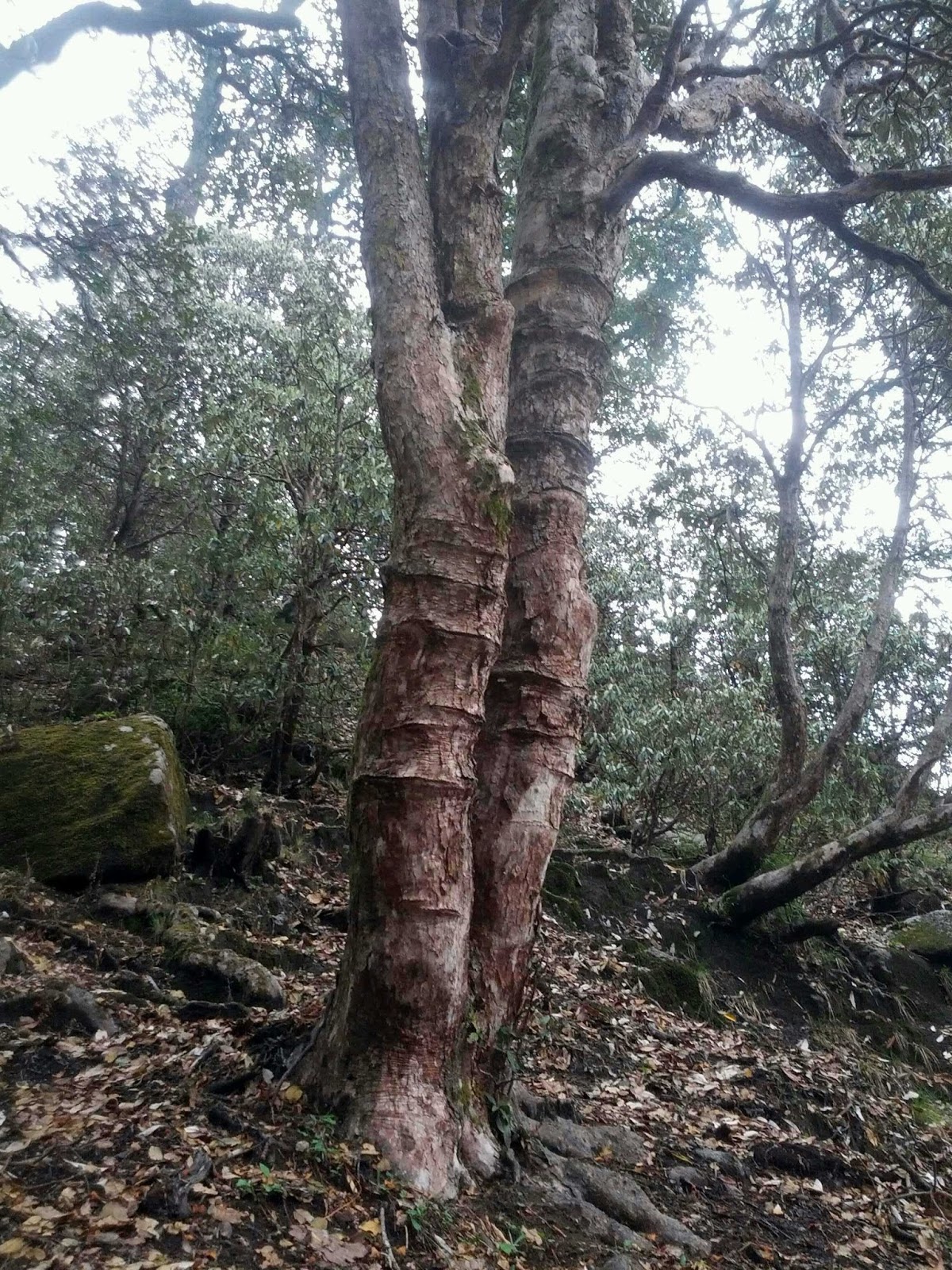
In April 2016 I had the privilege of walking along a Himalayan hillside with Emmanuel Theophilus and S. Subramanya and we came across trees with curious swollen rings on their trunks. Observing them closely showed that there were series of punctures made over these rings by woodpeckers. There are a group of woodpeckers in North America that are called sapsuckers - they all belong to the genus Sphyrapicus and have the habit of making punctures on trees and waiting for sweet sap to fill them up. They revisit these holes and sip the sap that collects. Now there is just one species in Asia that has the same habit - the rufous-bellied woodpecker and even called the rufous-bellied sapsucker (Dendrocopos hyperythrus) - and it leaves a trace on the trees. They are not produced by single individuals but by generations of them. The trees which are at least a century old have rings that are tapped repeatedly and the calluses grow quite wide due to the repeated injury. Not all trees seem to respond to the damage in the same way and the most significant callusing was found in karsu oak and rhododendrons (they are massive trees here, worth mentioning for readers familiar only with rhododendrons from higher latitudes). Interestingly Green-tailed sunbirds (Aethopyga nipalensis) seem to be secondary sapsuckers and they hover and steal sap from the same puncture sites.

Emmanuel Theophilus points to calluses on karsu oak Quercus semecarpifolia

Callus rings on a Rhododendron


Rings from at a distance. 
Close up of a ring showing a fresh line of punctures.


Perhaps there are places in the Himalayas where the woodpeckers have left their traces and vanished since and hopefully those histories that are not lost to the timber trade.

There is then a case for historians to learn a bit of ornithology and there is of course a case to be made for ornithologists to know a little bit of history. The latter is probably harder considering that hordes  contribute to such systems a ebird with no standards for the recording of habitat conditions. It is as if they assume that habitats are static. If anything has been learned by looking at old bird literature it is the inability to guess what kind of a habitat a bird formerly used. Standards for describing habitats that can guide future work and that which can be analyzed quantitatively has to be evolved locally, it involves democratizing citizen science websites and therein lies the problem. History, even of humans, is important for software designers, as much as it is for scientists.
 
Postscript: 5-Sep-2024 found this - Baral, H.S. 2023. Ecosystem engineering: Rufous-bellied woodpecker Dendrocopos hyperythrus (Vigors, 1831) modifying tree shapes of Himalayan broadleaved forests. Nepalese Journal of Zoology, 7(2):1–7.

Sunday, June 5, 2016

Ordering chicken

A few weeks ago, I was asked a few questions by a couple of friends relating to why the bird-groups in bird-books are ordered the way they are. The groupings themselves were not so much in question, it was only the sequence. Why do the larger birds come before the smaller birds? It then led to further questions on why the Galliformes (for example chicken or junglefowl) are considered representatives of an older branch of birds (simply sometimes stated as "primitive", and termed "basal" by cladists) compared to say crows. Part of the question was also the understanding that the sequence to a large extent has been around since the first bird-guides for the Indian region. It was hard to make a clean, coherent, non-anachronistic reconstruction particularly since the sequence has to a large extent been followed long before molecular biology took root. In trying to clarify this, at least for myself, I have been forced to look at some historic literature that few read in modern times. [Needless to say my research also led me to improve some Wikipedia biographies.]

Max Fürbringer (1846-1920)
We can skip the pre-Darwinian state largely because the birds were then put in groups whose order was largely decided by tradition and never questioned (at least not within birds which were themselves placed in the scala naturae / "ladder") - and in this we have already seen ideas such as Quinarianism that were followed by Jerdon in India. But why order birds? It appears that everyone wants some order when listing out all the birds of the world and like dictionaries they initially followed some kind of convention that did not need to be questioned. These lists beginning with that of Linnaeus include those of G.R. Gray and R.B.Sharpe. The sequence that Gray and Sharpe followed was based on one established by N.A.Vigors - again a quinarian. Whether the desire to get away from this sequence was related to the unpopularity of quinarianism, I do not know but the sequence followed in  modern bird books has its roots in a system that was established by two ornithologists who are sadly somewhat lesser known perhaps because their writings were in German. (Interestingly Jerdon's contemporary, Edward Blyth, taught himself German and had little tolerance for Jerdon's scheme that followed Swainson). The two Germans who matter for our analysis are Max Fürbringer (1846-1920) and Hans Gadow (1855–1928) [and they had a counterpart in botany Adolf Engler (1844-1930)]. Gadow by virtue of moving to Britain and writing in English is somewhat better known but his work draws greatly on a lot of hard work and thinking on the part of Fürbringer. 

Pierre Belon's comparative anatomy (1555)
After Darwin, the idea of genealogical trees was well adopted and it was also quite clear that evolutionary processes decidedly lacked order and the ragged bush representing the birds of the world had some bushy branches while others were skeletal and many where difficult to place. Now flattening out this bush (or at least the leaves on a 2-dimensional representation of the bush) and reducing it to a linear list can be done in many ways (computer literates will recognize only two - a breadth-first and a depth-first approach!). There were numerous ways in which the tree itself was being re-arranged (phylogenetics) starting with methods that went from the use of intelligent guesswork on the basis of morphological and anatomical characters to methods that reduced guesswork and attempted to reconstruct evolutionary history on the basis of DNA sequences. Ernst Mayr and Walter Bock referred to the "standard sequence" as one based on Gadow-Wetmore-Peters. Mayr and Bock also went to the extent of suggesting that the sequence be maintained independent of matters of phylogeny (then already showing signs of fluidity) so as to make communication easier. Modern bird-guidebook authors and publishers have obviously given that suggestion a pass. Mayr and Greenway in 1956 set three principles for the taxonomic sequence to be followed - (A) To follow as closely as possiblethe traditional arrangements, except where subsequent work has shown conclusively that a change is advisable (B) To place familes near each other whichare presumably closely related (C) To place the more primitive families near the beginning and the more advanced families near the end.

Back to Max Fürbringer who was a student of  Carl Gegenbaur and a great comparative anatomist. Comparative anatomy at this point had evolved from its early origins as an area of amateur investigation in medical studies. It was not just about looking at gross skeletal similarities but looked at minutiae such as the twisting of the tendons of the foot and the bones of the skull. Fürbringer made use of 51 characters, mostly internal anatomy but also some that included whether the state in which the young are born. He had worked earlier on reptiles and their musculature and was an expert on fossils and osteology as well. He gives special importance to the muscules and tendons on the shoulder. It is quite mind boggling to think of the time and effort it would take to dissect and examine the shoulders of so many kinds of birds, leave alone obtaining the specimens needed for it. Given that it has to be done over a significant length of time, it involves meticulous note making and sketching. Fürbringer identified the key characters for each of the bird groups and then he compared every pair of bird groups noting the number of common characteristics and the number of differing characters. He used this pair of numbers (matches and mismatches) to decide a measure of distance between the groups (what we would now call as phenetics - but all this was done before Hennig and the formal birth of cladistics). Gadow would, four years later in 1892, comment that Fürbringer was being a bit too precise (read "German"!) in doing this pair-wise distance computation and that this was unneeded overkill. Gadow also made some alterations, he emphasised that not all characters were equal and that the equal weightage for characters was inappropriate. So he decided based on his expertise that some of the relationships that Fürbringer saw were spurious. It is worth reading his original text:

The anatomical portion has been written with the view of abstracting there from a classification. In the meantime (after Huxley, Garrod, Forbes, Sclater, and Reichenow's systems) have appeared several other classifications: one each by Prof. Newton, Dr. Elliott Coues, Dr. Stejneger, Prof. Fuerbringer, Dr. R. B. Sharpe, and two or three by Mr. Seebohm. Some of these systems or classifications give no reasoning, and seem to be based upon either experience.in ornithological matters or upon inclination—in other words, upon personal convictions. Fuerbringer5s volumes of ponderous size have ushered in a new epoch of scientific ornithology. No praise can be high enough for this work, and no blame can be greater than that it is too long and far too cautiously expressed. For instance, the introduction of " intermediate " groups (be they suborders or gentes) cannot be accepted in a system which, if it is to be a working one, must appear in a fixed form.     In several important points I do not agree with my friend ; moreover, I was naturally anxious to see what my own resources would enable me to find out. This is my apology for the new classification which I propose in the following pages.

The author of a new classification ought to state the reasons which have led him to the separation and grouping together of the birds known to him. This means not simply to enumerate the characters which he has employed, but also to say why and how he has used them. Of course there are characters and characters. Some are probably of little value, and others are equivalent to half a dozen of them. Some are sure to break down unexpectedly somewhere, others run through many families and even orders;  but the former characters are not necessarily bad and the latter are not necessarily good. The objection has frequently been made that we have no criterion to determine the value of characters in any given group, and that therefore any classification based upon any number of characters however large (but always arbitrary, since composed of non-equivalent units) must necessarily be artificial and therefore be probably a failure. This is quite true if we take all these characters, treat them as all alike, and by a simple process of plus or minus, i. e. present or absent, large or small, 1, 2, 3, 4, &c, produce a "Key," but certainly not a natural classification.

To avoid this evil, we have to sift or weigh  the same characters every time anew and in different ways, whenever we inquire into the degree of affinity between two or more species, genera, families, or larger groups of creatures.

Of my 40 characters about half occur also in Fuerbringer's table, which contains 51 characters. A number of skeletal characters I have adopted from Mr. Lydekker's 'Catalogue of Fossil Birds' after having convinced myself, from a study of that excellent book, of their taxonomic value. Certain others referring to the formation of the rhamphotheca, the structure and distribution of the down in the young and in the adult, the syringeal muscles, the intestinal convolutions, and the nares, have not hitherto been employed in the Class of Birds.
......
Of course this merely mathematical principle is scientifically faulty, because the characters are decidedly not all equivalent. It may happen that a great numerical agreement between two families rests upon unimportant characters only, and a small number of coincidences may be due to fundamentally valuable structures, and in either case the  true affinities would  be obscured.


Of the 26 positive points not less than 19 are common to Falconidae, Psittaci, and Coccyges. In the remaining 7 points Psittaci and Falconidae agree together against Coccyges, namely nestlings, downs of young and adult, fifth cubital, temporal fossa, fleshy tongue, convolutions of intestines. Most of these characters seem important, especially the woolly nestlings, considering that Psittaci breed in holes, and agree in the convolutions in spite of the totally different food.
On the other hand, the sifting of the 14 negative characters shows On the other hand, the sifting of the 14 negative characters shows that in 13 of them the Parrots agree with Cuculidae or with Musophagidae, or with both, and differ along with the Coccyges from the Falconidae. The syrinx is an absolute specialization. Fuerbringer remarks that powder-downs, ceroma, and beak speak for Falconidae against Coccyges. Again, Psittaci and Falconidae differ greatly in the formation of the furcula, in nearly the whole of the muscular system, and in the bones of the wings and legs.
Conclusion.—The Psittaci are much more nearly allied to the Coccyges than to the Falconidae, and of the Coccyges the Musophagidae are nearer than the  Cuculidae because of the vegetable food, ventral pterylosis, presence of aftershaft, tufted oil-gland, absence of vomer, truncated mandible and absence of caeca.

Gadow's weighing and sifting probably went wrong there as a 2011 study re-established the closeness between the parrots and falcons. (Fürbringer had carefully compared them but he too had them branching apart widely).
Suh A, Paus M, Kiefmann M, et al. Mesozoic retroposons reveal parrots as the closest living relatives of passerine birds. Nature Communications. 2011;2:443-. doi:10.1038/ncomms1448.
It is somewhat sad that Fürbringer is still hardly known in ornithological circles. Mayr and Bock call the bird-sequence used for so many years as the Gadow-Wetmore-Peter's sequence. (this despite Mayr being a historian of biology!) I saw with delight however that Tim Birkhead in his Ten Thousand Birds (2014) puts 1888 on the ornithological timeline to mark this landmark work.

Fürbringer's work is also remarkable because he finally produced a graphical summary of his entire work. An evolutionary tree and wait, it was a three-dimensional tree! He tried to represent it with side views from two opposite points and horizontal cross-sections at three levels. The cross-sections indicate phenetic distances between the groups. He seems to have hit upon some kind of manual equivalent of what we might produce today using canonical correspondence analysis. (It would be amazing if someone-who-knows-German could recreate his three-dimensional rendition and compare his own distance matrix which what a CCA algorithm would produce - Heidelberg University would do well to make a three-dimensional tree model as a tribute)


Front views of the avian tree.
Rear view of tree


Okay, so we now hopefully have a historical view of how the bird relationships were established. We still have a part of the original question hanging, why are chicken considered "primitive" or "basal" to use the more accurate phylogenetic term. The answer again lies in Fürbringer's scientific past- he had worked extensively on reptilian anatomy and he saw more of the older traits in parts of his bird-tree. Remember also that he tried to place extinct birds into the tree. Today, the way a tree is rooted or oriented is by comparing with an outgroup - a specimen that you know from prior knowledge to be distant enough to have a common shared ancestor with all the others that are in focus.

The specific characters that Gadow listed for the Galliformes (in which he also included the hoatzin) while he placed them as the 14th group (after the ratites, herons, seabirds and falcons but before the cranes) are :
  • Galliformes- Phytophagous. Nares impervious. Furcula with hypocleidium. Plagiocoelous type V. Caeca large. Crop globular. 10 primaries. 
    • Galli -  16 or more cervical vertebrae. Holorhinal. Coracoids touching each other. Flexors of type I. Hallux large. Neck without lateral apteria.
      • Gallidae -16 cervical vertebrae. Nidifugous. Spina communis sterni. Sternum with long posterior later processs and with obliue processes. Hypotarsus complex.
      • Opisthocomidae - 18 or 19 cervical vertebrae. Nidicolous. Spina externa only present. Sternum with small notches or fenestra only; no oblique process. Oil-gland tufted.
The Hoatzin has since been moved elsewhere but interestingly the claws on the hand used for clambering up vegetation are not even used.

That leaves one other question which is on whether the sizes matters in this sequence. It appears that the Galloanserae which appear early in the sequence are in general somewhat large sized, the ratites and flightless birds also tend to be large. At the other end of the spectrum the passerines tend to be small but it appears that there is no strong evolutionary trend in size.

Note: Thanks to Emmanuel Theophilus and Ashish Kothari for the original questions and discussions.
Postscript: Note that there were many other comparative anatomists in the period and many pieces of bird and reptile evolution had been figured out by several others including Archibald Garrod (1873-74 on muscles part 1 part 2 and W.H. Flower.
I have also found this very nice interactive site on comparative anatomy of birds that uses chicken as a model. 
Note that I had mistakenly attributed the parrot-falcon affinity to Fürbringer, turns out that he did not think much about it.
9 June 2016 - I have also found an interesting review by R.W. Shufeldt (that infamous racist!) which also summarizes the work of Professor William Kitchen Parker. Parker (1862) is quoted "I will first show, in two parallel columns, how both the Fowls and the Rails run insensibly through certain leading genera into the lowest (reptilian) types of diving-birds" 1862, William Kitchen Parker "On the Osteology of Gallinaceous Birds and Tinamous" in Shufeldt, R.W. (1904) An Arrangement of the Families and the Higher Groups of Birds. The American Naturalist 38(455/456):833-857.
Appendix - a list of the characters used by Gadow.

A.   Development.
Condition of young when hatched: whether uidifugous ur nidi-colous; whether naked or downy, or whether passing through a downy stage.
B.  Integument.
Structure and distribution of the first downs, and where distributed.
Structure and distribution of the downs in the adult: whether absent, or present on pteryls or on apteria or on both.
Lateral cervical pterylosis : whether solid or with apteria.
Dorso-spinal pterylosis : whether solid or with apterium, and whether forked or not.
Ventral pterylosis: extent of the median apterium.
Aftershaft:  whether present, rudimentary, or absent.
Number of primary remiges.
Cubital or secondary remiges: whether quinto-or aquinto-cubital.
Oil-gland: present or absent, nude or tufted.
Rhamphotheca: whether simple or compound, i. e. consisting of more than two pieces on the upper bill.
C. Skeleton.
Palate: Schizo-desmognathous.   Nares, whether pervious or impervious, i. e. with or without a complete solid naso-ethmoidal septum.
Basipterygoid processes: whether preseut, rudimentary, or absent: and their position.
Temporal fossa, whether deep or shallow.
Mandible: os angulare, whether truncated or produced ; long and straight or recurved.
Number of cervical vertebra;.
Haemapophyses of cervical and of thoracic vertebra;: occurrence and shape.
Spina externa and spina interna sterui: occurrence, size, and shape.
Posterior margin of the sternum, shape of.
Position of the basal ends  of the  coracoids: whether separate, touching, or overlapping.
Procuracoid process: its size and the mode of its combination with acrocoraeoid.
Furcula: shape; presence or absence of hypocleidium and of interclavicular process.
Groove on the humerus for the humero-coracoidal ligament: its occurrence and depth.
Humerus, with or without ectepicondj lar process.
Tibia: with bony or only with ligamentous bridge, near its distal tibio-tarsal end, for the long extensor tendons of the toes : occurrence and position of an intercondylar tubercle, in vicinity of the bridge.
Hypotarsus : formation with reference to the tendons of the long toe-muscles:—(1) simple, if having only one broad groove; (2) complex, if grooved and perforated ; (3) deeply grooved and to what extent, although not perforated.
Toes :   number and position, and connexions
D.  Muscles.
Garrod's symbols of thigh-muscles A B X Y,—used, however, in the negative sense.
Formation of the tendons of the m. flexor perforans digitorum : the number of modifications of which is 8 (I.-VIII.) according to the numbering in Bronn's Vogel, p. 195, and Fuerbringer, p. 1587.
E.   Syrinx.
Tracheal, broncho-tracheal, or bronchial.
Number and mode of insertion of syringeal muscles.
F.   Carotids.
If both right and left present, typical: or whether only left present, and the range of the modifications.
G.   Digestive Organs
Convolutions of the intestinal canal. Eight types, numbered L-VIIL, according to Bronn's Vogel, p. 708, and P. Z.S. 1889, pp. 303-
Caeca: whether functional or not.
Tongue: its shape.
Food.—Two principal divisions, i. e. Phytophagous or Zoophagous, with occasional subdivisions such as Herbivorous, Frugivorous, Piscivorous, Insectivorous, etc.

List of Characters employed occasionally.
Shape of bill.
Pattern of colour. Number of rectrices ; and mode of overlapping of wing-coverts, according to Goodchild (P.Z.S. 1886, pp. 184-203).
Vomer.    Pneumatic foramen of humerus.
Supraorbital glands.
Crop.
Penis.
Certain wing-muscles according to Fuerbringer.
Mode of life: Aquatic, Terrestrial, Aerial, Diurnal, Nocturnal, Rapacious, etc.
Mode of nesting: breeding in holes.
Structure of eggs.
Geographical distribution.

Postscript: I have subsequently come to learn of Stigler's Law of Eponymy!


Thursday, December 29, 2011

A pioneer of bird study in India

About twenty years ago, a time when the only reading was in print and good material hard to come by, my favourite place was the library at the University of Agricultural Sciences in Bangalore. The racks near where I sat held almost the entire collection of the Journal of the Bombay Natural History Society. Until a few years ago, that library held the most accessible copies of that venerable Journal and researchers from around the world have benefited from photocopies sourced from there. It was only a few years back that the journal was digitized by a couple of volunteers who, like me, were fascinated by the contents. In more recent times, high quality scans from better libraries have become available online through the efforts of the Biodiversity Heritage Library. The journal is a source not just for the fauna and flora of the Indian region, but  is also as an indicator of social and scientific change.

One of the many articles of interest that I had read in those years was a series on the birds of Coorg. The series was written by a certain F. N. Betts and his many writings made it very clear that he had spent a great deal of time in the region. His address indicated that he was one of the many British coffee planters, but his writings like those of many others in the Journal had little to reveal of the author. The BNHS had a tradition of including obituaries of their key contributors, but none had been written on Betts. When I earned my first salary, I invested it on becoming a life member of the BNHS. Unfortunately, by that time this ancient organization had moved rapidly into a new century, slipped on its way and had lost touch with its founding principles.
The newly wed Betts and Ursula Bower (Shillong 1945)
With the arrival of the Internet, and the loss of access to my favorite libraries, I often ended up searching on the Internet for material and one day I stumbled on a website (which does not exist today !). It was about a BBC radio play titled "The Butterfly Hunt"  and was based on the life of F. N. Betts. The story was that Betts, who had left the coffee plantations of Coorg to join the Army, had been enamoured by tales of a British anthropologist in Nagaland. American Pilots who bailed over the Hump  called her "The Jungle Queen" and the British called her "The Naga Queen!"  The Americans even had a comic strip cartoon based on her. Betts had decided that she was the kind of woman he could marry and had decided to visit her under the pretext of collecting butterflies. Reaching there and spending some time led to him proposing to her and they got married. The website revealed in its last line that the then BBC correspondent  in India, Mark Tully, was a nephew of Betts. With the help of some friends, I found the email address of Sir Mark Tully and rather tremulously sent an email asking  him for any information on his uncle. To my great surprise, he wrote back to say that the best person to contact was his cousin, Betts' daughter Catriona, who lived right in New Delhi! Catriona responded prompty to my next email and expressed surprise.  Few had asked her about her father, least of all about his ornithology, as most people wanted to know more about her mother who was decidedly famous. Ursula Bower, the Naga Queen, was a recipient of the Lawrence Memorial Medal instituted in the memory of T. E. Lawrence (of Arabia fame) and given for achievements in exploration  and research.  She led a guerrila unit in Nagaland, wrote several books and had been made a Member of the Most Excellent Order of the British Empire (MBE).

In February 2010, Catriona found time to make a visit to Coorg to trace her father's life. I joined her from Bangalore and we managed to visit some of the places where he lived and met others in the region who would find interest in his life and work. This was made possible by old friends who helped organize meetings at the the Coorg Wildlife Society premises in Madikeri and at the Forestry College at Ponnampet.
Lt. Col. F. N. Betts (1906-1973)

Frederick Nicholson Betts ("Tim") was born in 1906 near Launceston. Although interested in zoology he was forced to find work and decided at the age of 17 to work at a tea plantation in Ceylon. He then moved to coffee planting in the Nilgiris. In 1939 he was on holiday in Norway when the war began and on returning to India, he volunteered with the Army and was posted in Abyssinia with the 2nd Punjab Regiment. He was injured at Keren and was later posted back in India. He was active during the Hur uprising in Sindh and when Assam was threatened by Japan he was moved into a group that was involved in getting south Indian workers into Assam for road work. He was posted into this duty because of his knowledge of south Indian languages (he apparently knew six, which presumably could have been Tamil, Kannada, Malayalam and perhaps Kodava Tak, Tulu and Konkani or Telugu?). He did not enjoy this work and when he heard about a new unit called the V Force he moved to it. In March 1944 he was in the Chindwin area working with V Force Scouts, but this group had many Kukis who rebelled and defected to join the Japanese forces. An unpublished diary that he maintained during early 1944 after a long march  through Japanese lines has numerous interesting bits on birds, butterflies and how he found things to eat such as Bauhinia flowers. 
With binoculars in Arunachal Pradesh
A few entries from this diary:

14 April
Thundery and wet in the morning. Found Corbett is a very enthusiastic butterfly hunter and keen too on birds which is great fun. We had a lot of yarns to swap. I hope my heavy kit hasn't gone with all my war diaries and photos and films and papers written for the BNHS. He has gone in a lot for caterpillar breeding, which is about a virgin field with most of these tropical butterflies.

21 April
...Corbett got his kit with a very fine book of Ceylon Butterflies and a number of BNHS Journals. It made me horribly homesick. ...

23 April
Went into Gauhati ...One would'nt know there was a war on here. Went along to Malabar Camp and saw X and got ISLU news. MacClellan is away but babington is here now. Walker is giving up the CLLO job and going back to tote. Went along to see Babington. He has aged a good deal. He seems to have had a good war and done very well Being pulled out for ISLU from being DAAG Bangalore, much to his disgust. He had very little news of Coorg people but thinks Fred Foster is dead. I hope he is wrong.

24 April
Went into Gauhati again ... Rumour has it that the whole Dimpaur/Imphal road now open. Three mynahs here, Pied, Jungle and Common. The vultures in Gauhati town seem to have finished breeding.

8 May
In the jungle in the morning. Found Bronzed Drongo and Black-naped Flycatcher building. Saw a broken egg, apparently a Shortwing plain brown. Lots of butterflies. Kallima, no Parthenos here. Rang up Col. Binny and got permission to send Bridges and Whitaker on leave. Tibbetts to go off to protect Miss Bower the anthropologist. That's a job I should have liked. She sounds as if she might do me quite well for a wife if I could make contact. ...

9th May
...Was in the jungle morn and eve. Heard a jungle cock crowing and managed to call him up by the old handkerchief flapping trick. Saw Necklaced Laughing Thrush, Red-winged, Crested and Drongo cuckoos ...

21 May
... Ruther has pinched another jeep. Went up to Piphema to see him and try and find out what if anything was happening. As far as I can see 2 V Ops is dead. ... Went down to see Toby in the evening. Grans meeting him again. Barbara off to a WAC (I) OCTU in Simla. Bull is trying to get Walker back. Report of Ford's death believed false, thank goodness. Owen Tipping in England on sick leave from Italy.
----------
You can find a bit more on his life on the Wikipedia article here.

A group taken after a cricket match in Mercara
circa 1932 containing L to R: WAF Bracken,
Mrs Cunningham, JJ Cheesley, Owen Tipping,
RB Cunningham and FN Betts

Based on the addresses indicated by Betts in his JBNHS notes, we decided to visit two of the estates where he worked- Yemmegundi and Coovercully. Both these estates are today under the management of Tata Coffee and a lot of the old heritage appears to be untraceable. We discovered a photograph of him in the collections of Mr K P Uthappa of Pollibetta. While the estates did not yield much information on the life of F N Betts in particular, it did give us an idea of how life might have been in those days.

Kalbane bungalow (Yemmegundi). Shoe scraper (inset)
A steel safe at Coovercully estate reminds one of a time when large amounts of money had to be held when access to banks was limited. At another estate one is reminded of a time when one would come back from work and scrape the mud off their shoe before stepping in. A time when electricity, cars and telephony were not taken for granted.

The ornithological contributions of Betts have been mentioned several times in literature. Just as I left Bangalore for Coorg, I discovered a 1982 issue of the Newsletter for Birdwatchers  ( 22(11&12):2-4 ) with an editorial note by Zafar Futehally which quotes Salim Ali, here included in its entirety.

A Visit to Coorg
I had the good fortune of attending a meeting of the recently formed Coorg Wildlife Society at Mercara. The Society mainly consists of planters who have a great deal of knowledge of natural processes - the relationship for example, between vegetation and the water regime, and they might well form a Task Force for producing an Ecological Plan for Coorg. Mrs V. Rama Rao the District Commissioner, as well as Mr. Yellappa Reddy, Conservator of Forests seem to be the kind of civil servants who will encourage the rehabilitation of this wonderful area.

I was taken to Coorg through the kindness of Mr. Harish Chittiappa, and when I stepped out of his house in the morning, within a few minutes I could see a golden-backed woodpecker, white-breasted kingfisher, black headed munias, a shikra, jungle mynas, spotted doves, red whiskered bulbul, red-vented bulbul, magpie robins, a white-breasted waterhen. In view of the splendid bird life of Coorg, I had suggested to the Coorg Wildlife Society that they could not do better than reprint in the form of a brochure the two articles by F.N.Betts on the birds of Coorg, which were published in the Journal of the BNHS in 1951. This they have agreed to do. Dr. Salim Ali was requested to write a foreword and I have his permission to reproduce this here. Betts has the capacity to make the sort of perceptive comments about the habits and movements of birds which makes his writing so fascinating and instructive. Here is Salim Ali's foreword:
A steel safe (Coovercully)
I consider it a capital idea of the Coorg Wildlife Society to bring out in booklet form the excellent articles by F. N. Betts on The Birds of Coorg originally published in two parts in the Journal of the Bombay Natural History Society in 1951. It will thus become available not only to its own members but also to the growing band of keen bird watchers that has emerged in South India, and serve as an authentic bench-mark for future observations. The pace of our so-called 'Development' has accelerated to hectic proportions since the end of World War II, and particularly since our Independence in 1947. In the process the natural environment has become drastically transformed, and some areas have been rendered almost unrecognizable even by those who were intimately familiar with them no more than twenty years ago. Forests everywhere have been ruthlessly devastated through the short-sighted stupidity of State Governments or to make way for often dubious hydel or other projects or industrial complexes or for settlement of refugees and repatriates from other parts of the world.
With the forests has gone the wildlife which was once the glory of those forests as I remember them in Mysore from the time of my bird survey in 1939/40. However, Coorg, and Karnataka as a whole, are fortunate to have such authoritative first-hand records as Betts' paper and the report of the Mysore Ornithological Survey against which to measure the ravages that have been wrought in the intervening years and their impact on the biota. It is to be hoped that in course of time the Coorg Wildlife Society will also be able to provide a similar record of the conditions obtaining today for a comparison with what they will be say twenty years hence, in this inevitable march of 'Progress'.
Bird watchers of the present generation, especially those in Coorg, may be interested to know something about the author who was an esteemed friend and colleague of mine and an exceptionally keen and knowledgeable field naturalist. In the years up to World War II, Betts was a young British coffee planter who had started his professional as well as Indian bird watching career in the Nilgiris, I believe, and made a very useful contribution to our knowledge of the birdlife of those hills. By the time I first came to know him personally he had shifted to Coorg and was Manager of a coffee estate at (or near) Hebbale while I was working that area during Mysore survey. He was an ardent Zoologist and had made an excellent collection of eggs and notes on Mysore birds -especially of Coorg- adding significantly to what was known about the breeding biology of many uncommon species. Soon after the outbreak of the 1939 war Betts left coffee and volunteered for the army. He was on active service in various capacities in the Assam sector till the fighting with Japan ended, rising to become a Colonel in the process. There had been a belated realization on the part of the British Indian Government only when the Japanese invasion of Burma had brought the war to the frontiers of Assam that India's eastern borders were vulnerable. They had then set up in haste the N E Frontier Agency in order to fill the political and administrative vacuum between Assam and Tibet that had been allowed to drift. Betts was appointed Political Officer for one of the several tracts into which this hitherto no man's land was divided. He was in charge of Subansiri (earlier Balipara) Frontier Tract where he made friends with the Apa Tani, Dafla, Abor and other reportedly wild and ferocious tribes, and did much for their social uplift and economic and administrative betterment. At the same time he made the best of his opportunities to study the avifauna and collected valuable information from the tribals concerning these, till then, ornithologically virgin areas. At some point during his service as a Political officer, Betts seems to have fallen in love with a young British woman anthropologist, Ursula Bowers, who had been working for some time among the Nagas studying their local tribes (some of them as yet practising headhunters!). By her tact and friendliness she had won their trust and confidence to such an extent that she had come to be known among her British compatriots by the honorific of the 'Naga Queen'. An understandable romance developed which soon culminated in marriage! After Independence in 1947, when the services were nationalized, Col. and Mrs. Betts returned to the UK where he settled down to farming in the Isle of Mull (Scotland). Many of his meticulous notes relating to the birds of Coorg and N E Frontier Agency (NEFA), as Arunachal Pradesh was then called, he was good enough to offer to me and Dr. Ripley when our Handbook of the Birds of India and Pakistan was under preparation. They have proved of inestimable value in filling some of the gaps in our knowledge, particularly concerning the latter area. [Salim Ali]

Ornithological evolution

One of Betts' earliest publications in the JBNHS is about the Brown Shrike (1929 33(3):714). He noted that Stuart Baker in the Fauna of British India (edition 2) had failed to include southern India in its distribution and commented that it was a common  winter visitor in Coorg. The editors of the BNHS responded to it and commented that it was indeed an oversight. Looking at this further it turns out that the first edition of the Fauna of British India continues to have bits that are not found in almost all other subsequent works. It continues for instance to have the best feather colouration details and there is still an occasion when one needs to look it up. These presumably trivial details (at least from a bird spotting/ticking perspective) are often dropped in later syntheses and is something one notices especially when researching or reviewing the literature on species  (something that I often do when attempting to improve Wikipedia entries).

In the subsequent years in the Nilgiris, Betts seems to have kept a careful record of the arrival dates of migrants. In 1937 he wrote  the Bird life on a southern Indian tank ( JBNHS. 39(3):594-602) which is a very readable word picture of life around a wetland near Mysore. One of his favourite birding areas there  was Palahalli and is perhaps what is today Ranganathittu bird sanctuary. The editors of the JBNHS made a special comment on it: "Mr F. N. Betts contributed a well illustrated paper on the Birds of a South Indian Tank in the Province of Coorg. Ecological notes of this description covering bird life in relation to a particular environment deserve encouragement and indicate a line of study which might with advantage be followed by others in the country."
By 1936 Betts notes that there are great differences in the timing of breeding of birds (particularly waterbirds). Like ornithologists before him, he attempted to collate information from others to cover a larger geographic area. He sought information on  heronries and was particularly interested in the seasons in which the birds bred. 

He continued to write about the birds of Coorg and some of the interesting observations made by Betts include notes on the behaviour of Jerdon's Baza and on the construction of dormitory nests by Dark-fronted Babblers.

In 1938 he made a trip to the Lakshadweep Islands on a boat from Mangalore and noted the breeding of Sooty Terns. Around this time, he also compared the bird life of the dry and wet zones of Coorg.

After his move to the north east he wrote about the birds of Assam comparing the composition of various groups (or guilds) with expectations from a comparable south Indian habitat.

It seems like his search for patterns began after he moved to Kenya. In his 1952 paper on "The breeding seasons of birds in the hills of South India", published in the Ibis, he thanks Reginald Moreau. Now Moreau, it turns out was an important player in the history of ornithology. An accountant by profession, he began to use numbers to look for patterns. Working in Africa, he recruited local assistants to help him look for bird nests and to count eggs and survival of chicks. From this data he was able to suggest that comparable bird species had larger clutches in the higher latitudes than in the tropics. He was an editor of the Ibis from 1946 to 1960 and was among the pioneers (or rebels!) who transformed the Ibis from a systematics and taxonomy oriented journal into one that increasingly focused on ecological aspects of bird life. The exact nature of Betts' association with Moreau is not clear but in the Ibis paper, he notes that the birds of the hills of southern India have distinct breeding seasons - and that given the absence of any major day-light duration are largely limited to specific breeding periods by the rains. He then attempts to look at how the rains limit the breeding of birds and how different groups of birds breed before the rains (raptors, woodpeckers), during them (thrushes, rails and grebes) or  in the driest periods ( larger water birds - storks etc.) and correlates them with food availability. He notes his inability to find large scale geographic data but suggests that the breeding dates for the same birds may differ by as much as month between the wet and the dry zone. In 1966 he published a paper on the breeding of the birds of Kenya in which he finds a similar pattern entirely associated with rainfall.

Very little has since been studied on the effects of the monsoon on breeding seasonality in India and perhaps the only recent work on this was an analysis of secondary data [Pramod Padmanabhan and Yoram Yom-Tov (2000) Breeding season and clutch size of Indian passerines. Ibis 142(1):75-81] derived from the Handbook of the Birds of India and Pakistan. The timing of breeding in this work however mixes information from all parts of the country and does not take geographic variation into account. This is a problem even with the morphometrics data contained in it and even basic information on clinal variation is often lacking.

Given the interest in climate change, the theme of Betts'  key research is still alive and much remains to be studied. The evolution of Betts' research from stray reports of species from around his residence to larger collations of data  followed by the quest for underlying patterns is perhaps something that is reflected in the lives of most naturalists and in the nature of ornithology itself.

Note
Coorg Wildlife Society did not publish Betts' notes as suggested by Salim Ali in 1982. If anyone is interested in any of Betts' publications, please contact me and I will be happy to email a PDF copy.

Acknowledgements
Roshan, Shyamal, Caroline, Gayathri and Catriona (2010)

The black and white photographs of F N Betts are reproduced here through the courtesy of Catriona Betts. The 1932 photograph of the Coorg planters group is from the collection of Mr K P Uthappa, who kindly showed us his collection of photographs from the past. Thanks are due to Roshan Somaya, Gayathri and  family for hospitality and all the help in making this attempt to trace Betts' life in Coorg possible. Managers Machaiah and Rajeev at Coovercully and Yemmegundi respectively for their kindness and help. Many thanks are due to members of the Coorg Wildlife Society for finding time during  the busy coffee harvest season. The secretary of Coorg Wildlife Society, Tarun Cariappa for the organization of  the meet at Madikeri. Professor C G Kushalappa at the Forestry College in Ponnampet for help in organizing both the Madikeri and Ponnampet meets in February 2010. Thanks also to Dr S V Narasimhan and KN Changappa for their support.


Further links
Postscript
In August 2014 I visited the library of the Natural History Museum at London and examined some of the correspondence of Betts and it turns out that Norman Boyd Kinnear had been in correspondence on the matter of collecting in the Dafla hills. He mentions meeting Betts along with the late Hugh Whistler (Letter 29 June 1946). Betts' correspondence with Moreau is untraceable at the Edward Grey Institute Library (per Sophie Wilcox, email 11 April 2014).