click hide image

Wednesday, March 2, 2016

Some unsung Lepcha collectors


Photo from Bruce, C.G. (1923) The Assault on Mount Everest 1922. New York: Longmans, Green & Co.
 
A chance enquiry from Richard Conniff on some Lepcha collectors for his website for fallen naturalists led me to some very interesting tit-bits and as usual, I was surprised by the paucity of local interest and research. Not having had the good fortune of exploring the richness of north-eastern India (except for a short trip in Bhutan) it was hard to feel grounded with sufficient local context but reading through some of the available bits makes it clear that that so much local knowledge has been squandered in recent times. Hopefully someone based in Sikkim or nearby can make amends with a more detailed study.

The Gazetteer of Sikhim (1894) has an excellent introduction to ethnic and biological diversity. It includes a list of birds along with Lepcha names. It also has bits of local bio-lore such as notes on birds of good and ill omen. The sections on butterflies was written by J. Gammie and Lionel de Niceville while the one on birds was by L.A.Waddell. Wadell writes while dealing with the birds:
The Pahariyas, speaking a Sanskritic dialect- the Parbatiya, and the Bhotiyas, including the Tibetans are much less discriminating in their bird-names than the Lepchas, who are "born naturalists";  - [1894. The Gazetteer of Sikhim. p. 202.]
 Altogether the Lepcha is a very different sort of companion in the jungle from the Indian who knows and cares nothing about flowers, nor animals - except those that he eats or that eat him. - Laurence Waddell (1900) Among the Himalayas. p. 79.
The butterfly section in the Gazetteer by Niceville makes a tantalizing statement but sadly, he does not actually list the Lepcha names for butterflies (unlike Waddell who does include names for birds):
It might be noted that the Lepcha collectors of Sikhim are most skilful, and would compare favourably with those of any country in the world: they are the only race in Hindostan who have names for the different species of butterflies. - [1894. The Gazetteer of Sikhim. p. 115.]
Mycalesis (Pachama) mestra, Hewitson. Has frequently been brought into Darjeeling from the neighbourhood of Buxa in Bhutan by the Lepcha collectors employed by Messrs. Otto and F.A. Moller, A.V.Knygett and G.C.Dudgeon. -[1894. The Gazetteer of Sikhim. p. 121.]
H.J. Elwes was another user of Lepcha guides. It would appear that he first got to know of them via James Alexander Gammie who ran the cinchona plantations in Darjeeling. Elwes' obituary includes a note from Gammie: "The Lepchas are born naturalists, who know by distinctive names nearly all plant, beasts, and birds, and the more conspicuous insects. Elwes, by his personal magnetism and knowledge of Hindustani, in which he talked with them, gained their confidence to a remarkable degree, and they always remembered him as the 'great captain sahib.'" It turns out that Lepcha butterfly collectors went far from their traditional grounds.  
In 1893 and 1894 Mr de Niceville induced three amateur collectors in British India to send down to Sumatra some of the well-known Lepcha collectors from Darjiling to Dr Martin's care. These men met with very good success, though at first they were afraid to mix with the cannibal Battaks, and refused to go to the mountains. However, after giving them a Battak guide and interpreter, they went off to the hills regularly, and did very well there. - [Anon. (1896) Reviews and notices of book. The Butterflies of Sumatra. The Entomologist's Record and Journal of Variation 8(1):22-24.]
A Lepcha butterfly catcher
From "A Lady Pioneer" [Nina Elizabeth Mazuchelli] (1876) The Indian Alps and how we crossed them. p. 146
And some of them perished in their travels (the original enquiry) and the only person to have taken some trouble to document the Lepcha collectors has been C.F.Cowan. In his 1967 note in the Journal of the Bombay Natural History Society he finds some information on the collectors of William Doherty, the famous butterfly collector. When Doherty fell ill in Africa, his Lepcha assistants carried him to the hospital in Nairobi. Doherty wrote to Elwes: "I had to go to Darjeeling for my Lepchas and got two fairly good men: I have also two other men... and hope to keep them permanently." He had his Lepchas climb hills, "Each of my men used to take a peak and stay there all day". One collector, Pambu, made treetop platforms and stayed on them all day. Doherty took some of his collectors to Java and in his letters to Ernst Hartert mentions Chedi and Tungkyitbo (who died at sea). It seems that some of the collectors stayed on in the Malay peninsula and worked for other collectors like Oberthur. These include Lakatt and Pamboo. Lakatt returned to Calcutta in 1895. Pambu unfortunately did not make it and was "murdered by savages" on Japen Island, Geelving Bay, West Irian in 1898. Cowan notes: 
So passed Pambu, working some 5000 miles from home. We can picture him a dedicated and enterprising naturalist, a faithful and cheerful companion and a staunch and steady friend. 
Lakatt's name has been commemorated in butterfly nomenclature by the Lycaenid Jamides zebra lakatti Corbet, 1940 (Proc. R. ent. Soc. London (B) 9:2). It is hoped shortly to give Pambu similar recognition.

Lepcha bird trappers find a mention in Mackintosh's  Birds of Darjeeling (1915) - with a comment on Lepchas imitating the call of Glaucidium brodiei to lure small passerines.
 
Waddell's taxidermists (1900)

Lepcha collectors were in demand among the botanists as well. They not only found the plants but processed them into herbarium sheets (Lepcha boxes of butterfly specimens are also mentioned).
Mr Cave of the Loyd Botanic Gardent at Darjiling, who provided an admirable Lepcha collector always active and good-tempered, and helped me to find my way among so many genera that were strange.  [Lacaita, C.C. (1916) Plants collected in Sikkim, including the Kalimpong District, April 8th to May 9th, 1913. Botanical Journal of the Linnean Society 43:457-492.]
Portrait of Dr Hooker with his Lepcha collectors -
original painting by Frank Stone mezzotint by William Walker
The painting itself was based on sketches made by William Tayler (see p. 104 of his Thirty-eight years in India. Volume 1.) and apparently the small built Lepchas were depicted much larger even than Hooker.


Hooker, in his introduction to the work of J.F.Cathcart, an amateur botanist notes:
He had already established a corps of Lepcha collectors, who scoured the neighbouring forests, descending to 2000 feet, and ascending to 8000 bringing every plant that was to be found in flower; and in his house were two artists busily at work. He told me his plans, and invited my co-operation ; he intended to procure more artists, the best that could be obtained, from Calcutta, especially those skilled ones, who had been trained under Wallich and Griffith in the Botanic Garden, and to draw every plant of interest that he or I could procure. Knowing that a Flora of the Himalaya was a work which I contemplated, he most liberally offered me the use of all the drawings on my return to England, and expressed a wish that I should direct his artists to the plants best worth figuring, and instruct them in perspective, and in drawing the microscopic details, the points in which native artists are mainly deficient. -[J. D. Hooker in his introduction to J.F. Cathcart's - Illustrations of Himalayan Plants (1855) ]
Hooker's collectors maintained careful accounts written in the Lepcha script of which there is an interesting description from the Kew archives. [Sprigg, R.K. (1983) Hooker's Expenses in Sikkim: An Early Lepcha Text. Bulletin of the School of Oriental and African Studies. 46(2):305-325.]

George King of the Calcutta botanical garden also used Lepcha collectors and we find mention of the names of Dungboo  and Dotho.

The tradition seems to have continued at least till the late 1920s for we find mention of Rohmoo pictured at the head of this article. Rohmoo worked along with another collector Ribu for several botanists in the Botanical Survey of India and the Lloyd Botanical Garden at Darjeeling. He collected for several botanical expeditions in Sikkim including those of William Wright Smith, George H. Cave and Roland Edgar Cooper. Poa rohmooana was named after him by Henry Noltie in his Flora of Bhutan.
A statement by H.H.Risley (the physical anthropologist) in the introduction to the Gazetteer is particularly striking:
The Lepchas alone seem to doubt whether life is worth living under the shadow of advancing civilisation, and there can, we fear, be little question that this interesting and attractive race will soon go the way of the forest which they believe to be their original home. 

A similar pessimistic outlook is expressed by Florence Donaldson in her book Lepcha land, or Six weeks in the Sikhim Himalayas (1900).
Current events... are likely to open the flood-gates of Western civilization. But when this comes to pass, "Lepcha Land" will be a misnomer, and another primitive, patriarchal and peace-loving people will have died out.
Waddell in 1900 writes that:
On the way, I passed through several flourishing settlements of the Lepchas. The families averaged four to five children, and several numbered seven or eight; so that the current statement that this race is dying out through sheer inanition is scarcely correct. The real reason for their disappearance in British Sikhim, is the disappearance of "conservation" of their forests, which by cutting off in great measure their sources of food, forces them into the unreserved tracts of Bhotan and Nepal.

PS: It turns out that some researchers have tried some very interesting experiments, using Lepchas to monitor bird species.

Sample's from Mainwaring and Grunwedel's Lepcha dictionary (1898)

Further reading

Postscript

There is a Celastrina pambui Eliot, 1973 which may be after Pambu... but that is after the date given by Cowan.
2025 I am trying to find a portrait of Gen. Mainwaring for his Wikipedia entry! 

Tuesday, February 16, 2016

Moving Plants

All humans move plants, most often by accident and sometimes with intent. Humans, unfortunately, are only rarely moved by the sight of exotic plants. 

Unfortunately, the history of plant movements is often difficult to establish. In the past, the only way to tell a plant's homeland was to look for the number of related species in a region to provide clues on their area of origin. This idea was firmly established by Nikolai Vavilov before he was sent off to Siberia, thanks to Stalin's crank-scientist Lysenko, to meet an early death. Today, genetic relatedness of plants can be examined by comparing the similarity of DNA sequences (although this is apparently harder than with animals due to issues with polyploidy). Some recent studies on individual plants and their relatedness have provided insights into human history. A study on baobabs in India and their geographical origins in East Africa established by a study in 2015 and that of coconuts in 2011 are hopefully just the beginnings. These demonstrate ancient human movements which have never received much attention from most standard historical accounts.
Inferred trasfer routes for Baobabs -  source

Unfortunately there are a lot of older crank ideas that can be difficult for untrained readers to separate. I recently stumbled on a book by Grafton Elliot Smith, a Fullerian professor who succeeded J.B.S.Haldane but descended into crankdom. The book "Elephants and Ethnologists" (1924) can be found online and it is just one among several similar works by Smith. It appears that Smith used a skewed and misapplied cultural cousin of Dollo's Law. According to him, cultural innovation tended to occur only once and that they were then carried on with human migrations. Smith was subsequently labelled a "hyperdiffusionist", a disparaging term used by ethnologists. When he saw illustrations of Mayan sculpture he envisioned an elephant where others saw at best a stylized tapir. Not only were they elephants, they were Asian elephants, complete with mahouts and Indian-style goads and he saw this as definite evidence for an ancient connection between India and the Americas! An idea that would please some modern-day Indian cranks and zealots.

Smith's idea of the elephant as emphasised by him.
The actual Stela in question
 "Fanciful" is the current consensus view on most of Smith's ideas, but let's get back to plants. 

I happened to visit Chikmagalur recently and revisited the beautiful temples of Belur on the way. The "Archaeological Survey of India-approved" guide at the temple did not flinch when he described an object in the hand of a carved figure as being maize. He said maize was a symbol of prosperity. Now maize is a crop that was imported to India and by most accounts only after the Portuguese reached the Americas in 1492 and made sea incursions into India in 1498. In the late 1990s, a Swedish researcher identified similar  carvings (actually another one at Somnathpur) from 12th century temples in Karnataka as being maize cobs. It was subsequently debunked by several Indian researchers from IARI and from the University of Agricultural Sciences where I was then studying. An alternate view is that the object is a mukthaphala, an imaginary fruit made up of pearls.
 
 
Somnathpur carvings. The figures to the
left and right hold the puported cobs in their left hands.
(Photo: G41rn8)


The pre-Columbian oceanic trade ideas however do not end with these two cases from India. The third story (and historically the first, from 1879) is that of the sitaphal or custard apple. The founder of the Archaeological Survey of India, Alexander Cunningham, described a fruit in one of the carvings from Bharhut, a fruit that he identified as custard-apple. The custard-apple and its relatives are all from the New World. The Bharhut Stupa is dated to 200 BC and the custard-apple, as quickly pointed out by others, could only have been in India post-1492. The Hobson-Jobson has a long entry on the custard apple that covers the situation well. In 2009, a study again raised the possibility of custard apples in ancient India. The ancient carbonized evidence is hard to evaluate unless one has examined all the possible plant seeds and what remains of their microstructure. The researchers however establish a date of about 2000 B.C. for the carbonized remains and attempt to demonstrate that it looks like the seeds of sitaphal. The jury is still out.

Hobson-Jobson has an interesting entry on the custard-apple
 
I was quite surprised that there are not many writings that synthesize and comment on the history of these ideas on the Internet and somewhat oddly I found no mention of these three cases in the relevant Wikipedia article (naturally, fixed now with an entire new section) - pre-Columbian trans-oceanic contact theories

There seems to be value for someone to put together a collation of plant introductions to India along with sources, dates and locations of introduction. Some of the old specimens of introduced plants may well be worthy of further study.

Introduction dates
  • Pithecollobium dulce - Portuguese introduction from Mexico to Philippines and India on the way in the 15th or 16th century. The species was described from specimens taken from the Coromandel region (ie type locality outside native range) by William Roxburgh.
  • Eucalyptus globulus? - There are some claims that Tipu planted the first of these (See my post on this topic).  It appears that the first person to move eucalyptus plants (probably E. globulosum) out of Australia was  Jacques Labillardière. Labillardiere was surprized by the size of the trees in Tasmania. The lowest branches were 60 m above the ground and the trunks were 9 m in diameter (27 m circumference). He saw flowers through a telescope and had some flowering branches shot down with guns! (original source in French) His ship was seized by the British in Java and that was around 1795 or so and released in 1796. All subsequent movements seem to have been post 1800 (ie after Tipu's death). If Tipu Sultan did indeed plant the Eucalyptus here he must have got it via the French through the Labillardière shipment.  The Nilgiris were apparently planted up starting with the work of Captain Frederick Cotton (Madras Engineers) at Gayton Park(?)/Woodcote Estate in 1843.
  • Muntingia calabura - when? - I suspect that Tickell's flowerpecker populations boomed after this, possibly with a decline in the Thick-billed flowerpecker.
  • Delonix regia - when?
  • In 1857, Mr New from Kew was made Superintendent of Lalbagh and he introduced in the following years several Australian plants from Kew including Araucaria, Eucalyptus, Grevillea, Dalbergia and Casuarina. Mulberry plant varieties were introduced in 1862 by Signor de Vicchy. The Hebbal Butts plantation was establised around 1886 by Cameron along with Mr Rickets, Conservator of Forests, who became Superintendent of Lalbagh after New's death - rain trees, ceara rubber (Manihot glaziovii), and shingle trees(?). Apparently Rickets was also involved in introducing a variety of potato (kidney variety) which got named as "Ricket". -from Krumbiegel's introduction to "Report on the progress of Agriculture in Mysore" (1939) [Hebbal Butts would be the current day Airforce Headquarters) 

The following have been listed as pre-1861 introductions in Lal Bagh (from the centenary souvenir, 1957):

Grevillea robusta (1857, presented. by Y. Rohde.)
Araucaria excelsa (1857)
Amherstia nobilis (1859)
Anona muricata
Averrhoa Bilimbi
Poinciana regia
Cassia florida
Carica papaya
Parkinsonia aculeata
Eriobotrya japonica
Casuarina equisetifolia
Castanospermum australe
Araucaria Bidwilli
A. cookii
A. cunninghamii
Cupressus species,
Damara robusta,
Bixa Orellana,
Hibiscus rosasinensis,
Gossypium  barbadense,
Coffea arabica,
Vanilla aromatica,
Pisum sativum,
Arachis hypogaea,
Medicago sativa,
Daucus carota
Brassica oleracea
Lactuca sativa
Solanum tuberosum
Beta vulgaris
Myrtus communis
Corypha umbraculifera
C. australis
Ammomum angustifolium
Macadamia sp.
Podocarpus longifolia
Pinus longiolia,
P. sylvestris,
P. pseudo-strophilus
Allamanda cathartica
Achras sapota
Persea gratissima
Java fig
Swietenia mahogani (mahogany was first introduced into Bengal in 1795 from the West Indies)
litchi
guava
pineapple
tobacco
 
Introduced between 1861 and 1874 
 
Averrhoa carambola
Swietenia mahogani
Parkia biglandulosa
Joannesia princeps (Anda gomesii )
Kigelia pinnata
Crescentia alata
Filicium decipiens
Caesalpinia pulcherrima
Ceratonia siliqua
Magnolia grandiflora
Theobroma cacao
Lantana odorata
Fragaria vesica
Prunus persica
Prunus communis
Pyrus malus
Pyrus communty
Eugenia jambos

After 1874 (by John Cameron)

Boehmeria nivea Hooker (1874)
Coffea liberica
Helianthus annuas Linn, (1875)
Adansonia digitata Linn., from Calcutta
Bursaria spinosa Cav. Tristania conferta R.Br., both from. Adelaide
Clausena Wampi Blanco from Ceylon (1876)
Couroupite guranensis
Enchylaena luxurius,
Bambusa vulgaris from Calcutta (1877)
Prosopis juliflora
Pithecolobium saman from Ceylon
Trapa bispinosa from north India (1878)
Mahinot Glaziovii from the Royal Botanic Garden, Calcutta (1879)
Colvillea racemosa (1880)
Erithryxylum coca
Barringtonia speciosa trom Ceylon (1881)
Cyphonandra  betacea
Cola acuminata (1884)
Artocarpus incisa (1886)
Castanea vulgaris
Hevea Spruccana
Carissa edulis from Kew
Sechium edule from Ceylon1
Monstera deliciosa from Kew
Myroxylon penniferum from Kew
Glycine hispida
Landolphia watsoni from Kew (1887)
Albizzia moluccana from the Moluccas (1892)
Paspalum notatum from Calcutta (1900)

Further reading
  • Johannessen, Carl L.; Parker, Anne Z. (1989). "Maize ears sculptured in 12th and 13th century A.D. India as indicators of pre-columbian diffusion". Economic Botany 43 (2): 164–180.
  • Payak, M.M.; Sachan, J.K.S (1993). "Maize ears not sculpted in 13th century Somnathpur temple in India". Economic Botany 47 (2): 202–205. 
  • Pokharia, Anil Kumar; Sekar, B.; Pal, Jagannath; Srivastava, Alka (2009). "Possible evidence of pre-Columbian transoceanic voyages based on conventional LSC and AMS 14C dating of associated charcoal and a carbonized seed of custard apple (Annona squamosa L.)" Radiocarbon 51 (3): 923–930. - Also see
  • Veena, T.; Sigamani, N. (1991). "Do objects in friezes of Somnathpur temple (1286 AD) in South India represent maize ears?". Current Science 61 (6): 395–397.
  • Rangan, H., & Bell, K. L. (2015). Elusive Traces: Baobabs and the African Diaspora in South Asia. Environment and History, 21(1):103–133. doi:10.3197/096734015x1418317996982 [The authors however make a mistake in using Achaya, K.T. Indian Food (1994) who in turn cites Vishnu-Mittre's faulty paper for the early evidence of Eleusine coracana in India. Vishnu-Mittre himself admitted his error in a paper that re-examined his specimens - see below]
Dubious research sources
  • Singh, Anurudh K. (2016). "Exotic ancient plant introductions: Part of Indian 'Ayurveda' medicinal system". Plant Genetic Resources. 14(4):356–369. 10.1017/S1479262116000368. [Among the claims here are that Bixa orellana was introduced prior to 1000 AD - on the basis of Sanskrit names which are assigned to that species - does not indicate basis or original dated sources. The author works in the "International Society for Noni Science"! No idea about that term, wonder if that was a typo for "non-science"! ] 
  • The same author has rehashed this content with several references and published it in no less than the Proceedings of the INSA - Singh, Anurudh Kumar (2017) Ancient Alien Crop Introductions Integral to Indian Agriculture: An Overview. Proceedings of the Indian National Science Academy 83(3). There is a series of cherry-picked references, many of the claims of which were subsequently dismissed by others or remain under serious question. In one case there is a claim for early occurrence of Eleusine coracana in India - to around 1000 BC. The reference cited is in fact a secondary one - the original work was by Vishnu-Mittre and the sample was rechecked by another bunch of scientist and they clearly showed that it was not even a monocot - in fact Vishnu-Mittre himself accepted the error - the original paper was Vishnu-Mittre (1968). "Protohistoric records of agriculture in India". Trans. Bose Res. Inst. Calcutta. 31: 87–106. and the re-analysis of the samples can be found in - Hilu, K. W.; de Wet, J. M. J.; Harlan, J. R. Harlan (1979). "Archaeobotanical Studies of Eleusine coracana ssp. coracana (Finger Millet)". American Journal of Botany. 66 (3):330–333. Clearly INSA does not have great peer review and have gone with argument by claimed authority.
  • PS 2019-August. Singh, Anurudh, K. (2018). Early history of crop presence/introduction in India: III. Anacardium occidentale L., Cashew Nut. Asian Agri-History 22(3):197-202. Singh has published another article claiming that cashew was present in ancient India well before the Columbian exchange - with "evidence" from J.L. Sorenson of a sketch purportedly made from a Bharhut stupa balustrade carving - the original of which is not found here and a carving from Jambukeshwara temple with a "cashew" arising singly and placed atop a stalk that rises from below like a lily! He also claims that some Sanskrit words and translations (from texts/copies of unknown provenance or date) confirm ancient existence. I accidentally asked about whether he had examined his sources carefully and received a rather interesting response which I find very useful as a classic symptom of the problems of science in India. More interestingly I learned that John L. Sorenson is well known for his affiliation with the Church of Jesus Christ of Latter-day Saints and apparently part of Mormon foundations is the claim that Mesoamerican cultures were of Semitic origin and much of the "research" of their followers have attempted to bolster support for this by various means. Below is the evidence that A.K.Singh provides for cashew in India.
  •  

    Worth examining the religious motivation of Sorenson through the life of a close associate  -  here
PS: 2026 - following some discussions on Wikipedia, I came across Dorian Fuller's review/critique of the book World trade and biological exchanges before 1492.

Saturday, January 30, 2016

The value of outsiders - a bit of big-data

There are many examples from the past where recruiting someone from an entirely different specialization into an organization pushed the envelope of knowledge. It is quite remarkable to see how organizations rapidly turn dull when narrow policies are in place. Too many establishments languish because of inbreeding and the lack of a broad vision. Outsider perspectives are passively discouraged or even actively blocked out - as in many Indian research institutions.

I have written in the past on the Reginald Moreau and his contribution to ornithology thanks to being imported from accounting by C. B. Williams. Here are a couple of other stories from closer home.

A recent buzzword is "big-data". Like other fashionable words in business, this too will pass. But I like to extoll some of the great ideas related to data analysis that took root in India and became less important in later times. One of these was the Baconian ideal of evidence-based reasoning. It is interesting how India became a place where the idea of "facts" (an older word for data) and their collection grew in importance rather early. One of the early forces was W. H. Sykes, the man who brought the "Dukhun" (Deccan) into worldview, was perhaps the earliest data fancier. Sykes was a "statistical reporter" and founding member of the Statistical Society of London and when he returned to England he became an MP and a director of the East India Company where he championed methods of data collection for decision making. Sykes was amazingly interdisciplinary in his early data-collection work. Zoologists know him for the birds and fish that he collected but he was also a great collector of other kinds of data and a bit of an analyst. He calculated the efficiency of the E.I.C. and its army - comparing costs with those of the French. He looked at life expectancy, insurance and a number of ideas that were still unknown.

Sir Gilbert "Boomerang" Walker
Another place where data gathering became quite important was in the study of weather. The Indian Meteorological Department as we have seen earlier was established by an order signed by A. O. Hume (there are claims that Hume "established" the IMD but this is probably incorrect and it seems like more credit might be due to someone Hume did not like - Sir Richard Strachey) and was headed by a geologist Henry Francis Blanford (whose brother, another geologist, would plunge into zoology and be the founding editor of the Fauna of British India series).  One of the things that Blanford unearthed was a link between the amount of snow falling in the Himalayas and the monsoon in the subsequent season. Large scale patterns like the depression in barometric pressure across the country had already been detected before this. It soon became clear that someone with skills beyond traditional meteorology was needed and that was when Gilbert T. Walker known for his mathematical gifts left a teaching position at Cambridge to join the Indian Meteorological Department. He had already become a Fellow of the Royal Society thanks to his contributions to the mathematics of electromagnetism. Early in his career he worked on so much mathematics that he fell ill and needed to take breaks in Switzerland, a period in which he became an expert ice skater! Walker had other interests including boomerangs and had earned himself the nickname of Boomerang Walker. Walker like E.H. Hankin, the microbiologist, took an interest in the soaring of birds in India. When in India, he was frequently seen throwing boomerangs on the grounds of Annandale in Shimla. He worked on the physics of boomerangs, the mathematics behind the paths taken and examined parameters such as the twist and angle of the surfaces. Walker in his professional role began to examine weather data and developed methods to deal with time-series. Autoregression models today use what are called the Yule-Walker equations. The other contributor was Udny Yule who worked on sunspot patterns. (Interestingly it turns out that Walker's contributions were overlooked for years and one reviewer who had dismissed him was Herman Wold who helped developed the multivariate technique of PLS!) Using these methods Walker found large scale weather patterns across the southern hemisphere - what is now referred to as the ENSO (El Nino Southern Oscillation).

Thomas Nelson Annandale, a director of the Zoological Survey of India, was broad-minded enough to get someone with a statistical and mathematical perspective to examine data collected by physical anthropologists (the main collector was a Herbert Risley who has also been called a "scientific racist"). Annandale chose to hand out the dataset to P.C. Mahalanobis and that led to a major leap in multivariate analysis. The eponymous measure of distance (i.e. the opposite of similarity), Mahalanobis distance, is today one of the most widely used ways to examine the similarity of an object to a predefined group of objects and examine the likelihood of its membership to the group on the basis of a set of variables measured on a continuous scale.

T.B. Fletcher was a navy paymaster and amateur entomologist who was recruited as Imperial Entomologist in India to succeed Harold Maxwell-Lefroy. One of the first things he did was to comprehensively index all the entomological work in India, conducted meetings, and tried to find direction and focus while reducing redundancy in research effort.

Know an organization that needs to changes its valuation of specialists from other fields?

Saturday, October 10, 2015

The mantis guide to keeping geckos away

Many insects show resemblances to organisms that are well-protected. Some are examples of mimicry while a few others may be cases of convergent evolution. The evolution of behaviours that aid resemblance is often much harder to notice. For one, there is too much dependance on specimens and too little attention given to observation of living organisms. I have heard of a wonderful field botanist who would be unable to walk more than a kilometer an hour simply because the plants he saw on the way kept him so busy and occupied. It seems that the more trained one is as an observer, the more there is to see. Those with roving and restless eyes on the other hand quickly get bored and have a burning desire to seek novelty in far away places.

Here is something that you might spot right around your home. This nymph of a mantis in the genus Amorphoscelis waggles its abdomen in the style of a reptile. The most likely model, that is the species it has evolved to mimic, is a gecko in the genus Cnemaspis. These diurnal geckos are the most common ones found on tree trunks and they are most likely potential predators of these mantises. This aggressive stance presumably keeps geckos away.

The video below, rather poorly taken with low end equipment, shows this behaviour. I have seen the species in my strip of garden in Bangalore but this one was in the Eastern Ghats of Tamil Nadu. Notice how the mantis leaps and continues to run at the end of the video. Even this is extremely geckoesque.


And here is a very different and large gecko (genus Eublepharis) showing very similar tail waving behaviour. I have not found any videos of Cnemaspis as yet.

 
Illustrating the fact that behavioural observations have much to offer is a 2012 study of cryptically coloured moths and how they choose to sit on tree trunks. See the movie links at the end of the study.
Also see my older posts on lycaenid tails, spider mimicry and ant mimicry. And for some truly amazing caudal luring (the opposite of what is happening here) see this video of the spider-tailed horned viper. The tale of tails is long and complex.

References 

Saturday, August 15, 2015

Hammers, chisels, birds and beards

Imagining the history of the earth is an old pursuit. From fascinating tales of floods and elaborate fantasies of rat-designed Norwegian coastlines, ideas on landform origins have been built up by piecing jig-saws of evidence from fragments of coastline, fossils, magnetometry, isotope markers and a growing range of tools. The early geologists had far fewer tools but that was probably made up for by a great deal more excitement. Imagine calculating the rates of deposition of sediment and calculating the age of cliffs to find that it did not meet Biblical teachings. Early geologists had to tread with caution, but it was probably much easier if you were far away in places like India. 

The profession of geology in India can be traced to the period when travelling from Europe to the colonies in India became faster with steamships. Steamships evolved from using auxiliary paddles to propellers and screws. Steamships required coal and it was not always easy to store enough for a journey or even to stash along the route. The geology of coal was essentially a study of old forests, paleontology, and the people involved in its quest in India saw the land through a scientific lens (and toolkit) that differed from that of the physician naturalist (and of course that of the parson naturalist). The geologists tended to have a much keener sense of spatial patterns, associations with climate, patterns of dispersal and how land barriers may have worked to separate populations and create species.

We have already seen how Professor Robert Jameson's geology classes, attended by the likes of T.C. Jerdon and Charles Darwin had an enormous influence on them despite Darwin's claim that "the sole effect they [Jameson’s lectures] produced on me was the determination never as long as I lived to read a book on Geology, or in any way to study the science"! It is unsurprising that geologists in this period were fairly well-rounded naturalists.

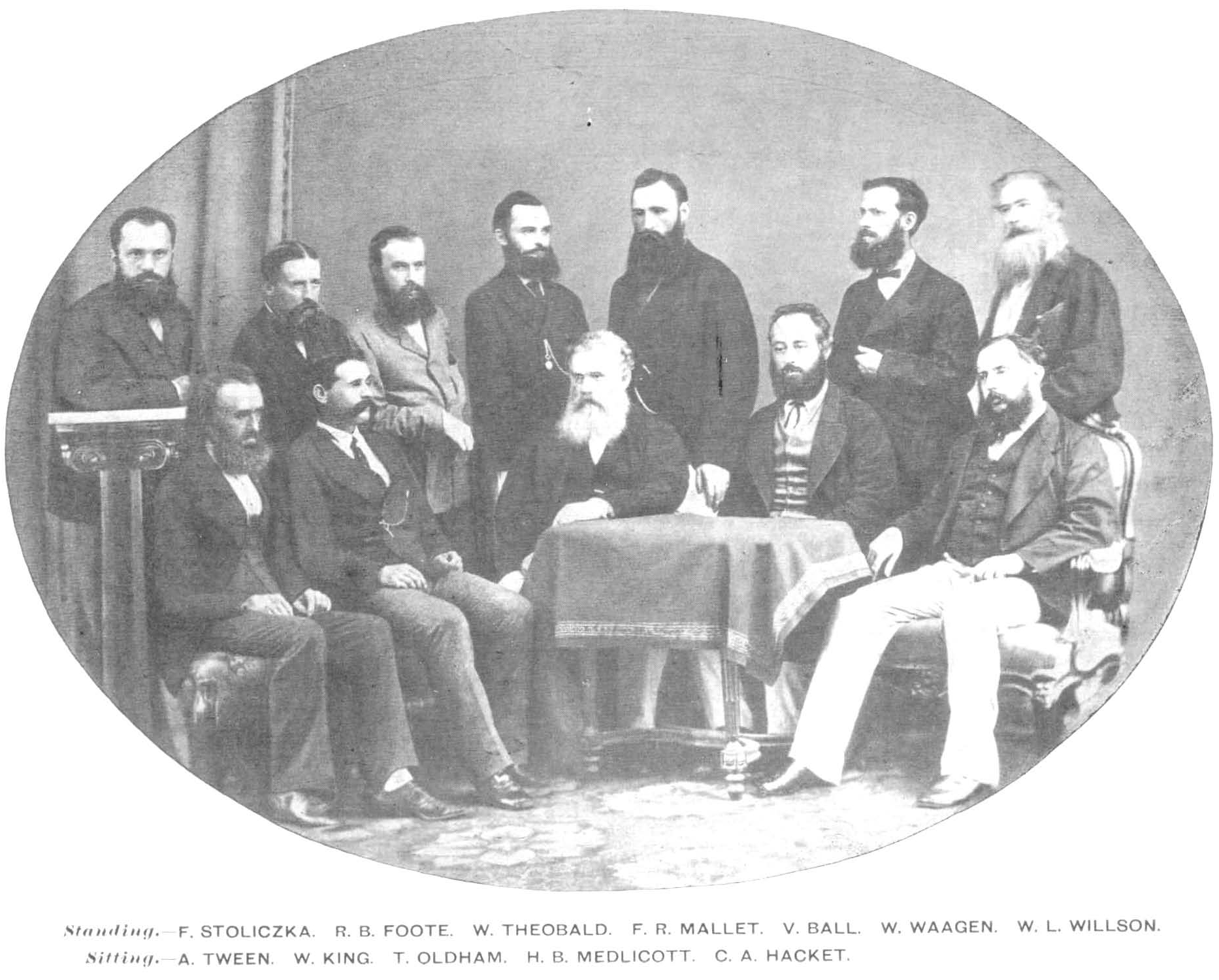
The Geological Survey of India (1870)
Hammers, chisels, birds and beards
There is an interesting old picture of the members of the Geological Survey of India in 1870. All of them are bearded, several from Ireland, and a couple of Europeans (a Moravian and a German) influenced by studies in Austria. Of this bunch, the man at the extreme left - Ferdinand Stoliczka, would contribute greatly to ornithology before dying young of altitude sickness. Standing fourth and fifth from left are F.R. Mallet and Valentine Ball who were also keen ornithologists. Ball was also into ethnology and when the first railway lines were being laid, he would advice the government on the best paths in central India to connect the coal fields of the Chota Nagpur Plateau with the port of Bombay. Both Ball and Mallet were Hume collaborators. Ball even joined Hume on the Andaman expedition and his name lives on in Otus balli. We get some idea of their zeal for collection from the writings of another Czech/Austrian who came replace the paleontologist's post held by Stoliczka. Otokar Feistmantel notes how they would travel with a large retinue of servants, three elephants and lavish tented accomodation arrangements. He pointed out that he was free to use the gun as he liked - something that only the royalty could do back in Europe. Feistmantel's also notes how European life in Calcutta revolved around the beach(!) and should be interesting reading for Kolkatans today. The grand work on the Fauna of British India series was placed under the editorship of a geologist W. T. Blanford. His brother H. F. Blanford went on to set up the Indian Meteorological Department, the order for its establishment being signed by Hume himself (although Blanford gives more credit to Richard Strachey, one of Hume's "opponents" in the Agriculture Department)

More recent ornitho-geologists like Jürgen Haffer took to geology for the secure career and prospect of travel that it provided. He worked extensively on bird speciation in South America and wrote a biographical note on his mentor Ernst Mayr and several interesting bits on the history (and philosophical phylogenetics) of European ornithology.

And from there we get to even more modern geologists who do not even have to travel to propose very interesting hypotheses in ornithology. In a series of articles by a team of geologists the idea has been proposed that grain size and soil properties create a somewhat narrow window of opportunity for large hole nesters and that the mechanical properties needed to support such burrows without collapsing are met by a specific soil type:- loess. The authors examine the breeding distributions of birds with loess deposits and find a substantial overlap. This naturally makes everyone worry that confirmation bias involved but the idea is clearly a very testable hypotheses and probably needs a lot more reading than it is getting especially within the ornithological community.

With modern academic specialization, it seems that geology and ornithology are never packed into the same person nor are persons from the fields teaming up. So it comes as a nice surprise to see some bold and fresh thinking in a recent series on the distributions of large hole burrowing bee-eaters. Looking at the citations of these series, it is a bit depressing to see that ornithologists do not seem to think too highly of the work. Heneberg points out that the original work does not take biological variables into account which is clearly why we need more interdisciplinary (if not antidisciplinary ie against subject boundaries) attitudes. As someone who was at least marginally trained in soil science, I found it rather interesting and was wondering how interesting it would be to conduct such studies in India on soil types and hole nesting birds. I would certainly encourage anyone who is not in the academic rat-race to take an interest in such ideas and appreciate interdisciplinary scientific hypotheses, even if it eventually turns out to be more complex or flawed even.
The overlap of loess deposits and the European bee-eater breeding zones from Smalley et al. (2013).
All rights belong to the author and publisher and are used here under a fair use rationale.

Thinking about this locally and from a precautionary perspective, it might be worth examining the soil type at Naguvanahalli, Srirangapatna where the blue-tailed bee-eaters nest. If the soil type is indeed special and restricted in its distribution, it might call for more concerted conservation action.

PS: I found this video above and it shows blue-tailed bee-eaters burrowing into near-horizontal ground, I am not sure this is actually documented anywhere! Ali & Ripley in their Handbook. Volume 4:106 mention this nesting habit for Merops superciliosus persicus.

Another bit of footage from Azerbaijan, thanks to Tatiana Petrova.

References


Do also look at the blog of the author Ian Smalley  - http://loessground.blogspot.in/

Note
It has taken a while to write out this piece, mostly because it has taken quite a while to research and write Feistmantel's biography on Wikipedia. Anyone having issues accessing these papers are welcome to write for a copy.
 
Postscript
Satyacharan Laha (S C Law)


Satya Churn Law in a 1926 study wrote a very perceptive piece on Merops orientalis bee-eater nests and how they varied in orientation in different kinds of soil. His idea was that horizontal tunnels were in soft earth that held up while inclining tunnels were common in harder soils with plant roots going through them. Law, Satya Churn (1926) Little-noticed habits of some birds of the district of 24-Parganas. Journal of the Asiatic Society of Bengal 22:411-420.