click hide image

Thursday, May 5, 2011

Life in the cracks and crevices

In the past, taking pictures was a challenge and most of our records were only textual notes that we exchanged when we met, and things have changed so much. For the old-time naturalists, photography has been more of a tool rather than an end and it is remarkable how good even the average photograph with a low-end digital camera is these days. One does regret not having these gizmos in the past. Most of these pictures were taken using a rather low-end aim-and-shoot digital camera (A 3.2 megapixel Nikon CoolPix E3700). Putting together these old pictures surprised me a bit especially to see the total volume of images which have a way of accumulating rapidly. out of control. Fortunately I release most of my images under creative commons licenses and include notes and metadata. Posting them on Wikimedia Commons, allows me to keep notes and categorize them while many get identified or go through revisions when group experts find them and these images  take a life of their own, making their way into books and newspapers with enquiries landing at your desk from around the world. The benefit to illustrate Wikipedia articles naturally does not need explication and such material is longer lived than the average blog, personal  or even organizational website. Anyway, here is a random assortment of free critter images (read that as you may) that have visited and live alongside. None of these are rare (in Bangalore) and are probably right around your home as well.
Ramanella variegata

A couple of years ago we had Ramanella variegata breeding in our water sump - one of these pretty frogs had a favourite PVC tube into which he would croak like a Tuvan throat singer in the mornings. The acoustics inside the tube were perhaps enjoyable, although some studies on frogs have suggested that males might try to cheat in the competition for mates by choosing locations where they sound mightier.  Unfortunately,  these frogs have not turned up this year even after the first few rains but still look forward to having these pretty residents breeding around.
Scanning you with advanced spectrometry
Jumping spiders are lynx eyed although the term "lynx spider" is used for the Oxyopidae. They turn around to take a close look at you but the most interesting times are when they meet others. That is when you see them wave their palps and forelegs in well defined semaphore patterns. They have extremely sharp vision and are said to have the ability to distinguish colours (extending to UV) and detect polarization as well. One rather fascinating species named Bagheera kiplingi is even thought to break from the basic spider characteristic in being herbivorous.

Heterorrhina elegans - no green pigment
The rainy weather brings numerous insects that have a short breeding period. These include brilliant beetles that have led the largest part of their lives underground as curly white grubs. Some can appear in rather large numbers especially when they swarm at chosen trees. Among these are the emerald green scarabs. It is amazing that they have evolved such cuticular microstructures that produce green colours entirely without the need for specific pigments. 

A change in the angle of lighting turns emerald to gold. The colour is produced by diffracting incident light, amplifying some frequencies, decimating others and letting only a part reach your eye. Naturally lots of people want to be able to replicate such microstructures for applications in human life such as for car exteriors but that would not be much of an innovation as it would still be for attracting mates.

A lycid beetle
I never seem to get the Lycidae identity right at first go. These rather soft-bodied beetles are found mainly on plants. As adults some are thought to feed on nectar or not to feed at all. The larvae are predaceous and bear a strong resemblance to the larvae of the firefly beetles and their rather primitive appearance has given them the name of "trilobite larva". The Lycidae belong to the same groups as the click-beetles and the thorax ends in a sharp point in this particular specimen although it does not function as in the click-beetles for flipping them back on their legs.

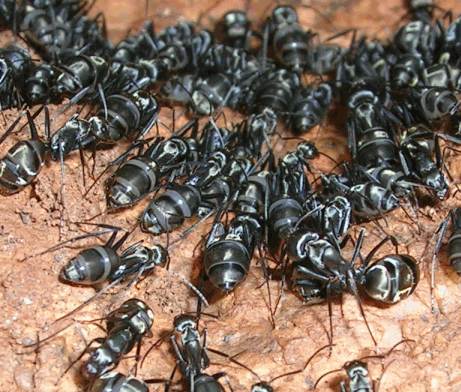
Camponotus sericeus under a rock
The space under pots and stones is  great for species that need a well regulated temperature and humidity.  Here one can often find numbers of land crustaceans, annelids and insects. This colony of ants lived in the space below a rock. The queen was apparently somewhere and the workers at the centre were taking care of larvae and pupae. The entire nest is just planar and in the narrow space, perhaps ideal as a study species.

Myrmicaria brunnea at sugar lick
Some ants have a taste for sugar - Myrmicaria brunnea - apparently just cannot resist it. A little water around a crystal of sugar attracts them in droves and they line up along the edge of the sweet waterholes and lap them up. Their sweet tooth leads them to harvest honeydew secreted by bugs. Apparently most members of the genus hold the gaster facing downwards as evident in the picture.

Mantis nymph (2 mm long)
Ants are so successful that numerous other tiny insects have evolved to appear like them. This effectively keeps away predators, and even tiny predators at like this nymph of a mantis are at risk. These are not the only ant like predators. Invariably to be found running on the wall, are also the ant mimic spiders.

Delias eucharis
Flying insects tend to be more interesting, as they can come in from much further off and are not dependent on the food resources within your home. This Common Jezebel butterfly Delias eucharis appears to be freshly emerged. The larvae breed on the parasitic mistletoe plants, the trees around my home are devoid of mistletoe, so it is a bit of a mystery.

Wasp possibly Phimenes sp.
Potter wasps are beautifully marked. Despite their distinct colours, the taxonomy of the Indian species is uncertain. I recently found one picking up clay from an older nest for use in a fresh nest. A leaky tap or a watery patch in the soil is a great attraction for them.

Camponotus with micro-livestock
A recent outbreak of scale insects led to a number of species of plants being covered in scales. These scale insects suck up fluid from the plants and share their secretions with ants. The ants keep away predators and move the scales around to new plants leading to a rather effective utilization of the vegetation by the ants.

Spalgis epius
But the defence by ants of these scale insects does not seem to be perfect. Their livestock, sooner or later become the target of pathogens, parasitoids and predators. One of the predators of these scales is, rather surprisingly, the caterpillar of a butterfly called the apefly. The name comes from the appearance of its pupa.

Platynotus excavatus doing a headstand
Coming down to ground level introduces us to a number of other visitors.  This Tenebrionid beetle was on the ground in the typical posture that many take. Some species in the Namib desert, adopt this posture termed as "fog-basking" to let moisture condense on their elytra. Some species even have ridges along the sides that lead the drops of water right to their mouths. The idea has even been adopted in some parts of the world to squeeze water out of the morning breeze to meet the water needs of people. Perhaps this beetle has something to offer for thirsty Bangalore.

Acknowledgements
The identification of insects is tricky and it takes a long while to orient oneself with the basic groupings and things get better over time.  Many thanks are due to the faculty and friends, especially Prof. C. A. Viraktamath, at the department of entomology at the University of Agricultural Sciences in Bangalore for many of the species level identifications above.

Saturday, April 30, 2011

Hunting and wilderness writings

Punch lampooning sport-hunters
A query from a friend led me to look for old hunting literature from India and the list (excluding the better-known Corbett / Anderson works) of materials available on the Internet Archive turned out to be quite long. It is interesting how perceptions of hunting differed even in the pre-conservation era. As early as 1910 Punch magazine had lampooned hunting literature.

Hunting in India was used almost as an incentive for recruiting young and adventurous lads into the service of the East India Company. Sramek (2006) gives a good summary of how hunting converged with ideas of masculinity, bravery, superiority, morality, and so on. Hunting was supposed to build "character". According to Henry Shakespear, hunting would make the sons of the British readers not only "fit for their duty as soldiers," but would also prevent them from "tak[ing] to the gaming-table, or to an excess of feasting, rioting ... debauchery" and other "frivolous pursuits or effeminate pleasures".

Sramek, Joseph (2006) "Face Him like a Briton": Tiger Hunting, Imperialism, and British Masculinity in Colonial India, 1800-1875. Victorian Studies 48(4):659-680.
J.C. Faunthorpe published posthumously

 
Edzard Friedrich Ludwig von Innhausen und Knyphausen
sitting on a bear he shot in India (1906)


Here is an index (will be updated now and then) of material from the Internet Archive related to hunting, natural history and wilderness from India.  This skips material that lacks a personal narrative such as botanical and zoological works. It would seem that India was far wilder and exciting when travel was tougher.

The following are not primarily on aspects of Indian wilderness but are included here (mainly for personal research).
PS: Apparently there was a journal called "The Indian Field" whose editor for a while was a W.S. Burke. This unfortunately is not readily found in Indian libraries and hopefully someone will find it and digitize it for the Internet Archive. Another serial was the "Indian Sporting Review".
23-Jan-2014 - subsequent to the comment by Milan Mandal - I have added some Kenneth Anderson, Jim Corbett and R.W. Burton books, the archive links are however a little problematic as some could represent material still in copyright. The Internet Archive claims that they can hold it as they are registered as a library in the United States of America, however this might not stand in the courts of some other countries.
12-Dec-2014 - Ameen Ahmed mailed me a list of online sources that he had found which led to some additions.
1-Mar-2017 - there is another bibliography here - Stockum, C.M. (1914) Sport. Attempt at a bibliography of books and periodicals published during 1890-1912. New York: Dodd & Livingston.
23-March-2021 - there is a bibliography by R.W. Burton in the JBNHS -

2025 - here is a booklet for hunters in India which was owned by Salim Ali - his own hunting notes also added. (Courtesy: Archives at NCBS)


 2026: A fishing tackle store in Delhi / Calcutta - from Cecil Lang


Sunday, April 24, 2011

Outdated pleasures

While some are after the latest, others enjoy the outdated. There are some archaic sources for India that will always be fascinating for the insights that they offer. Today I look at The Cyclopaedia of India - this amazing work was produced in several editions, the first in 1858 followed by 1873 and the third in 1885, with  35,000 entries.  The author of this work, Surgeon General Edward Green Balfour, is himself of some interest. He is hardly remembered today but was one of the founders of the Government museums in Madras and Bangalore apart from the zoological garden in Madras. Working as a military doctor, he noted that women doctors might be more acceptable within Indian society and this led to the first woman doctor Mary Scharlieb joining the Madras Medical College.  Skeptical of Indian traditional medicine, he also worked on translating European texts on midwifery into Indian languages. He was a cousin of Allan Octavian Hume and would sometimes get his works read out in the House of Commons through his uncle Joseph Hume (a topic of an earlier post). His medical work included surveys of health and disease in association with climate - Statistical data for forming troops and maintaining them in health in different climates and localities (Quarterly Journal of the Statistical Society of London, 8, 1845:192-209) and his Remarks on the abstract tables of the men discharged from the military (Quarterly J. of the Statistical Society of London 1851, 14:348-356)- from which he determined that places in the hills were better suited for maintaining Military stations.  He was among the first to link deforestation and famine, suggesting the link between forests and water in Notes on the influence exercised by trees in inducing rain and preserving moisture (in the Madras Journal of Literature and Science 25(1849):402-448). As the first superintendent of the Madras Museum, he maintained careful statistics of the collections, the number of visitors and made special attempts to ensure that more women visited it.  Heber Drury (of the orchid fame) acknowledges him in his "The Useful Plants of India."  Environmental historian Richard Grove noted that "Balfour stands as the clearest example of an apparent duality of humanist reform and conservation concerns." A painting of Edward Balfour is said to languish in the halls of the Chennai Museum.
The three volume Cyclopaedia (3rd edition)

His cyclopaedia is however an especially major work. Scanned versions of the third edition are available online. Later editions expanded from three to five volumes. (Volume 1, Volume 2, Volume 3)

A few random pickings (including some rather fantastic hail stones !)

Mooragana butter, or solid oil of Canara, is used medicinally as an ointment for the wounds of cattle injured by tigers. It is said to be produed from a forest tree growing in the Canara jungles. It is dark brown, and is the most solid of the solid oils. (v3:12)

Hail. ...At the end of the 18th century, a mass fell at Seringapatam the size of an elephant, which took three days to melt. On the 10th April 1822, at Bangalore, 27 bullocks were killed. (v2:3)

Todiramphus collaris, Scopoli. The white-collard kingfisher of the Sunderbuns, Arakann, Tenasserim, Malayana, and Archipelago. Its feathers are largely prized by the Chinese, who buy the skins at 24 for a dollar.

Bangalore. ...Bangalore city in 1871 had 142,512 inhabitants, of whom 105,632 were Hindus, 21,587 Mahomedans and 15,294 Christians. Public buildings for the administration of Mysore were erected during the minority of the present ruler. There are many Christian churches; and the French Catholics and several Protestant sects are spread over Mysore district. There is a college, and the Mysore Museum, which the editor founded in 1865. (Note: Italics added)

Hand. The figure of the hand, amongst all nations, is utilized as an emblem. ... In India, amonst Mahomedans and Hindus, the right hand is more honoured than the left; in China the left hand is more honourable the the right; in Siam the right more than the left. In British India, a person to whom you make a present, a servant to whom you do a kindness, will rush to your hand and press it to his lips. To seize a man's hand is to crave his protection, to profess yourself his servent.
Handkerchief. Handkerchief pieces form a considerable article of manufacture and traffic in Southern India. Handkerchiefs, coloured, from Madras, red from Sydapet and Ventapollem, are much admired for the harmony and richness of the colours, and the superiority of texture. Nellore pocked-handkerchiefs of jean deserve unqualified approbation. The silk handkerchiefs manufactures in Bengal are known in the market as Bandana, Kora and Chapa. They are generally figured, and of different colours. They are exported chiefly to the Burmese territories, and sold at from 1.5 to 5 rupees each. The coloured cotton handkerchiefs manufactured at Ventapollem, on the east coast, are well known in foreign markets, were formerly highly prized for their superior qualities and colours, but they have been driven from the markets by the Madras and Pulicat manufactures, which the community prefer for their superior qualities and colours. Madras handkerchiefs of the superior kinds are sold at 1.75 rupee each, and inferior sorts at 4 annas to 12 annas; the colour of the last description is very perishable. ...


One finds similar entries in the Hobson-Jobson, but that is often terse given that it aims mainly to be a dictionary or glossary. (scanned version) Some topics are handled by rather expansive treatments - an example is "opium".

Other links to see


Postscript
 
A trip to Chennai last week (7-8 March 2012) allowed me to make a trip to the Government Museum. At the entrance of one of the galleries is a large oil painting of Edward Balfour. Unfortunately the lighting was awful with ugly lights reflecting off it. The painting is covered by a glass front, but it is sad that a good digital reproduction has not been made available online. After taking photographs at oblique angles and digitally skewing them on GIMP and patching together some pieces, I (or rather Wikimedia Commons / all mankind) now have a reasonably good image of this 1880 painting by Walter Saunders Barnard (1851–1930). It happened to be Womens Day and they apparently had something special. One hopes they did highlight his role in bringing ideas of public health, women's education, museums and zoos.

Wednesday, April 20, 2011

Ferns for thought

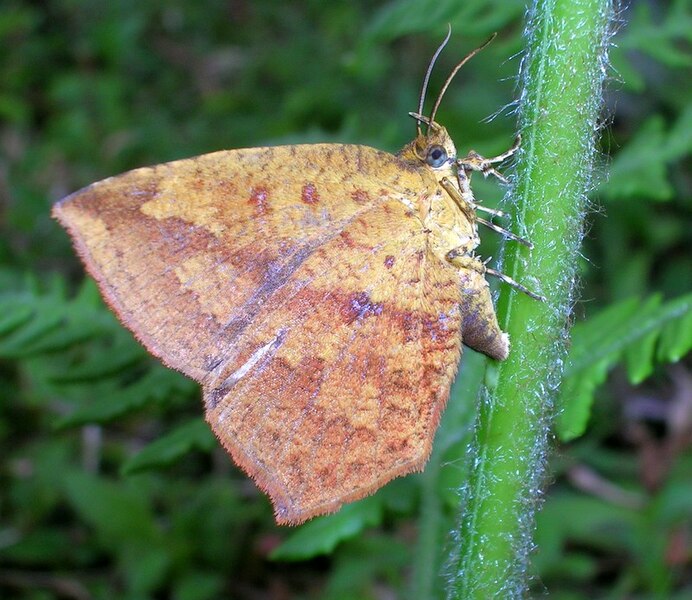
There is a widespread idea that things herbal are automatically safe. This, unfortunately, is not quite true as plants have, in their long drawn war with their enemies evolved some deadly defences. Ferns are some of the older plant groups that are found on land today. On a trip to the Talakaveri area in Coorg, I noticed this butterfly-like moth sitting on a fern.

Tetragonus catamitus
Although it holds its wings like a butterfly and is about the size of a typical Lycaenid, the antennae, the spines on the legs and the stout body give away its identity and it turned out to be Tetragonus catamitus, a moth in the family Callidulidae. Almost all the moths in this family have their caterpillars feeding on ferns. The entire family has a rather restricted distribution in South Asia and Southeast Asia but extending somewhat oddly  into Madagascar.

Callidulidae distribution from Grehan (1991)

On the same trip, we went down to Bhagamandala to collect Diplazium esculentum to cook a dish. This fern is widespread in Asia and young curly fronds are eaten across its range. In northern India it is called linguda. The picked fronds are typically sauteed with some spices to make up the rather tasy dish.

Edible ferns are not as common as the bracken ferns of the genus Pteridium, some of which are weeds. Their leaves have a protein called Ptaquiloside (PTA) that is carcinogenic and yet young fronds of this species are  cooked and eaten in Japan where it may be contributing to a high incidence of gastic cancer. Heat causes ptaquiloside to lose its function as a toxin or anti-feedant. PTA has even been considered an environmental contaminant as it may leach from the fronds and enter water and soil and traces have even been found in milk from cattle fed on bracken infested pastures. The more edible ferns like Diplazium have lower levels of PTA. Some ferns show a peculiar preference for arsenic, extracting it from soil and accumulating it in their leaves. Arsenic at high concentrations is toxic to most animals. Perhaps the younger fronds that are traditionally picked have a lower level of the toxin? Given the primitive vascular system, one might think that PTA is synthesized in the older leaves and retained there without being translocated into the young fronds. However this does not hold water as several studies have specifically looked at whether and how ferns translocate nutrients. The weedy Pteridium is very tolerant to  herbicides and studies have attempted to find the source of their resistance. It appears that they do not move the herbicide from the sprayed leaves to their rhizomes. So while herbicides cause leaf death, the rhizomes come back to life in the next rain. However other studies using radio-isotopes have found that sugars are translocated as in angiosperms and PTA concentrations actually tend to be higher in young fronds - where the need for protection from herbivores is greater.

Diplazium growing along a stream
Now the number of insects that feed on ferns is something to think about. One estimate (Hendrix, 1980) put it at a mere 465 species (Hendrix however missed the Callidulidae in his list) ! The number of vertebrates feeding on fern spores is 3 [a mouse, the bullfinch (Pyrrhula murina) and short-tailed bat (Mystacina tuberculata)] Ferns are the oldest vascular land plants and given that very few of the extant herbivores feed on them, some authors have suggested that their defenses may have been overcome by herbivores of the past, especially the larger dinosaurs of the Carboniferous Period. Taggart and Cross (1997) note that herbivory  is rather uncommon among extant reptiles. The mildest PTA symptoms include Thiamine deficiency and so a little searching for Thiamine deficiency in the nearest relatives of the dinosaurs, the birds, throws up the possibility that PTA was evolved as a defense against herbivorous dinosaurs. Thiamine deficiency in birds was something new to me and a paper on large scale declines in European birds due to it came as a bit of a surprise. I have heard of people getting sick from eating Diplazium and it seems like one should be careful when it comes to eating ferns.
A fern leafminer

Further reading

Thursday, April 7, 2011

Missing beans

I recently heard of a dealer of antique maps - Geographicus - there was no way I would have heard of them but for something remarkable that they did. They scanned up their treasures and, since these ancient maps were in public domain, released them for use on Wikimedia Commons. These maps are amazing sources of history! These original works with their historical purposes - probably to guide early traders find stuff to ship back to their homes. One of the maps I have been marvelling is this one from 1733. The full map by Homann's heirs can be found here but here is a crop of a region of interest. It includes places like Dharmapuri and the entire region holding 95 million people today is yet to be discovered.
 
Homann heirs 1733 map (no roads)

Come 1748 and the town of boiled beans is still not on their map! 1794 and Bengaluru (correct spelling!) appears in Jefferys map. Note that there are no major roads leading to it but then it seems like the Germans were not very interested in actual business. This was around the same time that the English were mapping the region so as not to get beaten again by Tipu.
Portion of 1794 Jeffreys map

The 1800 map by Faden Rennell shows road networks and it is clear that they are well established - note the neighbouring town of Pedda Ballapuram. In 1808 we see Chinna Ballapuram nearby.
1808 map
There must be many interesting things to study in these maps, rivers gone dry, towns coalescing, names  and boundaries changing and so on. Perhaps we can have more original geography classes (looking back, I cannot even figure out if there was a guiding philosophy in the teaching of geography) now that the compilation of geographical knowledge itself becomes more visible. 

Credits: courtesy of Geographicus, via Wikimedia Commons

Index to the maps 
(Make sure you click on the "full resolution" link below the images on these pages)


1652 - Nicholas Sanson
1733 - Homann heirs (South India)
1740 - Matthias Seuter (India, German view)
1748 - Homann heirs
1756 - Bellin (Kollam fort) 
1759 - La Rouge (French Coromandel - include Kallamedu - Pt. Calimere)
1764 - Jacques-Nicolas Bellin (French map of Bombay)
1768 - Jeffreys
1770 - Rigobert Bonne (northern India)
1775 - Jean-Baptiste d'Après de Mannevillette (maritime map, south India, Sri Lanka)
1776 - Rennell (Bihar, Bengal)
1777 - Rennell (Delhi)
1780 - Bonne-Raynal (northern India)
1780 - Bonne-Raynal (southern India)
1780 - Bonne (Maldives)
1780 - Rigobert Bonne (French map, northern India)
1784 - Tiefenthaler (Ganges)
1793 - William Faden
1799 - Clement Cruttwell
1800 - James Rennell
1804 - German version of Rennell's southern India map with notes on Tippu Saheb
1806 - John Cary (used by Bishop Reginald Heber)
1808 - Charles Smith
1814 - John Thomson (southern India)
1814 - Thomson (with details of Ganga)
1814 - Thomson (northern India, Nepal)
1818 - John Pinkerton
1821 - Matthew Carey (with English take-over dates)
1827 - Anthony Finley
1834 - Penny Cyclopaedia (Society for diffusion of useful knowledge)
1834 - Bombay Goa
1837 - Malte-Brun (French map with low resolution of detail)
1838 - James Wyld (S. India with rivers, roads)
1842 - Calcutta
1852 - Levasseur (S Asia)
1853 - S A Mitchell (princely state boundaries) 
1855 - Justus Perthes (includes India of Ptolemy and Eratosthenes)
1855 - Colton
1862 - A J Johnson
1863 - Edward Weller (map of Delhi - useful for readers of The Last Mughal)
1864 - S A Mitchell (Asia including Tibet)
1864 - A J Johnson (Hindostan)
1865 - A J Johnson
1865 - Karl Spruner von Merz
1879 - Bombay Harbour
1895 - Times of India (Bombay)

Note:
The reference to beans in the title is just a joke. One of the silliest and demonstrably ludicrous stories on the origin of the name "Bengaluru" is that some King went around the region and was fed with boiled beans that he liked and therefore gave rise to "Benda KaaLu Ooru"!

Further reading