You yourself must also make preparations for an Indian railway run, of any length, of a kind which would never be thought of at home. First of all you must and will have engaged a good man-servant, a "boy," on whom you will vastly depend for comfort. you cannot do without him at hotel, dak, bungalow, or even in private houses; and if he cheats a little he will, if reasonably honest, limit the peculations of others. Obtain a good "boy," and pay him fairly; it is he who will buy the tickets and take the places.
 |
| An "Etna" |
Then the next thing is a good tiffin basket, which he will keep sedulously filled with potted meat, biscuits, wine, soda-water, etc., with doubtless the machinery to brew tea; an Etna, spirits of wine, and the like, for you must not trust unboiled water or milk in the land. Moreover, although some of the way-side stations have excellent restaurants, these do not always turn up on the route when the voyager needs them most.
Then, again, he must carry his own light bedding with him-two silk or cotton razais, well wadded, and a pillow. The guide-books justly counsel that there must be two razais. The ready-made ones are usually very thin, but they can be got to order of any thickness. To these should be added a pillow-case, calico sheets, and a blanket. A rough waterproof cover in which to wrap the bedding must not be omitted, or the first time the bedding is carried any distance by a coolie, or packed on a pony, it may be very much soiled. A water-proof sheet is a very valuable addition to the bedding.
Without such a modesty supply of covering as is here indicated, a traveller may at any time have to spend a night shivering in the cold, which would probably result in an attack of ague.
To his boy, his tiffin-basket, and his bedding the tourists will add a copy of the "Indian A.B.C. Guide," or the "Indian Bradshaw," and for the rest he may safely trust the companies. They do all they can for the well-being of travellers, and especially those of the first class. To quote the guide-book: "Every first and second class compartment is provided with a lavatory, and the seats, which are unusually deep, are so arranged as to form couches at night. There are refreshment rooms at frequent intervals, and some of them are very well managed and supplied. The station-masters are particularly civil and obliging, and, as a rule, are most useful to travellers in providing ponies, conveyances, or accommodation at out-of-the-way stations if notice be given them beforehand. They will also receive letters address to their care; this is often a convenience to travellers."
Of course, it must be in what is called the "cold weather" that you traverse the various lengths and breadths of Hindustan. From the middle of November to the middle of March is the ideal period. Yet even then, and always, the sun must be respected from 9 a.m. until 4 p.m, and many a burning hot hour at best will be passed in the railway carriage. This may be foreseen by the method in which the railway-stock has been constructed.
The first-class compartments will have a double roof to them, to soften the fierce impact of noonday sunshine, and the windows will be duplicated, with pale purple or green glass and "jilmil"-shutters-to exclude, as far as possible, the hot winds and the dust. On those lines, too, where tunnels do not forbid the arrangement, the Transatlantic tourist will be amused to behold the third and fourth class carriages, devoted to the traffic of the common people, fashioned in storeys, so that, as with the Chinese pork-express, there are layers of humble travellers berthed over the heads of others- a kind of rolling Noah's Ark in floors.
In this luxurious fashion will the Hindu, with his family, contentedly journey day and night and go upon pilgrimages, being easily satisfied if he can only get over the ground cheaply. It was a moot point, at the commencement of railway-making in India, whether or not that Shastras, the Holy Books, would permit orthodox and devout Hindus to perform pilgrimages by the aid of steam.
Happily for the dividends of shareholders and for the convenience of the native public the pundits decided that there was nothing recorded against such a practice in Ved or Smriti; and it is the swarm of simple people which nowadays makes the Indian lines pay, together, of course, with the trade in grain, cotton, and general produce.
Remember that one must not expect good hotels in India. There are at Bombay, Delhi, Benares, Calcutta, and Madras some that are fair and sufficing, but not to him who has been accustomed to the magnificent accommodation provided by London hostelries. Here and there the railway depot will have bedroom as well as a restaurant, but along all by-roads, and in the Mofussil generally, the dak bungalow is just a plain white-washed shelter, with a "charpoy," a bed-stead or two, plus the services of a Khansamah, and the chance of a very tough fowl, which is caught, amid wild confusion, at the moment of the arrival of the guest and takes a tardy but desperate revenge for his death by the indigestion it bequeaths to this destroyer.
In whatever direction your Indian train may be moving, the landscape on either side, even as seen through the rapidly shifting frames of the windows, will be new to the Western visitor. If he be at all a botanist, or should he have any companion with him who can name and explain the details of such leafy and flowery vistas as may be seen in Guzerat or the Concan and Deccan, those leagues of moving plain, jungle, and village would not pass without instruction and interest.
 |
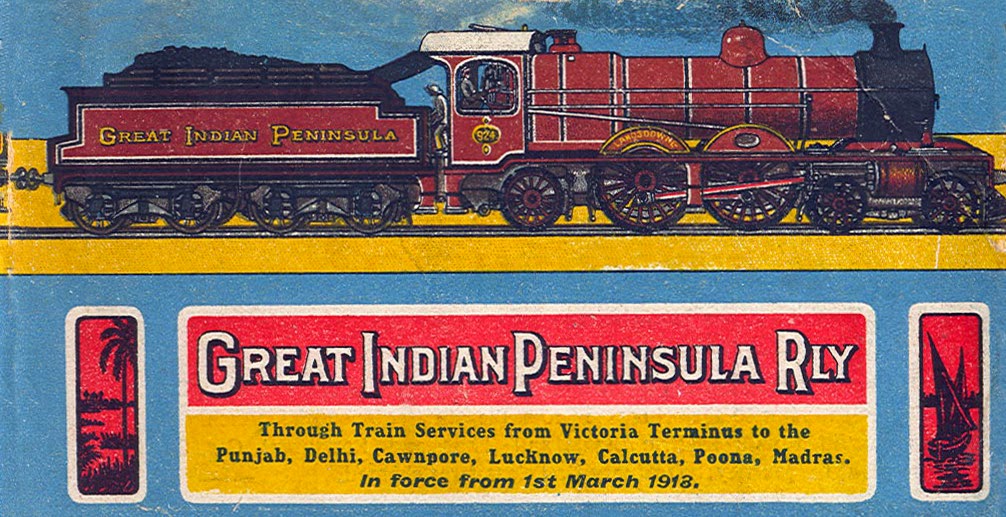
| 1930 tourism poster of the G.I.P. |
It adds immensely to the charm of any country when you understand a little of its flora and fauna. Along the Bombay lines it would go hard but that one might point out to him the white and golden star-flowers of the champak; the custard-apple, Sita's fruit; and the lotus, blue, rosy, or white, the flower par excellence of India, which has one hundred and thirty-five various names, and springs so pure and sweet from the black slime.
Then there will be the bil trees, and the neems with purple blossoms, and the bher- Zizyphus jujuba -which Mussulmans say is the Sidra, that grows in Paradise; together with the dark green mango (amba), and the gold mohur tree, and the bawa, the bloom of golden rain, and long pods like sword blades. There will be also countless acacias, babul, full of swinging weaver-birds' nests, and endless clumps of aloe and of prickly pear (nagphanna), as well as the classical kadamba and bright green karanda bushes; not to forget the banyan, the pipul, and palms of many kinds. One might see also the fragrant pandanus; the sandalwood (chandan); with everywhere bushes of erandi, the castor-oil plant, of which a Sanskrit verse says so contemptuosly:
"In the land where no wise men are, men of little wit are Lords.
And the castor-oil's a tree, when no tree else its shade affords."
If we could leave the train, and wander amid that dark deep thicket, there are many other strange plants and flowers which might be found, adding terror, or beauty, or marvel to those wild gardens of Asia. There is the deadly datura, with her flowers so milky-white and fragrant and her poison so quick; the samspan, which the little mongoose is believed to eat when the cobra has bitten him; and the charbaje, that opens her blooms exactly at four o'clock every afternoon, as punctual and almost as curious as the Desmodium gyrans, which twists and untwists her pink stem twice every twenty-four hours.
The tourist in India must not expect to see tigers and leopards, nor bears and bisons, from the windows of his carriage, but there will be something to interest any lover of nature all the same, and more, perhaps, than any other kind of swift travelling could supply. The sky will be full, especially near towns and stations, of kites and vultures, soaring aloft, and wheeling round and round with shrill cries. Over the pools and rivers he will mark the fish-tiger (muchi-bagh) hovering; a white and black halcyon and the pretty snow-white egrets will everywhere be noted stalking about among the grey cattle, and the king-crow flitting with his long black tail, and the jungle-dove with pearled and jewelled neck, cooing from every bush; as well as the green and bronze bee-eater hawking the butterflies, the "seven brown sisters" feeding and chattering in the bushes, and, perhaps, some grey thievish jackals stealing home at dawn.
There are many railways in the land along which he would be very likely to catch glimpses of the beautiful and graceful Indian antelopes, the black-buck, which are still plentiful in the central plains. I was riding myself once on a ballast-engine in the Deccan to get back more quickly to my educational duties, when we surprised a wolf in the entrance of a deep and long cutting, and never shall I forget how "Lupus" put on the pace as we rattled behind him between the steep embankments.
In passing through the green flats and forests of Guzerat, there are districts where for miles and miles you may beguile the journey by watching the monkeys, the bandar-log, those strange four-handed folk who come down to sit in the babul trees and to look at the passing trains and the travellers. Secure from all interference-for the white man must not molest them, and the brown man will not- they perch by families on the branches of the trees lining the track, and with their long tails swinging and their furry jaws busy with the fruit which they have stolen, like meditative Asia herself, they "let the legions thunder past." Or they squat demurely, in companies, about the fields of millet and grain, the old gossips together, and the youngsters merrily playing- all as confident and cool as if they were citizens of the place, and had votes.
In Rajpootana you may often notice, from the passing train, the beautiful dark blue peacocks break in a thunder of jewelled wings and lightning of purple plumes from the white marble rocks at the edge of the jungle, and you will pass many and many a spot notoriously frequented by tigers and panthers; no more visible, of course, on that account than if the wild green fastnesses concealed nothing except porcupines and mongoose.
The engineers along the various lines are mainly Europeans. There are not many Hindus or Mohammedans who have as yet the courage or the knowledge to drive the terrible and wonderful ag-gadi, the fire-horse, of which the Panjabi verse sings:
"Now is the devil-horse come to Sindh,
Wah, wah, Guru! that is true.
His belly is stuffed with the fire and the wind."
In parts of India the wandering tribes will still be offering tributes to the flying locomotives, and even prostrating themselves before the telegraph wire, which they style "sheitan-ka-rashi," the "devil's string."
Most of the stationmasters are Bengali Babus or Deccani clerks, or else some other Hindus educated at the schools and colleges. Such quiet duties suit them well, and they are very attentive and sedulous, but strictly given to carry out to the letter their bye-laws, and to refer on all possible occasions for directions from their superiors. Thus it is really no myth, but a solemn fact, that once, on the Great Indian Peninsula Railway, the Chief Superintendent received at the central depot from a member of the staff of a minor station in the up-country this telegraphic message:"Tiger on the platform, has killed station-master; is now devouring tikkit-wallah, Please wire instruction"!
 |
"Tiger jumping about on platform, men will not work; please arrange."
(Copy of telegram received at local office of the railway company) |
Further reading
Postscript
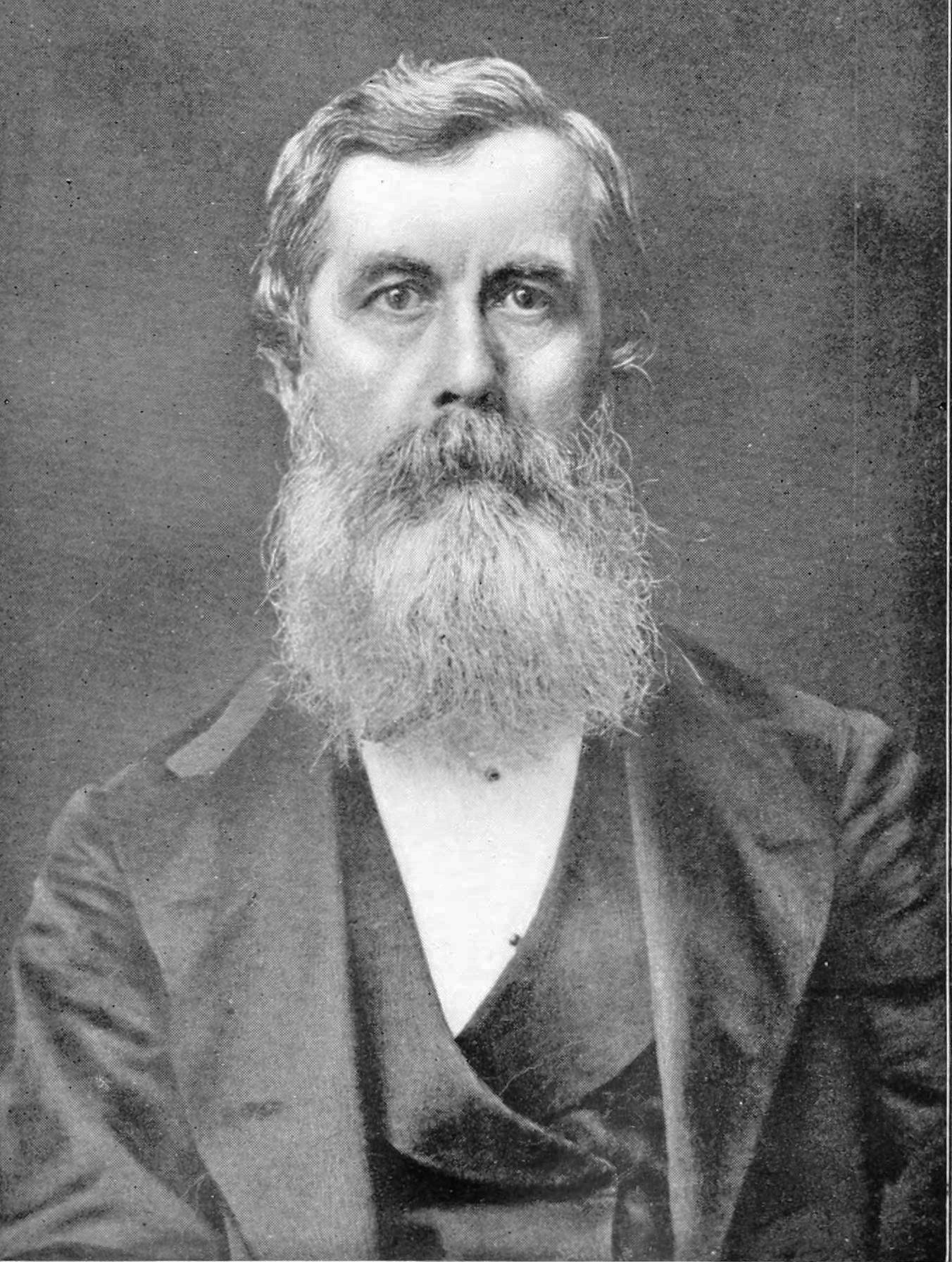
- Some other railway ornithologists who collaborated with Hume include Henry Charles Edward Wenden (1841-1919) who worked in Poona [Wenden met with Edward Lear in 1874 along with H.P. Le Mesurier]




.jpg)
.jpg)