click hide image

Friday, November 19, 2010

Splinters from the Cambrian explosion

One would love to be in a number of places but sadly this cannot be. Fortunately India is filled with people and hopefully there is someone near where I want to be, reading this, who can follow this up. The place I want to be in now is Rotung on the Dihang River, in Assam, not for birding although I would certainly look at the birds of the region, but to lift up and look under some stones and rotting logs in shaded humid places covered with a lot of leaf-litter. What I would be looking for is an animal from our deep evolutionary past - an animal that belongs to a phylum that is hardly even mentioned in college-level biology textbooks.

Meet Typhloperipatus williamsoni - the only representative of the Onychophora in the Indian region. Discovered in 1913 by Stanley Wells Kemp the Superintendent at the Indian Museum at  Calcutta when he went on the Abor expedition, hardly anything is known about this "velvet worm". The expedition really came about due to a local revolt in which the political officer of Sadiya, a Noel Williamson commemorated in the species name,  was killed. Strangely it seems that even political missions in those days had a zoologist on board!

Rotung in red ( http://geonames.nga.mil/ )
The expedition found it under rocks along the Dihang river near Rotung. Fortunately one can locate the location today - and I can share the map because it is published by the US military and is therefore in public domain. The irony is that tax-payer funded work of the Indian government has to be purchased and even if you do, it is copyrighted and you are not even allowed to make a tracing of it ! And to add to all this sadness, little has been known about this species thanks to the wonderful way in which Indian establishments keep useful material away under lock and key - away from any interested researcher and available only to feed the far more needy Dermestidae and Thysanura. So imagine the joy when I finally get to access (thanks to the Biodiversity Heritage Library - an effort that has zero support from Indian museums and libraries) the scanned versions of the Records of the Indian Museum with the original description of Typhloperipatus. The genus name is from typhlo for blind and peripatus, an existing major genus of velvet worms was given since these worms were completely blind. The word Peripatus itself is derived from a path around a school, the one in which Aristotle taught and walked in a peripatetic way.
Peripatoides sp. (photograph by Bruno Vellutini)

The velvet-worms or Onychophorans are a mysterious group. They are found across the tropical zone and it is believed that their origins were in Gondwana. They were among the early land pioneers and we know that for certain, as they continue to require high humidity conditions to survive. Their unique body plan consists of a soft worm like body without an exoskeleton or clear segments and their legs are soft and tubular. There are no joints, the legs move by hydrostatic pressure - in effect they move somewhat like a caterpillar with tubular balloon legs that are inflated and deflated to achieve movement. The ends of these feet have tiny claws - from which the group is name is derived (Gr. onyches = claw) and the ancestry of the group and relationships is still much debated. Some have considered them as the leggy link between the annelids and the arthropods and their ancient divergence makes them difficult to study even using genetic material. They moult to grow and this has been used to place them in a suggested clade called the Ecdysozoa with the arthropods and other groups. Onychophora are mostly nocturnal, they have antennae with which they feel for prey - mostly small invertebrates - and when prey is detected, they squirt a sticky fluid, spiderman style, which arrests the victim. They then inject digestive juices into the prey and wait for the food to liquify and then suck it up along with their sticky slime. 
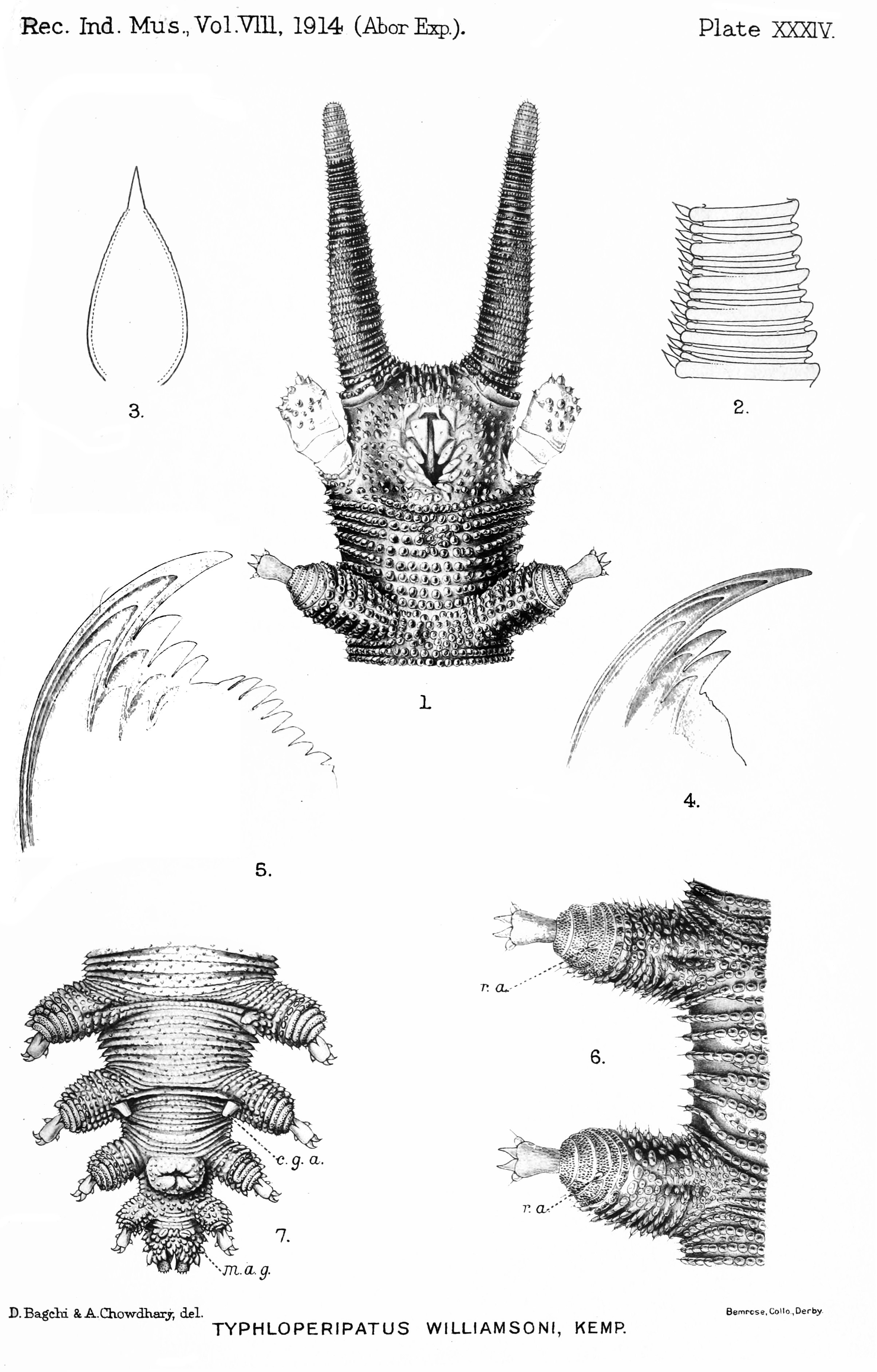
Close ups from the description of Typhloperipatus

Almost nothing is known about our Indian species, indeed nothing has perhaps ever been published after its discovery around 1913. Almost all members of the Peripatidae are on the endangered list - the Indian species however has evinced almost no interest - which is not surprising given that most conservation is money-dependent and small fleshy invertebrates lack the glamour needed to support flight and hotel bills. If ever the species can be found at Rotung or nearby regions in Assam, hopefully by interested locals (hope there are students, teachers and zoology enthusiasts reading) - the regions should be well worthy of some protection.

The Indian species is probably restricted north of the Brahmaputra - a major biogeographical barrier. Any relative discovered in south-western India would be even more spectacular, for it would probably show affinities to species from southern Africa.

Here is an extract from the original description:
The camp at Rotung where the majority of the specimens were found was situated at an elevation of 1320 ft. on a small plateau above  the Dihang River, one of the few approximately level pieces of ground seen in the Abor country. The site was at one time occupied by a village of Minyong Abors; but this was demolished in the latter half of 1911 and the villagers put up temporary dwellings half a mile further to the north at a considerably greater elevation.

The country in the vicinity of the camp was overgrown with dense scrub-jungle interspersed with stones and large trees, mostly jack-fruit. Here, as in so many parts, the ground had at one time been cleared for cultivation and scrub, which as a rule was not more than ten feet high, probably represented some eight or ten years' growth.

It was on the eastern side of the camp on dry gently sloping ground immediately above the edge of the great gorge of the Dihang River that Peripatus was found.

....
Solitary individuals were occasionally met with, but more usually two to four adults accompanied by a number of young (sometimes as many as six) were collected together.
Further reading

Some videos to see

Postscript

April 2025: ATREE Bangalore made a collecting expedition and rediscovered Typhloperipatus. It has since been published -  https://www.tandfonline.com/doi/full/10.1080/00222933.2025.2483434

Saturday, October 9, 2010

The parasite within

I came across this ant one day as it sat still, refusing to be disturbed, on a leaf looking upwards in a remarkable posture and passed it. Returning back two hours later, I found it in the exact same place and posture. It was not dead, for the antennae were mobile and the gaster appeared distended and she probably was a species of Camponotus.

Praying - a parasitized ant ?
Ants are puzzling and captivating. I have no clue what made this ant go into a meditative state, but ants are successful beyond any human definition. And behind every successful organism is a slew of piggy-backing hitchhikers that include parasites that live on individual ants and unwelcome house guests that live off the labours of the colony. Some better known parasites of individual ants are fungi and nematodes. Nobody has yet found the adaptive function of the mind-altering Psilocybin in mushrooms but fungi in the genus Cordyceps and Ophiocordyceps make ants go quite crazy. An ant in a late stage of infection climbs up a twig and sinks its mandibles into the plant, before going into terminal coma after which the fungus emerges to produce its own "fruiting body" - from which arise new spores that will infect another generation of ants. The behaviour of the ant is modified by the fungus to its own benefit. It was thought that "driving" the ant higher up into the vegetation helped the dispersal of the fungal spores but some later research showed that the height was related to the best humidity and temperature conditions for the spores to germinate !
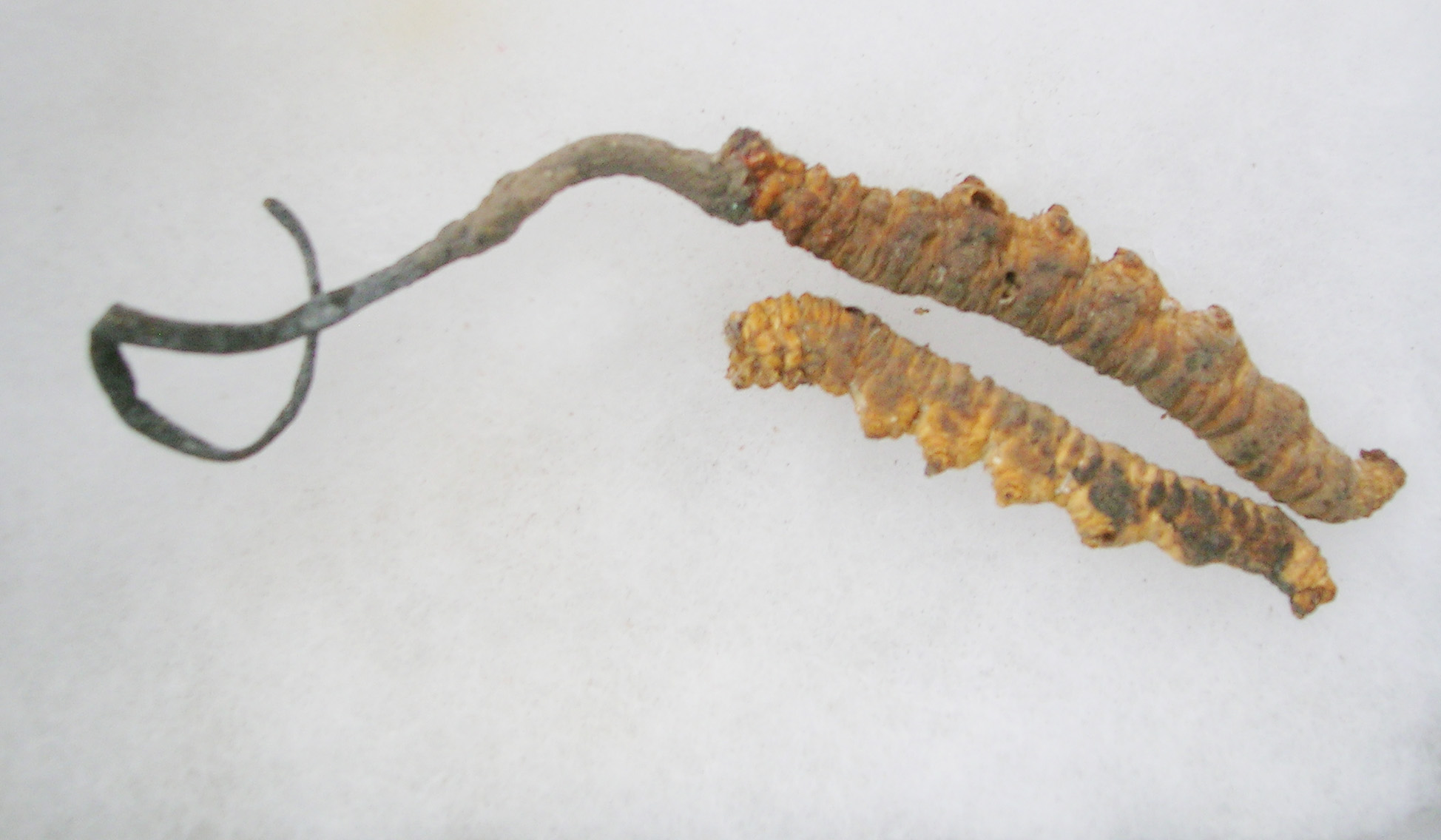
Cordyceps emerging out of a caterpillar

Species of Cordyceps  infect a range of insects. Up in the Himalayas, one species infects caterpillars of an as yet undetermined Hepialid moth (or possibly multiple species of them). The moth caterpillars emerge in the spring on high altitude meadows and some of them get infected by the fungus and a grotesque horn-like fruiting body emerges from the body of the dying caterpillar. Whether the fungus alters the behaviour of the caterpillars is unclear but it makes young men in the mountains across South Asia go mad - Yaartsa Gumbu - as this is known is collected by fit young men who climb up into the high-altitude regions across the region to harvest the caterpillars which are then sold to Tibetan and Chinese traders for an amazing fortune to be used in Chinese medicine. Like parasites, governments, Maoist quasi-governments and mafia in the region attempt to get a share of the enormous money (transactions are said to be made right on the high altitude meadows!) made in the harvest.

Coming back to our ants, their long evolutionary history has allowed them to adopt counter-measures. In some colonies, workers detect behavioural abnormalities among their fellow nest-mates. Any ants that are detected having perhaps a peculiar scent (members of each colony have their own characteristic scent) are quickly sent out of the nest by "bouncers".


Steve Yanoviak and T M Mushtak Ali at UAS, Bangalore
In 2009, some of  us in Bangalore had the good fortune of meeting up and listening to Steve Yanoviak Steve does his research high up in the canopy of the forests of South America and has discovered ants that glide and a bizarre nematode that infects ants. This nematode turns the gaster of an ant from its normal black colour into a large red-cherry like structure. These infected ants walk around with their berry-like hind ends raised and get eaten by  fruit-eating birds. Other ants, foraging for seeds on the forest floor pick up the droppings of these birds and continue the cycle of the nematode.

One of the greatest evolutionary thinkers, W D Hamilton had a knack of thinking about the strategies of organisms by putting himself in their "shoes". A successful parasite for instance should perhaps never kill its host, but manipulate its host to aid its own multiplication and to that end it could even "enhance" the behaviour of its host. In that light, the strategy of a virus like Ebola that produces near 100% fatality has to be rather bizarre - suggesting that humans are not the species with which they evolved. In 2000, some researchers found that rats infected by Toxoplasma acted rather oddly making them more likely to be preyed on by cats, the primary host of the parasite. This got others thinking if human behaviours (particularly "disorders") are in any way manipulated by parasites and infections and some have pointed out that some anti-psychotic drugs actually had the ability to kill parasitic organisms, particularly Toxoplasma and others have found bad drivers to have latent infections !

Now I am not sure what parasite got me to write this, but if you have some "good" viruses of the mind, make sure you spread them.

Further reading

Friday, September 24, 2010

When life is shi#

A skipper on bird dropping
People using the phrase need to watch out for they may very well be describing a life of heavenly bliss ! There are a whole lot of animals that depend entirely on the excretions of others. Scatology must be one of those subjects that universities are not advertising about but there are lots of amazing questions out there waiting to be researched. In some habitats there are very few sources of nutrition available, particularly for organisms with limited locomotion. A cave salamander has been found to be dependent on bat guano. A 2008 article discusses the antiquity of coprophagy in the beetles of the family Scarabaeidae - the dung beetles. It seems like they only took to this diet after the rise of the mammals , making it a relatively recent trend, evolutionarily speaking. The paper notes that herbivorous dinosaur dung is unlikely to have supported dung beetles due to the high nitrogen content - the result of the urinary and excretory tract merging into a cloaca. The feature is present in the birds and a study of beetle fauna in an oil bird cave found just one Scarabaeid, but that one fed on decaying plant matter. Coprophagy is however shown by many other insect groups and interestingly it is rather rare among the lepidoptera (as a primary diet)- two pyralids are known to live on mammalian droppings. Interestingly many adult butterflies will visit animal faeces, but this is related to special functions and do not appear to be part of their regular diet. The uninitiated are usually shocked when they see some of the prettiest butterflies they have ever seen perched on poop. Entomologists  however use the attraction to get closer to some of the rarer butterflies by baiting them. Skipper butterflies (Hesperiidae) have a particular fancy for bird droppings and some South American species are known to follow army ants which in turn are followed by ant-birds to get to the bird droppings !

Painting by J B Fraser with Greater Adjutants
An exhibition of old illustrations of India at the National Gallery of Modern Art caught my attention recently. An old (1819) watercolour by James Baillie Fraser showed Adjutant storks sitting over buildings in Calcutta, While researching the subject, I decided to improve the Wikipedia article on the Greater Adjutant Stork and realized in the process that this rather ugly-looking bird is essentially endangered by improved sanitation. At one time, there were thousands of this bird all over northern India, particularly in the city of Calcutta. They were busy feeding on the dead bodies disposed into the Ganges and disposing off offal, animal and human excreta with such efficiency that the Calcutta Municipal corporation of that time decided to make them their mascot, two birds facing each other became a part of the corporation logo. Their populations however rapidly declined during the Nineteenth Century and kept dropping to become the endangered bird that it is today. The best places to see them in India now are apparently garbage dumps in Assam and the only major breeding areas are in the Brahmaputra valley.

Other scavengers have declined sharply too- the most famous being the vultures - once found along the avenues of Delhi and floating in thermals in large numbers, they are almost absent today and the cause  is usually attributed to the non-steroidal anti-inflammatory drug Diclofenac. Interestingly these hit the vultures of the genus Gyps the most. There is however a smaller vulture - the Egyptian Vulture (Neophron percnopterus) which has also declined across its range and some Spanish scientists have suggested that they might have been affected by antibiotics - which apparently depress their innate immune system. Now this black-and-white vulture has a bright yellow bare facial skin and it seems that the birds derive the colour from carotenoids derived from a diet of mammal excreta. The usual ideas is that the fitter males have a brighter face and females choose them as their mates and it seems like this might have the cost of exposing their immune systems to the onslaught of bacteria. And having a weak immunity could be bad under those circumstances - so it seems like antibiotics, pain-killers and sanitation are not without ill-effects for some.

As another aside one should note that the ancient Egyptians who revered both the dung beetles and vultures  introduced some innovations in sanitation and it is comforting to see that there are scholars looking at these aspects of daily human life.

Further reading
  • Arillo, Antonio & Ortuño, Vicente M. (2008) Did dinosaurs have any relation with dung-beetles? (The origin of coprophagy). Journal of Natural History 42(19): 1405-1408
Postscript
  • Another blog post on an allied theme 
  • Campos-Arceiz, A., 2009. Shit happens (to be Useful)! Use of elephant dung as habitat by amphibians Biotropica. 41(4):406-407.

Monday, September 20, 2010

The twisted tale of the Lycaenid

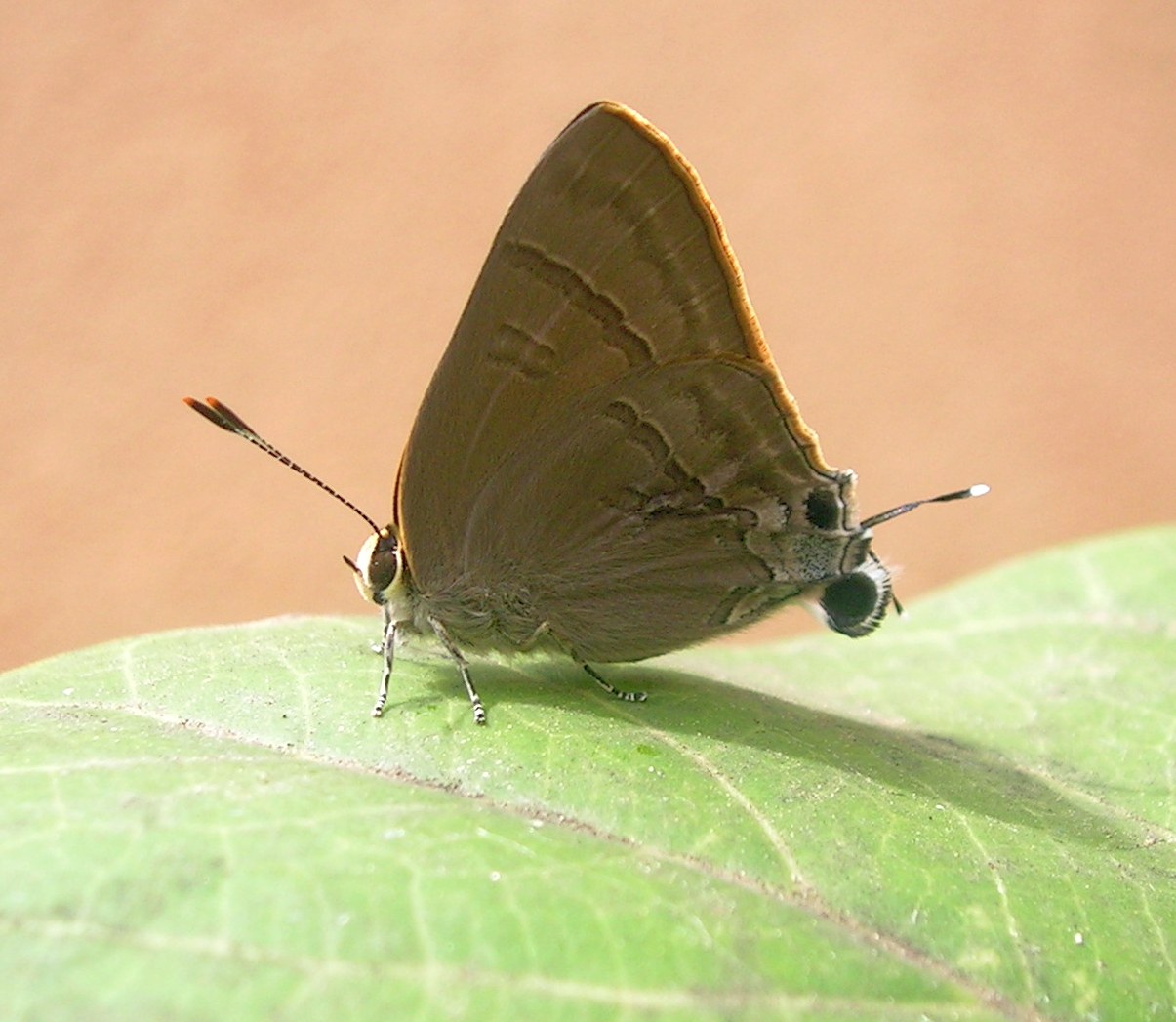
Rapala in my backyard (false head raised)
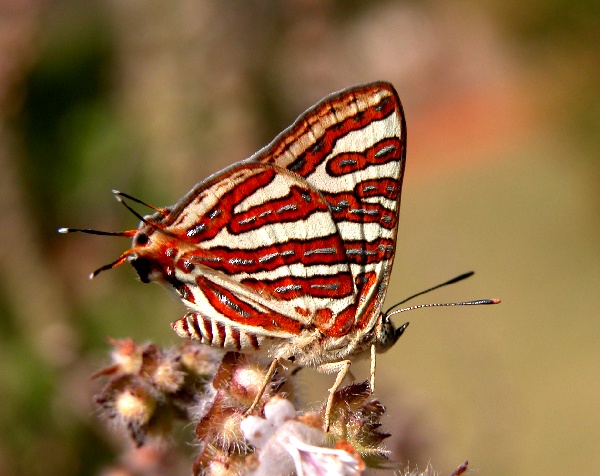
The hair-like tails of butterflies in the family Lycaenidae are quite well known. Many of these butterflies move their hindwings further drawing attention to the antenna-like hairs. These are frequently white-tipped and further enhanced by an eye-like spot at the base of the tail. In some species in the genus Spindasis, the markings on the wing appear to radiate from the false-head and even the posture of the butterfly may be altered to make the hind end look like a raised-up head. For a very long time, their role has been decided as being an anti-predation mechanism, to lure potential predators towards the non-vital end and allowing them to make an escape with minor loss. Some species will even make a quick 180° turn after landing or walk backwards a few steps to further this impression. This behaviour has been termed as "anticipatory deflection" !

Lines radiating from the false head (Spindasis)
But ideas like this can be dismissed as merely "anecdotal" these days and need to be demonstrated more carefully and several researchers have attempted this. In the 1980s R K Robbins looked at the old ideas from Victorian times. Some suggested that having two heads confused predators while others suggested that an eye would alarm predators. The evidence that Robbins looked at was the extent to which symmetrical hind-wing tips with damage were found in the wild population. He first had to decide if that kind of damage could be caused only by failed predator attacks, particularly by birds. So he first kept specimens in cages and looked at the frequency with which symmetric wing damage could be produced without predators. Convinced that this did not happen in his control population, he looked at the damage levels in the wild. He also looked at the ease with which breakage of the wing occurs and found that breakage happens more easily at the tail end. Van Someren in 1922 noted that lizards invariably attacked the hind ends of Lycaenids. Robbins found that most of the symmetrical damage was at the hind end. This was however pointed out as merely an indicator of the number of butterflies that escaped and not a clear difference in the value of the "false head" to their survival. Some later researchers took butterflies without spots and used false tails and paint to artificially add eye-spots to dead Pierids and then placed them in a cage with birds and checked out what the birds do and found that they indeed tended to peck close to these spots. The tale does not end here - in 2007 someone decided that the 1922 observations needed to be looked at more carefully and they found that there was no real evidence that caged Anolis lizards attacked eyespots on butterflies (not Lycaenids, but Bicyclus). The authors further question the evidence of bird beak marks that were used in the past as well ! Turns out that there is a renewed interest in these questions and one recent paper by Ullasa Kodandaramaiah et al. suggests that large eyespots may startle small predators. One of his fellow researchers further adds that this may be particularly effective in low-light conditions. False eyes are also found on caterpillars and in these cases, they are often on the front end of the caterpillar and these may not have the same kind of survival value as in the Lycaenids. Indeed the suggestion here is that they serve to startle potential predators by appearing like the eyes of a larger predator.

Now here comes another twist - Cordero in 2001 suggested that predators preferentially attack the rear ends of butterflies and that the false head served to deflect the attacker making them come into view and increasing the likelihood of timely evasive action !

In the Sunderbans, there was an idea of using a face mask behind the head to reduce the attacks on people by tigers, which typically ambush from behind. The idea was that the tiger would try to approach from the front giving more time and a chance for the person to make an escape. Apparently tigers are now beginning to discriminate the false face. It should be interesting to look out for and observe the behaviour of lynx spiders near Lycaenids.

Credits

Vijay Barve - photograph of Spindasis vulcanus (Creative Commons /Wikimedia)

Further reading


Wednesday, September 15, 2010

Turning over a new leaf

The hoi polloi views insects as pesky fellow passengers on this crazy ball in space and science degrees hardly have an effect on most people. However insects are perhaps one of the most interesting fellow passengers around and more than make up for the annoyance of a few biters and blood-suckers. They came out of the waters a long time before the branching of life-forms with internal skeletons. Which means that they have had that much more time encountering the problems of life and solving them using "evolutionary algorithms". What interesting answers and questions might they have figured out ? (apart from perhaps finding that the answer is 42!)

Galls on Pongamia leaves
How does one find food on a planet like this ? There is so much green stuff and yet humans in a forest find so little that is edible. What has gone wrong here ? For someone who thinks about insects and plants, the real questions are not about how to keep the insects away from plants but about how plants keep them away and stay green in spite of the onslaught. Not every plant-eating insect feeds on every plant species and the few that are found in numbers on any plant has evolved such an array of tools to deal with their dinner and dining table.

Here are some Pongamia pinnata leaves I found not so long ago. One usually finds little outgrowths on the leaves. These are mostly insect galls, but galls may also be formed by fungi. If you cut an insect-gall you will likely find a central hollow, perhaps an exit hole on the base or tip and if you are lucky, a tiny larva somewhere. That could most likely belong to one of numerous wasps or flies and you will surely be hard-pressed to find anyone who can identify the species. Galls are not always shaped like this - they can be spherical, formed at the tip of a branch and botanists have been known to sometimes describe the gall as the characteristic fruit of a new found tree species. What exactly is happening is something to consider - is the plant trying to isolate the insect like a cyst forms to engulf a foreign body or is the insect manipulating the biochemistry of the plant to make it produce tasty tissue around it ? Turns out that the latter is often the case and sometimes the gall-inducer seems to be capable of inducing galls with very specific shapes, colours and structures (this article with illustrations is particularly worthy of reading).

Ficus at Hebbal with leaves eaten away
Anyone who has worked with plant-tissue culture can tell you what a complex and sensitive cocktail of auxins, cytokinins and other compounds have to be delivered to get a bunch of cells to grow into something that resembles a plant. Now, given that the structure is essentially an insect induced "fruit", there must be a few that people can eat and after some research I came upon the "Mulga apple" (apparently on Acacia aneura) of Australia but the number of cases of edible galls seems rather low. I have a rather vague recollection of seeing swellings on nettles in the Uttaranchal Himalayas and some comments on their edibility (if anyone has eaten this or knows more please do let me know). Now plants are not taking such damage lying down and they have come up with their own defences. (some years ago some of us worked on this article on Wikipedia and hopefully it is still readable) Turns out that the biggest human use of galls is in the extraction of tannins - and tannic acid - a mixture of potent chemicals used to treat leather (tanning leather), at least in the past. And printing ink was once made by treating rust with gall extracts ! Tannins are essentially anti-insect chemicals and in some plants, the tannin content goes up rapidly when the plant is physically damaged by insects this can have an effect on the insects. Now if the insects are such experts in plant biochemistry, perhaps the plants have in turn figured out the most critical insect biochemical gears into which their molecular spanners should be thrown. Given that these are potent chemicals tailored through evolutionary time-scales, there must be something in these Chinese cocktails worthy of some serious scientific attention.

Leaf mine - note widening with age of miner
The birdwatcher's of Bangalore hold regular field outings at Hebbal and Lalbagh on the first and second Sundays of each month. On one of the Hebbal outings around June and July we came across this Ficus, the leaves with holes, the ground below covered in tea-like frass and you could hear the fall of caterpillar droppings. The caterpillars were extremely pretty, moving along the trunk in large numbers, presumably the last instars looking for a place to pupate. Unfortunately we have been unable to obtain any further identification of this lepidopteran caterpillar. With the monsoon rains, the tree has now shed all its leaves. Now leaf-shedding is actually a bit of a story of its own and there are numerous theories on when a tree "ought" to shed its leaves "if its purpose" was to achieve something and one such function, teleologically speaking, is to get rid of pesky insects. But surely dropping leaves is not a good strategy to get rid of that eat leaves . At least certainly not without withdrawing all the best nutrients.

The caterpillars on the Ficus (unidentified)
Perhaps the easiest insect targets to get rid off by leaf-shedding would be things like galls and leaf miners. Life miners, usually moth or fly larvae live in the layer of the leaf and feed under the protection of the leaf surface, no rain, no drying and perhaps some protection from parasites and predators.
So, next time you have something to ponder over when you see a fallen leaf...

Turns out that some studies suggest that leaf dropping does not kill many leaf-miners and so seems unlikely while others point out that gall infestation induces early leaf shedding.

Postscript

Also discovered Huitlacoche caused by Ustilago maydis

2026: The caterpillars are of Phauda sp.