click hide image

Tuesday, February 18, 2014

Why look like a spider?

"Why did the fly fly? Because the spider spied'er." - Anon.

Not every resemblance is a case of mimicry. An image of the Tephritid fly Goniurellia tridens with spider-like or ant-like patterns on its wing went viral in recent times and some have pointed out that this might be a case of wishful thinking. A little more than a week ago, I was observing a tiny day-flying moth in the Western Ghats of India and its behaviours. It seemed to make quick movements after landing and before coming to rest and then it would wave its hind legs slowly. It also made slight shifts of the forewings giving it the distinct impression of a jumping spider (Salticidae). 

Here are some not so brilliantly captured videos:


I cannot find a matching Salticid model but the posture and appearance make the mimicry seem perfectly plausible. Unlike the ants, which are dreaded by most of the smaller majority it is harder to think of a jumping spider as being recognized and avoided.

Here is a Salticid as seen from the side

Salticus scenicus from California by Kaldari (Wikimedia Commons)

Roger Kendrick has kindly identified this as belonging to the family Glyphipterigidae
Now there are ways to test if the resemblance is just accidental or if it really enhances the survival of the mimic. When I posted this on Facebook, I was pleasantly surprised to know that the Tephritid pattern which is quite widespread has actually been put to some test by an old friend, Dinesh Rao and his colleagues. Some of the earlier studies on the Tephritids with experiments involving wing transplantation suggests that the behavioural part is vital and that this seems to be specifically to avoid predation by Salticids. It seems like much more work is needed and we may well find many more cases of Salticid mimicry. But why only Salticids, is it because they are the most active on vegetation? And then we have some Salticids themselves being mimics of ants.
Brenthia sp. (from Rota & Wagner, 2006)


Here are some more suspects -
http://bugguide.net/node/view/433093 (another moth)
http://www.flickr.com/photos/orionmystery/8266380277/ (Amphientomidae, Psocoptera)

See also the excellent and interesting videos on http://naturedocumentaries.org/4450/predator-mimic-fly/
Rear end of Amycle sp. (from Zolnerowich 1992)

PS:  Have just examined the history and it seems that Tom Eisner was the first to suggest spider mimicry in Zonosemata.


Many other "microlepidoptera" have the habit of raising or waving their hindlegs. Given that salticids are considered masters of taking indirect routes to their prey, it seems like waving legs from the blind hind end might have a benefit not unlike that of the false heads of lycaenids. Perhaps salticids choose to circumvent this false head and come into the visible zone of the potential prey's zone of vision, thereby making them less liable to fall prey.


PS: In July 2015, during the monsoons, I noticed this common tetrigid with prominent white (maxillary?) palps making these jumping-spider-like motions. The grasshopper itself moves in jerks and it seems that the resemblance might have a value in escaping predators.

Acknowledgements

Dinesh Rao for pointing out the work he is doing and allowing me to post without fear of sounding like a complete crank.


A salticid peers from the cover of a fern (Wynaad)


References

Saturday, November 9, 2013

Hill-topping

A colourful term used by field biologists for a kind of mate-seeking behaviour that involves unmated males and females going up to the highest point in a locality and then competing and pairing up before dispersing. (this behaviour is thought to be restricted to insects although I know several mountaineering couples!) Apparently some of us had expanded the "hill-topping" entry on Wikipedia a few years ago but the real impact of that behaviour did not sink in until last week.

There is a wonderful line of hills somewhere between the two westbound highways going down from Mudigere and Sakleshpur in the Western Ghats of Karnataka, India that we decided to visit. More importantly it was accessible to researchers, unlike the national parks and sanctuaries in the neighbourhood. The forest here surrounds a towering hill with a rock that sticks out from lower hills covered in grass.


We climbed up the summit and were surprised by an enormous swarm (several thousands) of Tetraponera rufonigra (you can find some images here), all of them winged. It was so large and the numbers quickly got onto our bodies and faces that we were forced to descend back. I tried to tolerate them but had to swat one off leading to a sting that quickly swelled into a nice weal that took a couple of days to fully subside. We packed off a few specimens just to confirm identity and check whether we had any males. Getting back we checked with Dr Musthak Ali and he found that the few we collected to be only queens. We had hoped for some males, perhaps some more valiant observers will determine how males respond to these aggregations. It would seem that the usual emergence of breeders is in October-November, possibly after some rains.
Looking towards the western horizon - a matrix of tropical montane forest and grassland

Hill-topping behaviour is apparently very widespread and the definition of a hill can be as low as a small mound. In some countries the location of such sites are carefully avoided when roads are aligned or special wildlife crossings and other measures considered at such places. And talking of roads, there is a particularly well-done bit of road between Belur and Hassan. The road is uniformly wide and just right for two lines of traffic with well marked medians and edges and the shoulders are level with the roadside verge well covered by a tough species of grass. Overall this would seem like a great model for other roads, good enough and supporting a smooth flow of traffic without being too much of a hazard for people and wildlife around it. The quality of the road and the surroundings seems to induce calm driving behaviour.

The road between Belur and Hassan. Well marked and bordered. Accidental or by design?
Further reading


Wednesday, October 2, 2013

The Elephant Killer

I was looking for some Wikipedia articles tagged under the umbrella of WikiProject India - I was looking for poor quality articles to use in a little training exercise and of course there was no shortage there. Since the article list was alphabetically sorted, I espied the entry for Anaconda. Now why should that be related to India when the snake does not even occur outside of South America? Turns out that the word for the South American snake may have never been used in South America and that the word somehow emerged out of Sri Lanka. The material on the Wikipedia article was not entirely incorrect but the sources it cited were really poor quality and dubious and there was excessive emphasis on one theory - that the word anaconda was derived from the Tamil roots anai and kondra meaning "elephant killer". 

As always, a good researcher needs to find better sources and so a check for better sources for etymology and associated information led to a fairly interesting pursuit. The first port of call was that incredible and most entertaining piece of scholarship - the Hobson-Jobson and Henry Yule had practically sorted it all out in two and a half pages of in depth research but curiosity got the better of me and I decided to fish out the sources he used and found some others too.

Hobson Jobson entry


Entry from John Ray (1693)
Charles Owen (1742) An essay towards a natural history of serpents has this entry which expands on Ray and cites the source as D. Cleyerus (=Andreas Cleyer) which seems to be fairly good fit for the rock python (except for the length which might be based on stretched skins or imagination).
And The Dublin Penny Journal for 1834-5 has a long entry explaining the boa constrictor and anaconda.
Frank Wall, the herpetologist who worked in Sri Lanka, seems to be quite clear that the snake in question was a python. It would seem that somehow a really tiny little snake (Ahaetulla pulverulenta - and that genus name is also derived from Sinhalese) known as Henakandaya in Sinhalese somehow got mixed up with tales of pythons which then grew into monstrous man-eaters in South America (and Hollywood).

Now there is a second tale here, the one that I really came here to tell, which is that one can research the Internet and find Wikipedia articles in quite a bad shape or worse, appearing to be in good shape and not being scholarly enough. The right thing then is not to blame the medium but to use it to make things easier for future seekers/researchers. Part of that is to recognize bad sources and the other part is to fix it and I just did my bit for today.

PS: Have not been able to locate a scanned copy of Cleyer's note - (Cleyerus, Andreas 1683?/1684? De Serpente magno Indiae orientalis urobubalum deglutiente. Ephemer. curios. natur. Dec. 2, an. 2, p. 18)


"Boa Constrictor seizing a Government Messenger" by William Daniell  (1769-1837)

Monday, July 15, 2013

Ant mimics redux

A few weeks ago I was looking at a clump of grass and spotted this little ant-like insect walking on a blade. When I stooped to take a closer look, it leaped and I knew immediately that this was something to check carefully. After a little bit of searching I found it not far away and, with absolutely no hesitation, I was able to put a species identification to it - it had to be Formiscurra indicus. I had seen pictures of it at the entrance to the lab of Professor C.A. Viraktamath, a specialist on the oriental Cicadellidae and one of the two authors who described (i.e. taxonomically described and named the species) this species, at the University of Agricultural Sciences in Bangalore. This remarkable insect is a Caliscelid hopper and this is the male. The female looks quite different and fits the description brought to mind by the name of "piglet bug", a generic name used for many other members of the family. Male-limited mimicry is rather rare, indeed it is not entirely clear if there is a real value to the ant-like appearance. Females being vital to the survival of offspring are more often selected for mimetic resemblances that make them harder for predators to find or cause predators to avoid them. I decided to put together whatever little was known about this species on Wikipedia and for the first time also created a little DYK (Do-you-know) entry which appeared on the main page of Wikipedia. It was quite remarkable in that it led to ~3000 views and some interesting questions were raised on the talk page. One question was about why this species was described only in 2011 although specimens had been collected at least since 1976 and that too right within the limits of Bangalore city, a major science hub. The species seems to have a wide distribution and is probably not restricted to dry habitats as suggested in the original description paper. A few months ago, another male leaped away before I could make any careful observation at Moolehole on the Karnataka-Kerala border inside fairly dense moist-deciduous forest.

Hopefully some enlightened and more qualified entomologists will take the hint and decide to contribute to Wikipedia - the kind of outreach potential it has clearly beats the readership that an average scientific paper gets. I am quite sure that a good and accessible article will lead to greater readership of the more technical literature too. This article published by The Guardian last year undoubtedly caught attention, but it does not introduce the reader to the original work in the journal and I think a part of science communication should be about getting people to see the process by which knowledge is organized. Wikipedia cannot be that difficult to contribute to for anyone involved in science. I am happy to help anyone get started in adding to a major research resource. Maybe someone needs to write a "Why entomologists should embrace and contribute to Wikipedia" too.

This hopper is facing right, the forelegs are waved like feelers.

Formiscurra literally means "ant-clown" and refers to the "bulbous nose"


You can see the eyes and the antenna-bases below them.

For the photo of a shrivelled specimen see the one in the Guardian. And here are some older posts on spiders looking like ants and another ant-like bug.

Saturday, June 1, 2013

Bird art from the past

In a review of old bird art (Review of Fine Bird Books, 1700-1900 in New Statesman 1953, reprinted in Enjoying Ornithology), David Lack makes a curious statement:
"...It must also be remembered that, while Gould himself was a skilled craftsman, many of the books that bear his name were illustrated by others, including H.C. Richter, Edward Lear and Joseph Wolf. Indeed, some would regard the last-named as the greatest bird illustrator, particularly in his birds of prey, which combine accuracy with power. One must, I think, qualify this statement by 'of the western world', because the bird paintings from India and China surpass anything that the West has yet produced, and only these, perhaps, come in the category of great art."
India? Well, I suspected for long that Lack got this wrong. China? One can certainly find support for some truly artistic works from this region. The only major bird art from India that can even be considered in comparisons with the likes of Joseph Wolf are from the Mughal period. There are very few works of quality (at least as far as someone with very limited means for research can see) from the pre-Mughal period in India. The lack of good media as well as archival means that even if good works were made, few are preserved for us to examine. In an earlier post we saw some 30000 year old rock paintings from near Bhopal depicting large birds which are more likely to be floricans than ostriches as has been claimed by archaeologists.
30,000 year old rock paintings from near Bhopal
From what is available, one has to accept that the oldest and best depictions of birds have to be the ones from Egypt. The famed Meidum geese are truly a spectacle. The detail of serrations on the mandibles and the general stance are remarkable for 2500 BC. (Alfred Newton in his classic dictionary of birds notes it almost in his second page on the history of ornithology!)
Meidum geese - a plaster panel from the Tomb of Nefermaat and Itet, Egypt (zoomable facsimile) c. 2500 BC
The pair facing right are Red-breasted Geese, Branta ruficollis, and the pair facing left are Greater White-fronted Geese, Anser albifrons. The outer birds have been thought to be Bean Geese (Anser fabalis) although some have suggested that they could be Greylag Geese.

The Egyptians used paint on limestone and rock very effectively and the results have lasted long. There are several wonderful examples of Egyptian art available online via the Metropolitan Museum of Art.
Birds in a papyrus thicket - the duck, egret and cormorant are distinctive (2000 BC)


The Egyptians looked very carefully at their falcons and vultures too. They had reduced, symbolic versions that were part of their hieroglyphics. They seem to have done well in their understanding of feather arrangement, something that Joseph Wolf had taken great care of unlike some earlier bird artists in Europe.

Vulture from a panel in Memphis, could well be used in a modern field guide. (From Larousse Dictionary, 1910)

Falcons and Ibis painted pottery from Egypt, 400 BC 
From Hermann Ranke (1936)
The falcons show feather patterning which is very artistic and reasonably accurate. It seems like later works in Egypt were not as well preserved. If they did paint on papyrus, it seems like it was not preserved.


Crane by Sesshū Tōyō  (1420 – 1506) [Fenollosa, 1913]
The Chinese and Japanese found a medium that allows for more delicate depictions. They used ink on silk and paper and these are perhaps what Lack refers to in his review. Bird art from this region, from a later age though, is beautifully composed with artistic landscape backgrounds and elements of the environment. Contrast enhancing techniques are used in the way they set their mountains from the skies and white birds like egrets from the background. They also make careful choices in their use of unpainted areas. (artists will be interested in this guide to brush-painting technique)

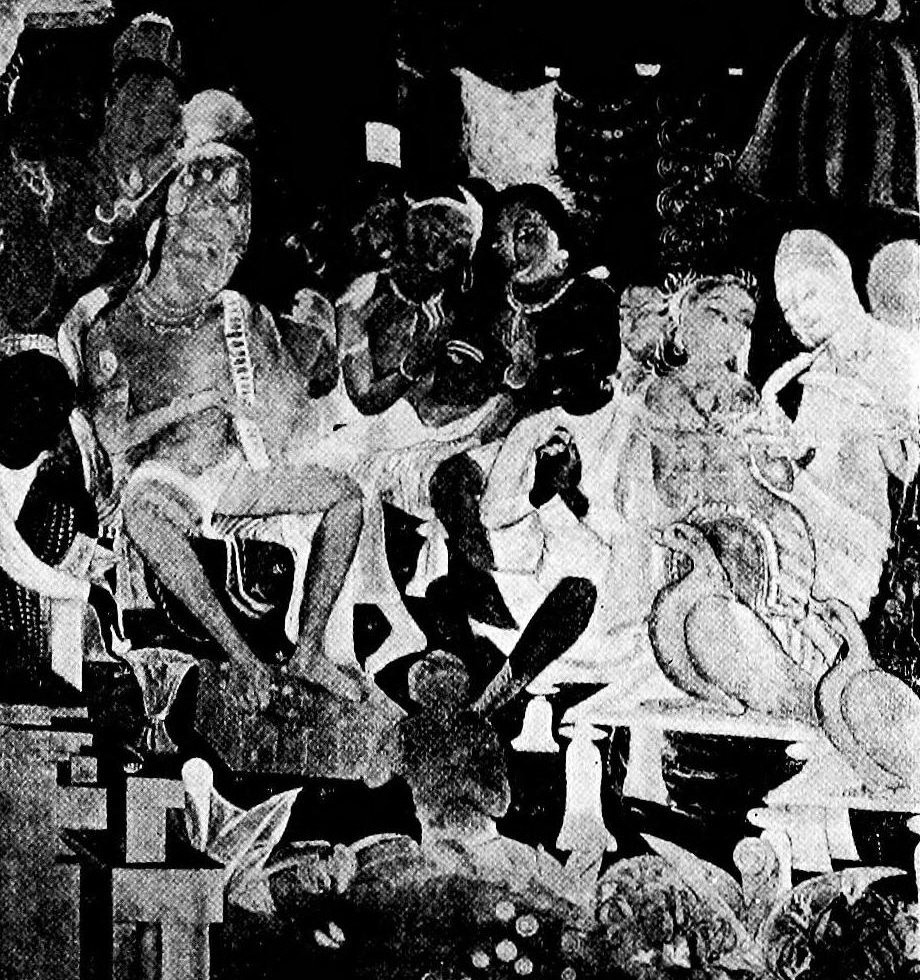
Now let us examine some of the older Indian bird portrayals. Most of the early art belongs to the Buddhist school. These included semi-mythical birds such as the hamsa which the Buddhists clearly identify with the goose (probably the Bar-headed Goose) unlike some Indian scholars who seem to feel better about calling it, however improbable it could be, a swan. Ornate renditions of the hamsa are found in 6th century China as well as in the cave paintings at Ajanta.


Three ducks by Manju - 12th century China

An ornate hamsa (See also this ornate goose at the Metropolitan Museum) is found in Cave 1 at Ajanta (sketched by James Burgess here). One can see the horses and elephants depicted with a level of naturalism that far exceeds that of the birds.
Frieze over cave 1 at Ajanta (100 BC - 500 AD)
A fresco inside cave 17 at Ajanta depicting Mahahamsa jataka or the tale of the golden king goose also has a stylized goose rendition. These birds are of course talking ones!


Animal world around sacred tree on east gate at Sanchi

The carvings on the gate at Sanchi show a parrot like bird which has been interpreted as an early version of garuda. Cave 17 at Ajanta also has some garuda, with a combination of bird and human traits and it is interesting that it almost retains the same name, karura, in Japanese Buddhism of the 8th Century.
Garudas from cave 17 at Ajanta
There is little by way of evidence of later bird art until the arrival of the Mughals. The idea of scribes maintaining journals for the Mughal rulers was itself an innovation and the introduction of illustration to capture scenes from daily life was something that historians would have liked others to do. Lots of collections of Mughal paintings have been made, and many have resulted in coffee table books. Salim Ali traced his ancestry to the Mughals and wrote a multi-part essay on Mughal natural history.

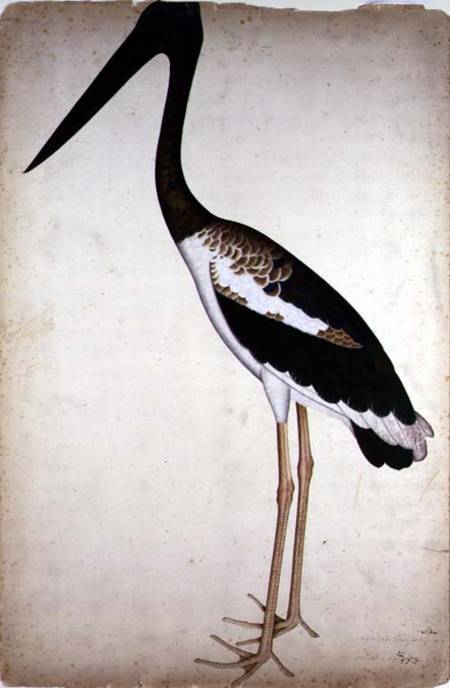
If Lack was appreciating Indian bird art, it has to belong to the Ustad Mansur school that worked for Jahangir. Mansur is most well known for his depictions of the dodo and Siberian crane. Others  like Shaikh Zain ud-Din painted for wealthy English patrons and the most famous collection is that of Lady Impey (of Impeyan pheasant or Monal fame), wife of Elijah Impey of the Calcutta court. This collection has some spectacular images of the Pink-headed Duck and Black-necked Stork that are painted from living specimens. They lack the sense of depth produced by shading techniques that the Chinese had mastered long before.
Pink-headed Duck by Bhawani Das ca. 1778-82 (Impey collection ) which was used by Latham to describe the species
Black-necked Stork by Sheikh Zain al-Din made for Lady Impey around 1781
The lack of a good historical and technical account on art in other periods stands out. A lot has been written about Mughal and Rajput art techniques but it seems like not enough mention has been made about some better art from southern India. A 1595 sample of art from Bijapur(?) (reprinted in Beach, 1992) seems to show better technique in shading. Basawan was an artist in Akbar's court. Although this does not depict birds, it suggests that there must be more interesting works languishing in collections around the world.
A work by Basawan of Akbar's court.
We have already seen in another post that T. C. Jerdon (of Jerdon's Courser fame) hired Indian artists to produce bird pictures for him. From a few other sources we know that he (or perhaps his wife Flora, who was a bit of an artist) trained traditional Indian artists to help him. Very little is known about their talc paintings or the antiquity of this form.

PS: If you have seen any exemplary Indian bird art from the pre-Moghul period, please do let me know.
In August 2014, I had an opportunity to examine the work of Hodgson's artist and for the 1850s, truly spectacular - see my post on it.

Further reading

Postscript:


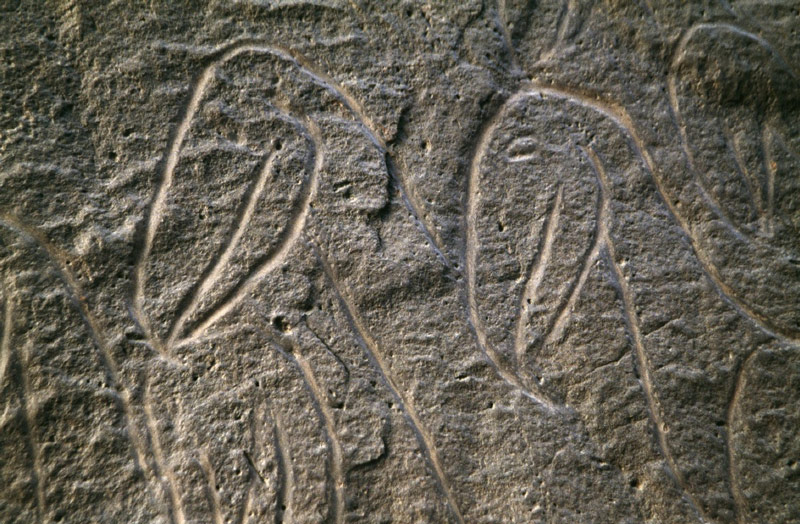
12 July 2022 - misidentification of birds in archaeology seems to be common and widespread - for instance all the African specialists (non-natives mostly) seem to identify a petroglyph of a group of birds from Wadi Djerat in Algeria as pelicans when in fact they clearly look closer to shoebill storks.