click hide image

Tuesday, March 11, 2014

A young cloud-forest?

In the last week, I have been examining some historic pictorial evidence of the vegetation atop Nandi Hills . It forced me to research the people behind the pictures. The key person involved was Colin Mackenzie, who had a strange interest in the history of mathematics and worked on a biography of John Napier, the man who is considered to have discovered (or invented?) the idea of logarithms in arithmetic computations. One of Napier's kin wanted Mackenzie to study the possibility that logarithms were in use among Hindu mathematicians. When this sponsor died, another relative bought Mackenzie a commission with the Madras Engineers. Setting off from the Outer Hebrides ("Farthest Hebrides"!), he arrived in Madras on 2 September 1783 and was never to return home, dying in Calcutta on 8th May 1821. Working in the army during tumultuous times, he quickly forgot the biography project, but retained an interest in antiquities and kept careful notes, had illustrations made and collected artefacts as he travelled around southern India. During the campaign against Tipu Sultan, he had illustrations made of the scenery around and among them is a picture of "Nandidrug" made in 1791 probably by Captain Thomas Sydenham. His interest in surveying the land and collecting information led to him being chosen for the new position of "Surveyor General".

[A side effect of the research was a bit of improvement of the Wikipedia biography of Colin Mackenzie.]
"Nandidrug" (1791) from the Mackenzie collection, British Library

The picture appears to have been drawn from the adjoining hill (which has some trees) and the painting may have some aspects exaggerated and has many inaccuracies. The top is however shown to be largely devoid of any vegetation. The overhang to the right side of the picture just beyond the end of the lower and second line of fortification exists but is much less prominent.
Mackenzie and his fellow researchers

Colin Mackenzie is somewhat special in his use of native interpreters. Early in his career, he was introduced to Kavali Boria, a "Brahmen" from Andhra with linguistic abilities that included the ability to read old Kannada script. Several other brothers and family members were part of his team, and after Mackenzie's death, the third brother Ramaswamie went on to publish books in English and these include perhaps the first Indian cookbook written in English (Pakasastra, translated from a book in Telugu by a Saraswati Bai) ! A pity this out of copyright work is not available online.

Mackenzie appears to have been quite accurate with his descriptions and the illustration of Nandi Hills is rough but still identifiable. The one shown may have been redrawn from a field sketch and lost some detail in the copying. Apparently a course in drawing (esp. of topography) was part of military training at the Royal Military Academy at Woolwich (Dias, 2013). The lack of trees on Nandi Hills is also mentioned very specifically by Surgeon C. J. Smith (see my earlier post "Perfect Alembics" for the full text).

The metalled road that leads up Nandi was set up only after 1923 according to the memorial stone at the entrance arch. It appears that some of the fortification was removed in the process (as it appears by comparing with the 1799 image).

It is widely claimed that Eucalyptus was first introduced in India in the Nandi hills by Tipu Sultan somewhere between 1782 and 1790. (Where did he get the plant from?). The Eucalyptus trees at Nandi Hills are among the largest trees in the Bangalore area and many of them show a surprisingly different kind of bark, not peely, smooth and white as elsewhere but fissured and cork-like bark. Surgeon Smith's claim that clouds covered the adjoining vegetated hills but not Nandi is also not something that is seen. In fact on one overnight stay in summer we noticed that the tree trunks are all covered in a thin film of flowing water each morning. This condensate is what makes the little forest patch on Nandi look so much like the Western Ghats, trees covered in moss and epiphytes. It has also been adopted by a wide range of birds that one would find more regularly in the Western Ghats - the Nilgiri Wood Pigeon, the odd Malabar Whistling Thrush, the Orange-headed Thrushes, the Pied Thrushes, the summering(!) Small Sunbird and so on.
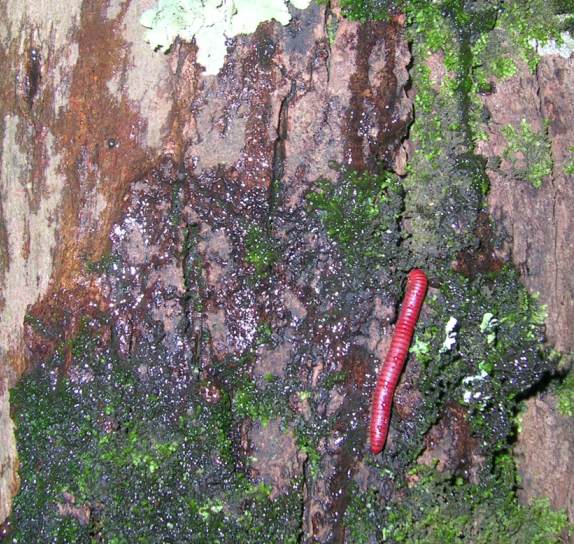
Bark of a Eucalyptus with condensation running down in summer 

There is little doubt then that Nandi Hills qualifies as a cloud forest. The question is, can one have accidentally been made in the course of a little under 200 years? Considering that the adjoining hills have not grown in a similar way, does the Eucalyptus itself have a role here?
Morning clouds around the adjoining hill (March 2014)
The top of the hill supposedly dated to c. 1880 showing barren ground and Cubbon's home.
Found on several internet sites. Provenance unknown . [Studio of Orr & Barton, Bangalore]


The central hill with the fort has vegetation that includes tall tree cover and undergrowth.


References


PS: Is something similar happening at Mount Sutro in San Francisco ? http://mntsutro.com/

March, 2016: It appears that the first person to move eucalyptus plants (probably E. globulus) out of Australia was  Jacques Labillardière. Labillardiere was surprized by the size of the trees in Tasmania. The lowest branches were 60 m above the ground and the trunks were 9 m in diameter (27 m circumference). He saw flowers through a telescope and had some flowering branches shot down with guns! His ship was seized by the British in Java and that was around 1795 or so and released in 1796. All subsequent movements seem to have been post 1800 (ie after Tipu's death). If Tipu Sultan did indeed plant the Eucalyptus here he must have got it via the French through the Labillardière shipment. 
 
PS: Two of the Eucalypts at Nandi Hills were cut down by the Archaeological Survey of India + department of horticulture in 2019 - this gives a great opportunity for research on climate with someone having access to the appropriate tools and techniques. We tried contacting people at IWST and other places to collect slices of the trunk for any future research but it seems nothing came out of it.


Tuesday, February 18, 2014

Why look like a spider?

"Why did the fly fly? Because the spider spied'er." - Anon.

Not every resemblance is a case of mimicry. An image of the Tephritid fly Goniurellia tridens with spider-like or ant-like patterns on its wing went viral in recent times and some have pointed out that this might be a case of wishful thinking. A little more than a week ago, I was observing a tiny day-flying moth in the Western Ghats of India and its behaviours. It seemed to make quick movements after landing and before coming to rest and then it would wave its hind legs slowly. It also made slight shifts of the forewings giving it the distinct impression of a jumping spider (Salticidae). 

Here are some not so brilliantly captured videos:


I cannot find a matching Salticid model but the posture and appearance make the mimicry seem perfectly plausible. Unlike the ants, which are dreaded by most of the smaller majority it is harder to think of a jumping spider as being recognized and avoided.

Here is a Salticid as seen from the side

Salticus scenicus from California by Kaldari (Wikimedia Commons)

Roger Kendrick has kindly identified this as belonging to the family Glyphipterigidae
Now there are ways to test if the resemblance is just accidental or if it really enhances the survival of the mimic. When I posted this on Facebook, I was pleasantly surprised to know that the Tephritid pattern which is quite widespread has actually been put to some test by an old friend, Dinesh Rao and his colleagues. Some of the earlier studies on the Tephritids with experiments involving wing transplantation suggests that the behavioural part is vital and that this seems to be specifically to avoid predation by Salticids. It seems like much more work is needed and we may well find many more cases of Salticid mimicry. But why only Salticids, is it because they are the most active on vegetation? And then we have some Salticids themselves being mimics of ants.
Brenthia sp. (from Rota & Wagner, 2006)


Here are some more suspects -
http://bugguide.net/node/view/433093 (another moth)
http://www.flickr.com/photos/orionmystery/8266380277/ (Amphientomidae, Psocoptera)

See also the excellent and interesting videos on http://naturedocumentaries.org/4450/predator-mimic-fly/
Rear end of Amycle sp. (from Zolnerowich 1992)

PS:  Have just examined the history and it seems that Tom Eisner was the first to suggest spider mimicry in Zonosemata.


Many other "microlepidoptera" have the habit of raising or waving their hindlegs. Given that salticids are considered masters of taking indirect routes to their prey, it seems like waving legs from the blind hind end might have a benefit not unlike that of the false heads of lycaenids. Perhaps salticids choose to circumvent this false head and come into the visible zone of the potential prey's zone of vision, thereby making them less liable to fall prey.


PS: In July 2015, during the monsoons, I noticed this common tetrigid with prominent white (maxillary?) palps making these jumping-spider-like motions. The grasshopper itself moves in jerks and it seems that the resemblance might have a value in escaping predators.

Acknowledgements

Dinesh Rao for pointing out the work he is doing and allowing me to post without fear of sounding like a complete crank.


A salticid peers from the cover of a fern (Wynaad)


References

Saturday, November 9, 2013

Hill-topping

A colourful term used by field biologists for a kind of mate-seeking behaviour that involves unmated males and females going up to the highest point in a locality and then competing and pairing up before dispersing. (this behaviour is thought to be restricted to insects although I know several mountaineering couples!) Apparently some of us had expanded the "hill-topping" entry on Wikipedia a few years ago but the real impact of that behaviour did not sink in until last week.

There is a wonderful line of hills somewhere between the two westbound highways going down from Mudigere and Sakleshpur in the Western Ghats of Karnataka, India that we decided to visit. More importantly it was accessible to researchers, unlike the national parks and sanctuaries in the neighbourhood. The forest here surrounds a towering hill with a rock that sticks out from lower hills covered in grass.


We climbed up the summit and were surprised by an enormous swarm (several thousands) of Tetraponera rufonigra (you can find some images here), all of them winged. It was so large and the numbers quickly got onto our bodies and faces that we were forced to descend back. I tried to tolerate them but had to swat one off leading to a sting that quickly swelled into a nice weal that took a couple of days to fully subside. We packed off a few specimens just to confirm identity and check whether we had any males. Getting back we checked with Dr Musthak Ali and he found that the few we collected to be only queens. We had hoped for some males, perhaps some more valiant observers will determine how males respond to these aggregations. It would seem that the usual emergence of breeders is in October-November, possibly after some rains.
Looking towards the western horizon - a matrix of tropical montane forest and grassland

Hill-topping behaviour is apparently very widespread and the definition of a hill can be as low as a small mound. In some countries the location of such sites are carefully avoided when roads are aligned or special wildlife crossings and other measures considered at such places. And talking of roads, there is a particularly well-done bit of road between Belur and Hassan. The road is uniformly wide and just right for two lines of traffic with well marked medians and edges and the shoulders are level with the roadside verge well covered by a tough species of grass. Overall this would seem like a great model for other roads, good enough and supporting a smooth flow of traffic without being too much of a hazard for people and wildlife around it. The quality of the road and the surroundings seems to induce calm driving behaviour.

The road between Belur and Hassan. Well marked and bordered. Accidental or by design?
Further reading


Wednesday, October 2, 2013

The Elephant Killer

I was looking for some Wikipedia articles tagged under the umbrella of WikiProject India - I was looking for poor quality articles to use in a little training exercise and of course there was no shortage there. Since the article list was alphabetically sorted, I espied the entry for Anaconda. Now why should that be related to India when the snake does not even occur outside of South America? Turns out that the word for the South American snake may have never been used in South America and that the word somehow emerged out of Sri Lanka. The material on the Wikipedia article was not entirely incorrect but the sources it cited were really poor quality and dubious and there was excessive emphasis on one theory - that the word anaconda was derived from the Tamil roots anai and kondra meaning "elephant killer". 

As always, a good researcher needs to find better sources and so a check for better sources for etymology and associated information led to a fairly interesting pursuit. The first port of call was that incredible and most entertaining piece of scholarship - the Hobson-Jobson and Henry Yule had practically sorted it all out in two and a half pages of in depth research but curiosity got the better of me and I decided to fish out the sources he used and found some others too.

Hobson Jobson entry


Entry from John Ray (1693)
Charles Owen (1742) An essay towards a natural history of serpents has this entry which expands on Ray and cites the source as D. Cleyerus (=Andreas Cleyer) which seems to be fairly good fit for the rock python (except for the length which might be based on stretched skins or imagination).
And The Dublin Penny Journal for 1834-5 has a long entry explaining the boa constrictor and anaconda.
Frank Wall, the herpetologist who worked in Sri Lanka, seems to be quite clear that the snake in question was a python. It would seem that somehow a really tiny little snake (Ahaetulla pulverulenta - and that genus name is also derived from Sinhalese) known as Henakandaya in Sinhalese somehow got mixed up with tales of pythons which then grew into monstrous man-eaters in South America (and Hollywood).

Now there is a second tale here, the one that I really came here to tell, which is that one can research the Internet and find Wikipedia articles in quite a bad shape or worse, appearing to be in good shape and not being scholarly enough. The right thing then is not to blame the medium but to use it to make things easier for future seekers/researchers. Part of that is to recognize bad sources and the other part is to fix it and I just did my bit for today.

PS: Have not been able to locate a scanned copy of Cleyer's note - (Cleyerus, Andreas 1683?/1684? De Serpente magno Indiae orientalis urobubalum deglutiente. Ephemer. curios. natur. Dec. 2, an. 2, p. 18)


"Boa Constrictor seizing a Government Messenger" by William Daniell  (1769-1837)

Monday, July 15, 2013

Ant mimics redux

A few weeks ago I was looking at a clump of grass and spotted this little ant-like insect walking on a blade. When I stooped to take a closer look, it leaped and I knew immediately that this was something to check carefully. After a little bit of searching I found it not far away and, with absolutely no hesitation, I was able to put a species identification to it - it had to be Formiscurra indicus. I had seen pictures of it at the entrance to the lab of Professor C.A. Viraktamath, a specialist on the oriental Cicadellidae and one of the two authors who described (i.e. taxonomically described and named the species) this species, at the University of Agricultural Sciences in Bangalore. This remarkable insect is a Caliscelid hopper and this is the male. The female looks quite different and fits the description brought to mind by the name of "piglet bug", a generic name used for many other members of the family. Male-limited mimicry is rather rare, indeed it is not entirely clear if there is a real value to the ant-like appearance. Females being vital to the survival of offspring are more often selected for mimetic resemblances that make them harder for predators to find or cause predators to avoid them. I decided to put together whatever little was known about this species on Wikipedia and for the first time also created a little DYK (Do-you-know) entry which appeared on the main page of Wikipedia. It was quite remarkable in that it led to ~3000 views and some interesting questions were raised on the talk page. One question was about why this species was described only in 2011 although specimens had been collected at least since 1976 and that too right within the limits of Bangalore city, a major science hub. The species seems to have a wide distribution and is probably not restricted to dry habitats as suggested in the original description paper. A few months ago, another male leaped away before I could make any careful observation at Moolehole on the Karnataka-Kerala border inside fairly dense moist-deciduous forest.

Hopefully some enlightened and more qualified entomologists will take the hint and decide to contribute to Wikipedia - the kind of outreach potential it has clearly beats the readership that an average scientific paper gets. I am quite sure that a good and accessible article will lead to greater readership of the more technical literature too. This article published by The Guardian last year undoubtedly caught attention, but it does not introduce the reader to the original work in the journal and I think a part of science communication should be about getting people to see the process by which knowledge is organized. Wikipedia cannot be that difficult to contribute to for anyone involved in science. I am happy to help anyone get started in adding to a major research resource. Maybe someone needs to write a "Why entomologists should embrace and contribute to Wikipedia" too.

This hopper is facing right, the forelegs are waved like feelers.

Formiscurra literally means "ant-clown" and refers to the "bulbous nose"


You can see the eyes and the antenna-bases below them.

For the photo of a shrivelled specimen see the one in the Guardian. And here are some older posts on spiders looking like ants and another ant-like bug.