
Some months ago, I needed to look at an old work on Indian birds - Illustrations of Indian Ornithology printed in 1847 at Madras. It was privately published by Dr Thomas Caverhill Jerdon who is most famously associated with Jerdon's Courser. Being privately published meant that very few copies of the book were printed. If any are left in Indian collections, they are most likely in a bad state if not vandalized and sold off to collectors and in any case these are inaccessible to ordinary citizens interested in researching them. This work included paintings made by Indian artists. In An Indian Olio (1888), Lt-Gen. E F Burton (page 61) mentions that Jerdon hired native artists at Trichinopoly and taught them to produce natural history illustrations. These artists traditionally painted on talc (actually mica which came from Bihar and Bengal) and rice paper, making portraits of local chiefs and royalty. For samples of these mica paintings from Trichinopoly see here and here. The author noted further that :
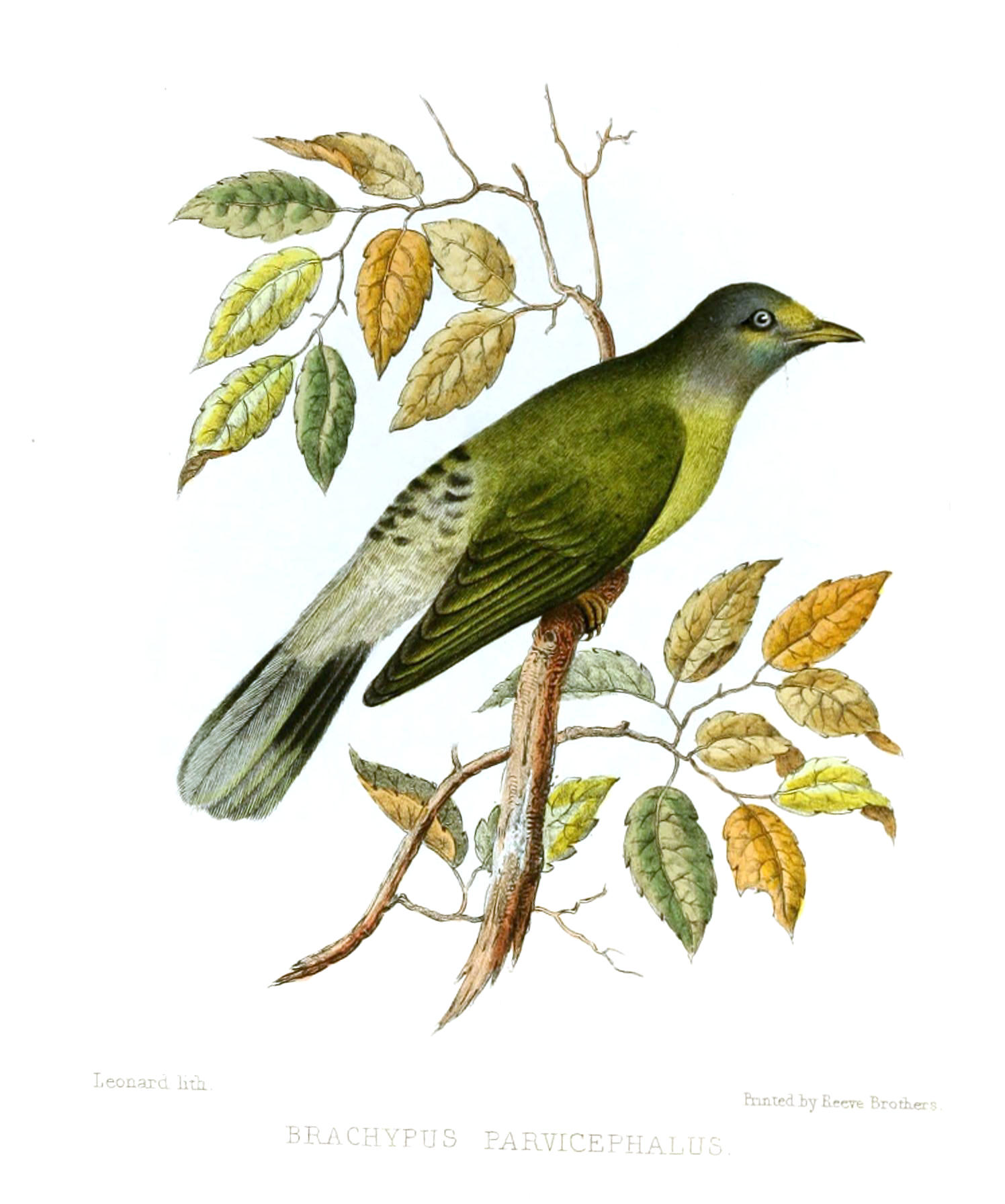
Under Dr. Jerdon's teaching these people became apt in faithful and laborious representations of the feathered tribes, and attained a really high pitch of excellence. With true Hindoo patience, every feather - nay, every vane and cirrus of each feather - was separately and truly shown; the pictured bird was a laboured and exact presentment of the bird itself. These were painted on rice paper or on sheets of talc.These comments made me want to see these paintings badly. The Biodiversity Heritage Library is an incredible project. Despite being an enormous project, they have a place where the lay public can make requests and I made one. A few days ago, I noticed that the Library had scanned this work and it was all suddenly accessible. Some of the plates are signed by C V Kistnarajoo while several others appear to have been redone in London. Jerdon however noted that all the originals were made by "natives".
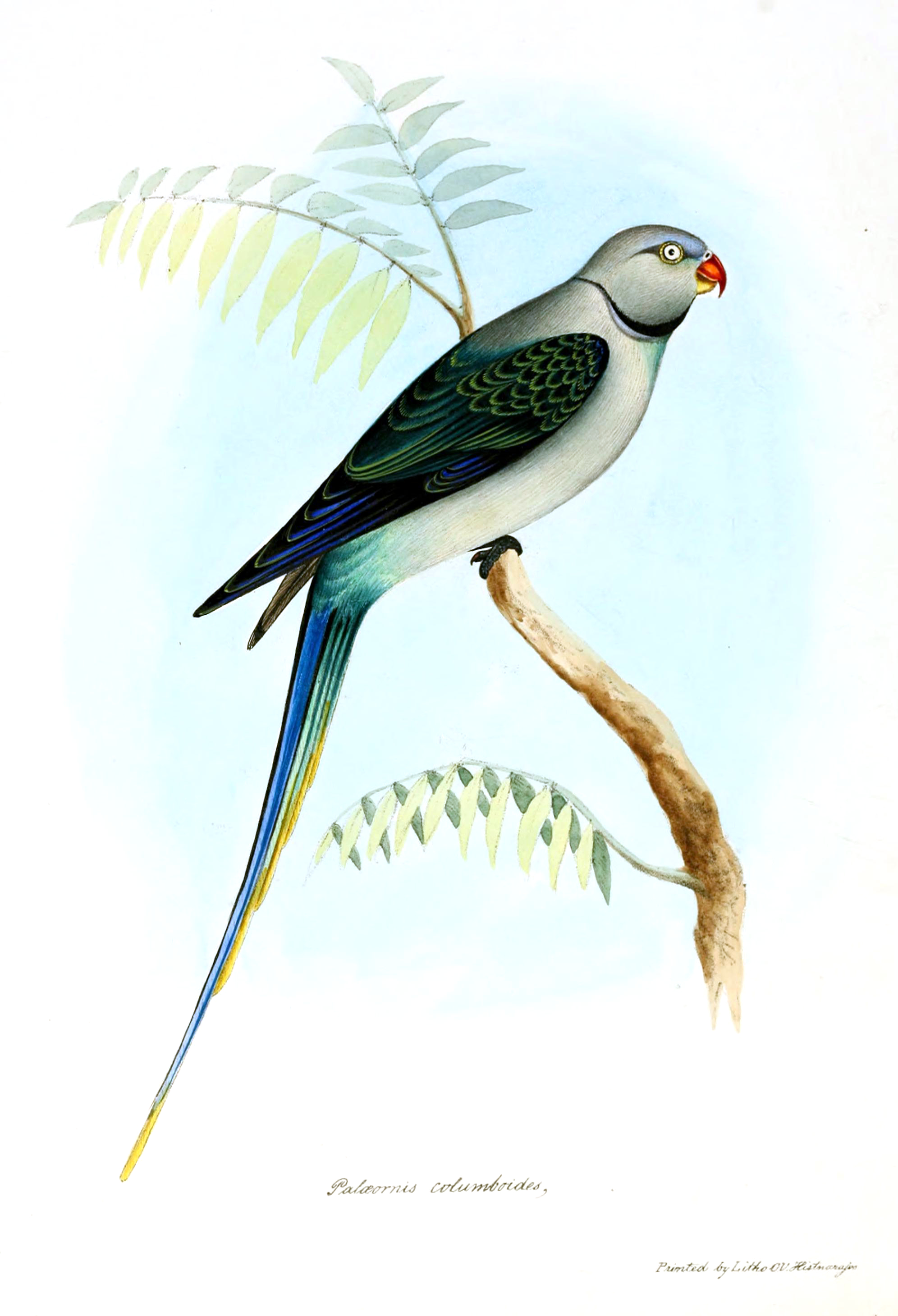
My choice for the best of Kistnarajoo's work would be for the Blue-winged Parakeet Psittacula columboides - which makes use of a range of blue shades.
One of the species that Jerdon described was once common in Bangalore. Its identity had however troubled many Bangalore birders in the past. It is now known as Mirafra affinis - only recently reinstated as a full species (formerly as Mirafra assamica affinis) and known as Jerdon's Bushlark. A recent trip to Pune courtesy of Colonel Ashwin Baindur allowed me to see what was I think was a proper Mirafra erythroptera - at least it was quite distinctly different in call and appearance from the commonest bushlark in Bangalore. Jerdon's notes in his Illustrations state that the two are entirely distinguishable from the shape and dimensions of the beak. Jerdon also seems to have guessed the southern boundary of M. erythroptera quite accurately.
Publishing these works probably contributed to Jerdon being pushed into debt and it is said that he died insolvent. We however owe a debt to Jerdon for all these works. He was instrumental in rallying, along with big names like Darwin and Hooker, for the project that produced the Fauna of British India - a work that continues to be indispensable even today. Jerdon was also a part of the scholarly group that brought in ideas of conservation leading to the establishment of the forest department in India. His role was noted in a widely cited article (Grove, Richard H. (1992). “The Origins of Western Environmentalism,” Scientific American 267(1, July), 42-47) which included a photograph of Jerdon and others taken by Samuel Bourne. Jerdon has not been forgotten yet, and there has just been a publication of an interesting piece of detective work on that same photograph to determine the identities of the people in it - Notie, HJ (2011) A botanical group in Lahore, 1864. Archives of natural history. 38(2):267-277.
|
|
|


For more images see Wikimedia Commons.
Postscript
Many years ago, I came across a handwritten manuscript called the "Lepidoptera of Kanara" written by a certain Samuel Neville Ward. I also knew of Jerdon's name for the Pied Thrush (Zoothera wardii) (more info on the Wikipedia link) which he named after a S. N. Ward of the Madras Civil Service. And this year (2012) I happened to notice a memorial at the entrance of the St. Stephen's Church at Ootacamund to the son of this S. N. Ward! Apparently S. N. Ward was a magistrate at Sirsi and he presented his illustrations of lepidopteran caterpillars on their host plants to the NHM.
|
|


Samuel Best (c. 1808-5 October 1851) Captain, Madras Engineers: entered the service in 1826 : Secretary to the Board of Revenue in the P.W.D., 1842 : planned the Singapore fortifications, and was made Superintendent of roads in Madras, 1845 : under him road-making was very well managed under fixed rules : he executed many important works in the Madras Presidency : such as the Southern Trunk Road and the Goolcheroo Pass : and made valuable contributions to the Madras Literary Transactions and the Madras Engineering papers : died of jungle fever at Chitore on his return from the hills, Oct. 5, 1851.


