click hide image

Sunday, December 4, 2011

Trichinopoly talc

Some months ago, I needed to look at an old work on Indian birds - Illustrations of Indian Ornithology printed in 1847 at Madras. It was privately published by Dr Thomas Caverhill Jerdon who is most famously associated with Jerdon's Courser. Being privately published meant that very few copies of the book were printed. If any are left in Indian collections, they are most likely in a bad state if not vandalized and sold off to collectors and in any case these are inaccessible to ordinary citizens interested in researching them. This work included paintings made by Indian artists. In An Indian Olio (1888), Lt-Gen. E F Burton (page 61)  mentions that Jerdon hired native artists at Trichinopoly and taught them to produce natural history illustrations. These artists traditionally painted on talc (actually mica which came from Bihar and Bengal) and rice paper, making portraits of local chiefs and royalty. For samples of these mica paintings from Trichinopoly see here and here. The author noted further that :
Under Dr. Jerdon's teaching these people became apt in faithful and laborious representations of the feathered tribes, and attained a really high pitch of excellence. With true Hindoo patience, every feather - nay, every vane and cirrus of each feather - was separately and truly shown; the pictured bird was a laboured and exact presentment of the bird itself. These were painted on rice paper or on sheets of talc.
These comments made me want to see these paintings badly. The Biodiversity Heritage Library is an incredible project. Despite being an enormous project, they have a place where the lay public can make requests and I made one. A few days ago, I noticed that the Library had scanned this work and it was all suddenly accessible. Some of the plates are signed by C V Kistnarajoo while several others appear to have been redone in London. Jerdon however noted that all the originals were made by "natives".
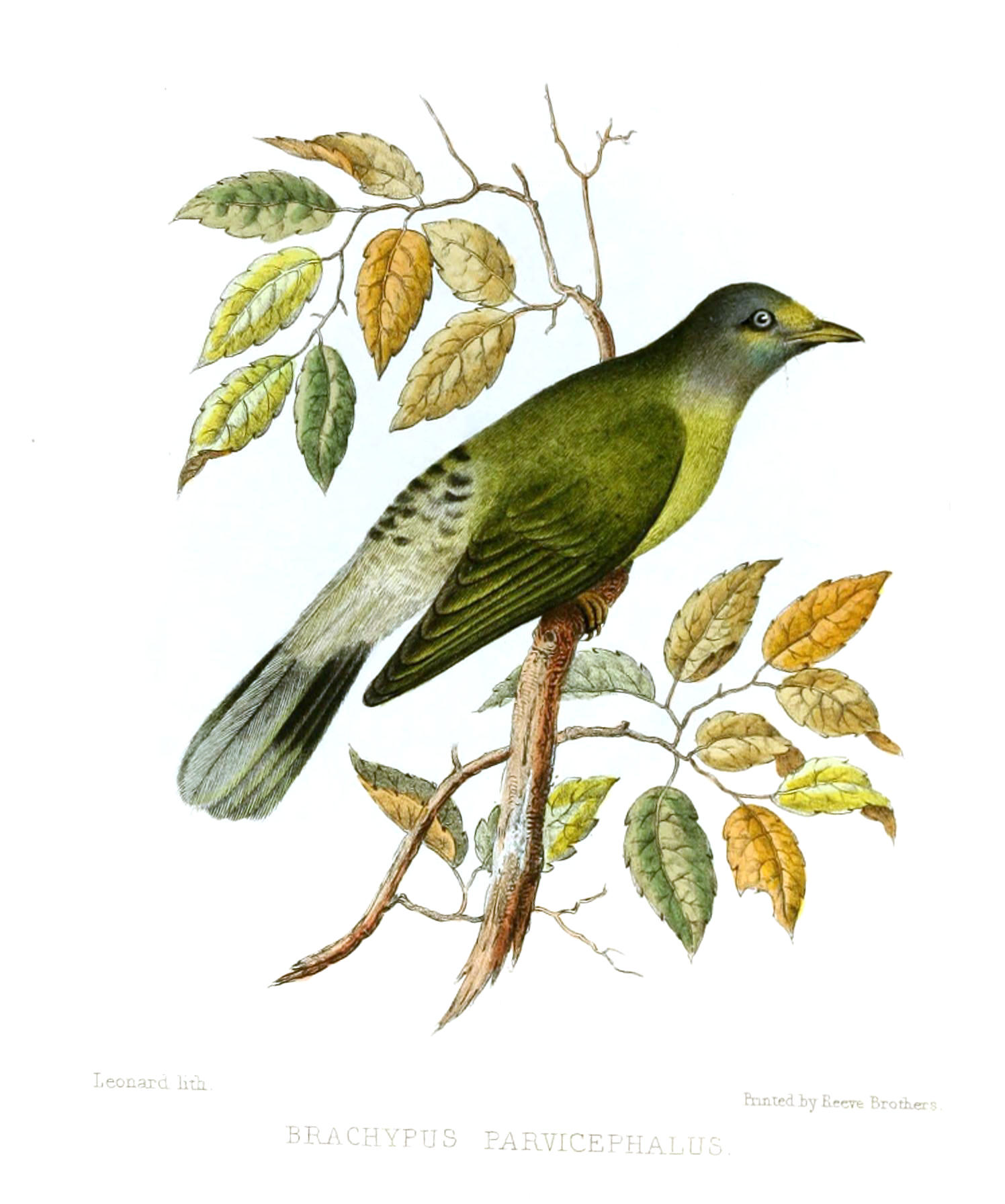
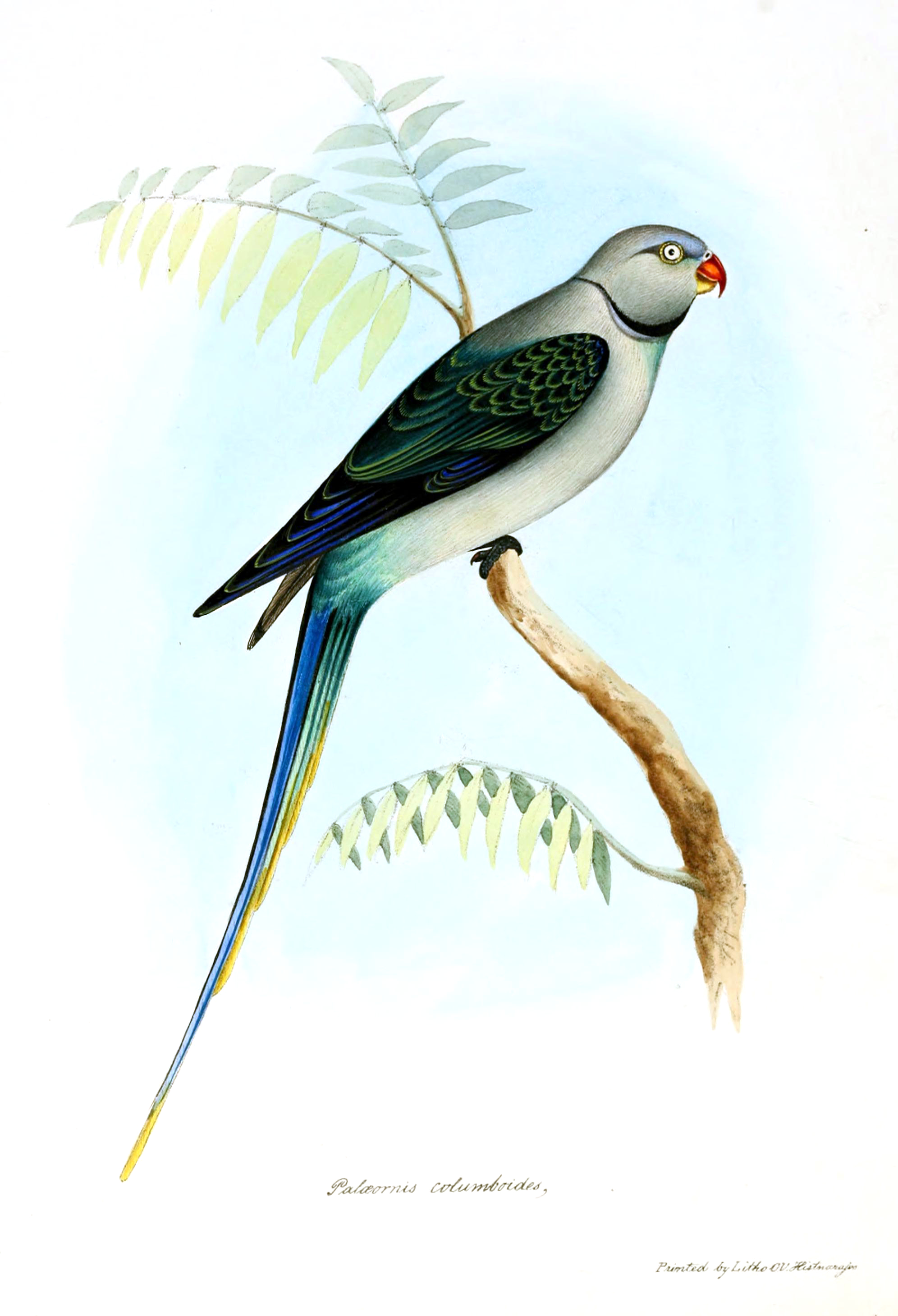
Among these interesting paintings is one of the Grey-headed Bulbul and is captioned as "Brachypus parvicephalus" - a spelling that does not even seem to be noted in major taxonomic synopses. This could however be an error of the artist (a certain Leonard) as the text uses "poioicephalus". Interestingly a French work from around the same time - on the voyage of the Bonita - described the species under the name of Ixos fisquetti, again a name missed in taxonomic works. Burton's description of the paintings needs to be interpreted on the basis of the styles of the time and the technology used for printing. These pictures, at least the lithographs, are not very spectacular by modern standards or even by the later standards set by Keulemans, Smit and Wolf. But I am impressed by how well the shades of blue have been retained since 1847. The images shown here are digitally enhanced and include white level corrections and increased contrast.

My choice for the best of Kistnarajoo's work would be for the Blue-winged Parakeet Psittacula columboides - which makes use of a range of blue shades.

One of the species that Jerdon described was once common in Bangalore. Its identity had however troubled many Bangalore birders in the past. It is now known as Mirafra affinis - only recently reinstated as a full species (formerly as Mirafra assamica affinis) and known as Jerdon's Bushlark. A recent trip to Pune courtesy of Colonel Ashwin Baindur allowed me to see what was I think was a proper Mirafra erythroptera - at least it was quite distinctly different in call and appearance from the commonest bushlark in Bangalore. Jerdon's notes in his Illustrations state that the two are entirely distinguishable from the shape and dimensions of the beak. Jerdon also seems to have guessed the southern boundary of M. erythroptera quite accurately.

Publishing these works probably contributed to Jerdon being pushed into debt and it is said that he died insolvent. We however owe a debt to Jerdon for all these works. He was instrumental in rallying, along with big names like Darwin and Hooker, for the project that produced the Fauna of British India - a work that continues to be indispensable even today. Jerdon was also a part of the scholarly group that brought in ideas of conservation leading to the establishment of the forest department in India. His role was noted in a widely cited article (Grove, Richard H. (1992). “The Origins of Western Environmentalism,” Scientific American 267(1, July), 42-47) which included a photograph of Jerdon and others taken by Samuel Bourne. Jerdon has not been forgotten yet, and there has just been a publication of an interesting piece of detective work on that same photograph to determine the identities of the people in it - Notie, HJ (2011) A botanical group in Lahore, 1864. Archives of natural history. 38(2):267-277.


White-cheeked Barbet

Pink-headed Duck

White-winged Tit

For more images see Wikimedia Commons.

Postscript

Many years ago, I came across a handwritten manuscript called the "Lepidoptera of Kanara" written by a certain Samuel Neville Ward. I also knew of Jerdon's name for the Pied Thrush (Zoothera wardii) (more info on the Wikipedia link) which he named after a S. N. Ward of the Madras Civil Service. And this year (2012) I happened to notice a memorial at the entrance of the St. Stephen's Church at Ootacamund to the son of this S. N. Ward! Apparently S. N. Ward was a magistrate at Sirsi and he presented his illustrations of lepidopteran caterpillars on their host plants to the NHM.

Memorial for S N Ward's son
Zoothera wardii based on a drawing
by S. N. Ward, background by Samuel Best
S. N. Ward has been said to have been born in 1813 and died 1897. A news report - Morning Post 23 July 1887 notes the death of Mary Catherine on the 16th at Clive Dale, Steyning, wife of S. N. Ward, late of the Madras Civil Service.

Memorial to Samuel Best from St. George's Cathedral Madras. Best drew the background for Jerdon's illustration of the pied thrush.

Samuel Best (c. 1808-5 October 1851) Captain, Madras Engineers: entered the service in 1826 : Secretary to the Board of Revenue in the P.W.D., 1842 : planned the Singapore fortifications, and was made Superintendent of roads in Madras, 1845 : under him road-making was very well managed under fixed rules : he executed many important works in the Madras Presidency : such as the Southern Trunk Road and the Goolcheroo Pass : and made valuable contributions to the Madras Literary Transactions and the Madras Engineering papers : died of jungle fever at Chitore on his return from the hills, Oct. 5, 1851.

Tuesday, November 1, 2011

Adrift

I recently joined a bunch of bird-photographers and birdwatchers who decided to hire a fishing boat out to sea to watch seabirds. The result was that we, at least I, got to see among others our first view of one of the world's most abundant birds - Wilson's Storm Petrel (some amazing photographs on the Wikipedia article contributed there by Nanda Ramesh) The bird books for the Indian region seem to be completely off mark with information on the sea birds. It seems like a number of birds that are considered extremely rare are actually quite common at least seasonally. The problem of course is that the vast majority that are interested in birds are employed in the cities and are trying to learn more by making a trip here and there, now and then, while the ones who can be doing that best in those locations, the fishermen, have never been recruited into this business of knowing-science.

Unidentified Scotophilus
Anyway, it was a great experience being in the open with a 360 degree unobstructed view of the horizon, silence, colourful sunrise and sunset; and various sea denizens. Masses of pulsating jellyfish, the beauty of which could not be captured easily (I am not sure if there is any aquarium in India that displays their beauty like they do at the Monterey Bay aquarium), many sea snakes (mainly in the evening), and several sea birds. The gulls, terns and skuas all sat on floating debris allowing photographs that are truly sharp and detailed but anathema to photography purists. There were some lepidoptera flying in to the Indian peninsula from the West - some looked a bit like Melanitis and there were moths, a lacewing and several other insects such as the Pantala dragonflies flying about. Far out at sea at dawn, a Scotophilus bat flew from the west and finding some terra firma ("the more the firmer, the less the terror") in the form of our boat seemed to desperately look for a quiet corner where it went to sleep. It could have gone out on a large ship and then taken off to be lost at sea or who knows, in migration. It just seems like there is so much that nobody has ever bothered to learn about. There are of course heavily funded government departments and the ZSI who for sure run expeditions out here but what they learn or the quality of their work is not easy to discover unless someone is willing to go to court and spend time trying to straighten out governance, justice and all else. Anyway, I suspect that one could easily learn a lot more for a lot less if someone started a scheme to provide old digital cameras to some selected curious-minded fisherfolk to document what they see.

What a tern can use
By some coincidence, I happened to read a semi-autobiographical account of Curtis Ebbesmeyer, titled Flotsametrics: How One Man's Obsession with Runaway Sneakers and Rubber Ducks Revolutionized Ocean Science (2009). A captivating book that one can especially appreciate if one saw Nandini milk sachets way out in the Arabian Sea. It deals with the study of ocean currents and the methods involved. A historical bit talks about the tracks taken by wooden objects dropped by Icelandic Vikings in a ancient tradition to establish the locations of their settlements. Ebbesmeyer worked on how the sea retained little patches of water without mixing and that included sewage from American coastal cities that would upwell far out at sea and apparently a lot of these phenomena had military applications and oceanography appears to have been well funded during the Cold War. Certain underwater density anomalies could apparently obscure sonars. The circular routes of certain currents results in some parts of the ocean becoming garbage patches for floating debris. Ebbesmeyer notes that the major garbage patches are in the centres of about eight of the eleven distinct gyres.

Dead Olive Ridley with signs of propeller damage
Ebbesmeyer also writes about his Japanese colleague Akira Okubo who applied mathematics to oceanic phenomena and then moved onto what started as a hobby study on the ecology of squirrel competition, something that resulted in a book on the application of the principles of diffusion in ecology (a new edition of the book should give some impression of its impact). It seems like such theoreticians tend to be little known and their work not easily grasped or appreciated. One of Akira's works was on the oceanic Halobates or sea striders - a relative of the water striders and one of the few insects that lives on the sea, a world where crustacea are more at home. I hope someone looks out for Halobates, one species of which is known from the Indian Ocean. A mitochondrial DNA based study on phylogeography notes that there is considerable isolation of gene flow inspite of the continuity of oceanic waters and the suggestion in Akira's paper that there would be considerable gene flow. Some petrel species feed on these sea striders.


A lot has been written about the Great Pacific Garbage patch, but there seems to be little done about what happens around India. What is the effect of effluents into the seas? We know how our rivers have been destroyed and one just hopes that the seas are managing our onslaught better.

On a different note, I was wondering about the advantages to seabirds using polystyrene perches. They appeared to prefer them. Perhaps there is an energy saving by choosing to stay dry. Strangely there appears to be little published on the topic (unless I have not got the right keywords for Google Scholar).

Young Heuglin's Gull (?) here panting in the heat

Polystyrene, not getting wet could help save energy


A pair of Wilson's Storm Petrels working over a patch of sea.

Monday, October 3, 2011

Making kitchen scrap fly

I have recently been watching some very interesting films. One was Waste Land (http://www.wastelandmovie.com/) which covers the artistic work of Vik Muniz done in collaboration with the recyclers who work on a landfill in Rio de Janeiro and another was No Impact Man. Both are well worth watching. In our home we started composting about a couple of years ago. We just handle it in two large concrete pots with lids to keep away rats. It works very well and it is probably the biodiversity hotspot within our home. There are so many critters living off this resource.

Yesterday, I was watching the soldier flies (Hermetia sp.) emerging and some of them were laying eggs. I was mainly admiring the beautiful patterns in their eyes.
Soldier fly Hermetia sp.
The eye up close
It such a joy to see the biomass from the kitchen being converted into these insects. I was however quite surprised that many people see this as a problem. Some university extension sites even have guidelines on how to deal with them.

If one can afford to have the composting done outdoors, one should perhaps really be aiming to produce more flies.

PS: The images are taken with the Panasonic FZ100 with the Raynox DCR 250 magnifier which now makes the new camera compete with my old 3.2 Megapixel CoolPix. Thanks greatly to Ullas for importing the DCR-250 lens.

In case you want to start composting - there is an excellent introduction (and no, you do not need African earthworms)  here.

Sunday, September 11, 2011

Weatherwise and otherwise

The climate science debate seems to have cooled off but it has raised various questions on data and its accessibility. Apparently most weather data has not been digitized and in some countries in Africa and South America, data has been gathered only since the mid 20th century. India has been extremely fortunate that data collection began early with a large network of stations. It is however extremely unfortunate that this legacy of data has effectively been made useless by bureacratic procedures and a lack of a public-domain release policy on data.

One project however seems to have made good with whatever has been available and made extrapolations to fill up blanks and smoothen any bumps. WorldClim  - www.worldclim.org has made these layers available and hordes of researchers who have no better data to use make use of it.

After a day of downloading various layers for four-tiles that India straddles and merging them and formatting them, I found that it is quite educative to see how the bigger picture of temperature and precipitation looks. Here are four animated PNGs showing temperature and precipitation parameters in the region (Firefox and Chrome apparently support APNG, in case you see a static picture - its time to change your browser)
Monthly minimum temperatures

Monthly maximum temperatures
Monthly mean temperatures

Monthly precipitation

If governments could liberate satellite remote-sensing, weather and demographic/health (without personal information) data, the results could be so useful and revealing to everyone.

Worth reading
Post script
There is a bit of a lie effect in the rainfall map. The colouring scheme and bin choice makes it look like the South Asian region is a green paradise. Here is another with a slightly altered binning and colouring scheme which emphasises the drier parts.

Monthly precipitation (version 2)

Lie factor - a term introduced by Edward Tufte - More on this here, and a result of looking for the link got me to sit and read an interview with Tufte which like his books is just as interesting.

Also NASA has a number of data layer at a lower resolution. Here is a rendering of Relative Humidity using their data. You can find a number of nice animations out there as well.
Relative Humidity (%)

Tuesday, August 30, 2011

Ant-mimic spiders

There seem to be quite a number of these around my place. Yesterday I spotted one with what appeared to be prey and looks like an ant queen (or drone?).


An online survey of literature indicates that they do not normally feed on ants!

My Nikon Coolpix E3700 (3.2 Megapixel) produces a sharper image than a Panasonic FZ100 (14 Megapixel) - but then the subject does not fill the screen in the new camera even at the macro setting and seems to need an extra lens to really utilize the sensor size.

References
PS: 2013-04-12 A Tetraponera look-alike - FZ100 Lumix with Raynox DCR 250