click hide image

Saturday, June 1, 2013

Bird art from the past

In a review of old bird art (Review of Fine Bird Books, 1700-1900 in New Statesman 1953, reprinted in Enjoying Ornithology), David Lack makes a curious statement:
"...It must also be remembered that, while Gould himself was a skilled craftsman, many of the books that bear his name were illustrated by others, including H.C. Richter, Edward Lear and Joseph Wolf. Indeed, some would regard the last-named as the greatest bird illustrator, particularly in his birds of prey, which combine accuracy with power. One must, I think, qualify this statement by 'of the western world', because the bird paintings from India and China surpass anything that the West has yet produced, and only these, perhaps, come in the category of great art."
India? Well, I suspected for long that Lack got this wrong. China? One can certainly find support for some truly artistic works from this region. The only major bird art from India that can even be considered in comparisons with the likes of Joseph Wolf are from the Mughal period. There are very few works of quality (at least as far as someone with very limited means for research can see) from the pre-Mughal period in India. The lack of good media as well as archival means that even if good works were made, few are preserved for us to examine. In an earlier post we saw some 30000 year old rock paintings from near Bhopal depicting large birds which are more likely to be floricans than ostriches as has been claimed by archaeologists.
30,000 year old rock paintings from near Bhopal
From what is available, one has to accept that the oldest and best depictions of birds have to be the ones from Egypt. The famed Meidum geese are truly a spectacle. The detail of serrations on the mandibles and the general stance are remarkable for 2500 BC. (Alfred Newton in his classic dictionary of birds notes it almost in his second page on the history of ornithology!)
Meidum geese - a plaster panel from the Tomb of Nefermaat and Itet, Egypt (zoomable facsimile) c. 2500 BC
The pair facing right are Red-breasted Geese, Branta ruficollis, and the pair facing left are Greater White-fronted Geese, Anser albifrons. The outer birds have been thought to be Bean Geese (Anser fabalis) although some have suggested that they could be Greylag Geese.

The Egyptians used paint on limestone and rock very effectively and the results have lasted long. There are several wonderful examples of Egyptian art available online via the Metropolitan Museum of Art.
Birds in a papyrus thicket - the duck, egret and cormorant are distinctive (2000 BC)


The Egyptians looked very carefully at their falcons and vultures too. They had reduced, symbolic versions that were part of their hieroglyphics. They seem to have done well in their understanding of feather arrangement, something that Joseph Wolf had taken great care of unlike some earlier bird artists in Europe.

Vulture from a panel in Memphis, could well be used in a modern field guide. (From Larousse Dictionary, 1910)

Falcons and Ibis painted pottery from Egypt, 400 BC 
From Hermann Ranke (1936)
The falcons show feather patterning which is very artistic and reasonably accurate. It seems like later works in Egypt were not as well preserved. If they did paint on papyrus, it seems like it was not preserved.


Crane by Sesshū Tōyō  (1420 – 1506) [Fenollosa, 1913]
The Chinese and Japanese found a medium that allows for more delicate depictions. They used ink on silk and paper and these are perhaps what Lack refers to in his review. Bird art from this region, from a later age though, is beautifully composed with artistic landscape backgrounds and elements of the environment. Contrast enhancing techniques are used in the way they set their mountains from the skies and white birds like egrets from the background. They also make careful choices in their use of unpainted areas. (artists will be interested in this guide to brush-painting technique)

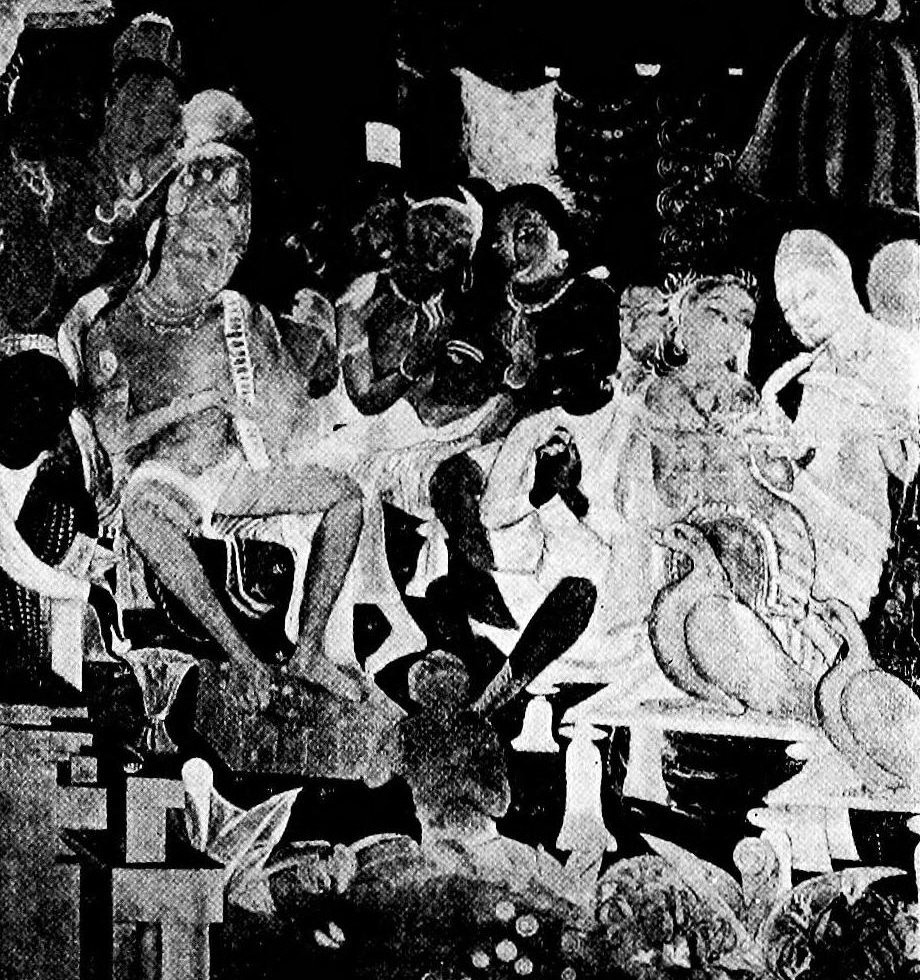
Now let us examine some of the older Indian bird portrayals. Most of the early art belongs to the Buddhist school. These included semi-mythical birds such as the hamsa which the Buddhists clearly identify with the goose (probably the Bar-headed Goose) unlike some Indian scholars who seem to feel better about calling it, however improbable it could be, a swan. Ornate renditions of the hamsa are found in 6th century China as well as in the cave paintings at Ajanta.


Three ducks by Manju - 12th century China

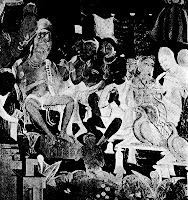
An ornate hamsa (See also this ornate goose at the Metropolitan Museum) is found in Cave 1 at Ajanta (sketched by James Burgess here). One can see the horses and elephants depicted with a level of naturalism that far exceeds that of the birds.
Frieze over cave 1 at Ajanta (100 BC - 500 AD)
A fresco inside cave 17 at Ajanta depicting Mahahamsa jataka or the tale of the golden king goose also has a stylized goose rendition. These birds are of course talking ones!

Animal world around sacred tree on east gate at Sanchi

The carvings on the gate at Sanchi show a parrot like bird which has been interpreted as an early version of garuda. Cave 17 at Ajanta also has some garuda, with a combination of bird and human traits and it is interesting that it almost retains the same name, karura, in Japanese Buddhism of the 8th Century.
Garudas from cave 17 at Ajanta
There is little by way of evidence of later bird art until the arrival of the Mughals. The idea of scribes maintaining journals for the Mughal rulers was itself an innovation and the introduction of illustration to capture scenes from daily life was something that historians would have liked others to do. Lots of collections of Mughal paintings have been made, and many have resulted in coffee table books. Salim Ali traced his ancestry to the Mughals and wrote a multi-part essay on Mughal natural history.

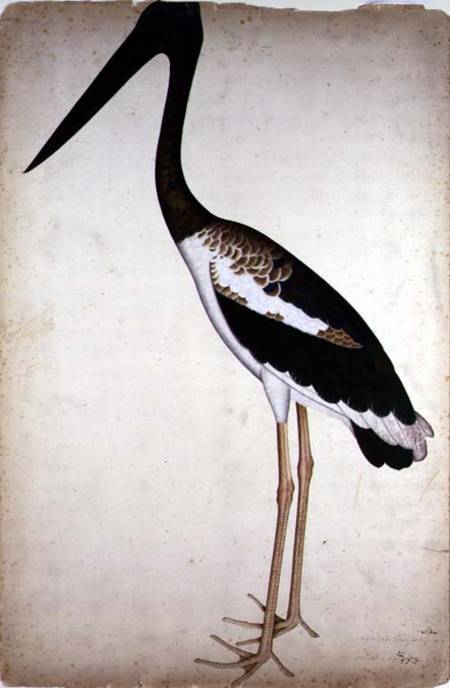
If Lack was appreciating Indian bird art, it has to belong to the Ustad Mansur school that worked for Jahangir. Mansur is most well known for his depictions of the dodo and Siberian crane. Others  like Shaikh Zain ud-Din painted for wealthy English patrons and the most famous collection is that of Lady Impey (of Impeyan pheasant or Monal fame), wife of Elijah Impey of the Calcutta court. This collection has some spectacular images of the Pink-headed Duck and Black-necked Stork that are painted from living specimens. They lack the sense of depth produced by shading techniques that the Chinese had mastered long before.
Pink-headed Duck by Bhawani Das ca. 1778-82 (Impey collection ) which was used by Latham to describe the species
Black-necked Stork by Sheikh Zain al-Din made for Lady Impey around 1781
The lack of a good historical and technical account on art in other periods stands out. A lot has been written about Mughal and Rajput art techniques but it seems like not enough mention has been made about some better art from southern India. A 1595 sample of art from Bijapur(?) (reprinted in Beach, 1992) seems to show better technique in shading. Basawan was an artist in Akbar's court. Although this does not depict birds, it suggests that there must be more interesting works languishing in collections around the world.
A work by Basawan of Akbar's court.
We have already seen in another post that T. C. Jerdon (of Jerdon's Courser fame) hired Indian artists to produce bird pictures for him. From a few other sources we know that he (or perhaps his wife Flora, who was a bit of an artist) trained traditional Indian artists to help him. Very little is known about their talc paintings or the antiquity of this form.

PS: If you have seen any exemplary Indian bird art from the pre-Moghul period, please do let me know.
In August 2014, I had an opportunity to examine the work of Hodgson's artist and for the 1850s, truly spectacular - see my post on it.

Further reading

Postscript:


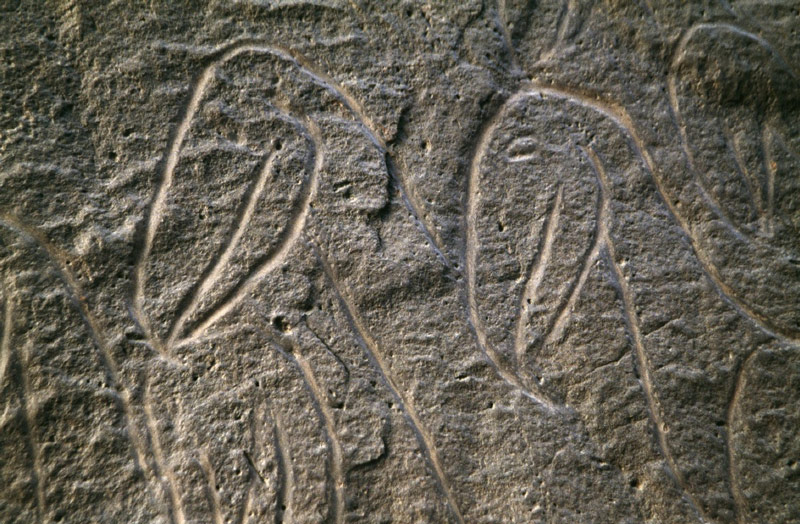
12 July 2022 - misidentification of birds in archaeology seems to be common and widespread - for instance all the African specialists (non-natives mostly) seem to identify a petroglyph of a group of birds from Wadi Djerat in Algeria as pelicans when in fact they clearly look closer to shoebill storks.
 

Tuesday, May 14, 2013

The hidden world of the crouching tiger-beetles

An ultrasound detector
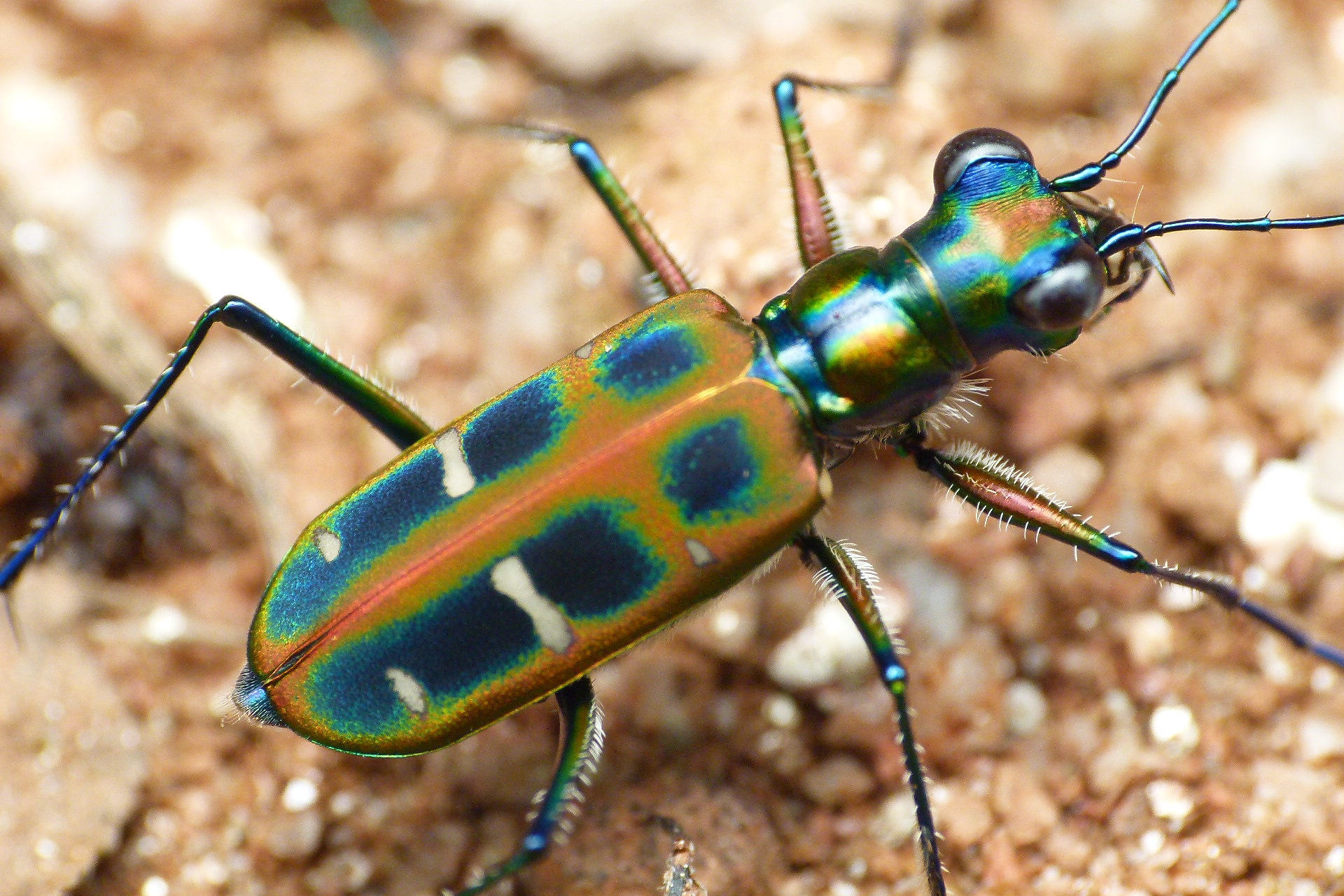
Tiger beetles are an iconic group for many entomologists and ecologists. They have been considered to be a good surrogate group for use in biodiversity studies. They are perhaps not as good as the more ecologically dominant ants, but are certainly full of character and action. To add to that, most of them can be found on open paths, saving the need to dash through vegetation and load oneself with ticks. Unfortunately, nobody has quite made an illustrated fieldguide for the Indian region despite the ease of making one especially for someone with access to a good collection. Perhaps the museums have not been welcoming to anyone who might be motivated. A major reference for the Indian region is by R. Acciavatti and David Pearson (Acciavatti, R.E.; Pearson, D.L. 1989: The tiger beetle genus Cicindela (Coleoptera, Insecta) from the Indian subcontinent. Annals of Carnegie Museum, 58). 


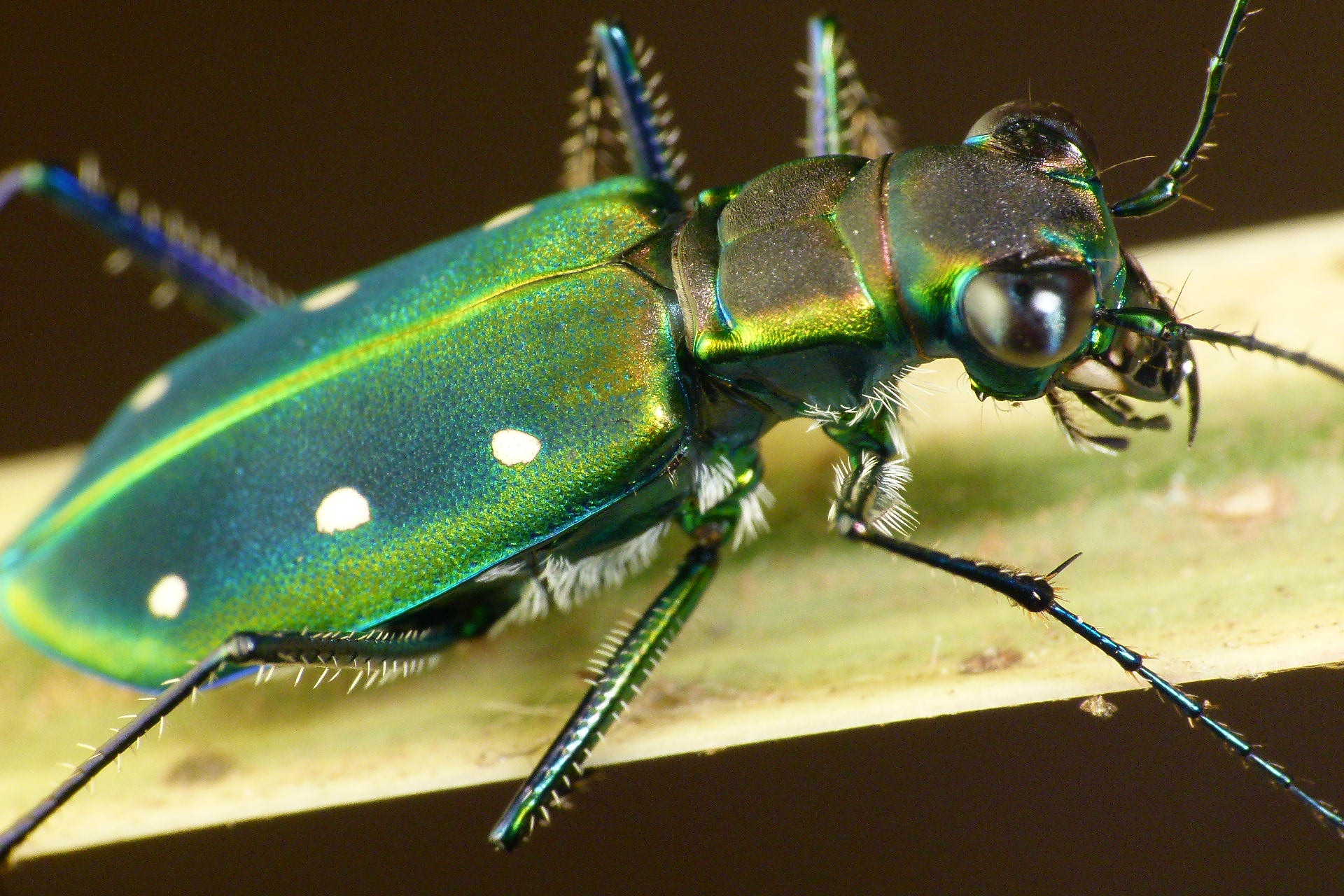
C. venus up front
A somewhat less studied aspect of tiger beetles is the production and hearing of ultrasound. Some years ago I went out on a bat-watching outing with the Norwegian Zoological Society to a lake to the east of Oslo. Equipped with bat-detectors, we were able to hear more bats than we could see. It is simply fascinating when a world that our senses do not detect is suddenly made perceptible. I think this is the fundamental allure of photography (showing detail we may not spot), microscopes, binoculars, ultrasound detectors, DNA sequencers and a most other instrumentation. Anyway, I would love to hold a sensitive bat-detector up close to these critters.


Cicindelids apparently hear ultrasound using two "ears" on the dorsal side of the first abdominal segment. They respond to bat pulses with escape behaviour and also produce ultrasound at around 30–35 kHz in non-defensive contexts, perhaps for communication. According to one study the production of ultrasound in flight is possibly through a mechanism that involves the elytra and wings. I however wonder if they may be producing other sounds through mandibular stridulation, when not flying. They often seem to gnash their jaws, mandibles crossing over each other and perhaps the micro-structure of the flat mandibular surface will have something to reveal. Someday hopefully we can hear these beetles, who knows they might even be detected and identified by their sounds.

A regular on forest paths in the Western Ghats
Cicindela (Cosmodela) duponti Dejean, 1826
Another view of
Cicindela (Cosmodela) duponti Dejean, 1826


Cicindela (Jansenia) venus Horn, 1907
another forest species found on leaf-litter
Cicindela (Calochroa) hamiltoniana Thomson, 1857
most times seen on shaded paths close to water
Cicindela aurofasciata Dejean, 1831
a stouter species found on open grassy habitats
Cicindela (Calochroa) flavomaculataHope, 1831
One of the few species more often attracted to light in the night

Lophyra lineifrons, Bandipur (April-2013) [Determined by Michael Geiser]
Cicindela (Calochroa) whithilli (Hope) from Talakaveri, Coorg
Cicindela (Ancylia) calligramma Schaum, 1861 from near Nandi Hills, Bangalore (15-July-2013)


To be determined. Mudigere, 11- May 2013
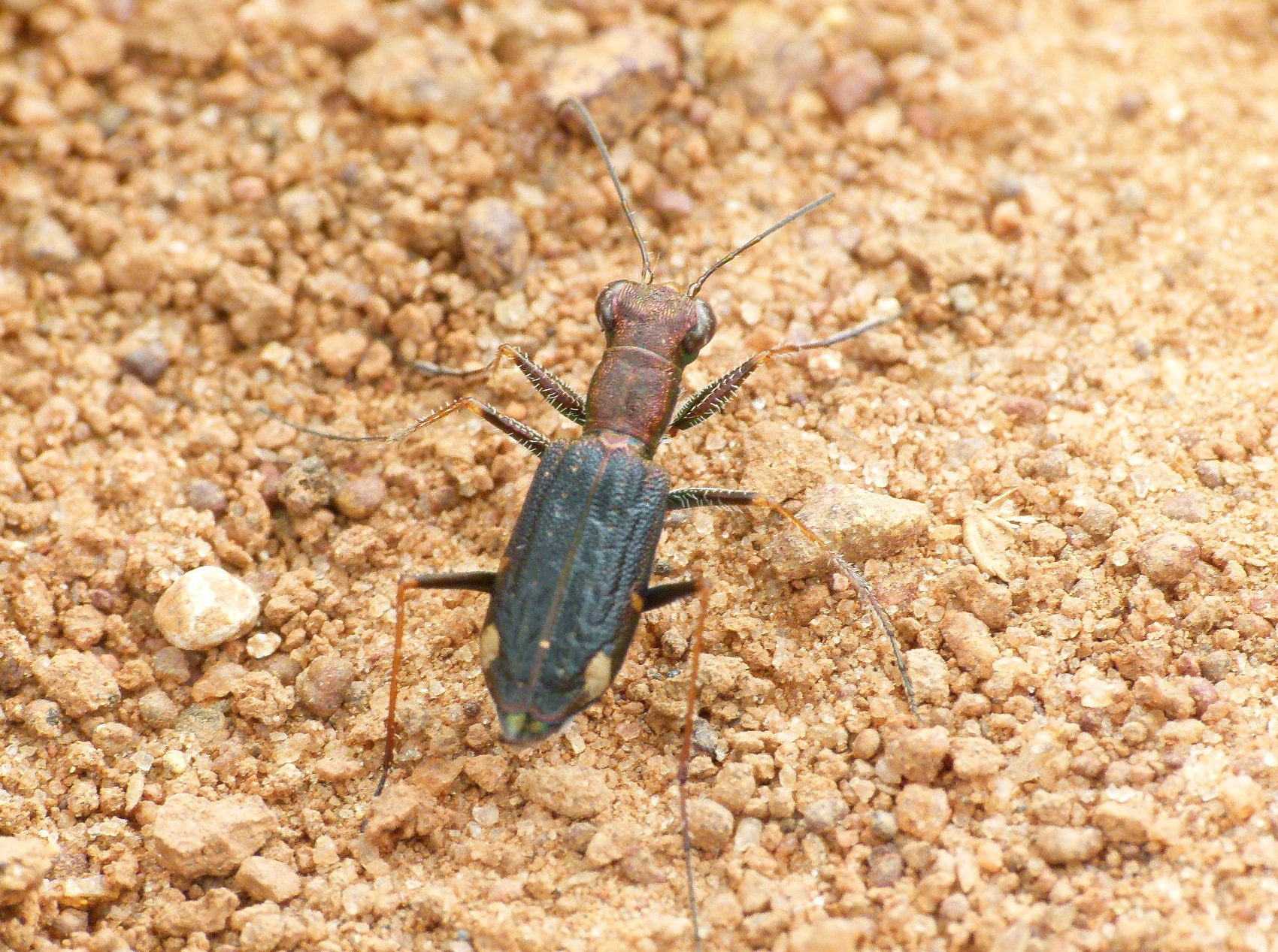
Cylindera (Eugrapha) sp. Seen in large numbers on sand beside stream (11-May-2013).
(Identified to genus by Michael Geiser - 5-Dec-2013)
Cicindela (Jansenia) dasiodes Acciavati & Pearson, 1989 (from GKVK, 19-June-2013)

A feature that makes tiger beetles particularly interesting for those interested in electronic field guides is their patterning. It would appear as if there was a fairly simple archetypal "bodyplan" (what the Germans called Bauplan, but often avoided because of an implicit idea of "design"). An archetypal plan is however possible without any fear of "intelligent design" if one considers that patterns are coded by sections of genetic code, modules of which are shuffled about during the evolution of species. An amazingly old (1917) work on this is by Shelford and he identifies patterns of colour and provides some interesting insights into developmental biology. By subjecting larvae and pupae to specific environmental conditions of temperature and humidity he was able to alter the patterns that form on the elytra of the adults.


"Showing the geographic distribution of types and patterns. The first series at the left are world-wide in distribution, being most generalized in Eurasia and North America. The second group of patterns belong to several groups of species but all are characterized by the presence of three spots at the base and along the elytral suture. They are most numerous in Africa and India. The next group shows the relatively rare type with the pattern oblique but in the opposite direction from the slope of the tip of the elytron. The last type is one showing peculiar joinings of markings characteristic of species found chiefly in • Indo-Australian region." (Shelford, 1917)

Inspired by Shelford, I attempted to look at the patterns on some Indian species. It is however very difficult to see much without access to museums or other collections.

Patterns on a handful of Indian species - easily drawn using Inkscape

 
Acknowledgement

Most of the photos were taken on field trips either accompanied or made possible by Dr. Revanna S. Revannavar, entomologist at the University of Horticultural Sciences, Mudigere.
.
References

Postscript
Would be terrific if someone can come up with a low-cost ultrasound monitoring instrumentation in India - based on ideas such as this. Would be very happy to help in field testing for any electronic whizzes out there that might be interested.
 
2020: Much of what I wrote above is  obsolete after the publication of a wonderful and ground-breaking fieldguide to the tiger beetles of India - You can buy the book via Amazon India or the publishers.


Monday, May 6, 2013

Bird fossils from the Indian Subcontinent

I normally desist from the archaic practice of listing things within meaningless political delineations but a need to locate information on bird (and near-bird) fossils and ichnotaxa from the Indian region led me to the discovery that there are no readily available reviews. This is a rather rough working index of taxa and sources. Additions are welcome.
  • Struthio asiaticus A. Milne-Edwards [Siwaliks] (bones, egg-shells from a wider range)
  • Dromaeus sivalensis Lydekker [Siwaliks]
  • Leptoptilos falconeri (=Argala falconeri) A. Milne-Edwards [Siwaliks]
  • Megascelornis sivalensis Lydekker [Siwaliks]
  • Pelicanus cautleyi Davies [Siwaliks]
  • Vastanavis eocaena Mayr et al., 2007 [Vastan, Gujarat]
  • V. cambayensis Mayr et al., 2010 [Vastan, Gujarat]
  • Strigidae [Narmada] Patnaik, R & A. Sahni (1994)
  • Egg clutch [Lameta, MH] Mohabey D.M.; S.G. Udhoji; K.K. Verma (1993)
Postscript: 8-May-2013
In going through an article by Badam (2005) I came across reproductions of a couple of rock drawings from Kathotia and Firengi south of Bhopal. These have apparently been attributed with some doubt to ostriches by paleographers. The illustration from Firengi is pretty poor for a match with an ostrich and on the other hand is a very good match to a Lesser Florican particularly in the fluffy neck and the two plumes exaggerated on the back. I agree with the authors about the inaccuracy in the detail of feet.

A 30,000 year old rock illustration reproduced from Badam (2005).
The bird on the right is a good match for a Lesser Florican.
An old illustration of Lesser Florican (Sypheotides indicus)
Postscript (24 Dec 2013): An exhibition on rock art at the National Gallery of Modern Art in Bangalore included a photograph of the Kathotia bird and it is clear that Badam's sketch is an oversimplification.

PS: 10 Dec 2014 - new paper by - Blinkhorn, J.; Hema Achyuthan; Michael D. Petraglia (2015) Ostrich expansion into India during the Late Pleistocene: Implications for continental dispersal corridors. Palaeogeography, Palaeoclimatology, Palaeoecology 417:80–90.
Late Pleistocene ostrich egg shell records (Blinkhorn et al. 2015)

Sources

Sunday, April 28, 2013

Be like a bee

I have written in the past about ant-mimicry (Why look like an ant?), and last week I was reminded how good their relatives, the bees and wasps, are as models for Batesian mimicry. It was just by chance that I noticed this yellow spot on a rock beside a stream running through the forest. 
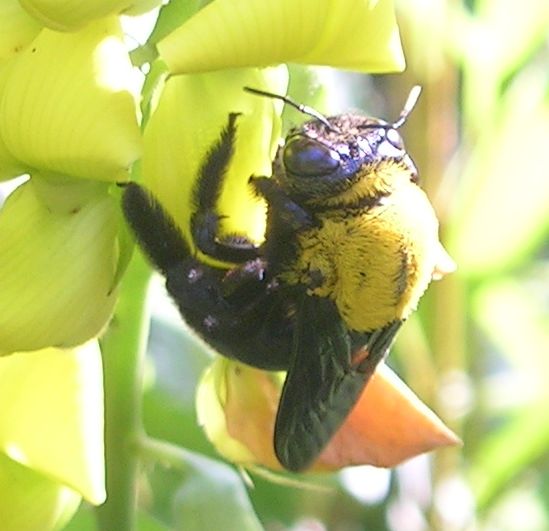
It was evident that this was a moth, a hawk-moth for sure, confirmed by looking at the hooked tip to the antennae. The remarkable similarity in pattern and size to carpenter bees of the genus Xylocopa is readily evident. As kids we used to play a trick with Xylocopa males that would perch atop wooden posts. Toss a pebble in the direction of the male and it would set off and pursue the pebble. Handling a dead carpenter bee was a painful lesson on how spiny and hard they are. Females can sting but they rarely need to use it. There is probably no predator of adult Xylocopa bees. Little wonder then that several species in the day-flying hawk-moth genus Sataspes have been selected to appear like carpenter bees (other day-fliers like Cephonodes look like clear-winged bees). The genus Sataspes does not seem to be well known in southern India and this observation may be among the few reports from southern India.

Species in the genus appear to show considerable variation within populations in the distribution of blue and yellow on their body and wings. Several of these variants have been described in the past as species and the exact determination of species may be reliably established only by dissecting out their genitalia (which show species-specific lock-and-key patterns). In 1900, a year before he died of malaria, Lionel de Niceville described a species from Burma:
S. tagalica (=S. hauxwelli) and model
"I have named this handsome moth (which is unique) after Mr. T. A. Hauxwell, Deputy Conservator of Forests, who is an enthusiastic collector of birds and Lepidoptera. It is a beautiful mimic of the very common large blue carpenter bee, Xylocopa auripennis, Lepeletier, a male of which I have figured-for the first time-for comparison ..." JBNHS 13:173
Some people find the evolution of mimetic forms too implausible to occur by random processes and those that question evolution pose the question as to how the "exact" same pattern could arise. Interestingly enough there is considerable variation within the mimics and it is actually not an exact imitation. Here are a couple of Xylocopas (unidentified) from southern India just for a sampling.

A Xylocopa from the W. Ghats
A Xylocopa from Bangalore

Looking at the variations in Sataspes it is clear that a series of characters are being mixed in various forms and species.Yellow bands, thorax, tufts, bluish wing shine and so on.
Sataspes xylocoparis described by A G Butler in 1875
Writing about Xylocopa aureipennis in 1922, Cedric Dover notes incredulously:
In addition to the localities noticed by Bingham, the Indian Museum also possesses specimens from the Parjiling District, the Naga Hills and Sibsagar in Assam, South India and Nepal. The species is supposed to be mimicked by a Sphingid moth (Sataspes hauxwelli), which according to De Niceville (Journ. Bomb. Nat. Hist. Soc. XIII, p. 174) was "a beautiful mimic of the very common large blue carpenter-bee Xylocopa auripennis, Lepeletier." The wings of the moth are a deep indigo-blue with bronze markings, which scarcely resembles the wings of the bee, and in the cabinet the whole insect seems entirely different.
De Niceville does not say that the bee and the moth were taken together, and in the absence of definite field-observations, the moth has little claims to being a mimic of the Xylocopa.
My own impression was that the moth above was the right size, shape and colour to give the impression of a carpenter bee.

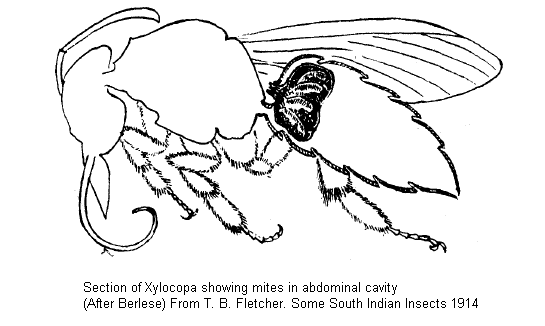
Although carpenter bees are free from predators, they are not free from parasites and their immature stages probably have predators. A peculiar feature of carpenter bee females is a cavity on the first abdominal segment, known as the acarinarium, which is home to mites of the genus Dinogamassus. Nobody quite knows what the role of these symbiotic(?) mites are. Dr B. Mallik, an acarologist (and one of my teachers) at the entomology department in the University of Agricultural Sciences (Bangalore) showed me some of these mites under a microscope a few years ago pointing out that they stack up in a toroidal pattern.
The fact that so few records of these amazing day-flying moths exist is either due to their rarity or the fact that we have so few people keeping an eye on life around them.

References
Postscript
1-May-2013: Ian J. Kitching of the Natural History Museum notes:
... all the evidence now points towards it being the first representative of infernalis from SW India. All other specimens I have seen from the Western Ghats are the relatively non-metallic forms as shown on SEP. None have the strong blue sheen on the wings of your specimen. ..., the moth does look a bit more like S. tagalica but this usually has a greenish metallic sheen and the females (which your moth is) never have a yellow thorax, only the males. That said, there is a definitive feature that could settle the matter BUT it is on the underside of the abdomen. This is a long shot but do you have a photo in which the colour of the underside of the terminal segments of the abdomen is visible, even slightly. These are yellow in infernalis/xylocoparis and black in tagalica.

All that said, no Sataspes in our collection of any species has the subdorsal rows of yellow spots; they either have more extensive yellow bands (see xylocoparis on SEP) or broad central patches (see tagalica on SEP). So I am minded to think that this may be a new species, or at least a distinctive subspecies of infernalis.

Friday, March 22, 2013

Wild laws

An advertisement in the Times of India Delhi (20-March-2013) with a photograph that violates copyright apart from being of the wrong species (showing a Tree Sparrow instead of a House Sparrow)
A newspaper carried a government advertisement last week. A politician declared the house sparrow as the bird symbol for a state but the picture chosen was just picked off the Internet, was of the wrong species and was a case of unethical reuse. A simple image search via Google allowed me to find the person who took that photograph, Dani Studler, and he confirmed that he was never asked for permission to use that image. This is a violation of the law - the Indian Copyright Act 1957 clearly should be something that the government should have known about. Governments however are not known for being law-abiding.

A training in science and biology does not help in making one a fan of the legal system or indeed of traditional governance and authority. One instead seeks to derive one premise from another. One can consider a principle of fairness. Determining fairness in most cases involves examining if you would approve of an action if it was done by someone else. The actions of legal institutions however is not morality based but driven by other forces - those of economics.

Copyright laws, it turns out grew out of the lobbying first in support of printers. Printing presses came to England in 1476. In later times the booksellers lobbied to change this. There was the Statute of Anne (Wikipedia has an excellent entry on the history of copyright law) in 1710. There were also other controls on the printing press, mostly in the form of censorship. Prior to the Statute of Anne, the printers had a perpetual monopoly on their rights to print copies. The Statute introduced a time limit and this meant that material older than a certain age would go out of control - that is - go into what we call today as the Public Domain. For reasons unknown, the Indian media and government officials routinely use the phrase "public domain" to mean merely that which is publicly available or accessible. Perhaps the government's failure to respect the laws passed by them comes out of this reasoning. Now the legal system spends most of its time taking archaic laws and constantly beaten it into shape to fit the whims-and-fancies of contemporary authorities and cases. The digital revolution however actually requires a complete shake-up of such laws and it was very nice to see an enlightened and refreshing take on the topic.

When material is placed on the Internet - there are so many "copies" - there is one on the server, there are copies on the networks, cached copies in your computer and so on. Search engines like Google makes copies, creates derivatives - indexes that allow searching and so on. So when you browse there are thousands of inadvertent copyright violations happening, if one were to take a strict interpretation. Other sites mix material from multiple sources and completely radical content produces like Wikipedia involve little acts of creativity from large masses of people which make ideas of ownership and authorship increasingly difficult to define. It was therefore of interest to see what William Patry, a Copyright Counsel for Google had to say in How to fix copyright (2012). Like many other things done in Google-style it starts from first principles - his introductory chapter is titled "Unlearning Copyright". Here he notes:
Copyright laws arose out of eighteenth-century markets and technologies, the most important characteristic of which was artificial scarcity. Artificial scarcity was created by a small number of gatekeepers, by relatively high barriers to entry, and by analog limitations on unauthorized copying. Artificial scarcity was important because it created monopoly value: not profits earned above costs of production, but rather profits disconnected to costs.
The spirit of copyright laws is that it protects acts of creativity, however the law does not distinguish the forms of creativity. For the law - a piece of software code, art, music, writing or photography is all creativity. Patry is especially enraged by copyright law advocates who claim that creativity is encouraged by the law. He asks if publishers are involved in creativity when they actually make money out of authors. A devastating case he makes is that of the movie industry and here he cites economist Edward Jay Epstein on the funding of the movie Lara Croft: Tomb Raider. Through international transactions on paper with investments leases and retransfers the movie company makes big money which is completely unrelated to the real process of creativity. However he notes that Copyright law gives the assurance to allow the financing that occurs. With tax deductions and other sops, a lot of the money is actually made through taxpayers! Well that is about the private industry but what about the government itself. Exactly what is the idea behind government?

The normative idea of government is that it enables the welfare of people within its borders. The laws of India are however not ones derived bottom up but those that have been adopted from its "rulers". The Indian Copyright Act 1957 is based on Crown Copyright and one of the most stupid clauses in it is that nearly all work done by the government is copyrighted (for a period of 60 years). That for instance means the taxation rules published by the government may not be legally duplicated by anyone. Maps by the survey of India cannot be recopied or modified - no wonder users who want to use maps or any other useful sources are forced to use freely licensed material such as OpenStreetMaps which are made by volunteers. So all the taxes paid and used by the Survey of India are then a complete waste. Similar can be said of things like the Zoological Survey of India, Botanical Survey of India and the hundreds of other government organizations. Contrast this with the laws of the United States of America - examine 17 USC 105 - Sec. 105. Subject matter of copyright: United States Government works :
HOUSE REPORT NO. 94-1476 Scope of the Prohibition.The basic premise of section 105 of the bill is the same as that of section 8 of the present law [section 8 of former title 17] - that works produced for the U.S. Government by its officers and employees should not be subject to copyright.
The provision applies the principle equally to unpublished and published works.
The general prohibition against copyright in section 105 applies to "any work of the United States Government," which is defined in section 101 as "a work prepared by an officer or employee of the United States Government as part of that person's official duties." Under this definition a Government official or employee would not be prevented from securing copyright in a work written at that person's own volition and outside his or her duties, even though the subject matter involves the Government work or professional field of the official or employee.
Although the wording of the definition of "work of the United States Government" differs somewhat from that of the definition of "work made for hire," the concepts are intended to be construed in the same way. A more difficult and far-reaching problem is whether the definition should be broadened to prohibit copyright in works prepared under U.S. Government contract or grant.
It is hard to see why India cannot follow such a simple bit of wisdom especially since we do have many talented and visionary people in the judiciary.

Now to get back to the spirit of copyright - that of creativity and examining the principles of fairness - it is hard to see what creativity is involved for instance in recording the song of a bird. All that it means is perhaps an investment in equipment which might be related to the quality of the sounds captured. Wildlife photographers often claim to be non-consumptive but even so-called eco-tourism has been shown to have huge negative impacts. Recent studies of Indian wildlife photographers and the destruction caused by them (see for instance this on a grassland near Bangalore and this on lorises ) through intrusions and  uncontrolled use of SUVs (remember that diesel is subsidised by taxpayers) across the few wilderness regions raises concerns. The application of copyrights to photographs of nature is in a way immoral. When a fashion model is photographed, the model too holds rights. The rapaciousness of wildlife  photographers is unlikely to be controllable by law or through self-regulation. Had the Ministry of Environment and Forests gone the American way, it would have made use of its humongous resources to make available photographs in the public domain (and it is well worth examining what that phrase really means ) of such things as House Sparrows. The government being a recalcitrant entity, one can only hope that at least some enlightened photographers (those that are really interested in preserving the environment) will make available (say on flickr/Wikimedia Commons) their best photographs under a Creative Commons attribution license, allowing all forms of use including commercial use, so as to demonetize and destroy the motivation for competitive photography that leads to damage of the environment.

It is very interesting to see that countries like Bolivia and Ecuador have taken steps towards being more moral in their laws. Bolivia passed a Law of the Rights of Mother Earth in 2010. It is only by accepting our biological roots that we can hope for greater morality and ethics. To assume that all humans should have a name that can be transcribed, a surname, gender, an address, a religion, an education and so on is pure arrogance. An organization like the Unique ID authority of India that asks for an address or a fingerprint is just violating human rights - in one case that of nomadic livelihoods and in another those who are  handicapped. One merely needs to see whether a rule can be extended to every other human and every other organism, if it does not, it means that the law is not based on fairness or moral foundations.

Further reading
Postscript: The Government advertisement shown above is copyrighted (in spite of being a violation of Dani Studler's copyright) and will go into the public domain in 2074, however I use this under the fair use claim for the purpose of review/critique that the Indian Copyright Act 1957 allows.