click hide image

Wednesday, July 13, 2011

Prying levers

F-W-E
The levers three
each in turn in the centre be


A school mnemonic to remember the three orders of levers (with the fulcrum, weight and effort at the centre). 
Muscle schematic

In biological systems, the third order lever is the most often seen system. On a recent trip a friend of mine pointed out the foraging technique used by Asian Pied Starlings - they always pierced the soft soil and then were opening apart their bill to uncover prey. Some subsequent research showed that this prying or gaping action of starlings was well documented from an anatomical perspective but rarely recorded in behavioural studies. Another Indian bird that is well known for prying is the Hoopoe. All these birds have better developed muscles to open apart the bill. However some species have the lower mandible processes extending further back to give extra leverage.


It is a better known fact that birds can move their upper mandible, to a greater degree in some cases as in the skimmers and parrots.
Huia skulls

Lower mandible depressor muscles and the extended process at the back of the mandible are (were ?) particularly pronounced in the now extinct Huia. This bird had an extraordinary sexual dimorphism in the bill shape (although the bony parts are similar and the difference in length largely accounted for by the rhamphotheca). It appears that a downward curve is quite helpful when depressors are well developed. The Huia also had a cavity at the back of the skull to accomodate the muscles used to open apart the beak. Interestlingly a fossil bird with similar adaptations was described in 2005 by Gerald Mayr. Although the case of the Huia was never mentioned in that study, he notes that none of the skulls he examined (including that of the Pied Myna) had as long a process extending backward.


References


Saturday, July 9, 2011

The endless miles to read

So many books. So little time
Frank Zappa 

Hidden away between the Jungle Books of Rudyard Kipling is a lovely story titled "The Miracle of Puran Bhagat". Sir Purun Das KCIE however came to mind again while reading Jon Krakauer's Into the Wild (1996), which I have just read many years after it was first published. A very impressive and moving work that everyone who thinks about themselves and the environment will appreciate. Economics and ecology, both words derived from the same roots (oikos for "home"), are remarkably disparate and the connections and disconnections resulting from mixing the two should make anyone think about the compromises we make. Even though few would be against conserving the environment, the debates of left versus right, top-down versus bottom-up are enough to suggest that the least contradictions are found in the anarcho-primitivist position. Unfortunately, it is a position that very few have managed to attempt living without getting into the situation of Chris McCandless or Theodore Kazynski. And it seems like one has to also read Tolstoy and Thoreau and so much more to understand the origins of the various viewpoints. It would be great if there was an accessible classification of the various philosophical underpinnings of conservation to make up for the rather superficial and misused blanket labels widely in use.
"When the first handful of Norwegians showed up on the shores of Iceland in the ninth century, the papar (Irish monks) decided the country had become too crowded-even though it was still all but uninhabited. The monk's response was to climb into their curraghs and row off towards Greenland. They were drawn across the storm-racked ocean, drawn west past the edge of the known world, by nothing more than a hunger of the spirit, a yearning of such queer intensity that it beggars the modern imagination." Into the Wild p. 97
"Waiting for father" by R A Sterndale - this was about a family of bears waiting for their father that was killed. The next day the mother bear was also killed. Sterndale's work was an inspiration for Kipling.


PS: It seems like this site lets me post notes but does not let me post responses to comments!

Saturday, June 4, 2011

Aerostatic skeletons

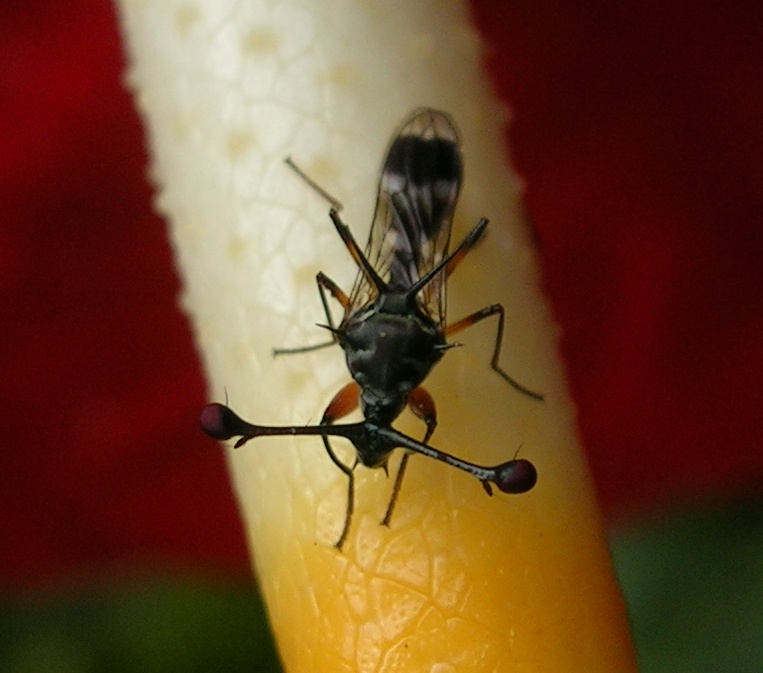
Teleopsis sykesii amnoni - Diopsidae, a common stalk-eyed fly in the Western Ghats
The strawberries at the ends of the handle-bar are the eyes.
 
 
It was not too long ago that I first learnt about an insect with eyes on stalks. Somehow, nobody had introduced it in our student days and for us (true) stalked eyes were found only in the crustacea. When I first came across it and discovered that it was hardly uncommon, it was a bit depressing to see that there were no experts who could identify it to species. Apparently problems had been created in the museums with labelling errors. I had uploaded my photographs on Wikimedia Commons and only recently obtained a species level identification of it - actually a confirmation of my own part-guess based on old literature - Teleopsis sykesii (named after Colonel Sykes). A redescription of the species that makes use of photographs of yours truly as well as the superior images of Karthik has just been published.

  • H. R. Feijen, C. Feijen (2011) On the biogeographic range of the genus Teleopsis Rondani (Diptera: Diopsidae), with redescription of Teleopsis sykesii from India and description of a new species from Borneo. Zoologische Mededelingen, 85:141-159. (PDF)
It is interesting that this these are not the only flies with elongated eye bases - apart from the Diopsidae, the feature is also seen in the Richardidae. A very interesting piece of footage in one of Sir David Attenborough's Challenges of Life - shows how the fly emerges from the pupa looking more or less like a typical fly and then inflates the tubular stalks with air to form the elongated eye stalks. In most other insects, this kind of expansion of structures is done by pumping liquids that then subsequently dry - as in the case of the Lepidoptera. The use of pneumatic (perhaps aerostatic is the equalent of hydrostatic) structural elements seems to be rather rare in life - indeed I have not been able to find any other. Strangely enough however, there are a number of ideas in robotics (including the art of Theo Jansen) and tent making that use pneumatically operated structures, after all it means you use the air around you and save yourself from carrying extra construction baggage.
Postscript: 10 December 2022 - that photograph was subsequently determined NOT to be of Teleopsis sykesii - the authors apparently got someone to collect specimens from Wynaad (does not look like it followed the provisions of Indian law though) and they redescribed it as a new species - Teleopsis amnoni.

Wednesday, May 18, 2011

Artistic impressions

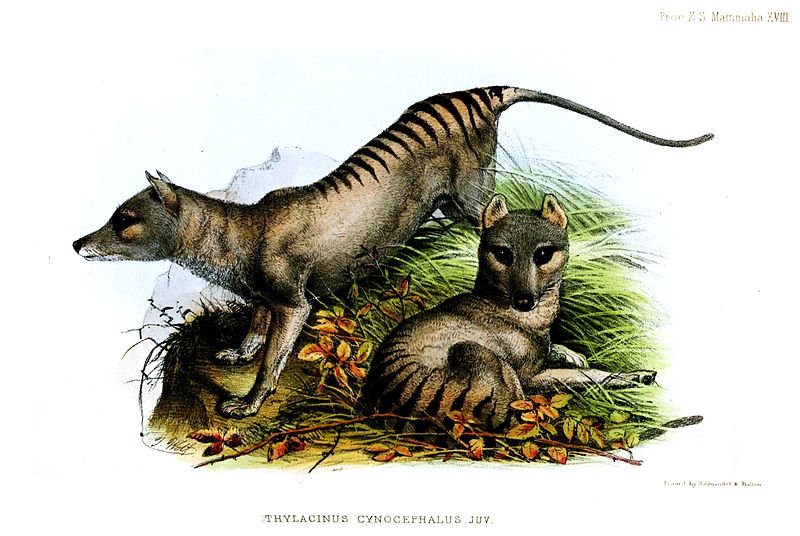
Art in black and white is something that is always striking. In early times, when printing technology was still underdeveloped, the woodcut was the choice for illustration. Particularly interesting are the early illustrations of animals and plants. One of the earliest and best known examples of animal illustration printed using the woodcut technique was that of Albrecht Dürer. His rhinoceros of 1515 is something that has been widely written about. First done in ink (facing left) it was converted by the printmaking technique of the woodcut into a classic image (facing right due to the process by which it is made).


The BBC has a nice piece on the history of this rhinoceros and its significance.

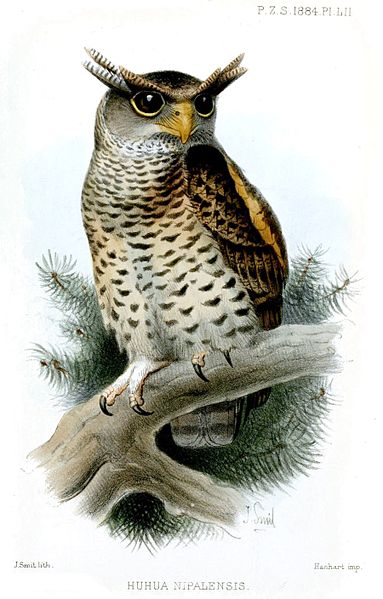
Looking at the Proceedings of the Zoological Society of London in the 1840s gives one a good idea of how intricate the art of the woodcut had become by then. Print makers had moved from wood to limestone - using the technique of lithography. With colour washes and multiple impressions on paper they were able to produce colour prints or chromolithographs. The black areas were covered with wax or oil and the uncovered areas were treated with weak acid causing the areas to be depressed. The block was then painted using flat rollers and then pressed on to paper (once for black and white and multiple times for colour) to produce the prints. The process sometimes involved the use of a delineator, a colorist and a printer. One could argue about who among the three is the actual copyright owner here ! The process was expensive but the results were spectacular. The expense meant that journals like the Proceedings of the Zoological Society of London had options for subscribers to opt for versions with or without the plates. One of the downsides of the technique was in the representation of molluscs and crabs which are often not bilaterally symmetric. Most snail shells, for instance, are coiled so that when the apex is above the aperture opens to the right - so called dextral and only the rare few have left-handed coils  (termed sinistral from which is derived the word sinister). Mirrored images aside, the masters of the art produced works that continue to have a life-like glow. Modern exponents like Robert Gillmor continue to produce such amazing works with modifications to this basic technique such as the Linocut.

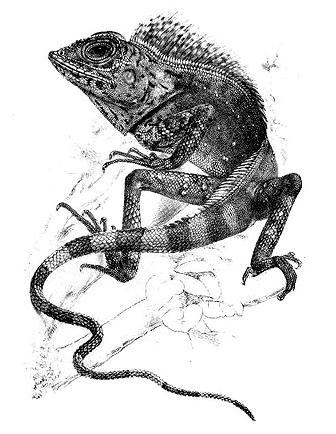
Here is a sampling from the 19th century. Click on the images for viewing them in better resolution.

G. H. Ford
Ford seems to have specialized in black and white illustrations of reptiles and amphibians.


W. Mitchell


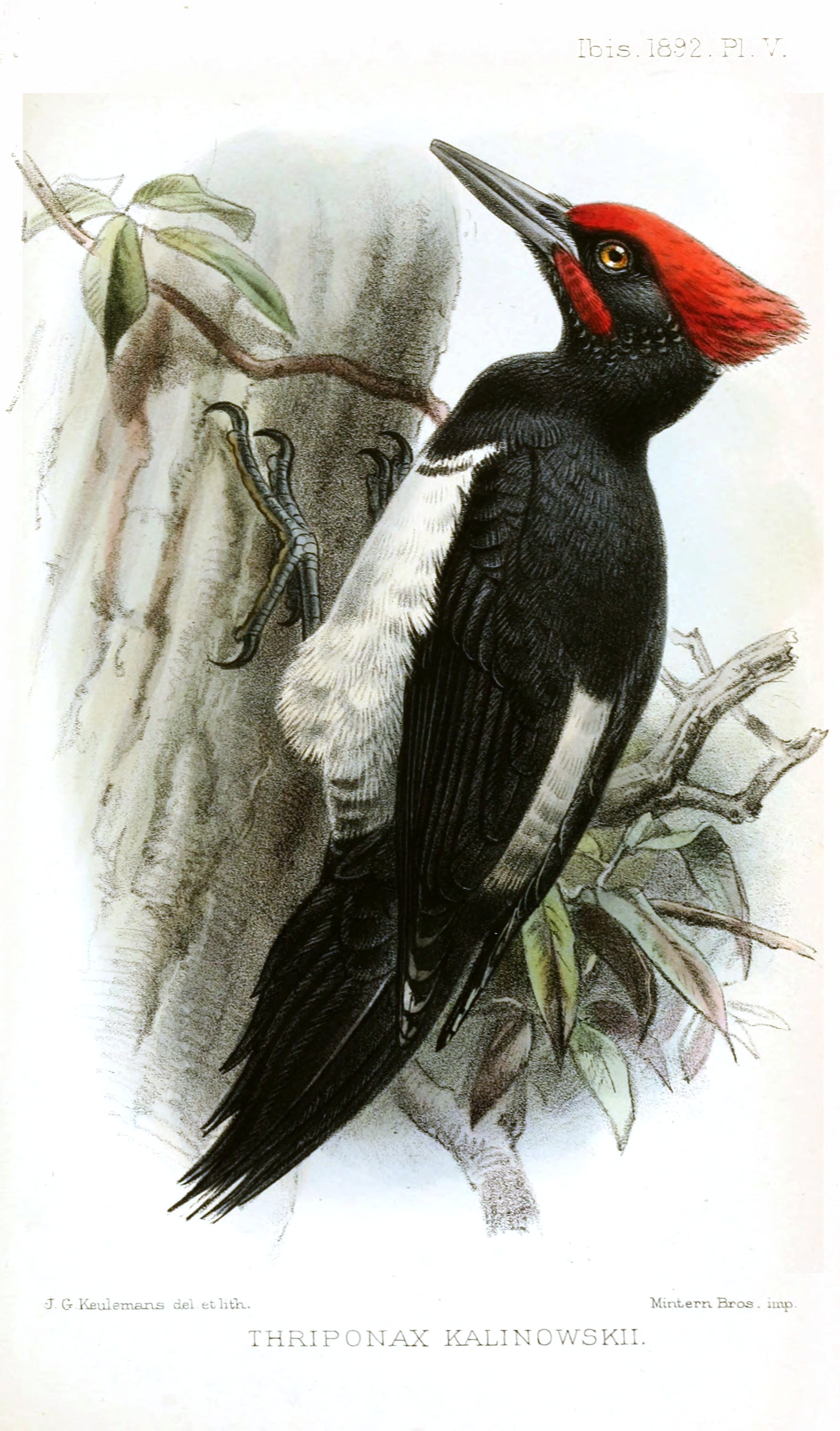
John Gerrard Keulemans (1842 - 1912)


Thriponax kalinowskii

Spilornis cheela pallidus

Calyptomena hosii


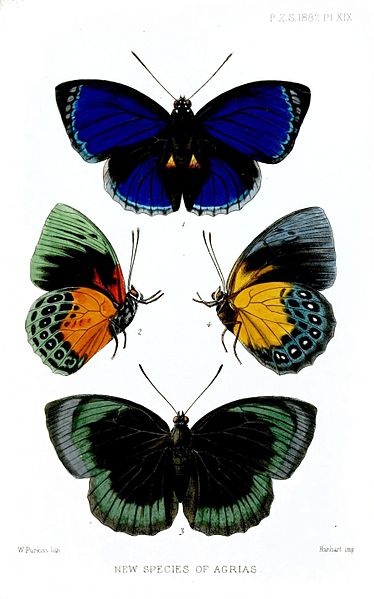
W. Purkiss

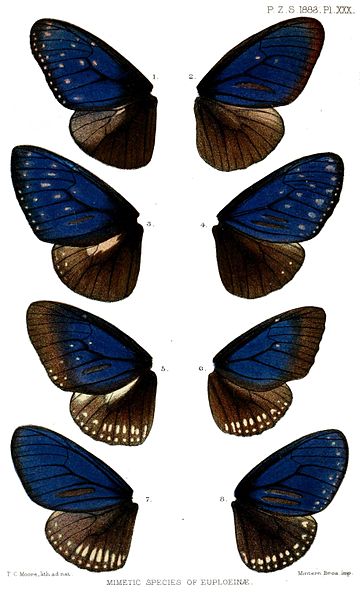
Ornithoptera victoriae


Joseph Wolf (1820 - 1899)

Anathana elliotti


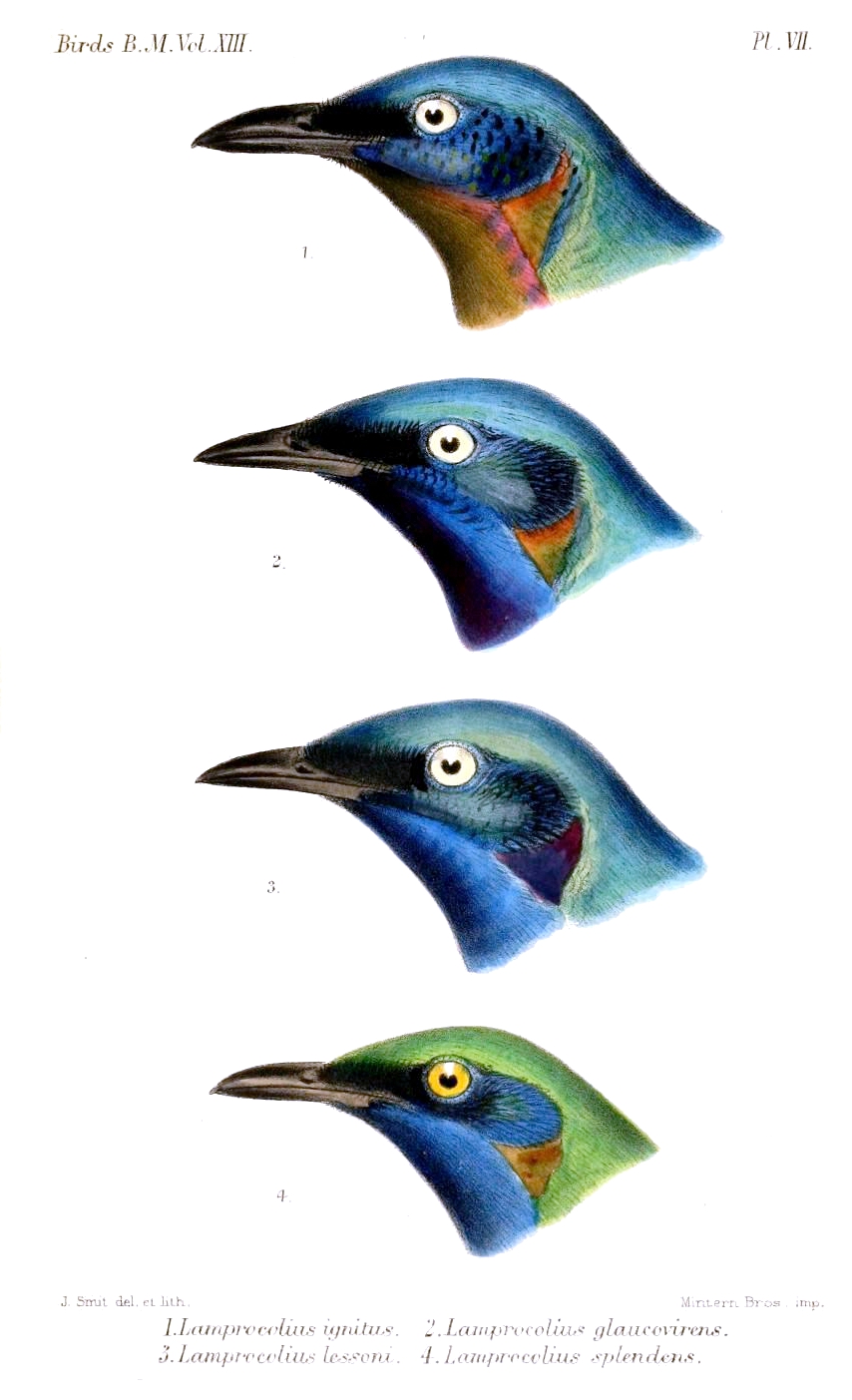
Joseph Smit (1836 – 1929)
Note: Smit (and possibly his son Pierre) was responsible for many of the woodcuts that are used in the Fauna of British India (edition 1) and reused in the Fauna of British India (edition 2) as well as in Ali & Ripley's "Handbook".

Lamprocolius

Testudo trimeni


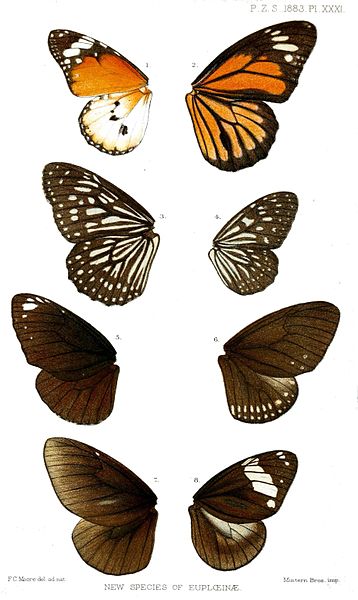
Frederic Moore (1830 - 1907)


Moore's greatest contribution to India was the Lepidoptera Indica, a work that he did not live to see to completion. Those who have seen the images in this work will not fail to be impressed. Most of the illustrations here were made by his son F. C. Moore. Moore senior also appears to have been artist, but it appears that considerable care is needed in identifying the works of the two. More than two hundred years later, the butterflies in his tomes seem almost ready to fly out of the pages.


All of the above images (and more by Gould, Richter, Hewitson, Westwood) are on the Wikimedia Commons image repository and being in public domain are ready for reuse in yet another century.

Postscript
7 June 2011 - Found out that Frederic Moore's son was F. C. Moore
and the Biodiversity Heritage Library has completed the scanning of Lepidoptera Indica
The original scans are linked below
Volume 1 Volume 2 Volume 3 (copy of 3)
Volume 4 Volume 5 Volume 6 Volume 7
Volume 8 Volume 9 Volume 10


1 November 2011 - All the images from Lepidoptera Indica volumes 1 to 10 have been extracted and can be found under the following category on Wikimedia Commons
http://commons.wikimedia.org/wiki/Category:Lepidoptera_Indica


Further reading
* Allmon, WD (2007) The evolution of accuracy in natural history illustration. Archives of natural history 34 (1): 174–191.
* Terms and techniques

Monday, May 16, 2011

What-is-it bird

Proceedings of the Zoological Society of London 1851
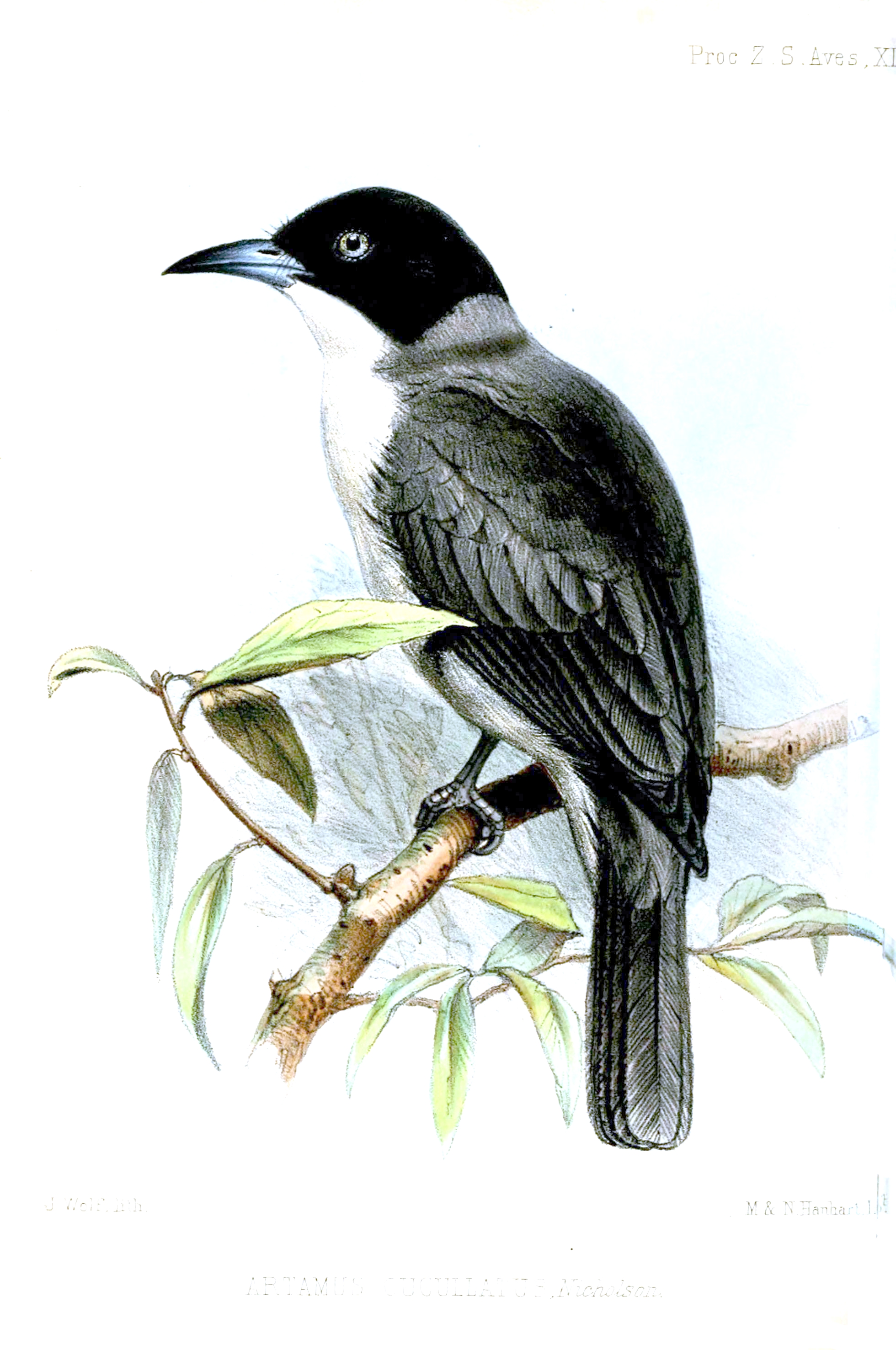
One of the joys of working on Wikipedia is the way one stumbles on material. One of the foremost scientific illustrators of the Victorian Age was Joseph Wolf who made chromolithographs for many publications. T. C. Jerdon thought it must be a Sibia = Heterophasia . Dr Nicholson who proposes the bird as a new species does not even indicate the part of India where it was found (although a preceding note suggests he lived mainly in Surat, Kutch and nearabouts) ! He however notes the peculiar habit of using rodent holes :
These birds are only found in very thick jungles among the brushwood, where they are always moving about, and are shot with great difficulty, and even then, if not killed outright, they are so tenacious of life, that they creep into the first hole or crevice they come to. The only note I ever heard was like 'chick, chick.' I think they are residents, but the few I have seen just appear and are lost in a moment, so that I know little of their habits; the one figured here had one leg and both wings broken, and still crept into the hole of a jerboa-rat, from which I dug it out dead.
Length from bill to tip of tail 7 2/8 inches. Alar extent 10 inches. Head large. Bill strong, narrow and sharp, gently arched on the culmen; a distinct notch near the tip of upper mandible; gape wide. Tongue horny and divided at the point. Nostrils basal, small. Eye rather small. Iris of a silvery colour, tinged with yellow. Wings rounded; first quill very short; third longest; second, third and fourth quills emarginate on outer web.
Tail short, and nearly even at the end, of twelve feathers, 2 3/4 inches long.
Tarsus strong. Hallux and claw stronger than the other toes, and as long as the inner toe, and has a large pad at its base; the outer toe is shortest; the claws are much hooked. 
 Dr Nicholson (1851) Notes on a new species of Artamus, from India. Proceedings of the Zoological Society of London. June 1851:195-196.

Postscript

According to another editor on Wikipedia, the bird is the Orphean Warbler, Sylvia hortensis crassirostris. So do Orphean Warblers use rodent holes ?