click hide image

Saturday, February 26, 2011

Caring invertebrates

An Oxyopid spider that stayed put for 3 months
L. Shyamal - Creative commons / Wikimedia
We are not brought up on the notion of  invertebrates being caring and that presumably allows us to swat them without pangs of conscience. This spider sat on leaf of a Michelia tree in my garden, without making a movement for nearly three months. The kind of parental care given by invertebrates can be rather subtle. Invertebrates may carry their brood with them, stay over and conceal them, guard them actively, feed larvae or even sacrifice themselves as food for their brood. And it not just females, in some cases the males are involved in care of the brood. From my regular visits to the leaf while watering the plants, I imagine that this mother spider guarding her egg clutch never fed for all of three months unless she hunted by night (but these spiders are said to be diurnal) or found prey that came within reach.

Male water bug carrying eggs
Marshal Hedin - Creative Commons/Wikimedia
The Scientific American article (full text link below) by Douglas Tallamy includes a number of interesting pictures including a praying mantis that positions itself on the lower branch of a plant to intercept any predators that might climb up toward its young on the distal branches past it. 

Lethocerus indicus
Carrion beetles (including the male) regurgitate a fluid to feed their young. Water bugs in the genus Abedus and Belostoma have a peculiar system in which the female lays eggs on the back of the male which he carries until the eggs hatch.  Females  mate with multiple males and encumbered males never mate again until the eggs in their care hatch. The larger water bugs in the genus Lethocerus have the females laying eggs above the water on plant stems, and the male periodically climbs up to moisten the eggs, preventing dessication, and guarding the eggs by night. 

Great eggfly females stand guard near eggs
The social insects (mainly Isoptera, Hymenoptera) are of course well-known for the care of their brood however earwigs, carrion beetles, several bugs, cockroaches, butterflies and a host of others are known to show a range of parental care behaviours.  This extends even into the lower "insects" - the Diplura are known to show parental care in the form of guarding the eggs. Marine amphipods are also known for brood care. Freshwater leeches in the family Glossiphoniidae brood their eggs as do octopuses and other cephalopods. 

In general the idea is that parental care is more likely when the brood is smaller and "more precious" and when the organism is larger and long-lived.

Further reading

Friday, February 25, 2011

Crunching elephants

Apparently the physict Freeman Dyson came up with a complex formula in 1953 and when Enrico Fermi saw it, he just did not like the complexity. Fermi in his quest for simplicity and elegance apparently quoted John von Neumann who had said:
"With four parameters I can fit an elephant, and with five I can make him wiggle his trunk"
I was recently muddling with some techniques for shape quantification which has applications for field biologists, for instance to match or compare biological shapes. Naturally I decided to try out what are termed as elliptic Fourier descriptors - an idea based on the epicyclic movements of planets that goes back to ancient times although the mathematical forms are relatively new. A lovely demonstration of the concept can be found here. The problem of getting the parameters from a given closed curve however is not shown by that applet. The reduced number of terms to describe a closed curve, elliptic Fourier descriptors, have been widely used in analysing shapes for systematics. 
Mathematically reduced elephant

What got my attention was a 2010 paper (I usually stay away from physics) titled "Drawing an elephant with four complex parameters" where the authors try to reconstruct an elephant with four complex numbers and wiggle its trunk with a fifth ! This was attempted earlier in 1975 with least-squares Fourier series fitting but that apparently took 30 parameters. The figures in the new paper show that they managed to do something close.

Program Screenshot: My elephant clearly beats the math
I decided to write up a program and see for myself but have been able to get a passable elephant only with 8 parameters and that is 8 sets of 4 real numbers (a, b, c and d of Kuhl and Giardina can be considered as two complex numbers) and so not as good as the results of the authors of the 2010 paper.  Maybe my elephant is too complex for the math. In case you want to play around with the idea, download (Windows unfortunately, but works in Wine) the small program  that I wrote today from here - you can also find some Matlab code here.

Further reading

Thursday, February 17, 2011

Math in the wild

If the spots were mobile towers,
the polygons represent the area covered
What is common to mobile towers, giraffes and cracked clay? If you do not already know about it, you might like to play around with the Java Applet here (or this) or see a particularly beautiful visualization of a particular computational method here. You can also look up more about Voronoi tesselations. The connections are well known to most folks with an interest in  "recreational mathematicians"  and although I have been aware of this from my school days, search engine results still surprise me and its great to see lots of new content. This museum/art exhibit seems particulary interesting as a way of introducing such topics  (the exhibit, strangely enough, is named after the thesis of Dr. Theodore Kaczynski - better known as the Unabomber! Incidentally, his manifesto is eminently readable and worthy of examination in our troubled times, quite unlike his thesis which was said to be accessible to only about at best 10 mathematicians when it was published )
Cracking clay
Coming back to giraffes. We usually think that every cell on our body has the same DNA  but this is just the abridged version. There can be major variations and these are large enough sources of error for one to worry about a lot of research. We used to be taught in "genetics 101" about chimerism, but I have recently learnt about the nuanced differences between that and "mosaicism". The patterns by which cells differ, multiply and communicate with each other can be thought of as driving some of the intricate patterns that one can find in nature.  In Siamese cats, for instance, it has been shown that a heat-sensitive mutant of Tyrosinase which leads to a failure in melanin synthesis causing albinism in the warm parts of the body and leaving the cooler nose and extremities black. An increasing number of works are melding ideas from genetics and computer science and some of these demonstrations include the simulation of mammalian coat pattern, such as those of giraffe. The earliest ideas on the mathematical, physical and chemical principles for biological patterns were illustrated  by pioneers like D'Arcy Thompson and Alan Turing. Turing is of course better known for his work in the theory of computability.
Clonal mosaic models to simulate coat patterns (Walter et al. 1998)

Working on the intersections of multiple fields often produces interesting results, and while these are largely ignored by professional biologists, they are becoming increasingly visible, in cartoon animation. Some of the techniques used in computer graphics and to a limited amount, biological studies are becoming more accessible on the Internet. One of these is http://algorithmicbotany.org/ with a PDF version of the book "Algorithmic beauty of plants" on simulating plant forms by Przemyslaw Prusinkiewicz and other related works including the simulation of seashell patterns by Hans Meinhardt (his book "The Algorithmic beauty of Seashells" is into its third edition but is not publicly available online, but a related paper can be found here)
Prum & Williamson (2002)

An interesting 2003 paper on the evolutionary patterns of eyespots in Satyrine butterflies is accompanied by a nice animation that gives a visual way of looking at patterns and correlating them with molecular phylogenies. (Flash animation) Another study has looked at the simulation of feather patterns. Unfortunately, nobody has made an accessible Java Applet to illustrate this idea although for  overall structure there is a nice applet here.
Silhouettes generated using a software toy

Some years ago I considered the idea of simulating the silhouettes of birds. Although rather skeletal and comical, it is something that those with an understanding of bird identification can toy with. You can find the Windows compatible program here. The illustration alongside has a collage of some of the shapes that can be generated using the program. While it is mostly a toy, it might help in sharpening one's idea of how the positions and relative bone lengths alter our perception of shape and how just the relative lengthening or shortening of feathers can give pointed, or rounded wings and graduated, wedge-shaped or forked tails .

Postscript: Unfortunately, nothing that I have written above will change the life of   millions of school children who complain about boring mathematics classes.


Image credits: The Great Wave (public domain); Cracks  in clay (Hannes Grobe, Wikimedia Commons)

Further reading

* Arbesman, S. , Enthoven, L. & Monteiro, A. (2003) Ancient Wings: animating the evolution of butterfly wing patterns. BioSystems, 71:289 - 295  (paper)
* DL Imes, LA Geary, RA Grahn, and LA Lyons (2006) Albinism in the domestic cat (Felis catus) is associated with a tyrosinase (TYR) mutation. Anim Genet. 37(2):175–178.
* Ting-Xin Jiang; R B Widelitz; Wei-Min Shen; P. Will; Da-Yu Wu; Chih-Min Lin; Han-Sung Jung and Cheng-Ming Chuong (2004) Integument pattern formation involves genetic and epigenetic controls: feather arrays simulated by digital hormone models. Int. J. Dev. Biol. 48: 117-136 (2004)
* Shigeru Kondo (2002) The reaction-diffusion system: a mechanism for autonomous pattern formation in the animal skin. Genes to Cells 7:535–541
* Iwashita M, Watanabe M, Ishii M, Chen T, Johnson SL, et al. (2006) Pigment Pattern in jaguar/obelix Zebrafish Is Caused by a Kir7.1 Mutation: Implications for the Regulation of Melanosome Movement. PLoS Genet 2(11): e197. 
* Richard O Prum and Scott Williamson (2002) Reaction-diffusion models of within-feather pigmentation patterning. Proc Biol Sci. 269(1493): 781–792.
* Applets - fern leaf -  tree - tree


The Great Wave off Kanagawa by Hokusai (1831)
A fractal wave

Thursday, January 27, 2011

Flying in the face

God in his wisdom made the fly
And then forgot to tell us why.

- Ogden Nash


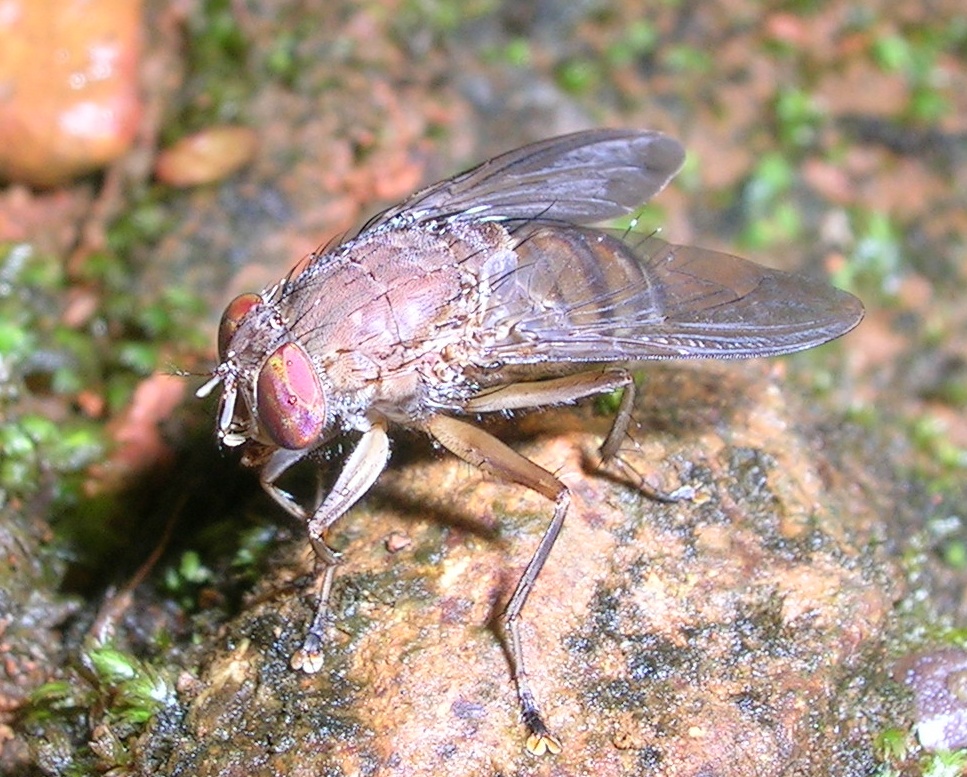
Bengalia looking out for a victim
One of my favourite flies was a species of Bengalia found especially during the rainy season. You will find him or her beside ant columns, watching stealthily and then making a quick dash and stealing a pupa or snatching food out of the mandibles of a passing worker. It was actually years between my first observation and finding the identity of the fly. The identity incidentally was made possible thanks to the Internet, on an email group, at a time when the web was still in its infancy. I posted a description of the behaviour and was entirely surprised when it was identified to genus by Dr D P Wijesinghe. Apparently the food-stealing or kleptoparasitic behaviour has been documented from early times. I later learnt that hardly anything is known about the life-history of this fly, which got me wondering how could anyone find more information about something like this. Perhaps one should build a large glass case and use some kind of passive marker with some detection apparatus on it to see where it goes. For all the spy gizmos and nano-technology, there does not seem to be any way. The only way to find out seems to be look out for it and to be prepared for surprise.
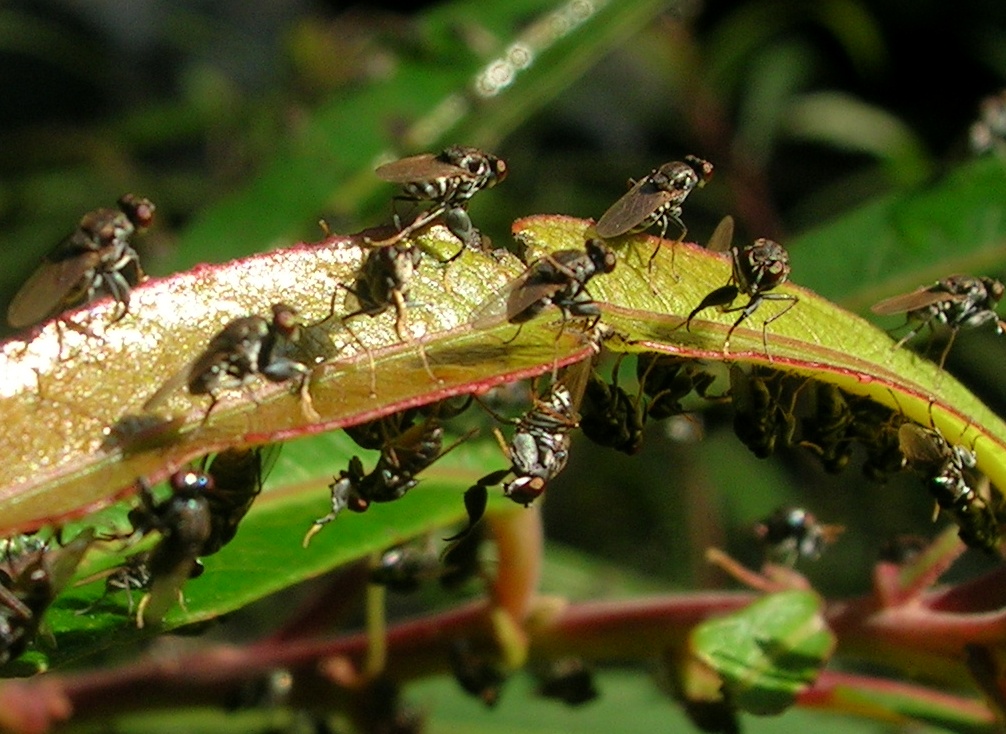
Ochthera - probably males at a lek

Lots of times, it is so hard to see what's happening. During the last rains I noticed a swarm of tiny silvery flies that seemed to like sunbeams under shaded trees. They are so alert and swift that they cannot even be captured. And no they are not hoverflies (Syrphidae). I asked my entomologist friends but they too have not figured a way to capture a specimen ! 

Another time I found this large aggregation of flies on a leaf. They have their forelegs raised and it looks a bit like a hand holding a sword. The structure is actually even closer to a pen-knife with a groove and the flies are actually capable of grasping prey - midges and indeed, the scientific name means midge-hunter. Now what this large aggregation is about is hard to tell, I suspect they are mostly males.

There are a couple of spectacular Internet gatherings of entomologists and the two that stand out at the moment are diptera.info and hymis.de - one on flies and the other on hymenoptera. These sites gather information, photographs and reassemble them into very interesting nuggets.  They are the kind of system that brings together taxonomists, photographers and amateur entomologists. You can login, ask questions, obtain papers, identifications and so on. Today, I came across this entirely curious case of what can only be called "fly falconry" - check it out !

Postscript

Monday, January 17, 2011

Bedazzled

I am interested in a little mystery - the origin of the term "Jatinga bird mystery". It would be unpardonable if a scientist coined that term, for there is hardly any mystery in the entire matter nor is it specific to that location. It might of course have been a way of getting tourists or obtaining funds for misguided research.

The first time I heard the phrase was when still at school. One evening there was a documentary screening  at  the Indian Institute of Science Gymkhana and the question was asked by a student and posed to an old man named Salim Ali who had just woken up from a nap for the entire duration of the screening of  a documentary  (about Bharatpur - and remember that it was a time when TV penetration was low and Doordarshan was dull) and I do not remember hearing a cogent answer. One interpretation was that the birds were "committing suicide" in Jatinga (that was also a time when there were Disney films  with Lemmings committing suicide and neither Snopes nor Dawkinism existed) !  Fortunately the government website today seems to be slightly more enlightened and points out that the locals kill the birds after confusing them with lights on foggy nights. There is still some mystery mongering, perhaps aimed at tourists, as a last word on their page though.

Punch. January 11, 1879. p. 11

All this came to mind, strangely enough, while browsing through some ancient digitized versions of Punch Magazine (thanks as always to the Internet Archive). It is quite a challenge to imagine the conditions of that time and identify the humour  in those brilliant cartoons. Some of them can still be thought provoking, for instance - how does one evaluate the consequences of new technology. It is easy to dismiss cautions when  the predictions such as those of the early Luddites and technophobes are hyped. So exactly how did lights affect birds? It seems like very little is known in the Indian context. The numerous lighthouses around the country must be trapping a range of birds during their migration and numerous birds must be dying there. Perhaps some qualified organization will find a way to communicate with the  government bodies that control lighthouses and actually find out how many birds are disoriented or killed. Jones and Francis (2003) note deaths of up to 2000 birds in a night at a single lighthouse. There are a number of factors that contribute to increased mortality, including cloud cover, bad weather and phase of the moon. Apparently fewer mortalities occur towards the full moon. Birds are also attracted and killed at flares on offshore oil rigs. The use of green and blue coloured lights may reduce the number of bird mortalities. (More here )

Luminous fungal colonies (via Earth3D 1.0.5)
What could an excess of light at night do to humans? Probably hard to do controlled experiments but work on mice shows that they can become obese. Anyway the people who have been most affected by light are the astronomers. The only country in the world to apparently have an advanced light pollution law is Chile and this is led mainly by the large number of astronomical observatories in the region. Light pollution standards may also exist in Australia and the Czech Republic includes light pollution prevention in its law on protection of the air ! (Teikari 2007) The picture of the world by night makes it clear that many countries need better management of their lights. Like sound and noise, light pollution is probably a lot tougher to control as its effects are not obvious or readily visible. Worse still is that almost everyone is an offender.

So make sure you switch off those lights early tonight. Good night.

Further reading

Postscript
Since writing this, I have found some rather old references to the use of lights in trapping birds.
Lanciatoia, an Italian hunting method
"In the south of Spain the practice of taking Larks and other little birds with bell and lantern supplies the markets with myriads of small fry. Mr Abel Chapman has referred me to his charming work, "Wild Spain", in which he says that the engines of the fowler are the "Cencerro" or cattle-bell and the dark lantern. "As most cattle carry the ' Cencerro' around their necks, the sound of the bells at close quarters by night causes no alarm to the ground birds. The bird-catcher, with his bright candle gleaming before its reflector and the cattle-bell jingling at his wrist, prowls nightly over the stubbles and wastes in search of the roosting birds. Any number of bewildered victims can thus be gathered, for Larks and such like birds fall into a helpless state of panic when once focussed in the bright rays of the lantern". There was a time in "Merrie England" when the right of catching Larks by such means was so highly valued as to be restricted in practice to the owners of land. The title of "Low-belling" was employed to distinguish this variety of fowling from other methods. (Macpherson HA (1897). A history of fowling. Edinburgh: David Douglas. p. 60)
Fowling at night from a book edited by A. Philippo Gallaeo with art by Jan Van der Straet [=Joannes Stradanus] (1596) Venationes   Ferarum,   Avium, Piscium. A copy of this treatise on hunting can be found on the wonderful French digital library. 

Post-postscript (20 February 2011)
While reading a book on the origins of phrases, I discovered that the phrase "beating about the bush" comes from the old practice of bat-fowling. The trappers who went at night were accompanied by those with long sticks who beat about the bushes to put the birds to flight.

19 September 2018 - larks were apparently also captured with mirrors!
Forty thousand larks are delivered in London every day for table purposes. Quite as many more are sacrificed for the sake of their feathers. And how are they caught? Smearing the branches of trees with lime, if slow, is an easy way of catching birds. A revolving mirror worked in the sunlight from behind a thick bush attracts all birds. They fly against it, are stunned, go to rest on neighbouring trees, the branches of which are limed; and the rest is easy. Another trick is to release a bird with a long limed rope attached to it. When others approach this birds (says the London Mail) they also become captives. This stuffed owl is thickly limed all over, and small birds that come to mock it cannot detach themselves from its feathers. - Dundee Evening Post 20 January 1903 p. 6